Pacific Nations
pp. 9-11 · Read in the full issue

The Region
Speak To Un
With One Voice
There may be regional differences in the South Pacific which emerge at the annual Forum and Conference get togethers but at the United Nations, Island representatives sound very much alike.
For the first time a total of four Pacific Island countries took the rostrum at last year’s thirty third session of the General As sembly of the United Nations in New York, writes a UN cor
respondent. They were West
ern Samoa, Fiji, Papua New Guinea and Solomon Islands.
Tonga has associations with specialised agencies of the UN but is not a member of the
General Assembly.
The speeches of the Islands representatives offer a vivid reflection of their common concerns.
For example, questions of economic development loomed large in every speech.
Western Samoa’s Minister of Finance Vaovasamanaia
Filipo, expressing his ‘despair’
at the widening gap between
the developed and developing
countries, criticised developed countries for their failure to ap proach the aid target of 0.7% of gross national product which was agreed by the UN in 1970.
In real terms, he said, aid today was less than it was in the early 19605.
For Fiji’s Berenado Vunibobo, the growing trend towards protectionism in the international economic com munity was a matter for ‘regret and some concern’. He said: ‘We do not merely view this trend as unhealthy. It also makes us wonder as to the sin cerity of those who have been loud in their assurances and commitment to a more equi able distribution of the world’s vealth.’
Papua New Guinea’s Minis er for Foreign Affairs and Hade Ebia Olewale ham nered the same theme, saying: If meaningful progress is to be
ichieved, developed industrial
lations must address them elves to the question of im )roved access to their markets
places of security for them and their families. ‘Now that our region has been exposed to nuclear pol lution we can only hope that cessation of testing and time will restore our environment to something like its original pu
rity.’
The Fiji and PNG spokes men also expressed the un equivocal opposition of their
for the goods of developing countries. It is a recognised fact that developing countries are an important market for the exports of industrialised coun tries. If these markets are to re main open, greater efforts must be made to enable Third World countries to increase their
export earnings.’
Speaking for UN ‘new boy’
Solomon Islands, Prime Minis ter Peter Kenilorea was more restrained in his comments but still urged the international community to ‘give greater rec ognition to the special prob lems of the small territories and grant them special measures to give added impetus to social and economic development’.
They were also vocal on issues of disarmament, taking up particularly the question of the continued testing of nu clear weapons.
For Western Samoa Vaovasamanaia Filipo said: ‘lt is a fact that the world has spent SUSI. 4 trillion on arms over the last five years and it is also a fact that there are more than 650 million people with out enough to eat let alone
countries to continued nuclear testing in the South Pacific, Mr Olewale saying: ‘There is one fact we know for sure. Man and his environment will never be the same. We have been told that radiation effects are insig nificant. This we find hard to believe. We in the South Pa cific have repeatedly expressed our opposition to nuclear tests in the region. However, our protests fall on deaf ears, and testing still continues.’
Islands delegates all in vari ous ways expressed their coun tries’ hopes for benefits from the wealth of the oceans sur
rounding them, while making
no secret of the difficulties ex perienced in current nego tiations of the South Pacific Forum to establish a South Pa cific fisheries organisation.
Perhaps their strongest language was reserved for the problem of decolonisation, with France, and to a lesser extent the United States, though not being named, serv ing as main targets.
Vaovasamanaia Filipo
voiced his country’s ‘deep con cern’ that some Pacific coun tries which want to gain
independence have yet to do so.
He said: ‘ln some cases their wish and their right to aspire to independence have not even been acknowledged by the col onial powers concerned. ‘We would wish to see an end to this situation as soon as possible. The Pacific peoples who have achieved indepen dence have for the most part followed peaceful paths to that goal. This has been due to a combination of patience and forbearance on the part of the people concerned and some measure of goodwill on the part of the colonial powers involved. We would not wish to see any of our neighbours re main in a situation which may
strain their patience beyond
endurance.’
Mr Vunibobo expressed ‘dis couragement’ that ‘a number of territories remain under col onial rulership’ and called upon the UN to ensure that ‘all that are under any form of foreign domination should be given the opportunity to exer cise their inalienable right to self-determination’. He
pledged that Fiji, through its
membership of relevant inter national organs, including the Committee of 24, will continue to work for those goals.
Mr Olewale was more out
spoken, saying: ‘Some colonial
powers, in particular one metropolitan state represented here today, has seen fit not to give people under its colonial rule the chance to express their views in line with various UN resolutions on decolonisation.
‘My delegation hopes that
this particular metropolitan
power will change its attitude towards decolonisation in the South Pacific, and will ensure that the people in those terri tories under its administration will be given the opportunity to exercise their right to self determination and indepen dence, rather than exploiting them by saying that those terri tories are an integral part of the
metropolitan state. My delega
tion cannot accept this argu ment because they are
definitely not.’
Whatever differences they have in their relations with each other, Pacific Island nations represented in the UN
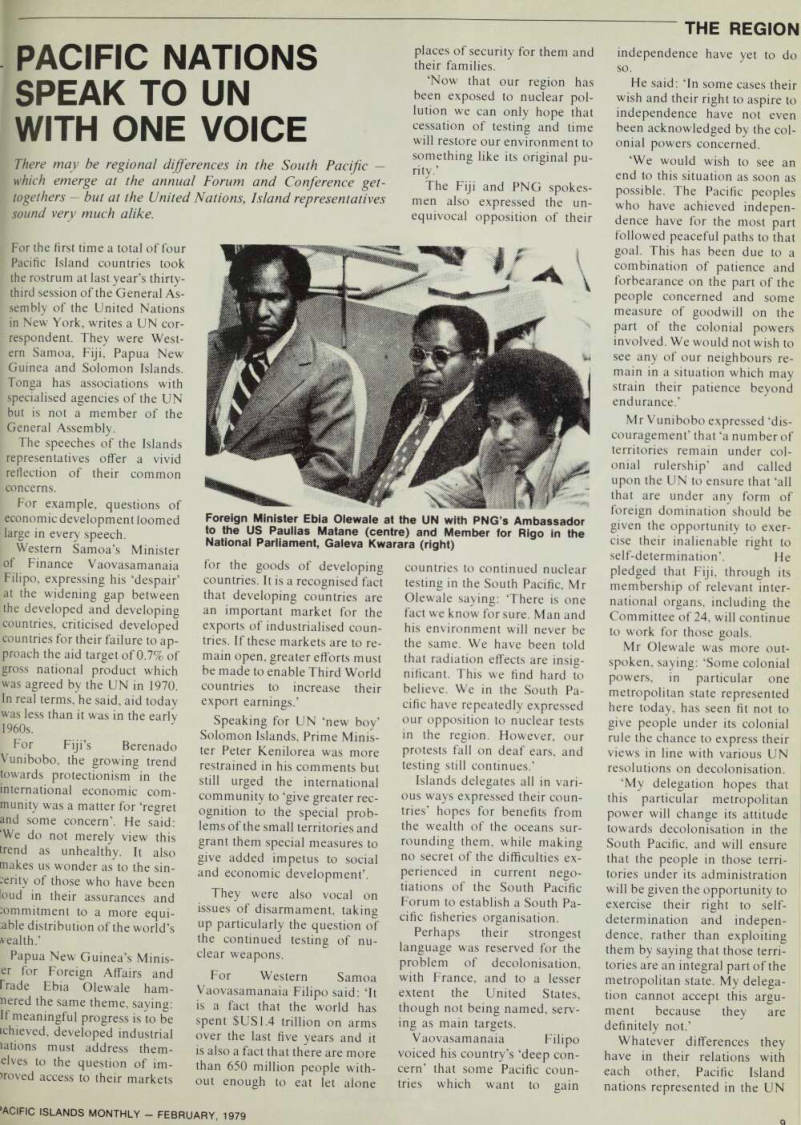
Foreign Minister Ebia Olewale at the UN with PNG’s Ambassador to the US Paulias Matane (centre) and Member for Rigo in the National Parliament, Galeva Kwarara (right)
certainly spoke with a regional “ voice, confirming a point made in his speech by Mr Olewale when he said: ‘The South Pacific region is often thought to consist of many small island nations
without a regional identity.
This is no longer true. The re gion now has an identity with
the coming into being of the South Pacific Forum seven years ago. ‘This is an organisation which strives to solve problems that confront our people in the South Pacific region and to consider differing ways in which economic growth can be achieved in the region. t ‘Proper utilisation of our natural resources, in particular fish, is one such way that this goal can be reached. The South Pacific contains what may be the world’s only under-utilised tuna resource and this, for sev eral South Pacific nations, rep resents the only natural resource available to them and, as such, is vital to their future
economic growth.
‘lt is for this reason that the South Pacific Forum is seeking to establish the South Pacific
Regional Fisheries Organis
ation (SPRFO) which will ensure that it is the people of the South Pacific who obtain the maximum benefits from the vast stocks of tuna that live in our waters, and not the
major distant water fishing
nations.’
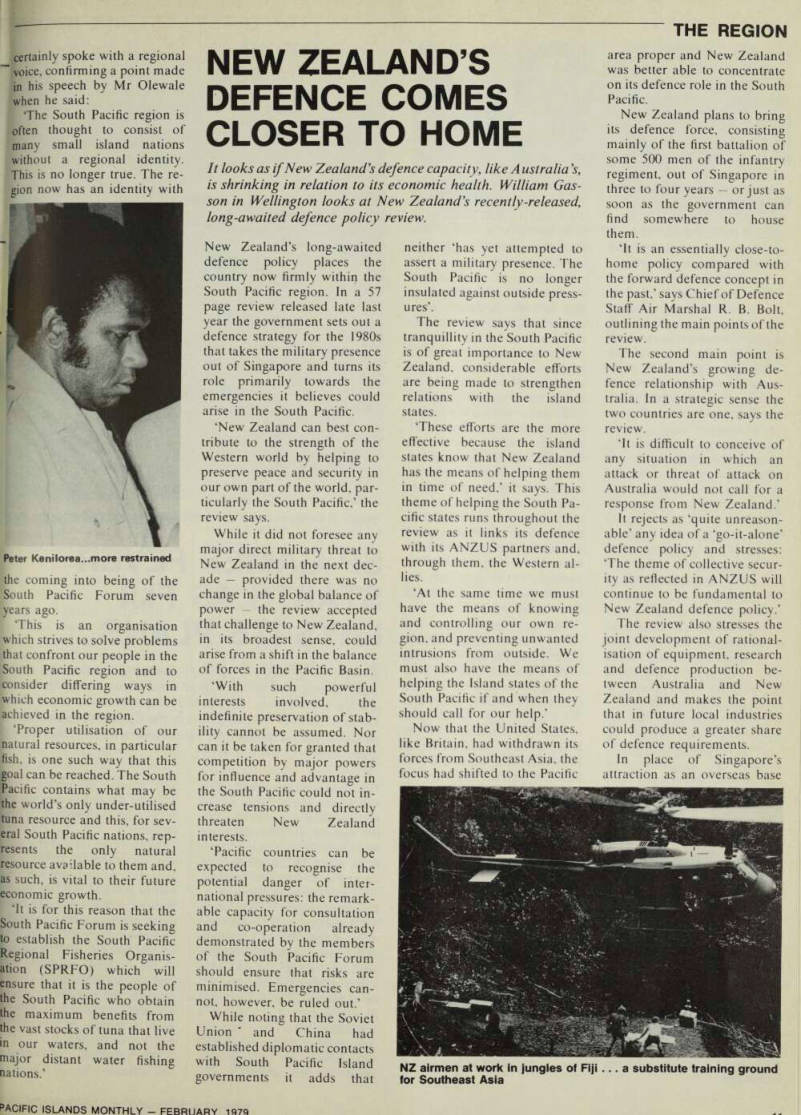
Peter Kenilorea...more restrained