Mounties
pp. 51-56 · Read in the full issue

Tradewinds
Nab
Tonga’S
Bank
‘Whiz-Kid’
‘ln Tonga, the dazed smile has [ come into fashion. Not that many people here are ashamed of having been taken on a South Seas excursion by Mr Meier; they consider them selves in good company. “If he did it to Howard Hughes, he could do it to us,” admits one official. “The world is full of
stupid people”.’
So writes Barry Newman, staff reporter of The Wall Street Journal reporting from Nukualofa on the latest epi sode in the saga of US businessman John Meier and his ill-starred Bank of the South Pacific (BoSP) (PIM Sep tember 1978). Newman went to Tonga to research the story after Meier was arrested by the Royal Canadian Mounted Police at his suburban Van couver home on October 20.
Newman’s frontpage report in the November 17 issue of the leading US business daily said that Meier had been released on bail of SCSO 000, and that
‘the thinking among diplomats
is that he has a fair chance of easing out of trouble again be cause of some fine points in the US-Canadian extradition treaty.’
The Mounties grabbed Meier in connection with an
obstruction-of-justice charge
pending against him in the US.
Canadian authorities had earlier refused to extradite him to the US on a tax-evasion charge. The new charge, which claims that Meier submitted forged documents to a court hearing in Utah last northern spring, exposed him to the
danger of extradition again.
Central charge against Meier
is that he filched his former employers in the Howard Hughes empire of about SUSB million by selling them a sheaf
of virtually worthless mining
shares.
Tracing the origins of Ton ga’s involvement in the affair, Newman writes: ‘Tonga’s first mistake, as critics here now see it, was the appointment a few years ago of Bill Waterhouse as
the country’s honorary consul
in Sydney. Mr Waterhouse is said to be Australia’s biggest bookmaker. What he does is legal, but as one Tongan says, “to have a bookie as your diplomatic representative isn’t in the best of taste”. It was Mr Waterhouse, through his Las Vegas contacts, who introduced Mr Meier to the
king.
‘With perhaps greater can dour than he knew, the honor ary consul explained his motives to the magazine Pa cific Islands Monthly. “I can’t see any sense,” he said, “in let ting money go to Switzerland if we can do something with it in the South Pacific”.’ (The quote is from PIM, February 1978.)
Lawyers for Hughes’
interests say that the money al
legedly misappropriated by
Meier had been traced to a Swiss bank account.
Of the sole practical achieve ment of Meier’s defunct BoSP the beginnings of the pro
jected ‘upgrading’ of
Nukualofa’s international air port Newman turns in the
following account:
‘So when Mr Meier, newly accused of obstruction of jus tice, arrived last May to pick up
his (Tongan) diplomatic pass
port, he brought with him an American contractor named Jim Doyle who apparently laid out the money for four weary bulldozers from Fiji. ‘The king, Mr Meier and Mr Doyle went out to the airport site one day and held a cer emony. Mr Meier announced that the project, plus an adjac ent industrial park, would cost over SUSIOO million. The king snipped a ribbon and turned over a shovel of dirt. “This air port,” he said, “will put Tonga at the crossroads of the South west and the Northeast.” Mr Doyle demonstrated one of his bulldozers. Pictures were taken, and Mr Meier ordered lots of copies.
‘Mr Doyle began knocking
down coconut trees, and for a few weeks Mr Meier made his home at the International Dateline Hotel, handing out $lOO tips to the headwaiter in the restaurant... ‘Soon thereafter. Mr Meier
made his exit, passport in hand.
He left behind a number of peeved Tongan civil servants who hadn’t been allowed near the airport project. And he was followed by an American diplomat who informed the king that Mr Meier was indeed being pursued by several US
agencies...
‘For Tongans, the time had clearly come for disen gagement. Tonga’s parliament gracefully withdrew the bank ordinance on a technicality, Mr
Doyle stopped knocking down
coconut trees, abandoned his equipment and flew away without paying his hotel bill. (The hotel now is renting out his bulldozers.) A government
engineer who inspected the
work site reports that “it had no particular relevance to the con struction of an airport what soever”.’
But King Taufa’ahau Tupou
IV is a determined man.
Hardly was Meier out of the country than the king set out on a trip of his own, still pursuing his dream of an international airport which would bring in thousands of tourists from Tokyo, New York and Hawaii.
His main destinations were
Japan, Taiwan and Hong
Kong.
As reported in The Tonga Chronicle, he told the Legislat ive Assembly in his formal speech of closure of its 1978 session, that in Japan he had
discussed the airport project,
the setting up of a fishing industry, and the possibility of
operating ferry services cover
ing Tonga, Fiji and Samoas. A
major hotel company in Japan showed some interest in invest ing in Tonga. To firm up the interest of possible Japanese investors, Tonga would soon open an information office in that country.
He also reported interest from Taiwan investors, and suggested it would be a wise move to appoint Jardine Matheson as Tonga’s agent for
Hong Kong and Singapore.
Such proposals are still highly tentative. But one can’t avoid the feeling that they offer Tonga at least the prospect of moving on to much firmer ground than the treacherous
quagmire conjured up by the
dubious John Meier.
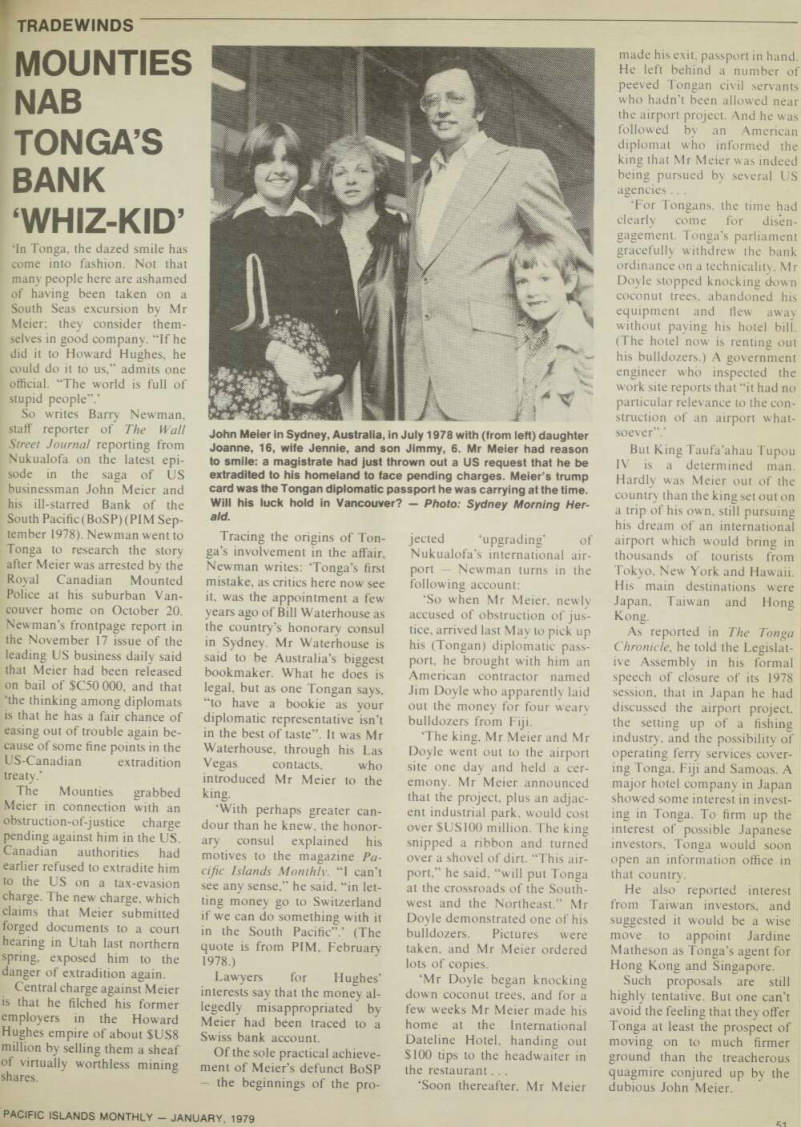
John Meier in Sydney, Australia, in July 1978 with (from left) daughter Joanne, 16, wife Jennie, and son Jimmy, 6. Mr Meier had reason to smile: a magistrate had just thrown out a US request that he be extradited to his homeland to face pending charges. Meier’s trump card was the Tongan diplomatic passport he was carrying at the time.
Will his luck hold in Vancouver? - Photo: Sydney Morning Her ald.
Niue: sex
and the
passionflower
Little more than a centimetre separates Niue from a golden bounty in passionfruit.
The critical measurement is in the flower of the yellow pas sionfruit which is too elongated for the bees to be effective in pollination.
As they forage for nectar the bees pass underneath and make no contact with the pollen-laden anthers.
A fruitless death ensues for the flower which opens but once and then for only half a
day.
In the circumstances hand pollination is the only way to achieve a crop.
It is work to which, tradition ally, children are assigned, and which requires vigilance and a delicate hand work which the children of Niue, being like children in most places, are in clined to do fitfully.
Fruit set is generally disap
pointing.
In 1977 only one flower in five produced the yellow pack
age of seed and sweet pulp which represents an export industry bigger than the rest of Niue’s exports combined.
From an average fruit set of 17% Niue exported 75 tonnes of pulp and juice in the nine month season to August, 1976.
Production last year was 86 tonnes, all of which was shipped to New Zealand.
When the New Zealand market complained last April it had to have more passionfruit or it would look elsewhere, the Niue Government resolved to boost the industry.
A special task force, working in conjunction with the Niue Development Board, was told to make an all-out effort to maximise production from the existing 20 hectares of pas sionfruit vines and to plant,
plant, plant...
The target for new plantings in 1977 was set at 40 ha double the total existing pas sionfruit stands which cling to the scattered shallow pockets of soil with wire, wooden sup ports and concrete stays.
The harsh terrain, domi nated by jagged coral,' is no encouragement to horticulture.
Indeed, for most Niueans, pas sionfruit production is ad hoc to a job in the public service.
This is how a stand is established; The property holder indi cates interest to the Develop ment Board which inspects the site for suitability then calls in a bulldozer and gangs to work up the soil.
Lines of poles made from native Tavahe are wired some what like a fence with wide strands. Concrete pegs are buried at the end of each line to brace the assembly.
Planters engaged by the
Development Board tie up the young passionfruit vines, sup plied by the government nur sery at Vaipapahi.
At the first flowering, the board hands over the stand to the owner. He, then, is respon sible for pollination, main tenance and harvesting.
Half the revenue from the crop goes to the grower and half to the board until the costs of establishing the stand are re paid.
New Zealand assistance to Niue’s passionfruit industry
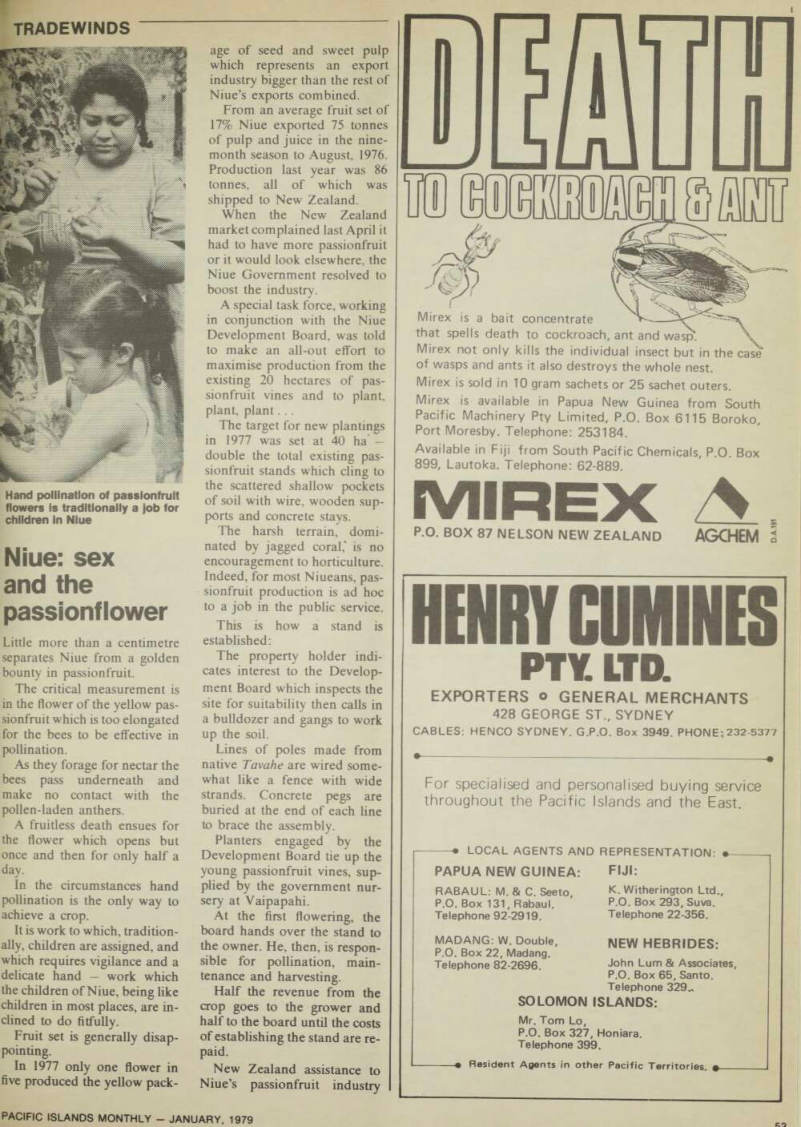
Hand pollination of passionfruit flowers is traditionally a job for children in Niue
has largely centred on ways of
improving pollination.
An obvious suggestion was to try a bigger bee. The Italian variety, common in New Zealand, flourishes on Niue.
Of the tropical bees, how \ ever, only the Carpenter is big enough to make the necessary contact in the yellow pas sionfruit flower and this species is considered the last re sort because of its nasty habit of tunnelling in wood, buil dings included, to build nests.
Other species of passionfruit
are being studied but according to Dr Murray Hopping, of the NZ Department of Scientific and Industrial Research plant diseases division in Auckland, it would take at least three years before a hybrid combin ing the fruit quality of the yel low passionfruit with a flower structure suitable for bee polli nation could be released for planting on Niue.
Fiji boosts its
floating stock
Two new vessels on the Fiji scene are the Vasua and the Cagidonu. The Vasua was
brought from Singapore, more
than 8500 kilometres away, under the command of Captain John Kerbyson and a Fijian crew of 11, to replace the ferry Tabilai which sank in 1977.
Chief engineer on the trip was Mike Tuvali and chief officer was Waisale Salu.
The Cagidonu, the first sail
ing ship and the fifty-fourth
vessel to be built at the govern ment’s Suva shipyard, was launched in November by Adi Ateca, eldest daughter of Prime Minister Ratu Sir Kamisese Mara.
Tonga pelts
NZ with its
tomatoes
Tongan tomatoes in New Zealand have been causing mild apoplexy among local growers, writes William Gas son from Wellington. The problem is that island tomatoes play havoc with local prices.
New Zealand growers, with SNZI2O million tied up in glass
houses, land and equipment,
and employing a labour force of 2000, worry that Tonga’s tomatoes will destroy that investment if allowed to flood the country. ‘We’re not yelling protect us,’ the executive officer of the Vegetable and Produce Growers Federation (Vegfed), Trevor Brown, insisted. He, and local growers, want the Tongans to divert their grow ing skills to other non competitive vegetables and fruit such as bananas, pea nuts, root crops and a fruit called Indian apple which has a white flesh and should appeal to New Zealand palates.
A Vegfed delegation, led by
the market division chairman, Jim Clayton, visited Tonga in August to look at the tomato issue first hand. They took with them their argument that Ton gan tomatoes were not opposed
in principle just so long as
they did not compete directly with New Zealand supplies.
They saw a need to regulate the size of Tongan shipments, subject to existing licences.
They also favoured limiting
Tongan supplies to sale by auc tion not fixed prices that in fluenced prices for local supplies.
The delegation reported
back to Wellington that the
Tongan growers’ philosophy
not surprisingly was that while they were getting reason able prices in New Zealand
they would continue consign
ing as much as the New Zea land Government would allow.
Nor were they impressed
with the auction argument -
they preferred the certainty ol
fixed prices to fluctuating auc tion prices. Nor did the del
egation find much sympathy
from Tonga’s bureaucrats whc took an ‘uncompromising atti tude’. One insisted there was great scope for Tongan tom atoes in New Zealand and re jected entirely fears that the livelihood of New Zealand growers would be jeopar dised.
Faced with this attitude the
Vegfed delegation repaired to
Wellington and concluded their salvation lay in directing government aid towards Ton gan horticultural production and the wide-scale commercial
production of non-competing
crops.
On that theme the del
egation also suggested Tongan
officials be invited to New
Zealand to look at the market potential here for these non
competing crops.
Tonga has the capability of growing almost any variety of vegetables at certain times of the year and therefore must be counted as a potential supplier of these products to New
Zealand as shipping improves
and the New Zealand Govern ment allows, the Vegfed dele
gation reported.
Meanwhile it is up to the Vegfed people to prove to the New Zealand Government that the increased import li cences given last year for Ton gan tomatoes actually had a detrimental impact on the local
industry.
Above: The Vasua leaving Singapore; below: artist’s detail of the Cagidonu
Success brews
for SI rice
growers
Brewer Solomons Associates rice project on the Guadal canal Plains in the Solomons, is but one of a number of agricultural projects being con ducted around the world by Hawaiian Agronomics (Inter national), a wholly-owned sub sidiary of the Hawaii-based multinational C. Brewer and Co. Ltd., writes Peter L. Young in Honiara. The business of these concerns is agriculture, or ‘agribusiness’ as the company brochures put it.
On the Guadalcanal Plains, Brewer Solomons has 405 ha under cultivation and hopes to double that in the next two to ;hree years. The operation here s a highly-mechanised one in xamparison with the tra ditional, labour-intensive meth ods of south-east and east \sia. The company has con tracted a large rice mill for accessing the crop and has >aid particular attention to the iroblems of storage in tropical dimates an aspect of rice reduction that has been the lownfall of some rice projects a Papua New Guinea re
ently.
It is hoped that locally- Toduced rice will be able to ffectively supplant imports of iustralian rice into the olomons and thereby help the
ewly-independent nation’s
alance of trade.
The present problem in larketing local rice is a prefer nce for the Australian pro ud. However, the company is ttempting to counter this
irough advertising on
olomons’ radjo.
The company has been able » export small quantities of alomons’ rice to Papua New uinea and New Zealand and as recently gained an order om Fiji. Jim Macaweo de ribes the future for small ale exports as “very •omising” despite the prob ms of freight costs in this part ' the Pacific.
The original task of growing :e in the Solomons was taken > by a company called uadalcanal Plains Ltd. Prob-
lems of climate and insect pests overcame that venture and
Brewer Solomons paid just
under $1 million for the company in receivership. To the end of fiscal year 1978, the total Brewer Solomons invest ment in the rice project is expected to be approximately $6 million.
The main problem that has had to be overcome is the pres ence of one of the greatest insect pests known to rice culti vators, the brown plant hopper Nilaparvata Lugens. Even reputedly resistant strains of rice plant have failed to with stand this pest in the Solomons.
The ‘hopper’ can devastate a crop, leaving the plants with a distinctive, scorched appear ance.
The rice project on Guadal canal still has the pest to con tend with, but aerial spraying has brought it under control.
Now a natural predator is being introduced and this has allowed a reduction of spray
ing.
In the past few weeks the project has become a joint ven ture with the Solomons Government. Returning from the recent meeting of the Asian Development Bank in Vienna, Solomons Finance Minister Benedict Kinika visited Honolulu. There he put the final touches to the agreement between C. Brewer and the Solomons Government which had been negotiated in Honiara in February.
Mr Kinika also visited Brewer’s facilities there includ ing a sugar mill and the central laboratory. On his return, Mr Kinika said he was impressed by what he had seen and that some of the diverse operations of the company in tropical
agriculture might well be
suited to the Solomons.
The company is seeking to recruit Solomon Islander graduates and has sent some of its local staff on courses in the Philippines. The number of
tertiary and higher technical
graduates employed in the local operation is at present eight and this is expected to in crease as the project grows.
The Brewer company and the Government of Solomon Islands reached agreement in October on a SSI 3 million joint venture which will eventually take over all Brewer assets in the country. These include the rice operation, and a butchery and self-service store in Honiara. The new company, known as Brewers Solomons Agriculture Ltd, is owned 45% by the Government and 55% by Brewer.
PNG increases
rice imports
Papua New Guinea bought
77 426 tonnes of rice from Rice Growers’ Co-op Mills of Aus tralia in the year ended June 30 1978. The cost of the rice, SA29 422 142, was 21.4% up on
the previous year’s expendi
ture.
Australia enjoys a growing
rice market in the Gilberts, but exports to Western Samoa, Fiji and Solomon Islands are start ing to fall away as those countries work toward
self-sufficiency.
Drivers hit by Fiji
budget
A savage 11.36 cents a gallon hike on petrol duty formed part of the Fiji Government’s November budget strategy to lift revenue in 1979 by more than SFS million.
Other items hit by duty in creases were tyres and tubes, petrol-powered vehicles, beer, tobacco, some foods, paints, plastic baskets, stationery and some clothing and linen.
Interest rates on loans and overdrafts were lifted by 0.5% to 10.5% and the lending rate for the Central Monetary Authority from 5.5% to 6.5%.
All this adds up to an accelerated rate of inflation in Fiji. The only sops in a budget questionably described as ‘mild’ were an increase of half a per cent to 4.5% interest on savings bank deposits and the lifting of estate values from $ 10 000 to $5O 000 before death duties are payable. All in all, not much for the living.
Finance Minister Charles Stinson indicated there might be a ‘mini’ budget after he had received a report from a fiscal review committee at the end of March. He said he was antici
pating recommendations by
the committee on tax reform. The Papuan New Guinea Government has moved to stop expatriate trade store owners
from expanding their existing
set-ups. The Minister of Labour and Industry, Mr Lemeki, said such owners would no longer be given li cences to expand. There was a need to localise such activities, he said. However, there was also a need for expatriate man agement of those activities, where local people did not have the management skills re quired. The National Invest
ment Development Authority
is reviewing the future of ex patriate trade store owners who set up before the NIDA Act came into effect.
Rice paddy in Solomons . . . plan to double cultivation