Makogai: the fight
pp. 47-49 · Read in the full issue
Books
Makogai: the fight to make leprosy a respectable tragedy
The history of leprosy in Fiji is clearly broken into the pre-
Makogai, Makogai and post-
Makogai eras. Although Sister
Mary Stella’s Makogai Image of Hope is concerned mainly with the 58 years of the occupation of Makogai as the Fiji and later, the Southwest
Pacific leprosarium, by
including chapters on the pre and post-periods, the author presents a record of the disease in Fiji from the time of earliest European contact until the
present-day.
Though her primary task has been to record the history of the Makogai period, the book is also a sociological study of the psychological reactions to the disease, and the impli cations of segregation upon the patients, their relatives, and those who cared for them in isolation. The author presents this with skill, sympathy and
great understanding.
This history is one of cour age. endurance, and above all, of hope, and a fascinating story of people banished to make a life apart; it is a story, too, of great endeavour, of trouble, riot, and of attempted murder, of tremendous sacrifice, but also of great happiness and achievement.
During the 58 years of Makogai’s existence, 4185 patients of 15 different ethnic origins were admitted for treat ment. Of these, 1759 were discharged or repatriated. 83 were finally transferred to Tamavua, and 1241 died on the island. Behind these stark stat istics lies a story of heroism by those, religious and lay, who, never thinking of themselves as heroes, deliberately accepted isolation and the risk of infec tion. There were heroes too, amongst those hopelessly dis
eased but actively maintaining
discipline, interest, and cour age in their fellow sufferers.
As this history unfolds, it is inevitable that names should
emerge: Mother Mary Agnes, her team and successors. Dr Hall, the first resident doctor.
Dr Harper, Dr and Mrs Austin - resident for 23 years. Dr
Keating-Clay, the only and
successful woman medical superintendent, and Dr Des mond Beckett, the last
leprologist on Makogai who
had the privilege of closing it down and of opening the new concept at Tamavua.
In this book we meet also those who dis ease while serving there: Sister
Filomena, and fathers Le Jeune and Nicouleau; and those stalwarts amongst the
patients Ernest the Tongan
boatbuilder. engineer, handy
man, and technical adviser; Fritz, scribe, fisherman and builder; Semisi the artist; and Maharaj the Brahmin self appointed counsellor to Indian patients.
But there is no more contro versial figure than that of the late Alan Thompson, New Zealand-born planter and trader, highly literate and vocal, who, while submitting himself to the law which sent him to Makogai when diag nosed as suffering from lep rosy, never ceased to campaign
against segregation. He wrote
often and forcefully in the
press of Fiji. Australia, New Zealand and the United States, arguing that the fear of re moval caused many cases to be concealed by their families,
thereby becoming foci for
cryptic infection; that segre gation imposed too great a hardship on the patients and their families: and that, in the light of recent developments in treatment, segregation was no
longer necessary. Alan Thomp
son became one of the best informed lay authorities on the disease.
Although Thompson was
undoubtedly the catalyst which
initiated the reforms leading to the repeal of the Leprosy Act. it remains questionable if. without the introduction of sulphone drugs, there could have been, at that time, any reconciliation between his de mands and the views of the medical department and the general public upon the need for the precautionary measures
against infection that Makogai
was providing.
Only those with experience
of the frustration and sense of impotence with the limited re sources of the hyndnocarpus (chaulmoogra oil) decades, can
really appreciate the seemingly
miraculous effects of the new
drugs. They so improved the
patient’s condition that the ma
jority, although not necessarily
cured, were rendered non infective. This removed the need for their detention and indeed, as it proved, for the
leprosarium on Makogai to
continue.
The problem of leprosy is not solved and sulphones are not the complete answer. They have brought their own com plications. Research and treat ment continue at Tamavua under Dr Enele Katutu and the sisters but leprosy in Fiji is now ‘just another disease’ and the public reaction to the new
Twomey (Memorial) Hospital
is minimal.
The treatment of leprosy as of any chronic disease involves not only the appli cation of medical techniques and therapeutics but also the treatment of the personal social problems of each individual
patient. At Makogai every
effort was made to provide, as far was as possible, treatment
in a normal life environment.
It may well be that this care of the ‘whole' person in a com munity of such diverse origins,
religions, and backgrounds
united by a common tragedy, was what gave rise to that nebulous, indefinable, but verv real Makogai spirit which Sis ter Stella confesses she ‘finds something of a mystery’. Per haps, when all is said, the Makogai spirit can be summed up in just one word — com
passion.
This well illustrated book does all involved great credit.
It is, therefore, a little invidious to mention a curious slip of the pen in the first sentence: as is well confirmed by the excellent
map end-plates, Makogai is
northeast of Suva, not north west. — Leonard Goodman , until 1972 senior tutor in sur gery at the Fiji School of Medi cine.
Makogai — Image of Hope. By Sister Mary Stella. Published by Lepers' Trust Board, New Zealand 1978. SNZ12.
Two for I ho
sea-struek
Britons Maurice and Maralyn
Bailey spent 117 days bobbing
around the Pacific in a life raft after their first yacht had been sunk by a wounded whale. To while away the long hours and
help keep themselves sane they
set about designing a dream boat. With a pencil stub on scraps of paper, and especially in their imaginations, the boat
took shape.
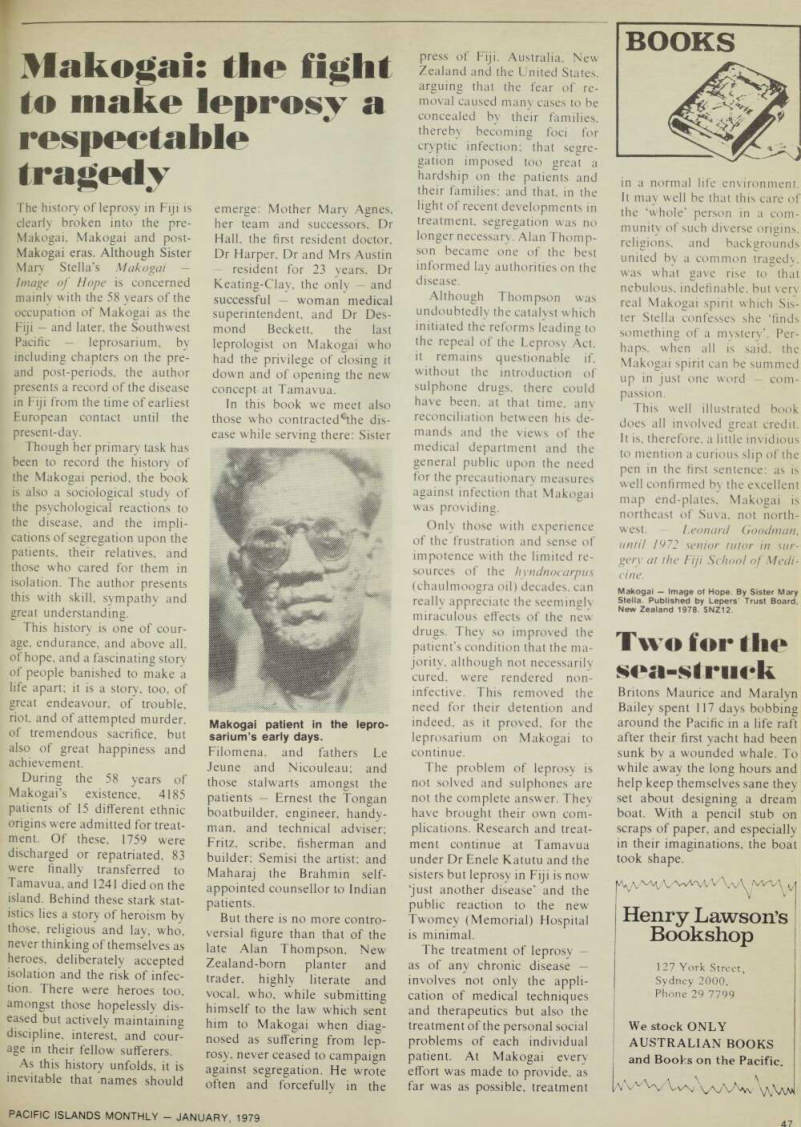
Makogai patient in the lepro sarium’s early days.
Call it courage, dedication, masochism, or what you will, no sooner had they been res cued and arrived back in Bri tain than they started raising funds to build it. No doubt the earnings from their first book, 117 Days Adrift, were a help here.
Their new book. Second Chance Voyage to Patagonia, is
a thoroughly entertaining cruis
thoroughly entertaining cruis
ing yam, made even more en
joyable by its genuine
co-authorship, with husband and wife writing chapters in turn. The account of their cruise across the Atlantic to South America, and then to the remote Patagonian Channels via Tierra Del Fuego and its consort islands, is extremely
interesting reading. Encounters
with the local Indian fishermen and marine life make this book not just another tale for those interested in boats and cruis ing, but also something to be read with interest by those interested in anthropology and
zoology.
Appendices include a small glossary of terms for the non sailor and a conversion table of nautical to statute miles.
The latest Mariner's Catalog from the USA keeps to the same highly successful formula established five years ago. Wel come additions include whim sical drawings by Buck Smith and cartoons by Darrel McClure.
Gems include a kite which in flight looks for all the world like an old square rigger in full sail (or perhaps a candle sconce in gimbals). The advent of the pocket calculator has not been lost on the editors of the
Catalog; they include a
detailed description of a calcu lator for navigational pur poses.
Contents cover boats of special interest, tools, wood,
seacloth, engines, rigging and
rope, fishing, marine mam mals, models and modelling you name it. The Mariner's Catalog remains the best full year’s reading available for the sea-struck. John Collins.
Second Chance - Voyage To
PATAGONIA, by Maurice and Maralyn Bailey. Published by Weldenfeld and Nlcol son, 2 Apollo Place, Lane Cove, NSW.
5A19.95. Mariner’S Catalog, Edited By
George Putz and Peter H. Spectre. Pub lished by International Marine Publishing, 21 Elm Street, Camden, Maine, USA. 5U57.95.
In reviewing this important
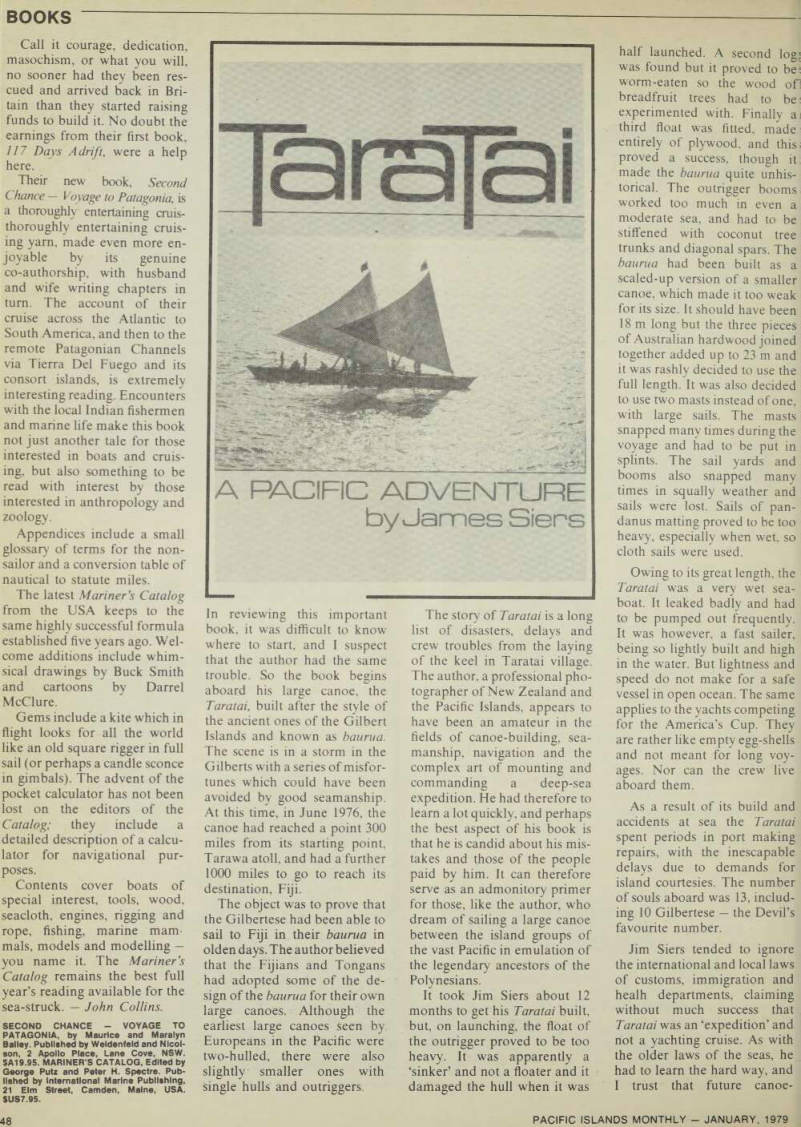
book, it was difficult to know where to start, and I suspect that the author had the same trouble. So the book begins aboard his large canoe, the Taratai, built after the style of the ancient ones of the Gilbert Islands and known as baurua.
The scene is in a storm in the Gilberts with a series of misfor tunes which could have been
avoided by good seamanship.
At this time, in June 1976, the canoe had reached a point 300 miles from its starting point, Tarawa atoll, and had a further 1000 miles to go to reach its
destination, Fiji.
The object was to prove that the Gilbertese had been able to sail to Fiji in their baurua in olden days. The author believed that the Fijians and Tongans had adopted some of the de sign of the baurua for their own
large canoes. Although the
earliest large canoes seen by Europeans in the Pacific were two-hulled, there were also slightly smaller ones with single hulls and outriggers.
The story of Taratai is a long list of disasters, delays and crew troubles from the laying of the keel in Taratai village.
The author, a professional pho tographer of New Zealand and the Pacific Islands, appears to have been an amateur in the fields of canoe-building, sea
manship, navigation and the
complex art of mounting and
commanding a deep-sea
expedition. He had therefore to leam a lot quickly, and perhaps the best aspect of his book is that he is candid about his mis takes and those of the people paid by him. It can therefore serve as an admonitory primer for those, like the author, who dream of sailing a large canoe between the island groups of the vast Pacific in emulation of the legendary ancestors of the
Polynesians.
It took Jim Siers about 12 months to get his Taratai built, but, on launching, the float of the outrigger proved to be too heavy. It was apparently a ‘sinker’ and not a floater and it damaged the hull when it was
half launched. A second log* was found but it proved to be; worm-eaten so the wood ofl breadfruit trees had to be; experimented with. Finally aj third float was fitted, made: entirely of plywood, and this; proved a success, though it; made the baurua quite unhis
torical. The outrigger booms;
worked too much in even a moderate sea, and had to be stiffened with coconut tree trunks and diagonal spars. The baurua had been built as a scaled-up version of a smaller canoe, which made it too weak for its size. It should have been 18 m long but the three pieces of Australian hardwood joined together added up to 23 m and it was rashly decided to use the full length. It was also decided to use two masts instead of one, with large sails. The masts snapped many times during the voyage and had to be put in splints. The sail yards and booms also snapped many times in squally weather and sails were lost. Sails of pan danus matting proved to be too heavy, especially when wet, so cloth sails were used.
Owing to its great length, the Taratai was a very wet sea boat. It leaked badly and had to be pumped out frequently.
It was however, a fast sailer,
being so lightly built and high
in the water. But lightness and speed do not make for a safe vessel in open ocean. The same
applies to the yachts competing
for the America’s Cup. They are rather like empty egg-shells and not meant for long voy ages. Nor can the crew live aboard them.
As a result of its build and accidents at sea the Taratai spent periods in port making
repairs, with the inescapable
delays due to demands for island courtesies. The number of souls aboard was 13, includ ing 10 Gilbertese the Devil’s favourite number.
Jim Siers tended to ignore the international and local laws of customs, immigration and
healh departments, claiming
without much success that Taratai was an ‘expedition’ and not a yachting cruise. As with the older laws of the seas, he had to learn the hard way, and I trust that future canoe
‘ adventurers, who are bound to I follow, will pay some heed to the lessons in this book.
The story of the voyage of I the Taratai occupies only about f 50 pages, including calls at f Abemama. South Tabiteuea, Rotuma and finally Fiji, where [ the expedition ended. Siers had I intended continuing on to * Tonga, Samoa, the Marquesas I and Tahiti and ultimately to I New Zealand. On reaching [ Fiji, however, he was convin l ced that the Taratai was not built well enough for ocean voyaging. He decided to build another canoe in Fiji and con tinue his grand design, and the old Taratai was shipped to Wellington to the National Museum.
The new canoe, called Tara [ tai 11, was to be built mainly of Fijian kauri timber, and to I be shorter and stronger in all respects. It was built again in Gilbertese style but not of tra ditional timbers. Its voyage began on June 29, 1977, from Suva, and only 40 days later in a heavy sea snapped the outrig ger booms. The canoe laid on its side and had to be aban doned. Presumably there was no ballast in the hull to keep it upright without the outrig ger.
The full story of Taratai II is promised in a new book.
Jim Siers and his 10-year-old son, Conrad, and the five man crew of the Taratai 11, were lucky to survive two weeks in an inflatable life-raft before being picked up by a tug on a delivery voyage from Sin gapore to Chile. It landed them at Niue Island. Brett Milder.
TARATAI. By James Siers. Published by Millwood Press, Wellington, N.Z. 306 po 5NZ16.95.
Islanders
on the
move
When is the Pacific not the Pa cific? The question must be asked by those interested in the Pacific Islands when they see documents whose titles state that they are concerned with the Pacific but turn out to be concerned only with the edges and not with the centre of the
region.
Yunshik Chang and Peter J.
Donaldson have edited Popu lation Change in the Pacific Re gion and I took it up hoping that I might find within it papers examining in depth the
pressing population problems
of Pacific Islands countries. I suppose it was a natural out come of the conference from which the book sprang, but I found the emphasis disap pointing as it focused on Japan, China, Korea, Taiwan and Thailand. If the Pacific is to be seen in terms of the major countries bordering the ocean, then why does nothing emerge in this publication of the popu lation problems of Australia, the west coast of the USA, and South America?
Of the 16 papers in the book, only three are directly con cerned with Pacific Islands people. Jean Fages in his Mi gration and Urbanisation in French Polynesia, very cor rectly brings to our notice that, almost unheralded, French Polynesia has become one of the most urbanised of the Pa cific Island countries. He shows us that this is because of invest ments in tourism and the French government’s expendi ture on installations and sup porting services associated with its nuclear testing programme.
The paper provides a timely
warning to planners, pointing
out that ‘the foundations of this
urban development are fragile,
because the development is the result of an artificial economic revolution. It is based not on the territory’s economic pos sibilities, but on its political connections with France’.
The presence of large num bers of Pacific Islanders in New Zealand has opened up a wide field of inquiry into demo graphic trends in that country.
David Pitt, in his Social Bound aries and Migration in New Zealand, brings to light an as pect of the attitudes of Pacific Islands migrants that will un
doubtedly strongly affect the
development of these emigre
groups. Pitt says: ‘Our recent work has shown . .. that mi gration has strengthened rather than diluted Samoan customs, first by providing cash for the support of the traditional insti tutions in the islands, secondly by creating vibrant new com munities in New Zealand
based on traditional insti tutions.’ The author points out that these manifestations may
have lasting sociological and
economic consequences for New Zealand, and that ‘the essential problem of migration may well be not so much the migrants but the rationali sations and restrictions of the bureaucrats and politicians.’
The third paper to be men tioned is Judith Huntsman’s The Impact of Cultural Exchange on Health and Dis ease Patterns: the Tokelau Island Migrant Study. This paper is to be commended as it spotlights many little
publicised aspects of migration
of Tokelauans to New Zealand. Two interesting points emerge. First, that de spite the efforts of the New Zealand Government to
reduce the population by
introducing a resettlement scheme, much of the move ment of Tokelauans may be attributed to the desires and efforts of the people them selves. Second, almost
paradoxically, Tokelauans are showing a marked tendency to return to their home islands,
despite the often emphasised
evils of over population.
Judith Huntsman rightly points the way for further, intensive research to be con ducted into the patterns of mi gration of Pacific Islanders to the major urbanised countries.
She says: ‘By continuing our research among this small eth nic group from a remote Pa cific homeland, we may be able to untangle somewhat that complex of factors which affect health and well-being.’
For those interested in the
principles of demographic
change this collection of papers has some value. For those con cerned with the population movements of Pacific Islanders, the papers of Fages, Pitt and Huntsman are of very considerable interest. W. G.
Coppell.
Population change In the Pacific Region; Papers presented In the Symposia on Pa cific Populations during the thirteenth Pa cific Science Congress. Yunshik Chang and Peter J. Donaldson, Editors. Pacific Science Association, Vancouver. 5C4.00.