People
pp. 33-35 · Read in the full issue

US Under-secretary of the Interior, James Joseph, 43, his deputy Wallace Green, and Ruth Van Cleve, director of the Office of Territorial Affairs, were in good spirits as they left Guam’s Government' House bright and early on Monday August 14, writes Paul Addison from Guam. The three senior US officials were looking for ward to what promised to be a novel and relaxing flight to Ulithi in Micronesia’s Yap dis trict for the dedication of a new dispensary.
At the Naval Air Station, the three officials from Washing ton greeted their fellow travel lers whose names read like a who’s who of US Pacific mili tary and federal policy-makers.
There were two rear-admirals, David S. Cruden, commander Naval Forces Marianas, and Neal Clements, head of the Pa :ific Facilities Engineering Command; Trust Territory of fie Pacific Islands High Com missioner Adrian Winkel,
\merica’s highest-ranking rep
resentative in Micronesia; Captain Ralph Smith, in his ast month as officer in charge )f construction and the over ;eer of SUS4OO million worth )f construction projects on Tuam and in Micronesia; and Captain Edward Estes, 44. :ommanding officer of the sland’s Naval Air Station,
klong with these dignitaries
he 20-year-old C-117 plane arried a number of lower anking military officers and 13
lervous military band mem
>ers who were to perform at he Ulithi ceremony.
Shortly after 9 am, as the rew tried to start the plane, me of its two engines splut ered and refused to grind into ction. But after a mechanic’s left twist of a screwdriver at omething inside, the engine prang into action. After a nor mal take-off, the plane quickly ose to about 2000 m.
As the plane, co-piloted by "aptain Estes and Lieutanant lobert Bell, banked over the
sland’s picturesque Turnon
Jay, the 30 people inside could ee the clear, shark-infested vaters lapping on the reef, and l few tall buildings in Guam’s
apital, Agana.
Shortly before 11, Rear-
Admiral Cruden and some crew members noticed oil leak ing onto the starboard engine.
Although the leak appeared soon to stop, the engine started to flutter and the plane’s pilots realised they would have
trouble reaching Yap. They
radioed naval officials on Guam that they had no option but to return. The navy im mediately activated all its emergency units, putting
planes, helicopters, boats and
personnel on immediate
standby.
The plane proceeded to limp back towards the island, with the sea loomimg ever closer.
Band members looked at each other silently, each caught up in his own thoughts. Prep arations were begun for a ‘con trolled ditch’ in the 2 m swells.
Passengers were told to put on life jackets and remain seated.
About 30 km off Guam, the plane was 70 m above the water, where a coast guard patrol vessel. Point Harris, and a submarine missile retriever were awaiting the crash. In the air, a B-52 bomber from Andersen Air Force base and two navy helicopters moni tored the rapid descent. Also monitoring the crash was a Soviet spy ship, the Vega, which poses as a fishing trawler off Guam’s coast.
In a desperate attempt to stay airborne the crew opened the cargo door and passengers
began to jettison their baggage.
First to go was the band’s
sousaphone; trumpets, a sax ophone and drums followed
shortly after.
It was to no avail. At 11.53 am the plane touched the swells tail first. Then it reared in the air and ploughed into the
Philippines Sea.
Tt was one loud sound,’
Under-secretary James Joseph
said later. ‘Then there was a second sensation and we were in the water. The pilot did a fantastic job. It was almost like
a regular landing.’
The plane’s fuselage had ac tually cracked open at the bot tom and water begun to pour in. Two men were drowned.
One of them, Ronald H. Cur tiss, 27, an aviation engineer from St. Louis, was apparantly sitting at the spot where the split occurred. The other dead person, 20-year-old musician Scott Smith, from Rio Linda, Calif., was thrown to the same area on impact, according to a
navy spokesman.
Within seconds, liferafts were inflated outside the plane.
In the high noon of the broiling tropical sun, most of the pass engers crawled onto the crowded rafts while the plane sank slowly into the world’s deepest ocean, the Marianas Trench.
Overhead, as 15 minutes
slowly ticked by, a navy plane
kept watch on the survivors.
Then, naval medical aides and divers were dropped from heli copters to assist the injured.
Those with the worst injuries were whisked into helicopters and away to Guam’s Naval
Hospital. Others, including
Joseph, waited for more than 90 minutes for the Point Harris to pick them up. From Guam’s port, a convoy of ambulances carried the injured to the Naval Regional Medical Centre where wives and friends waited tensely for news.
Miraculously the injuries
were not great. The two co pilots, Estes and Bell, under went surgery during the night while seven other passengers were held until morning. Ruth Van Cleve, the only female on the plane, and Wallace Green,
sprained their backs; Captain
Ralph Smith had a broken arm. Joseph, Cruden, Clem ents and 15 other passengers were treated and released the same day. As the rescue oper ations for the two men missing, presumed dead, came to an end for the evening, the crash site was marked only by a 6 m oil slick.
Joseph later sat resting at Government House where through the windows he could watch a bright red sunset. ‘lt’s
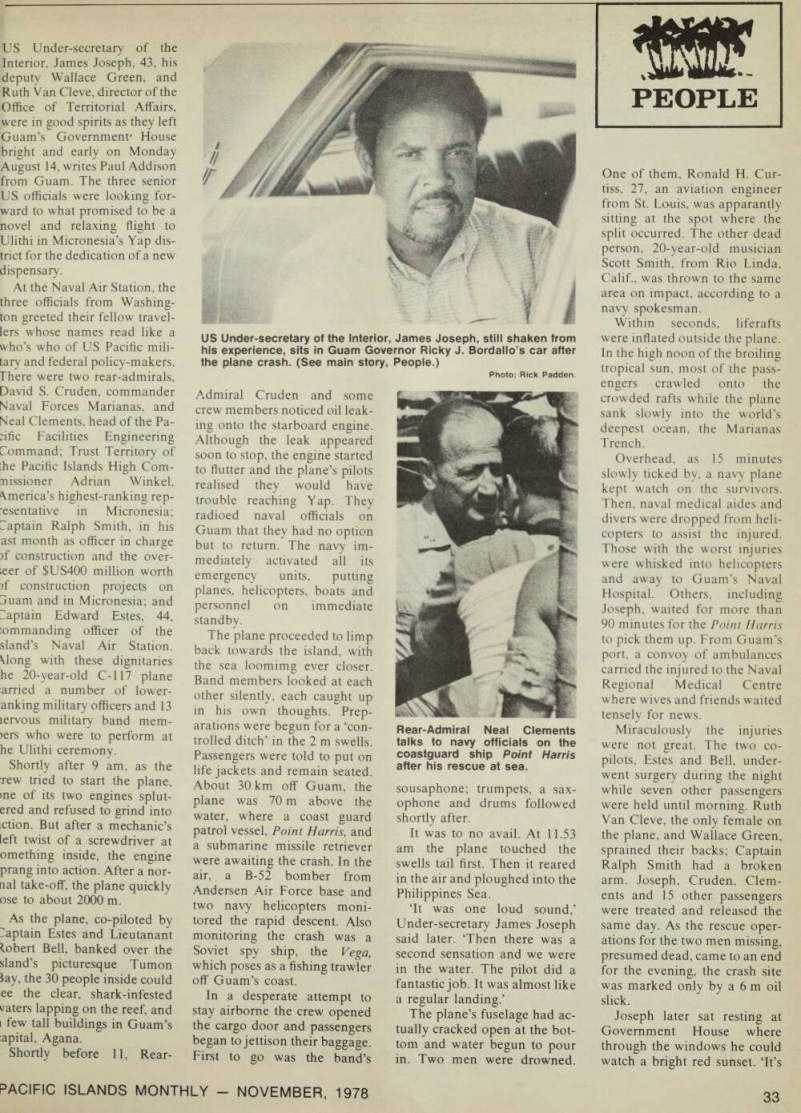
US Under-secretary of the Interior, James Joseph, still shaken from his experience, sits in Guam Governor Ricky J. Bordallo’s car after the plane crash. (See main story, People.) Photo: Rick Padden.
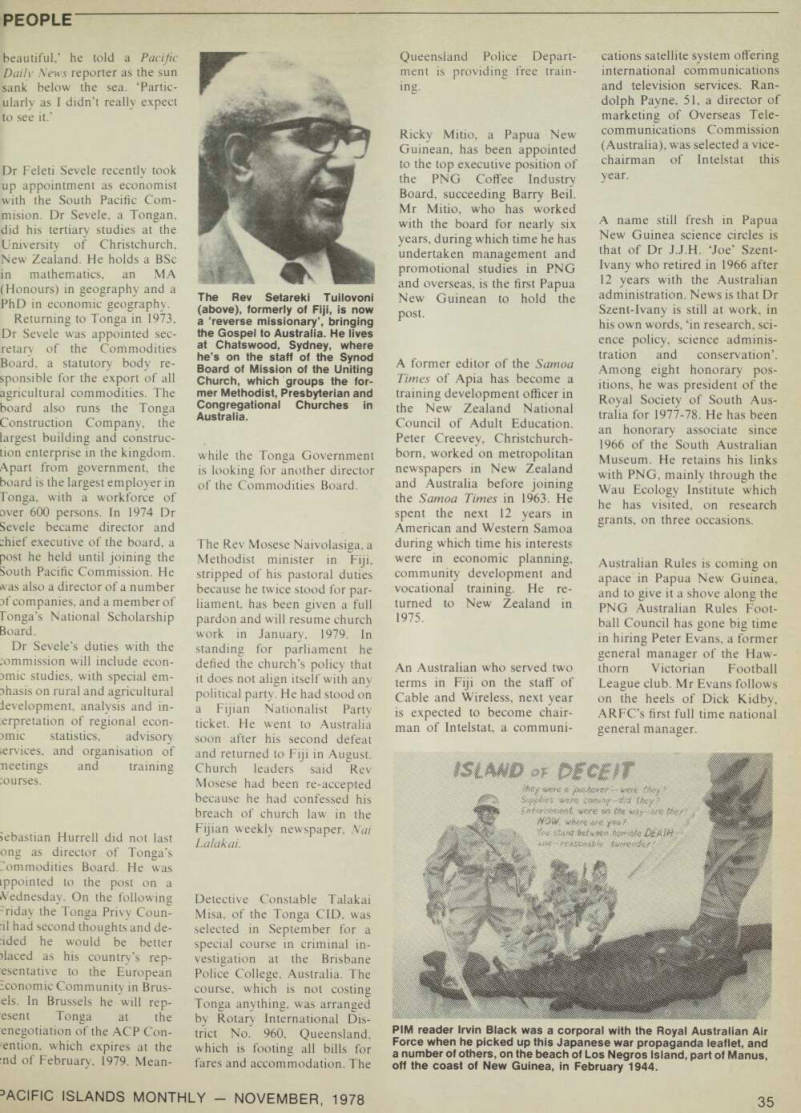
Rear-Admiral Neal Clements talks to navy officials on the coastguard ship Point Harris after his rescue at sea.
beautiful,’ he told a Pacific Daily News reporter as the sun sank below the sea. ‘Partic ularly as I didn’t really expect to see it.’
Dr Feleti Sevele recently took up appointment as economist with the South Pacific Com mision. Dr Sevele, a Tongan, did his tertiary studies at the University of Christchurch, New Zealand. He holds a BSc in mathematics, an MA (Honours) in geography and a PhD in economic geography.
Returning to Tonga in 1973, Dr Sevele was appointed sec retary of the Commodities Board, a statutory body re sponsible for the export of all agricultural commodities. The board also runs the Tonga
Construction Company, the
largest building and construc
tion enterprise in the kingdom.
Apart from government, the
board is the largest employer in
Tonga, with a workforce of over 600 persons. In 1974 Dr Sevele became director and :hief executive of the board, a post he held until joining the South Pacific Commission. He vas also a director of a number 3f companies, and a member of
Longa’s National Scholarship
Board.
Dr Sevele’s duties with the ;ommission will include econ omic studies, with special em phasis on rural and agricultural
development, analysis and in
erpretation of regional econ
omic statistics, advisory
services, and organisation of
neetings and training
xourses. iebastian Hurrell did not last ong as director of Tonga’s Zommodities Board. He was ippointed to the post on a
Wednesday. On the following
-riday the Tonga Privy Coun
cil had second thoughts and de rided he would be better )laced as his country’s rep esentative to the European
iconomic Community in Brus
els. In Brussels he will rep esent Tonga at the enegotiation of the ACP Con tention. which expires at the :nd of February, 1979. Mean-
while the Tonga Government is looking for another director of the Commodities Board.
The Rev Mosese Naivolasiga, a Methodist minister in Fiji, stripped of his pastoral duties because he twice stood for par liament, has been given a full pardon and will resume church work in January, 1979. In
standing for parliament he
defied the church’s policy that it does not align itself with any political party. He had stood on
a Fijian Nationalist Party
ticket. He went to Australia soon after his second defeat and returned to Fiji in August.
Church leaders said Rev Mosese had been re-accepted because he had confessed his breach of church law in the
Fijian weekly newspaper, Nai
Lalakai.
Detective Constable Talakai Misa, of the Tonga CID. was selected in September for a special course in criminal in vestigation at the Brisbane Police College, Australia. The course, which is not costing
Tonga anything, was arranged
by Rotary International Dis trict No. 960, Queensland, which is footing all bills for fares and accommodation. The
Queensland Police Depart ment is providing free train ing.
Ricky Mitio, a Papua New Guinean, has been appointed to the top executive position of the PNG Coffee Industry Board, succeeding Barry Beil.
Mr Mitio, who has worked with the board for nearly six years, during which time he has undertaken management and promotional studies in PNG and overseas, is the first Papua New Guinean to hold the post.
A former editor of the Samoa Times of Apia has become a
training development officer in
the New Zealand National Council of Adult Education.
Peter Creevey, Christchurch born, worked on metropolitan newspapers in New Zealand and Australia before joining the Samoa Times in 1963. He spent the next 12 years in American and Western Samoa during which time his interests were in economic planning,
community development and
vocational training. He re turned to New Zealand in 1975.
An Australian who served two terms in Fiji on the staff of Cable and Wireless, next year is expected to become chair man of Intelstat, a communi
cations satellite system offering international communications and television services. Ran dolph Payne, 51, a director of marketing of Overseas Tele communications Commission (Australia), was selected a vice chairman of Intelstat this year.
A name still fresh in Papua New Guinea science circles is that of Dr JJ.H. ‘Joe’ Szent- Ivany who retired in 1966 after 12 years with the Australian administration. News is that Dr Szent-Ivany is still at work, in his own words, ‘in research, sci ence policy, science adminis tration and conservation’.
Among eight honorary pos
itions, he was president of the Royal Society of South Aus tralia for 1977-78. He has been an honorary associate since 1966 of the South Australian Museum. He retains his links with PNG, mainly through the Wau Ecology Institute which he has visited, on research grants, on three occasions.
Australian Rules is coming on apace in Papua New Guinea, and to give it a shove along the PNG Australian Rules Foot ball Council has gone big time in hiring Peter Evans, a former general manager of the Haw thorn Victorian Football League club. Mr Evans follows on the heels of Dick Kidby, ARFC’s first full time national general manager.
The Rev Setareki Tuilovoni (above), formerly of Fiji, is now a ‘reverse missionary’, bringing the Gospel to Australia. He lives at Chatswood, Sydney, where he’s on the staff of the Synod Board of Mission of the Uniting Church, which groups the for mer Methodist, Presbyterian and Congregational Churches in Australia.
PIM reader Irvin Black was a corporal with the Royal Australian Air Force when he picked up this Japanese war propaganda leaflet, and a number of others, on the beach of Los Negros Island, part of Manus, off the coast of New Guinea, in February 1944.