Currents
pp. 28-31 · Read in the full issue
Political
Vanuaaku’S
Vital Talks
The Vanuaaku Party’s political
commissars are to meet on Ambrym Island, New Hebrides, in the first week of November to consider the suggestion by French Minister for Overseas Department and Territories Paul Dijoud for a 50/50 share in a New Hebrides Government of national unity, writes PIM Editor Bob Hawkins from Noumea, where he covered the South Pacific Conference in October.
Informed Vila sources suggest this could mean a cabi net with as many as 14 mem bers, the new portfolios taking over certain responsibilities now held by incumbent minis ters. It seems that some extreme Left elements in the VP are only willing to go along with the proposal, which has British backing, if Chief Minis ter George Kalsakau is willing to step down. The chief minis ter is unlikely to accede to such a request.
Vanuaaku Party president.
Father Walter Lini. and sec retary, Barak Sope. returned last month from a world tour during which they met Pacific leaders, visited the US, talked with the UN committee of 24 on decolonisation, and talked in London to Lord Goronwy Roberts (Minister responsible for dependent territories) and in Paris to Mr Dijoud.
If the Ambrym meeting
accepts the proposal the New Hebrides may be ready to embark upon a four-step path to independence in early 1980; a government of national unity, drawing up of a consti tution, a referendum to accept the constitution, and an elec tion late next year to find a government to take the New Hebrides into nationhood. The Vanuaaku Party would prefer an earlier election date, but it would complicate what is
already a tricky course of action.
Capture Of
Jacob Prai
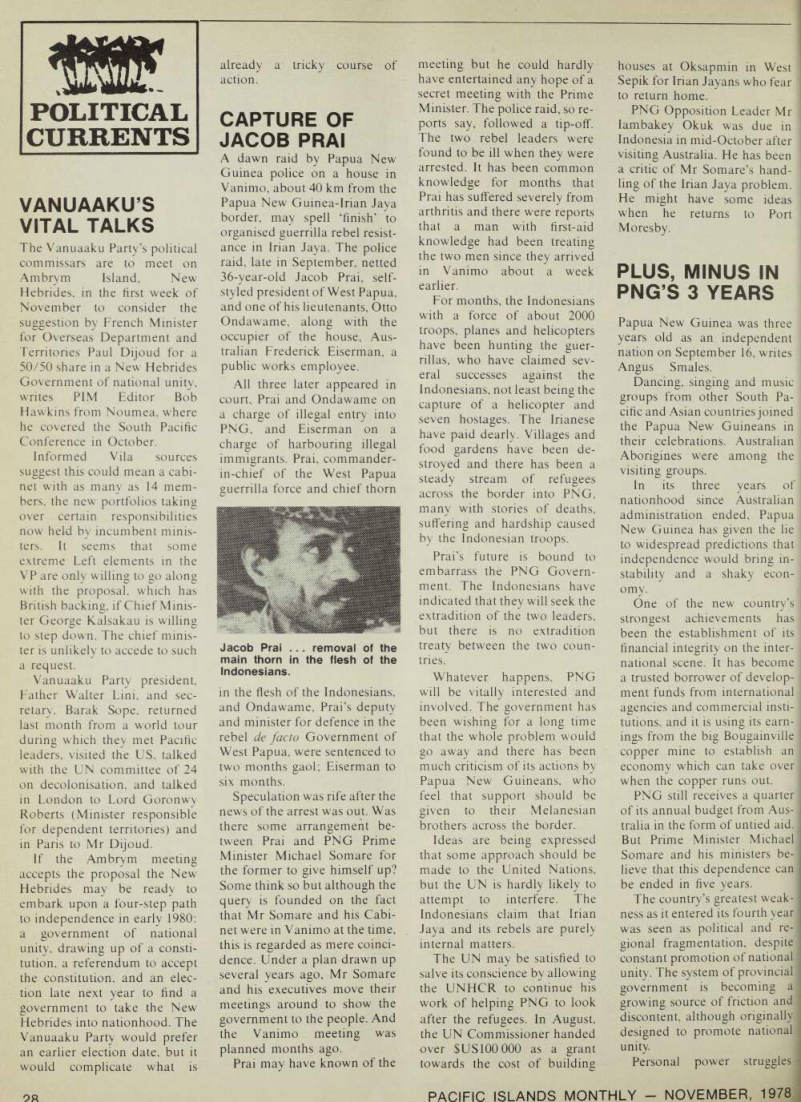
A dawn raid by Papua New Guinea police on a house in Vanimo, about 40 km from the Papua New Guinea-Irian Jaya border, may spell ‘finish’ to organised guerrilla rebel resist ance in Irian Jaya. The police raid, late in September, netted 36-year-old Jacob Prai, self styled president of West Papua, and one of his lieutenants, Otto Ondawame. along with the occupier of the house, Aus tralian Frederick Eiserman, a
public works employee.
All three later appeared in court, Prai and Ondawame on a charge of illegal entry into PNG, and Eiserman on a
charge of harbouring illegal
immigrants. Prai, commander in-chief of the West Papua guerrilla force and chief thorn
in the flesh of the Indonesians, and Ondawame, Prai’s deputy and minister for defence in the rebel de facto Government of West Papua, were sentenced to two months gaol; Eiserman to six months.
Speculation was rife after the news of the arrest was out. Was there some arrangement be tween Prai and PNG Prime Minister Michael Somare for the former to give himself up?
Some think so but although the query is founded on the fact that Mr Somare and his Cabi net were in Vanimo at the time, this is regarded as mere coinci dence. Under a plan drawn up several years ago, Mr Somare and his executives move their meetings around to show the government to the people. And the Vanimo meeting was planned months ago.
Prai may have known of the
meeting but he could hardly have entertained any hope of a secret meeting with the Prime Minister. The police raid, so re ports say, followed a tip-off.
The two rebel leaders were found to be ill when they were arrested. It has been common knowledge for months that Prai has suffered severely from arthritis and there were reports that a man with first-aid
knowledge had been treating
the two men since they arrived in Vanimo about a week earlier.
For months, the Indonesians with a force of about 2000 troops, planes and helicopters have been hunting the guer rillas, who have claimed sev eral successes against the Indonesians, not least being the capture of a helicopter and seven hostages. The Irianese have paid dearly. Villages and food gardens have been de stroyed and there has been a
steady stream of refugees
across the border into PNG, many with stories of deaths,
suffering and hardship caused
by the Indonesian troops.
Prai’s future is bound to embarrass the PNG Govern ment. The Indonesians have indicated that they will seek the extradition of the two leaders, but there is no extradition treaty between the two coun tries.
Whatever happens, PNG will be vitally interested and involved. The government has been wishing for a long time that the whole problem would go away and there has been much criticism of its actions by Papua New Guineans, who feel that support should be given to their Melanesian brothers across the border.
Ideas are being expressed that some approach should be made to the United Nations, but the UN is hardly likely to attempt to interfere. The Indonesians claim that Irian Jaya and its rebels are purely internal matters.
The UN may be satisfied to salve its conscience by allowing the UNHCR to continue his work of helping PNG to look after the refugees. In August, the UN Commissioner handed over SUSIOO 000 as a grant towards the cost of building
houses at Oksapmin in West Sepik for Irian Jayans who fear to return home.
PNG Opposition Leader Mr lambakey Okuk was due in Indonesia in mid-October after visiting Australia. He has been a critic of Mr Somare’s hand ling of the Irian Jaya problem.
He might have some ideas when he returns to Port
Moresby.
Plus, Minus In
Png’S 3 Years
Papua New Guinea was three years old as an independent nation on September 16, writes Angus Smales.
Dancing, singing and music
groups from other South Pa cific and Asian countriesjoined the Papua New Guineans in their celebrations. Australian Aborigines were among the
visiting groups.
In its three years of nationhood since Australian administration ended, Papua New Guinea has given the lie
to widespread predictions that
independence would bring in
stability and a shaky econ omy.
One of the new country’s strongest achievements has been the establishment of its financial integrity on the inter national scene. It has become a trusted borrower of develop ment funds from international agencies and commercial insti tutions, and it is using its earn ings from the big Bougainville copper mine to establish an economy which can take over when the copper runs out.
PNG still receives a quarter of its annual budget from Aus tralia in the form of untied aid.
But Prime Minister Michael Somare and his ministers be lieve that this dependence can be ended in five years.
The country’s greatest weak ness as it entered its fourth year was seen as political and re-'
gional fragmentation, despite
constant promotion of national
unity. The system of provincial :
government is becoming a growing source of friction and
discontent, although originally
designed to promote national
unity.
Personal power struggles
Jacob Prai . . . removal of the main thorn in the flesh of the Indonesians.
have also tended to disrupt the political scene, and there has been an upsurge in crimes of violence and theft, much of it attributed to excessive
drinking.
Polynesia’S
Burning Cross
A model of the Cross of Lorraine, symbol of Gaullism in French politics, was burnt during the visit to French Polynesia of the Gaullist Mayor of Paris. Jacques Chirac (PIM September). Mr Chirac was the guest of the Gaullist deputy of French Polynesia to the National Assem bly in Paris, Gaston Flosse.
A letter, signed ‘Liberation
Movement of Polynesia’, was
delivered anonymously to the
Papeete newspaper. Les Nouvelles , in which the move
ment claimed responsibility for
the burning.
Among other things, the let ter said; ‘We affirm to the French Government that it will be unable to continue to re press our desire for indepen
dence: the day before
yesterday it was Fiji; yesterday
it was the Cook Islands; today it is the Solomons; tomorrow it will be the New Hebrides and Micronesia. Is it really to be be lieved that Tahiti can be :heated of its history and its legitimate desire for free dom? ...
The cross-burning is the latest in a series of incidents 3ver the past 12 months show ng new stirrings of various ndependence movements in
French Polynesia (PIM
April).
Js Discovers
Fhe Islands
'he Pacific journeyings of
JSS Home (PIM. October) re not the only sign of the
wakening of US policy
swards Pacific Island coun ties from the torpor and indif erence of past years.
Testifying before the US
lenate Foreign Relations sub
ommittee on East Asian and •acific affairs, Richard
Holbrooke, assistant secretary of State, said the US will establish ‘a larger and more effective presence in the South Pacific’ over the coming years.
Noting ‘signs of growing
Soviet and Chinese interest in the area’, Holbrooke, whose
special responsibility is East
Asia and the Pacific, said that the US saw ‘the orderly de velopment of the South Pacific region as a contribution to the stability of the broader Pacific
community’.
Holbrooke said that Soviet interest ‘seems to be concerned
largely with advancing their
fishing interests in the region
and promoting their diplomatic
standing vis-a-vis our own and that of the People’s Republic of China’. As for China, Holbrooke said: ‘Peking is also interested in expanding its diplomatic presence in compe tition not only with Moscow but with Taipei.’
The US was tied to the re
gion by history, geography and
a ‘growing economic interest’, he said, adding that US policy would ‘not in any way
impinge’ upon the sovereignty
of the independent Island countries, or usurp the leader ship role they shared with Australia and New Zealand.
Holbrooke dismissed the idea that the US should de velop ‘massive programmes’ for the South Pacific, but declared ‘the time is ripe for more active interchanges’.
The US programme, as summed up by Holbrooke, would include; • Active participation in
South Pacific regional organis
ation; • Adaptation of existing pro grammes and elaboration of new ones to fit the unique needs of the developing Island states; • Improved co-ordination among American and multi lateral programmes; and • Pursuit of the Micronesian status negotiations with the aim of achieving a free associ ation agreement between the US and Micronesia and ter mination of the US trusteeship by 1981.
Holbrooke also said the US would take ‘a Lesh look’ at its representatic. n the region ‘to see if we are making the best
use of our limited resources’.
He announced the assign ment of an Agency for Inter national Development officer, Robert Craig, to the US Embassy in Fiji, the first AID person ever assigned to the re gion. Mr Holbrooke attended the Solomon Islands indepen dence celebrations in July in the company of a member of the Senate sub-committee.
Senator John Glenn.
Also testifying before the committee was John H.
Sullivan, assistant aid adminis trator with AID. Mr Sullivan
listed the principal develop
ment problems faced by the
region as:
• Smallness and relative iso lation of the Island states: • A very limited natural re source base from which to de rive increased income; • Extensive but undeveloped and unmanaged ocean fish re sources:
• Inadequate agricultural
production and lack of diversi fication; • Decreasing amount of available arable land;
• Increasing population and
limited domestic employment opportunities; • Costly and unreliable com munications and transport facilities.
He commented: The lim ited nature of the US pro gramme and the development problems which 1 have men tioned have led to the design of a US assistance programme for the area consisting of three principal components. The first approach is through oper ational programme to private and volui .y agencies to enable them to improve current programmes or to undertake new projects. The ana is assistance to regional institutions whose activities are located in or ben eficial to several of the coun tries in the area. The third is an accelerated impact pro gramme which will enable us to support small-scale self
help projects, primarily aimed
at community and rural
development.’
Within this framework, Mr Sullivan discussed in detail specific US activities now being undertaken in Western
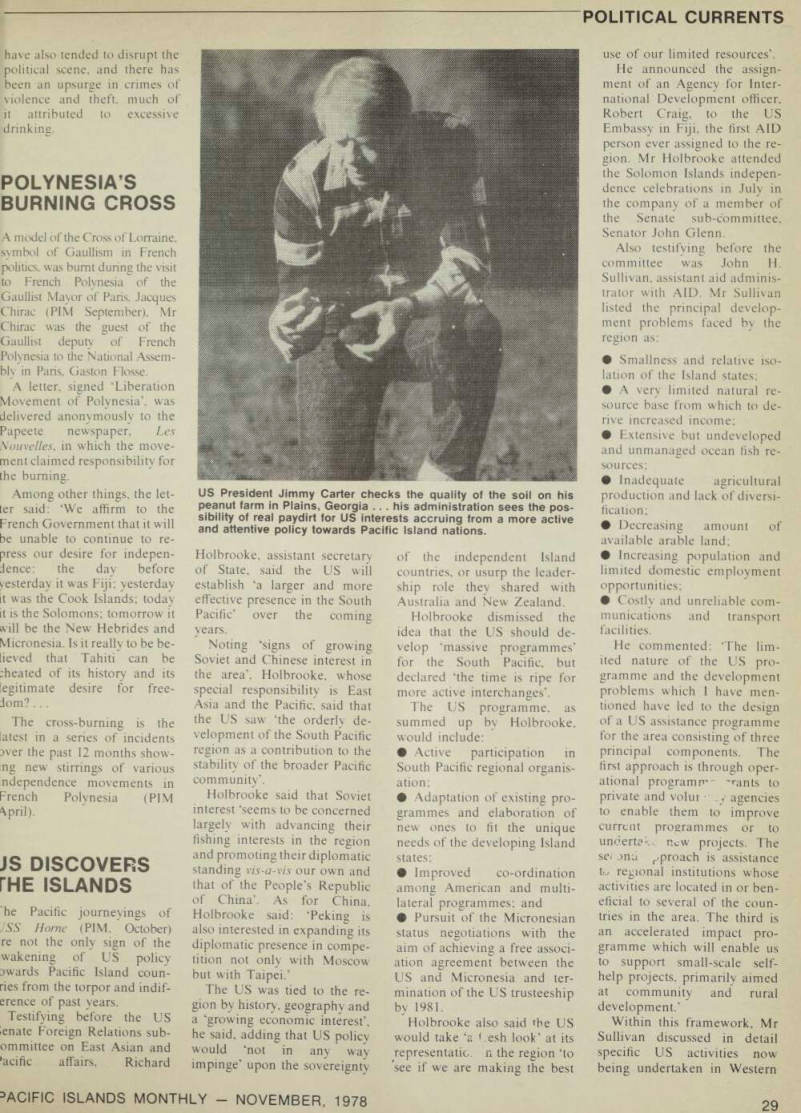
US President Jimmy Carter checks the quality of the soil on his peanut farm in Plains, Georgia . . . his administration sees the pos sibility of real paydirt for US interests accruing from a more active and attentive policy towards Pacific Island nations.
Samoa, Fiji, Tonga and Papua New Guinea. He also dealt with a current US examination of needs in the now indepen dent Solomon Islands.
‘Put Custom
In Png Law’
The Law Reform Commission of Papua New Guinea has recommended that the law should give greater weight to traditional customs and beliefs than it does at present.
The advice was contained in a report the commission sub mitted to the Government in October.
If the commission’s recom mendations are accepted, the maximum penalty for a killing, committed in accordance with traditional beliefs, would be
three years’ imprisonment. The
commission also recommends that courts be given much wider powers than they have at present to order compensation payments, both in cash and kind. If traditional law re quired that a pig should be
given in compensation, then
the modern law should do the same.
Two Samoas: A
Touchy Tale
Since the partition of the Samoan islands in the 1890 s, the relations between American Samoa and Western Samoa have often been far from happy, writes Felise Va’a from Apia. The latest case of
‘apparent’ misunderstanding
involves remarks attributed to Tupuola Efi. prime minister of Western Samoa, concerning the delicate issue of the unifi cation of the two Samoas.
These remarks appeared in a recent edition of the Los Angeles Times, according to its
correspondent, ‘Tupuola Efi.
prime minister of the sovereign state of Wesl vn Samoa thinks it is only a question of time be fore his flag flies over neigh bouring American Samoa, a
US territory’.
The report angered many of American Samoa’s political
leaders. Senator Fofo Sunia insisted that Tupuola should either deny its accuracy or make a public apology. The president of the American Samoan senate, Salanoa S.P.
Aumoeualogo, said he re spected the right of free speech, but that discussion of such issues was fruitless. ‘One might talk of moving Aunuu (an island in American Samoa) to the mouth of the harbour, but why do so when it shall never happen?’ he was reported to have said.
For his part, American Samoa’s first elected governor, the highly experienced and af fable Peter Tali Coleman, ex
pressed the opinion that
Tupuola was unnecessarily dis
turbing calm waters, and the question of unity was prema ture. He told Pago’s Samoa News, ‘We can work together closely in many fields but the separate development of the two Samoas for the last 78 years has created a situation where only time will give us the answer to the question of pol itical union.’
The irony of the whole thing.
as seen by some sources, is that it was Governor Coleman who took it upon himself to soothe the angry feelings of many of the territory’s political leaders caused by the remarks attribu ted to the prime minister. They said the governor told American Samoa’s political leaders that Tupuola should be forgiven for he was only a young man. While the Pago leaders spat out their hatred for what they suspected to be an
imperialistic design by Western
Samoa, Prime Minister Tupuola went on the defensive.
In a press statement, he for mally denied not only the
charges made against him by
the Pago leaders and his critics but also that he had ever made the remarks attributed to him.
According to Tupuola, a re porter asked him about reunification and he had re plied. T take a biblical attitude about reunification. Every thing under the sun has its season. Reunification will have its season. When it will be I cannot say.’ In reply to another question, he had said.
‘Hypothetically speaking there
is nothing to stop Western Samoa if it chose to promote reunification in the United Nations. In my assessment the proposition will not lack sup port in the UN. Significantly, however. Western Samoa is not promoting reunification in the UN for it is not convinced that it is the season for it.’
It is also a fact that reunifica tion is not the type of issue that can be bulldozed through the United Nations by one party.
There are two other parties to be considered; the US Con gress, legal owner of American Samoa, and the American Samoan people themselves.
The move towards reunifica tion can come from any of these parties, but the wishes of all parties must be taken into account. An American Samoan leader has put it bluntly: ‘There is no such thing as a season for reunification for the power over American Samoa lies with the United States Government.’
Prime Minister Tupuola may have oversimplified what is, in effect, a highly complex issue. Moreover, he may have
misunderstood American Samoan public opinion.
Some eight years ago, the American Samoan Fono (legis lature) established a Future Status Political Commission to study and report on the type of system American Samoa should adopt in the future. The commission visited many Island nations and territories in the South Pacific, including Western Samoa, to study the political systems of those coun tries and to see how these could be of use for American Samoa’s future.
After many months of meet
ings, the commission finally
came out with a report. It re jected an organic act, which would have made American Samoa an official territory of the United States. (American Samoa is still an unincorpor
ated, unorganised territory of
the United States ruled by
Congress.) It also rejected
union with Hawaii, as well as
the option of independence.
Above all. it rejected union with Western Samoa.
Union with Western Samoa entails many serious disadvan tages for American Samoa.
Problems that could arise, for instance, include that of how many seats American Samoa would have in parliament, how much of the national wealth would go to American Samoa, and the status to be accorded to American Samoan matai, traditionally considered of inferior rank to the matai of Western Samoa. Such things considered, the commission had no hesitation in vetoing union with Western Samoa.
The commission felt’
American Samoa ‘never had it so good’ as under American ad
ministration, so why change
things? It recommended to the Fono that American Samoa, should retain the present politi cal status and enjoy the best of both worlds. That remains the situation.
As for the territory’s future, a new commission is expected to be appointed in two years’ time for a further review of forms of future government.
While American Samoan leaders have not completely abandoned the possibility of one day uniting with their
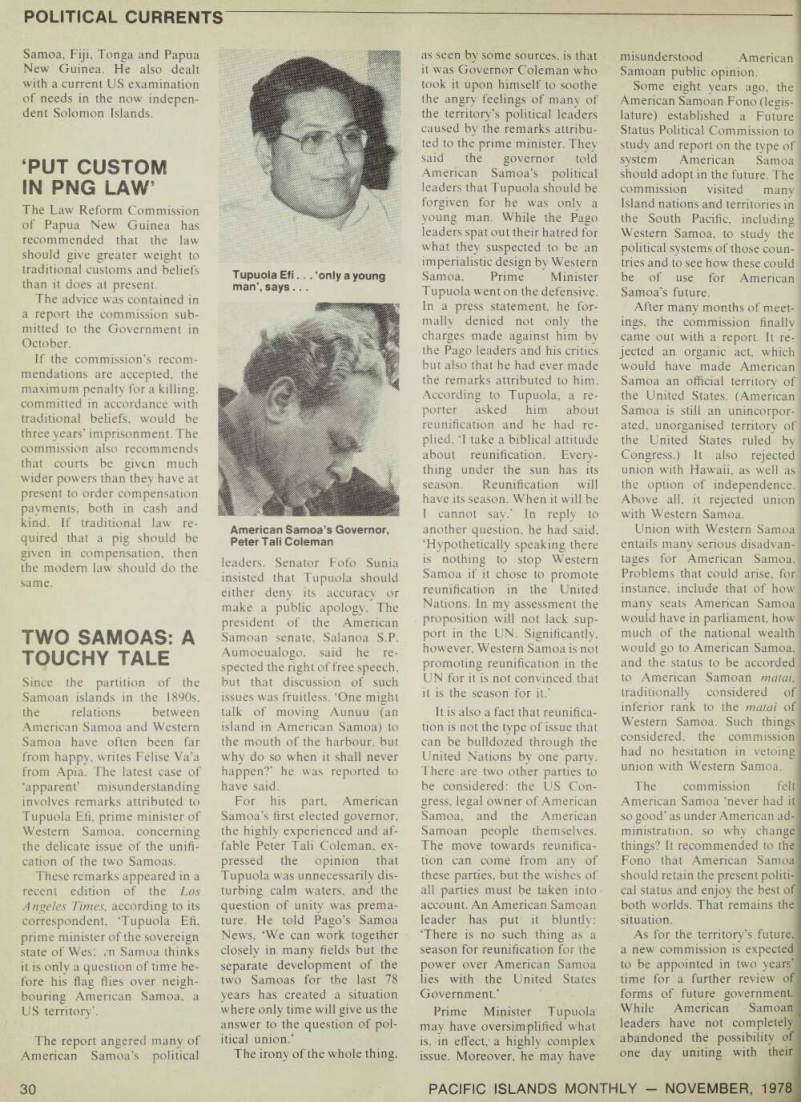
Tupuola Efi... ‘only a young man’, says . . .
American Samoa’s Governor, Peter Tall Coleman
cousins in Western Samoa, the
Los Angeles Times article
struck a severe blow at any future reunification. Prime Minister Tupuola appears to lack real understanding of the
sensitive feelings of the people
mf American Samoa. He may not have meant what has been attributed to him, but if his re narks carried any such impli
:ation he was certainly gravely
n error.
Banabans Are
Fighting On
\ fresh international campaign
:s being launched by the
Banaban people to win
ndependence for Ocean Island and to obtain more compen ialion for the phosphate mined Tom it, according to a recent mress release from Banaban iources. Appeals will be made o the United Nations, the south Pacific Forum and an
dready largely sympathetic
British public.
As a last resort the Banabans nay use their support in Bri ain’s House of Commons to
dock independence for the
Gilbert Islands, of which Jcean Island is at present pol tically part as a British colony.
Our platform is not changed
fom that of the previous coun il.’ the newly-elected chair nan of the Rabi Council of .eaders, the Rev Tebaiti "awaka, said in a message to upporters. ‘We want immediate self letermination for Banaba (the lanaban name for Ocean sland), immediate direct pay nent of the $A 10,000,000 'ffered to us by Britain, and mancial assistance for our ad
ministration and develop
ment.’
The Banabans, most of /horn live in Fiji, have been /aging a campaign over Ocean sland, their original home, for many years. They want the >land to be separated from the jilberts, which are expected to ecome independent soon, and iven its own independence, ossibly in association with
■iji.
They also want a bigger hare of the benefits derived rom mining of the island’s
phosphate deposits by the Bri tish Phosphate Commission directed by the British. Aus tralian and New Zealand Governments.
Judges: Local
Or ‘Expat’?
Despite the pressures being
brought upon the Papua New Guinea Government in certain quarters to appoint PNG law graduates to the bench to re place the Australian incum bents, it has met difficulty in the fact that of nearly 100
qualified graduates only a
handful have the basic require ments for appointment, writes
Sydney lawyer Robert W.
Moin.
Mr Buri Kidu, the PNG Sec retary for Justice, is recorded as opposing the making of local
appointments merely for the
sake of it, without considering the essential requirements of skill and maturity. ‘We have got to be very careful who we put on the Bench,’ he says. ‘You can’t have any Tom, Dick or Harry. One thing I’m afraid of is putting PNG men on the bench before they are ready. If they muck it up we’ll be a laughing stock around the world,’ he said.
Mr Kidu added: ‘People think that, merely because we
get PNG judges, they will work miracles. They would make mistakes just the same. I don’t think a PNG judge from one area who is sent to the opposite end of the country to hear a case would have any advantage over and an Australian judge in the same situation.’
Another difficulty experi
enced throughout the Pacific is the fact that the suitably quali
fied graduates are ‘grabbed’ by
their governments for import ant political and public service posts, particularly those with the capacity to progress to the bench. The opportunity of a steady job compared with the
uncertainties of private legal
practice are added consider ations for the new graduate
returning usually from either
Australia or New Zealand and wishing both to contribute his
acquired knowledge to his
homeland and improve his status.
One could ask how would
other expatriate judges deal
with the recent case of canni balism before Mr Justice Wil son in PNG (PIM October)?
How much judicial notice should be taken of local tra dition or custom?
Before the colonial adminis tration system moved into the Western province of PNG in
the early 1960 s cannibalism
was accepted, witchcraft prac
tised (It still is) and illiteracy, resulting in legal ignorance, the rule rather than the exception.
Should a conviction be recorded where the presiding judge states as did Judge Wil son: ‘They saw nothing wrong in what they did. They were ignorant of the introduced law which seeks to outlaw canni balism’. How can people be educated in the law? Surely a challenge to every govern ment! The process will cer
taiunly be long and will require
sympathetic understanding
from everybody involved in
legal administration.
Even countries reasonably advanced in legislative
development have continuing
difficulties assimilating with customs. Some countries like Western Samoa have given rec
ognition to incorporating,
where practical, traditional
practices into their legislative
process.
In almost direct contrast, Tonga, with a few exceptions, makes no recognition or men tion of custom at all. It seems that this was the desire of King George Tupou I, who held that the new order of change from the ‘old ways’ should be through the law. While in cer tain land cases a Tongan As sessor or Advisor sits with the European judge to advise him of Tongan custom where there is some dispute, his advice is usually on the pattern of what the law has come to mean since its introduction, by usage and practice in other words how the law has become custom, and not custom the law.
How do the simplified laws designed to meet a country’s needs even a mere 20 years ago now cope with the more
sophisticated and demanding
society that is being thrust upon it?
Countries like Australia and New Zealand have the legal
machinery itself already
fully extended to cope more of less adequately with such progress, particularly in the business world. Perhaps these countries should be more con scious of the need to assist their neighbours to cope with the
problems of legal development
when assessing their aid pro grammes.
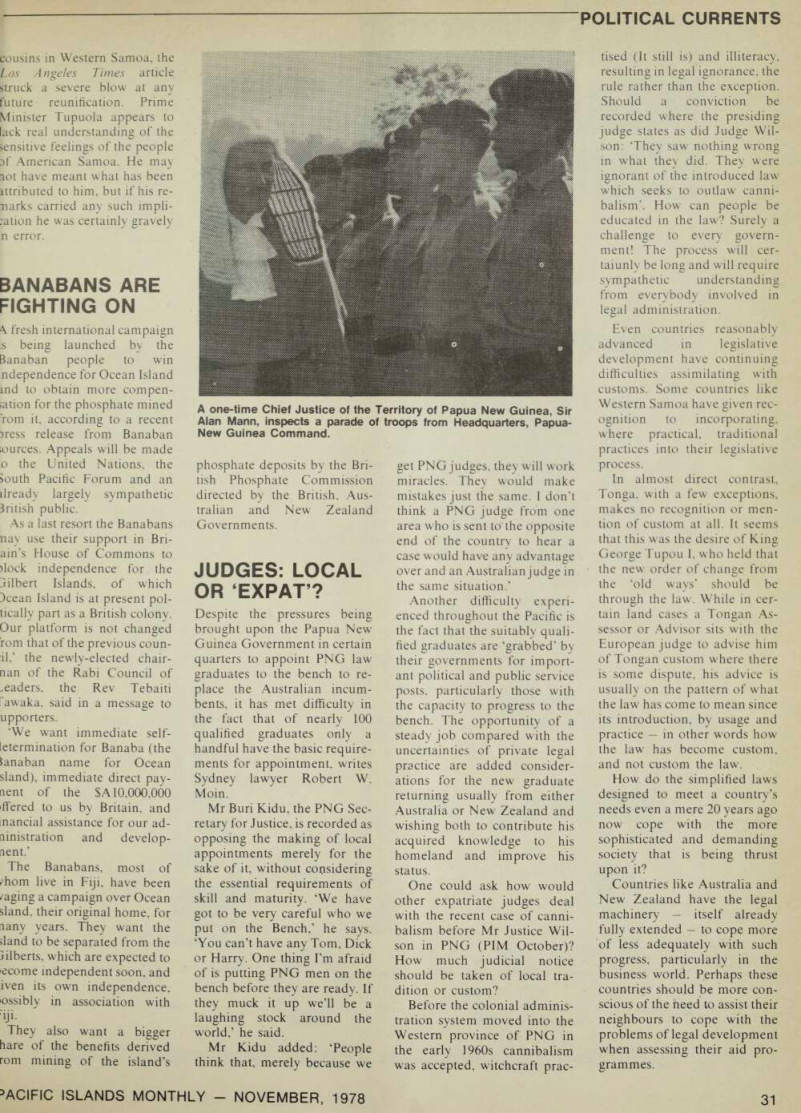
A one-time Chief Justice of the Territory of Papua New Guinea, Sir Alan Mann, inspects a parade of troops from Headquarters, Papua- New Guinea Command.