New Hebrides - past
pp. 18-19 · Read in the full issue
and present - by a veteran ‘colon’
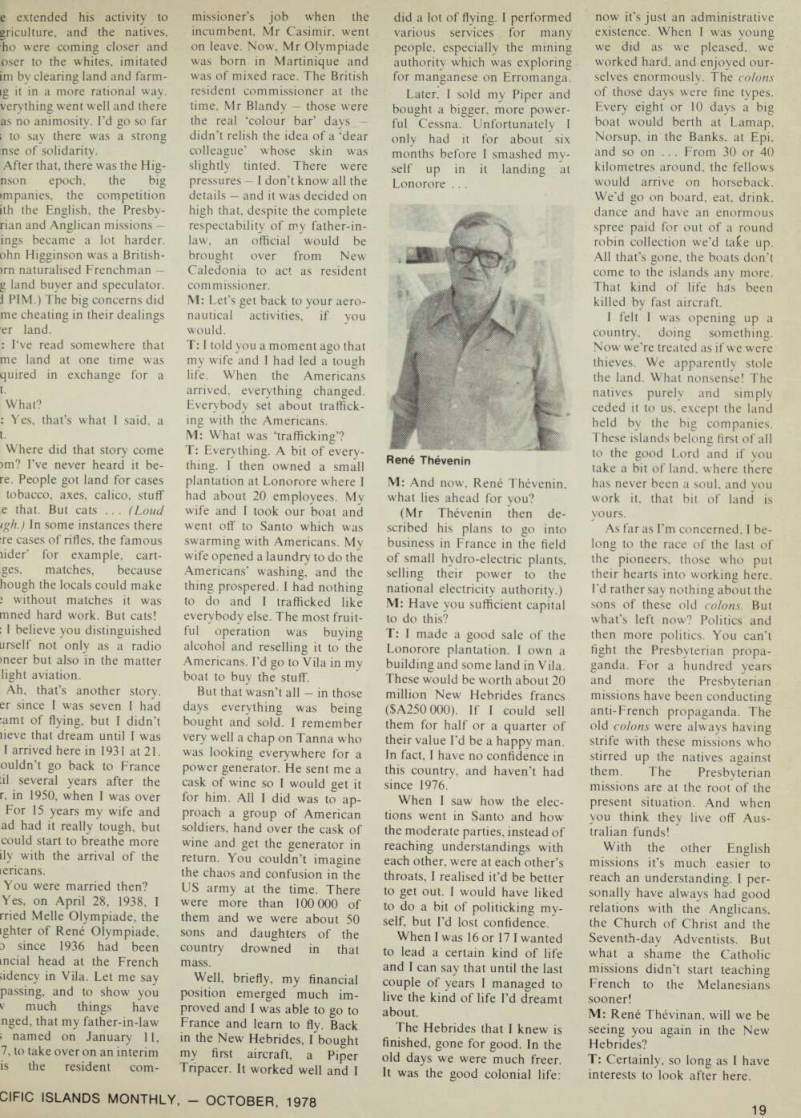
Rene Thevenin, 69 planter, pioneer of radio and aviation in the New Hebrides, and one of the best known French settlers in the condominium has gone home. He arrived in the New Hebrides in 1931. He was inter viewed on the eve of his depar ture by the director of the
French/Bislama fortnightly
newspaper Nabanga, Jean Mas sias. With independence approaching in a situation still far from calm, Mr Thevenin’s view of New Hebrides’ history, how the present situation came about and why he has decided to leave, is worth recording.
The interview began with Mr
Thevenin recounting his early
days as a radio pioneer. As a youth he trained as a merchant marine radio operator and
while doing military service in New Caledonia in 1931, found himself detached to do radio work in the New Hebrides. His
early duties included relaying
information in morse to planters about times of arrival of boats at their islands. Later in the thirties he provided lis teners with a rudimentary world news service. He even broadcast music by playing re cords on a hand-cranked phonograph placed next to the
microphone.
Mr Massias asked: Was there
anything comparable on the
English side? Were there also broadcasts in Bislama?
Thevenin: In English there was nothing at all and as for Bislama nobody ever gave it a thought. I personally was in the
New Hebrides for 10 years without speaking a word of Bislama. At the Compagnie Cotonniere des Nouvelles- Hebrides (whose radio he once operated Ed PIM), there were 700 Tonkinese (North Vietnamese Ed PIM) and 25
Europeans. The boys (New
Hebrideans Ed PIM) were never sighted. Don’t forget it was the Tonkinese who built the New Hebrides. If one had had to speak a language other than French, it would have been Tonkinese.
Today, people seem to have forgotten the history of the New Hebrides. They go around
saying anything that comes
into their heads. The very first colons to come here and I’m speaking of a time well before I was bom did not meet the hostility on the part of the natives about which people are so happy to talk today. At that time the Melanesians were
engaged in never-ending guer
rilla fighting oh, by mis chance, some chap’d get killed
once every six months or so and this fighting was con ducted with stone age weapons.
If you do a bit of clearing in the islands today you’ll still find stone axes that are not all that old.
If a European passed by they’d give him a bit of copra or, more particularly, some trochus shells, in exchange for tools and steel axes. Some Europeans even handed over to the natives knives and rifles.
So the natives soon understood that having a European within reach meant having a source of supplies which rendered them less vulnerable to the attacks of enemy tribes. It was purely in this way, and for these reasons, that at the beginning there was a very good understanding be tween Europeans and Melane sians. Later on, the big companies set themselves up here, and things were dif ferent ...
When a European came to the islands, it was first of all to engage in trade. Then, rapidly,
e extended his activity to griculture. and the natives, ho were coming closer and oser to the whites, imitated
im by clearing land and farm
ig it in a more rational way. verything went well and there as no animosity. I'd go so far ; to say there was a strong nse of solidarity.
After that, there was the Hig
nson epoch, the big
unpanies, the competition
ith the English, the Presby
rian and Anglican missions
ings became a lot harder, ohn Higginson was a British >m naturalised Frenchman g land buyer and speculator, i PIM.) The big concerns did
me cheating in their dealings
er land. : Tve read somewhere that me land at one time was quired in exchange for a t.
What? : Yes, that’s what I said, a t.
Where did that story come )m? I’ve never heard it he re. People got land for cases tobacco, axes, calico, stuff e that. But cats ... (Loud igh.) In some instances there tc cases of rifles, the famous lider’ for example, cart ges, matches, because hough the locals could make ; without matches it was mned hard work. But cats! ; I believe you distinguished arself not only as a radio meer but also in the matter
light aviation.
Ah, that’s another story, er since I was seven I had :amt of flying, but I didn’t lieve that dream until I was I arrived here in 1931 at 21. ouldn’t go back to France il several years after the r, in 1950, when I was over For 15 years my wife and ad had it really tough, but could start to breathe more ily with the arrival of the tericans.
You were married then?
Yes, on April 28, 1938, I
rried Melle Olympiade, the
ighter of Rene Olympiade,
3 since 1936 had been mcial head at the French ;idency in Vila. Let me say passing, and to show you
v much things have
nged, that my father-in-law ; named on January 11, 7, to take over on an interim is the resident com
missioner’s job when the incumbent, Mr Casimir, went on leave. Now. Mr Olympiade was born in Martinique and was of mixed race. The British resident commissioner at the time, Mr Blandy those were the real ‘colour bar’ days didn’t relish the idea of a ‘dear colleague’ whose skin was slightly tinted. There were pressures I don’t know all the details and it was decided on high that, despite the complete respectability of my father-in law, an official would be brought over from New Caledonia to act as resident commissioner.
M: Let’s get back to your aero nautical activities, if you would.
T: I told you a moment ago that my wife and I had led a tough life. When the Americans
arrived, everything changed.
Everybody set about traffick ing with the Americans.
M: What was ‘trafficking’?
T: Everything. A bit of every thing. I then owned a small plantation at Lonorore where I had about 20 employees. My wife and I took our boat and went off to Santo which was
swarming with Americans. My
wife opened a laundry to do the Americans’ washing, and the
thing prospered. I had nothing
to do and I trafficked like everybody else. The most fruit ful operation was buying alcohol and reselling it to the Americans. I'd go to Vila in my boat to buy the stuff.
But that wasn’t all in those
days everything was being
bought and sold. I remember very well a chap on Tanna who was looking everywhere for a power generator. He sent me a cask of wine so I would get it for him. All I did was to ap proach a group of American soldiers, hand over the cask of wine and get the generator in return. You couldn’t imagine the chaos and confusion in the US army at the time. There were more than 100 000 of them and we were about 50 sons and daughters of the country drowned in that mass.
Well, briefly, my financial position emerged much im proved and I was able to go to France and learn to fly. Back in the New Hebrides, I bought my first aircraft, a Piper Tripacer. It worked well and I
did a lot of flying. I performed various services for many people, especially the mining
authority which was exploring
for manganese on Erromanga.
Later. I sold my Piper and bought a bigger, more power ful Cessna. Unfortunately I only had it for about six months before I smashed my self up in it landing at Lonorore . . .
M: And now, Rene Thevenin. what lies ahead for you? (Mr Thevenin then de scribed his plans to go into business in France in the field
of small hydro-electric plants,
selling their power to the
national electricity authority.)
M: Have you sufficient capital to do this?
T: I made a good sale of the Lonorore plantation. I own a building and some land in Vila.
These would be worth about 20 million New Hebrides francs (SA2SO 000). If I could sell them for half or a quarter of their value I’d be a happy man.
In fact, I have no confidence in this country, and haven’t had since 1976.
When I saw how the elec tions went in Santo and how the moderate parties, instead of
reaching understandings with
each other, were at each other’s throats, I realised it’d be better to get out. I would have liked to do a bit of politicking my self, but I’d lost confidence.
When I was 16 or 17 I wanted to lead a certain kind of life and I can say that until the last couple of years I managed to live the kind of life I’d dreamt about.
The Hebrides that I knew is finished, gone for good. In the old days we were much freer.
It was the good colonial life:
now it’s just an administrative existence. When I was young we did as we pleased, we worked hard, and enjoyed our selves enormously. The colons of those days were fine types.
Every eight or 10 days a big boat would berth at Lamap.
Norsup. in the Banks, at Epi. and so on .. . From 30 or 40 kilometres around, the fellows would arrive on horseback.
We’d go on board, eat, drink, dance and have an enormous spree paid for out of a round robin collection we’d take up.
All that’s gone, the boats don’t come to the islands any more.
That kind of life has been killed by fast aircraft.
I felt I was opening up a
country, doing something.
Now we're treated as if we were thieves. We apparently stole the land. What nonsense! The natives purely and simply ceded it to us, except the land
held by the big companies.
These islands belong first of all to the good Lord and if you take a bit of land, where there has never been a soul, and you work it, that bit of land is yours.
As far as I’m concerned. I be long to the race of the last of the pioneers, those who put their hearts into working here.
I'd rather say nothing about the sons of these old colons. But what’s left now? Politics and then more politics. You can’t
fight the Presbyterian propa
ganda. For a hundred years and more the Presbyterian missions have been conducting anti-French propaganda. The old colons were always having strife with these missions who stirred up the natives against them. The Presbyterian missions are at the root of the present situation. And when you think they live off Aus tralian funds!
With the other English missions it’s much easier to reach an understanding. I per
sonally have always had good
relations with the Anglicans, the Church of Christ and the Seventh-day Adventists. But what a shame the Catholic missions didn’t start teaching French to the Melanesians sooner!
M: Rene Thevinan, will we be seeing you again in the New Hebrides?
T: Certainly, so long as I have interests to look after here.
René Thévenin