[?]Diotic
pp. 17-18 · Read in the full issue
Of All The Borders
- Not One So
AFTERTHOUGHTS with Percy Chatterton in Port Moresby.
The Australian Government does not consider that Indonesia has my valid claim to Dutch New Guinea . ’ So, in 1950, declared the hen Australian Minister for External Affairs, Sir Percy
Ipender.
Seven years later, during a United Nations debate on West New Guinea, the Australian representative struck the same note. The epresentative of Indonesia had reiterated Indonesia’s claim to overeignty over what he preferred to call ‘West Irian’, as having >een an integral part of the former Netherlands East Indies, and iad rejected the idea that the people of that territory had any ight to self-determination.
The Dutch representative reaffirmed Holland’s intention to etain control of the territory and to honour the promise which ; had made to the people of West New Guinea that they would e given an opportunity to determine their own political Liture.
The Australian representative warmly supported his Dutch ollegue. The policy of their two governments, he said, was to repare the people of New Guinea for the time when they would e able determine their own future.
With very few exceptions the nations of the Third World sup orted Indonesia. They appear to have based their support on vo rather odd beliefs first that oppression of dark-skinned eople by whites is very very wicked, but oppression of dark cinned people by other dark-skinned people is quite okay; sec nd, that the colonial boundaries bequeathed to the new nations y their former colonial masters, however ridiculous and illogical lose boundaries may be, are sacrosanct, and must be maintained t all costs.
The implementation of this fanatically held belief, while in
some cases it may have inhibited overfragmentation, has been achieved only at an enormous cost in terms of human suffer
ing.
During the next five years (1957-62) the situation deteriorated.
Indonesia’s assurance that it would not use force to press her claims to West New Guinea was followed by the dropping of Indonesian paratroopers there. Australia, apparently deciding that her ‘image’ in Southeast Asia and the Third World was more important to it than loyalty to friends or justice for a handful of Melanesians, did an abrupt volte-face, and in 1962 supported the transfer of West New Guinea from Holland to Indonesia. The United States, which disapproved of white colonialism anywhere in the world except in Micronesia, brought pressure to bear. Hol land, deserted by Australia and pressured by the USA, had no choice but to give way. West New Guinea was handed over to an interim UN Administration, which in turn handed it over to Indonesia without any attempt to ascertain the wishes of the
indigenous people.
True, Indonesia was required to hold an ‘act of free choice’ not later than 1969, but it was not stipulated what form that ‘act’ should take. In 1969, after six years of Indonesian rule, the only kind of act of choice which could properly have revealed the true wishes of the people would have been a referendum by secret ballot. The method actually chosen, that of reaching a decision by consultation and consensus (bermusjawarah) would only have been meaningful if the participants had been free to express their views without the constraint of fear. In a situation in which the Indonesian head of state had denounced one of the two alterna tives as treason, this could hardly be the case.
So the saga of betrayal was consummated, the people of West New Guinea were deprived of any hope of present or future self determination, and ‘West Irian’ became a province of the for merly federated but by this time unitary Republic of Indonesia.
The subsequent decade has seen the migration to ‘lrian Jaya’ of large numbers of people from other parts of Indonesia to com pete with the indigenes for a very limited number of jobs; and a regime of which Professor Ron Crocombe of the University of the South Pacific has written: i would not have believed the extent of the brutality, misunderstanding or incompetence of
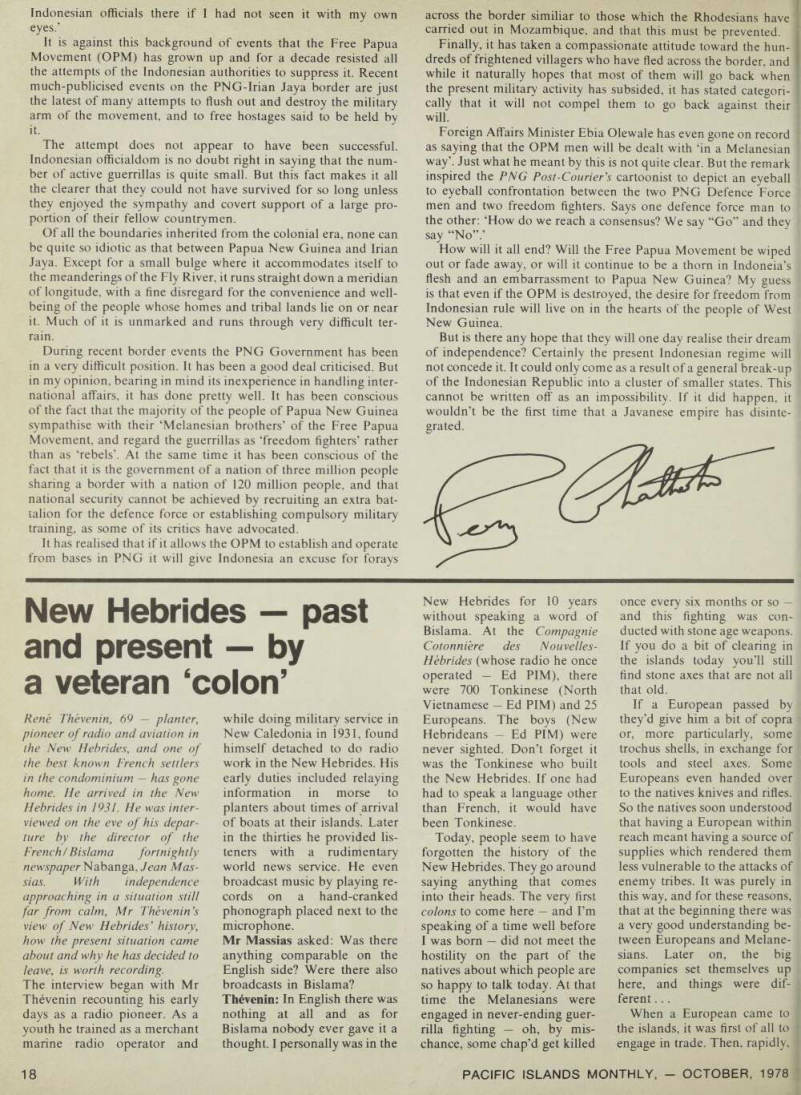
"But how can we reach a consensus? We say “Go” and they say “No”.”
The PNG Post-Courier’s view of the border situation.
Indonesian officials there if I had not seen it with my own
eyes.’
It is against this background of events that the Free Papua Movement (OPM) has grown up and for a decade resisted all the attempts of the Indonesian authorities to suppress it. Recent much-publicised events on the PNG-Irian Jaya border are just the latest of many attempts to flush out and destroy the military arm of the movement, and to free hostages said to be held by it.
The attempt does not appear to have been successful.
Indonesian officialdom is no doubt right in saying that the num ber of active guerrillas is quite small. But this fact makes it all the clearer that they could not have survived for so long unless they enjoyed the sympathy and covert support of a large pro portion of their fellow countrymen.
Of all the boundaries inherited from the colonial era, none can be quite so idiotic as that between Papua New Guinea and Irian Jaya. Except for a small bulge where it accommodates itself to the meanderings of the Fly River, it runs straight down a meridian of longitude, with a fine disregard for the convenience and well being of the people whose homes and tribal lands lie on or near it. Much of it is unmarked and runs through very difficult ter rain.
During recent border events the PNG Government has been in a very difficult position. It has been a good deal criticised. But in my opinion, bearing in mind its inexperience in handling inter national affairs, it has done pretty well. It has been conscious of the fact that the majority of the people of Papua New Guinea sympathise with their ‘Melanesian brothers’ of the Free Papua Movement, and regard the guerrillas as ‘freedom fighters’ rather than as ‘rebels’. At the same time it has been conscious of the fact that it is the government of a nation of three million people sharing a border with a nation of 120 million people, and that national security cannot be achieved by recruiting an extra bat talion for the defence force or establishing compulsory military training, as some of its critics have advocated.
It has realised that if it allows the OPM to establish and operate from bases in PNG it will give Indonesia an excuse for forays
across the border similiar to those which the Rhodesians have carried out in Mozambique, and that this must be prevented.
Finally, it has taken a compassionate attitude toward the hun dreds of frightened villagers who have fled across the border, and while it naturally hopes that most of them will go back when the present military activity has subsided, it has stated categori cally that it will not compel them to go back against their will.
Foreign Affairs Minister Ebia Olewale has even gone on record as saying that the OPM men will be dealt with ‘in a Melanesian way’. Just what he meant by this is not quite clear. But the remark inspired the PNG Post-Courier’s cartoonist to depict an eyeball to eyeball confrontation between the two PNG Defence Force men and two freedom fighters. Says one defence force man to the other: ‘How do we reach a consensus? We say “Go” and they say “No”.’
How will it all end? Will the Free Papua Movement be wiped out or fade away, or will it continue to be a thorn in Indoneia’s flesh and an embarrassment to Papua New Guinea? My guess is that even if the OPM is destroyed, the desire for freedom from Indonesian rule will live on in the hearts of the people of West New Guinea.
But is there any hope that they will one day realise their dream of independence? Certainly the present Indonesian regime will not concede it. It could only come as a result of a general break-up of the Indonesian Republic into a cluster of smaller states. This cannot be written off as an impossibility. If it did happen, it wouldn’t be the first time that a Javanese empire has disinte
grated.