Islands
p. 59 · Read in the full issue
What's In
It For The
In his interview with PIM, Mr
Tokuyama foresaw important
benefits for Pacific Island countries as his “Pacific cen tury” got under way. He said: “I believe that in the short term there will be a quite dramatic increase in the number of tour ists visiting Pacific Island coun-
tries. In the medium term, I
foresee major developments in
the part-processing and processing of the raw material exports of these countries.”
Among the most important obstacles to these developments, in MrTokuyama’s view, is the high cost of air travel in lie Pacific. This is an issue on which he feels strongly. He said: “In projecting the Pacific Basin economy, we must not overlook the remarkable progress that has taken place in the means of transportation and communication.” He listed the various stages by which trans- Pacific travel time had been cut from the 12-day sea voyage required to go from Tokyo to San Francisco in pre-war days to the 4.5 hours in which the Concorde could make the same trip
today.
“Such rapid progress has turned the Pacific into a ‘lake’ so to speak,” he said. Transport costs had also come down sharply. But none of this had been reflected in lower air
fares. “Because of the IATA agreement, the air fares in the Pacific are exorbitant,” he said, “I was amazed to learn that the
Australia-Japan Foundation
paid a round-trip fare for me,
Japan-Australia, Australia-
Japan, of 443 600 yen (about SAI 730). I just cannot under stand why you have to pay more to fly to Tokyo than to London. If the fare is lowered.
I am sure both Qantas and Japan Air Lines will get more passengers and more profits.”
But there’s light at the end of the tunnel, according to Mr Tokuyama. “President Carter’s decision to let the market de cide rates has made it likely that air passenger fares and air cargo rates in the Australia-
Japan-US-Pacific triangle gen
erally will be cut by half in the next two or three years,” he said. “This would be an im portant factor in stimulating the Pacific Basin economy, and
could bring striking changes
within the region in perhaps as little as three to five years.”
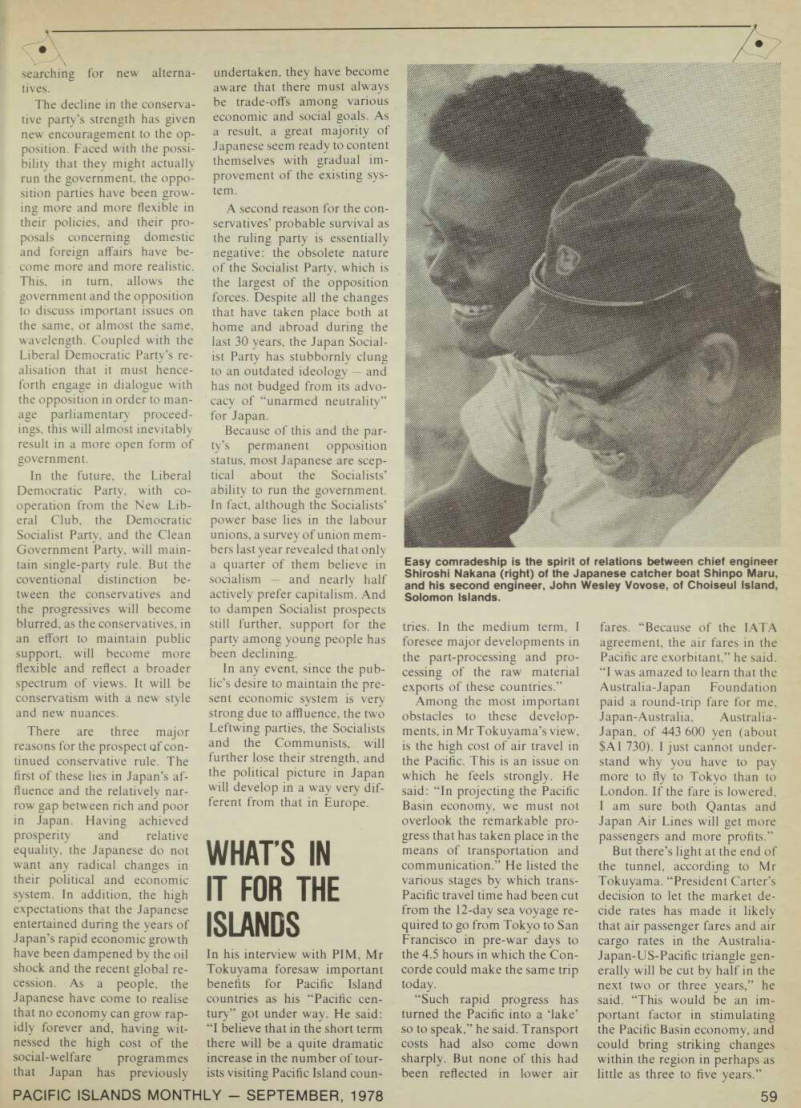
Easy comradeship is the spirit of relations between chief engineer Shiroshi Nakana (right) of the Japanese catcher boat Shinpo Maru, and his second engineer, John Wesley Vovose, of Choiseul Island, Solomon Islands.