Fiji: More
p. 61 · Read in the full issue
Than
‘Black
Sex’
Japanese investment in Fiji
continues to build up, par ticularly in the area of land and tourism investment.
As the money moves in, so do the Japanese tourists, mostly on tickets paid for at home, to stay in accommo dation with a strong Japanese
interest. Why they come,
according to Fiji tourist indus try operators keen to cash in, varies from sun, sea, cheap golfing facilities, just a new place to go and an interest in “black sex”.
The suggestion of black sex as a drawcard has been hotly denied by United Tourist Fiji Ltd which has been promoting Fiji in Japan, and by the chair man of the Fiji Visitors Bureau, Mr Mahendra Patel, who de nounced the idea of trying to attract tourists with “such pub
licity”.
When Taisei, one of Japan’s biggest construction groups, bought into the resort develop ment of Pacific Harbour, 55 km from Suva, steady, if not furi ous, development was expected to result and the possibility of the scheme attracting more Japanese investment was con sidered likely. At that stage, Taisei formed the SPP-Taisei Ltd with Southern Pacific
Properties of Hong Kong, in
which the British P&O ship ping group is a large share holder. They paid out $5 million for 2 400 ha of the 2 800 ha section which South Pacific Properties owned at Pacific Harbour.
Taisei took the bulk of re
sponsibility of planning and
developing the resort, and had
plans for small village-type
complexes similar to that already established at Pacific Harbour. A resident Taisei planner now lives at Pacific
Harbour although no building
has actually begun.
It now appears that the
Japanese yen-backed invest-
ment is to be joined by the petro-dollars of the Arabs.
Saudi Arabian multi-mil lionaire Adnan Kahshoggi’s
Triad Holdings Corporation is
buying out the SPP share holders in Pacific Harbour and the chain of Travelodge hotels
in Fiji.
The already-established sec tions of the Pacific Harbour re sort, operated by Hotels and
Development Ltd, a wholly
owned subsidiary of SPP, will now be fully owned by the Saudi Arabian group, with Taisei International Corpor ation Ltd “developing other sections of land at the Pacific Harbour complex”, an SPP spokesman said.
On the other side of Fiji’s main island of Viti Levu, near Nadi, Fuji Kon Fiji Ltd. a Fiji based subsidiary of a Japanese consortium, is planning to build Fiji’s biggest hotel on Denaurau Beach.
Fuji Kon Fiji has a sublease on a 10 ha piece of developed land at Denaurau Beach com
plex. The planned capacity of
400 rooms of the new hotel would outrank Denaurau’s other hotel. The Regent, as Fiji’s largest. It is understood that the proposed $2O million hotel could also involve one of two major names in inter national hotel business Sheraton or Hilton. Managing director of Fuji Kon Fiji, Mr Denis McElerath. said development of the hotel depended on water.
The 263 ha Denaurau pro
ject was master-planned in
1970 as a destination resort.
The 300-room Regent of Fiji
hotel was just the first step. Mr McElerath said.
Also on that side of Viti Levu is the island resort of Man, 80% owned by Todeco (Fiji) Ltd, a
private company formed by
more than 30 large Japanese corporations as a vehicle for investment in a wide range of fields in Fiji and possibly other areas of the South Pacific.
Managing director of Mana Island Resort Fiji Ltd is Mr Motoo Koyasu. He has applied for permission to build 800 000 worth of extensions to the re sort complex, which are still in the planning stage.
In another sphere, fishing, business is booming for the Japanese investors. The Pacific Fishing Co, formed by C. Itoh and Co Ltd of Osaka and
Nichiryo Ltd of Tokyo, opened
a freezing factory at Levuka 13 years ago to handle tuna
landed by Japanese, Korean
and Taiwanese vessels. Four years ago they and the Fiji government signed an agree ment under which the freezing facilities were expanded to can fish. The government acquired a 25% holding in PAFCO, with C. Itoh retaining 60% of the
shares and Nichiryo’s holding
dropping to 10%. Another 5% is owned by 20 local share holders.
Last month PAFCO an nounced it had won a record $4 million contract to supply canned albacore tuna to Canada’s biggest food distribu tors, British Columbia Packers, of Vancouver. General man ager and director of PAFCO, Mr Hiro Tanaka, said it was a significant achievement which
showed Fiji could compete with other world tuna pro ducers. Japan has always been chief supplier of canned albacore to BCP. But last year Japan had a bad season and failed to meet its quota. Last year PAFCO provided BCP with $3 million worth of fish and when Japan was hit by a bad season again earlier this year, supplied another $3 million worth. BCP has now signed a $24 million contract because it was satisfied with the quality of Fiji canned albacore. he said.
Meanwhile, the Fiji Govern ment has taken 20% share in Fiji Can Company Ltd, formed with Toyo Seikan Kaisha Ltd. to produce cans in a newly
completed factory which
expects to reach an annual out put of a million cans by 1980.
Fiji’s “green gold”, its pine
plantations, are due for first harvest in 1980. The Fiji Pine Commission is looking to Japanese markets to take much of the wood and pulp pro ducts.
While there has been little
major increase in Japanese
investment in Fiji in the past year, it is now a well established fact of tropical life and is obviously in the country to stay.
And with it come the Japanese tourists, 6 000 last year, mostly on Japanese air line charters, and the Ministry of Tourism estimate there will be more this year. Locals say you can tell where the Japanese money is by the number of Japanese guests at the hotel.
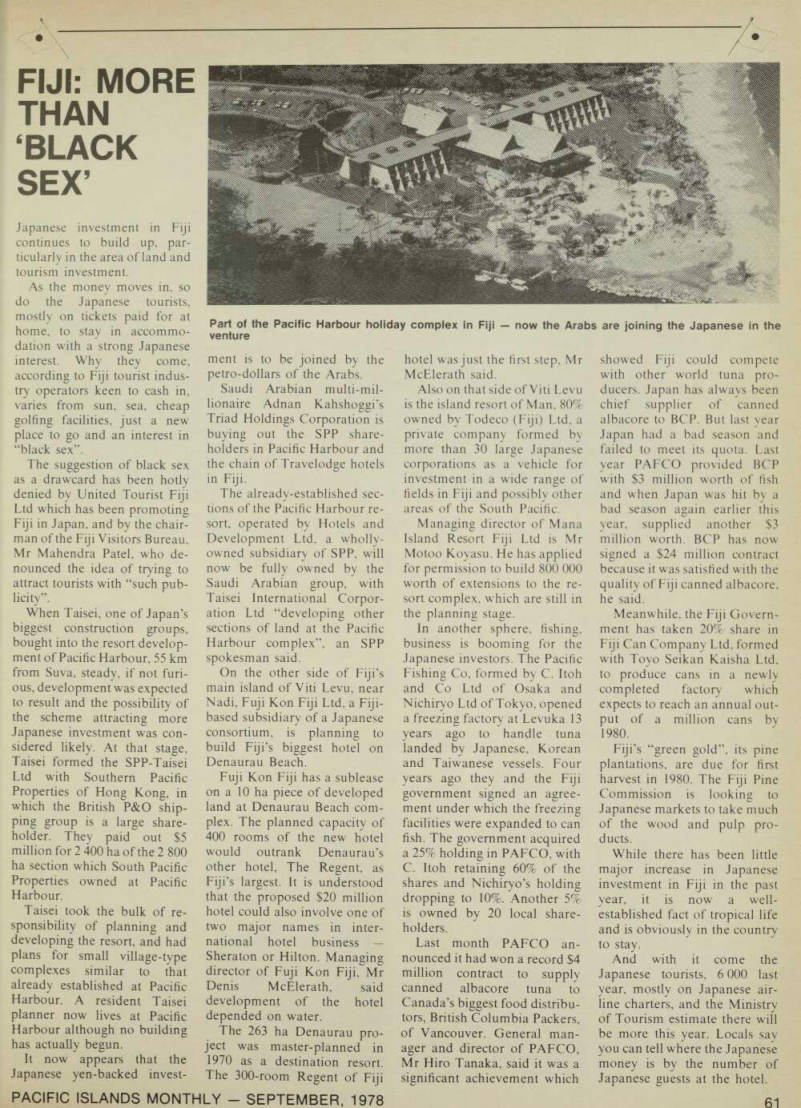
Part of the Pacific Harbour holiday complex in Fiji - now the Arabs are joining the Japanese in the venture