Politics Of
pp. 58-59 · Read in the full issue

The Future
Japan
The most conspicuous trend of modern Japanese politics is the long-term erosion of the power of the Liberal Demo
cratic Party (LDP) and the emergence of pluralism. For the first time since 1955, the LDP is now faced with the situ ation in which it must try to manage the Diet without an
assured legislative majority.
Although many voters re jected the LDP in the last elec tion, this does not mean that they' turned to its major opponents, the Japan Socialist Party and the Communist
Party.
The primary factor that obviously motivated many voters was the change in Japan’s economic environ ment. During the greater part of the last 30 years, the LDP has been able to maintain one party rule because it has been able to promise ever
improving standards of living
in a rapidly growing economy.
But despite the country’s rapid economic growth, problems of urban congestion such as hous
ing shortages and inadequate
public facilities have been left largely unattended. And what appears to be the end of
Japan’s era of rapid economic growth has now dispelled the illusion that such problems can be solved more or less auto matically over time as a by
product of ever increasing
prosperity. Public support has veered towards political forces which advocate gradual res tructuring of social and econ omic programmes.
The second factor is the
change in the age composition of the Japanese public. Most of today’s Japanese leaders have been playing key roles in Japan’s reconstruction and growth since World War 11.
They were in their middle or late thirties when the war ended. And while such men still form the top echelon of the Japanese political and business communities, they and their contemporaries people aged 65 or older now account for somewhat less than 10% of the population. And both Japan’s young people and its middle aged citizens (who account for 30% of the population) are
increasingly rejecting geron
tocracy of either the Left or the Right. No less important to consider is the fact that today’s Japanese youths have grown up under a system of diver sified values and refuse to see the world in terms of black
and-white dichotomy. Unper
suaded by the conventional view of politics as a struggle be tween conservatives and pro gressives, they seem to be
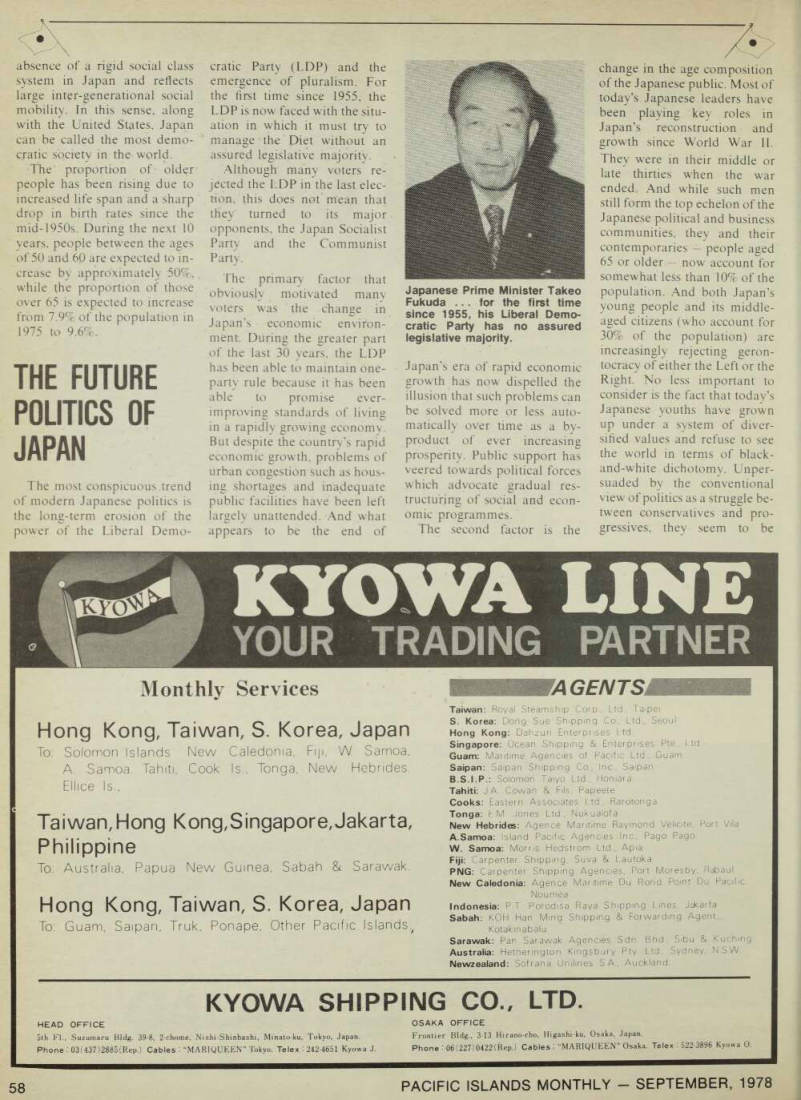
Japanese Prime Minister Takeo Fukuda ... for the first time since 1955, his Liberal Demo cratic Party has no assured
legislative majority.
searching for new alterna tives.
The decline in the conserva tive party’s strength has given new encouragement to the op position. Faced with the possi
bility that they might actually
run the government, the oppo sition parties have been grow ing more and more flexible in their policies, and their pro posals concerning domestic and foreign affairs have be come more and more realistic.
This, in turn, allows the government and the opposition to discuss important issues on the same, or almost the same,
wavelength. Coupled with the
Liberal Democratic Party’s re alisation that it must hence forth engage in dialogue with the opposition in order to man
age parliamentary proceed
ings, this will almost inevitably result in a more open form of government.
In the future, the Liberal Democratic Party, with co operation from the New Lib eral Club, the Democratic Socialist Party, and the Clean Government Party, will main tain single-party rule. But the coventional distinction be tween the conservatives and the progressives will become blurred, as the conservatives, in an effort to maintain public support, will become more flexible and reflect a broader spectrum of views. It will be conservatism with a new style and new nuances.
There are three major reasons for the prospect of con tinued conservative rule. The first of these lies in Japan’s af fluence and the relatively nar row gap between rich and poor
in Japan. Having achieved
prosperity and relative equality, the Japanese do not want any radical changes in their political and economic system. In addition, the high expectations that the Japanese entertained during the years of
Japan’s rapid economic growth
have been dampened by the oil shock and the recent global re cession. As a people, the Japanese have come to realise that no economy can grow rap idly forever and, having wit nessed the high cost of the social-welfare programmes that Japan has previously
undertaken, they have become aware that there must always be trade-off's among various economic and social goals. As a result, a great majority of Japanese seem ready to content themselves with gradual im provement of the existing sys tem.
A second reason for the con servatives’ probable survival as the ruling party is essentially negative: the obsolete nature of the Socialist Party, which is the largest of the opposition forces. Despite all the changes that have taken place both at home and abroad during the last 30 years, the Japan Social ist Party has stubbornly clung to an outdated ideology and has not budged from its advo cacy of “unarmed neutrality” for Japan.
Because of this and the par
ty’s permanent opposition
status, most Japanese are scep tical about the Socialists’ ability to run the government.
In fact, although the Socialists’ power base lies in the labour unions, a survey of union mem bers last year revealed that only a quarter of them believe in socialism and nearly half
actively prefer capitalism. And
to dampen Socialist prospects still further, support for the party among young people has
been declining.
In any event, since the pub lic’s desire to maintain the pre sent economic system is very strong due to affluence, the two Leftwing parties, the Socialists and the Communists, will further lose their strength, and the political picture in Japan will develop in a way very dif ferent from that in Europe.