Main Social
pp. 48-58 · Read in the full issue



The Three
Trends
There are three outstanding social trends in contemporary Japan. The first is equalisation of income, the second the rising educational level, and the third the gradual ageing of the popu
lation composition.
Before World War 11, the income levels of the urban and rural populations were so dif ferent that Japanese society was never really stable.
By contrast, in the early 1970 s the average income of a
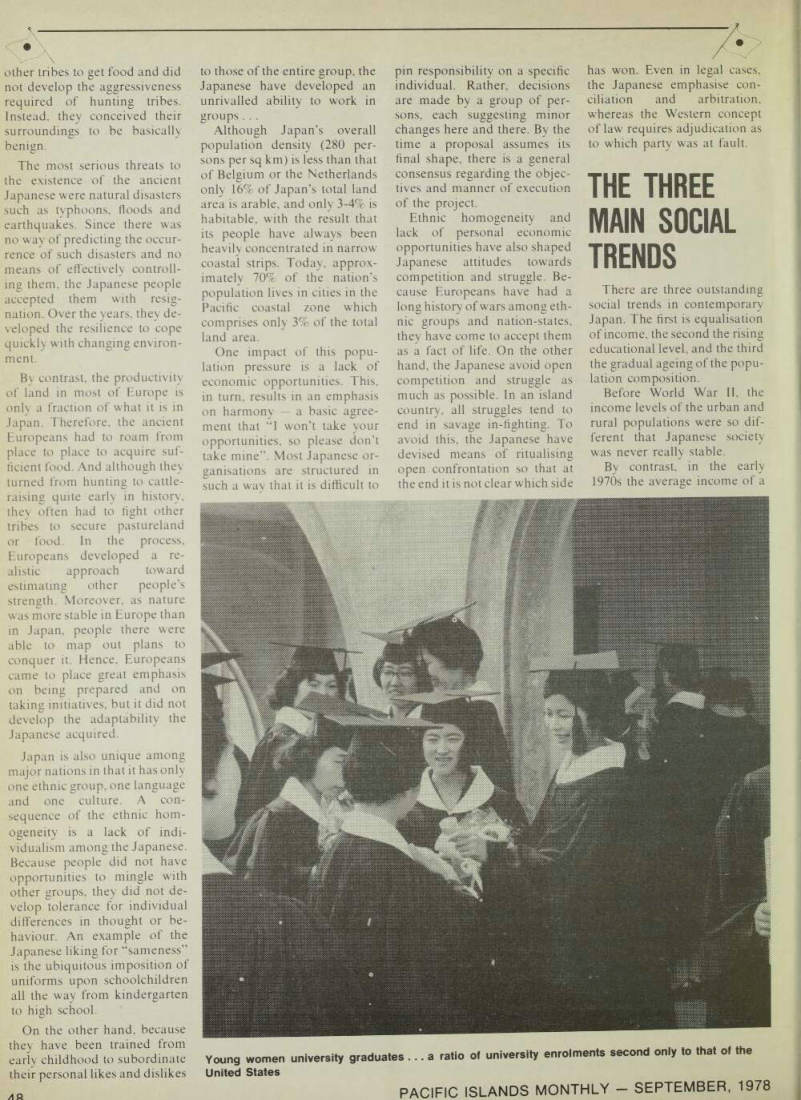
Young women university graduates ... a ratio of university enrolments second only to that of the United States
rural household exceeded that of an urban household for the first time in history. The dif fusion rates of such consumer durables as automobiles, colour television sets and re frigerators are higher in the countryside than in large cities, although even on a nation wide basis almost all Japanese homes possess a washing ma chine, a refrigerator, a colour television and a vacuum cleaner (the ownership ratios of these products are well over 90%). Nearly half of the country’s households have an automobile.
The increased income of the farming household can be attributed partly to the rice price-support system and
partly to growing employment
opportunities at automobile parts, electronics and other plants built near farming com
munities. Subway and sky
scraper construction in large cities absorbs a great number of farmers during the winter.
Consequently, today only 27%
of the agrarian household income is derived from farm
ing activity.
City dwellers have not fared badly, either. The living stan dards of industrial workers
have improved substantially
during the last 15 years. For example, in 1960 they had to work 63 minutes to earn the price of a bottle of beer. In 1975 that time was reduced to 10 minutes. The amount of labour
required to buy a refrigerator
was reduced from 37 days and four hours in 1960 to five days and four hours. For a colour television, the cut was from 94 days in 1960 to 18 days in 1975.
The dramatic improvement of the Japanese living stan dards since the war is attribu ted to rapid development of her industries. In Europe and
the United States, such mass production industries as automobiles and home electrical
appliances developed before
World war 11. In Japan, prewar
production was geared almost
entirely for military use and development of consumer industries had been suppressed. As a result, when reconstruction began after the war, the Japanese economy benefited from the simultaneous
development of these products
and those that were newly brought to the market by the “ g ' Cal breakthroughs of the 19505, such as electronics chemicals and petrochemical , v P ro uc s ‘ Despite the fact that the country was very poor then due to wartime destruction, Japan was able to absorb and develop new technology as its workers were highly educated and welldisciplined. The domestic mar-
ket expanded rapidly, helped
by a large population of 110
million and the robust appetite of consumers for new conveniences. Since Japan had renounced war as a sovereign right of the nation, the
Japanese focussed their aspir
ation on economic develop ment. Their efforts were helped to a great extent by the spirit of free trade that prevailed among the advanced industrialised nations. By the mid-19605, Japan emerged as a nation with a vast middle class.
A recent report by the organis ation for Economic Co
operation and Development
(OECD) asserted that Japan, along with Sweden and Aus tralia. had the smallest income gap between rich and poor.
A , with income- (he levd of educ tion has risen sharpl „ Tf r J In 1960, 60% of young persons
newly entering the job market
had only nine years of school
ing. Today they account for less
than one of every 10 job "seekers. The proportion of
senior high school graduates
rose from 30% to nearly 60%, while that of graduates from tertiary institutions rose from a mere 8% to 33%. Japan’s ratio for attendance at tertiary insti tutions is second only to that in the United States. The rapid
expansion of higher education
can be attributed to the
The traditional Japanese game of go helps pass the time in a home for senior citizens ... the marked ageing in Japan’s population com position is expected to increase the need for better social security provisions.
One way of coping with the housing shortage the Takashimadaira apartment complex, built on a former rice paddy area in northern Tokyo, consists of 10 170 apartments.
absence of a rigid social class system in Japan and reflects
large inter-generational social
mobility. In this sense, along with the United States. Japan can be called the most demo cratic society in the world.
The proportion of older people has been rising due to increased life span and a sharp drop in birth rates since the mid-19505. During the next 10 years, people between the ages of 50 and 60 are expected to in
crease by approximately 50%,
while the proportion of those over 65 is expected to increase from 7.9% of the population in 1975 to 9.6%,