Individualism
pp. 47-48 · Read in the full issue
Is Not For
Japanese
Exchanges between the West and Japan have multiplied many times during the last few decades. Yet, for all that, there still seems to persist outside
Japan a feeling that the Japanese are exotic creatures whose behaviour is hard to pre dict.
The chief, reason for this. I believe, lies in the human tend ency to interpret all facts and figures within the context of one’s own culture and experi ence. That works well enough when the facts and figures re late to a culture broadly similar to one’s own. But it does not work very well with a culture that has a unique frame of ref erence which is the case with
Japanese culture.
There are, I believe, at least three major environmental fac tors that help to explain the
uniqueness of Japanese so
ciety. The first of these may be found in the fact that his
torically, Japan had an
agrarian culture, while West ern European culture was based on hunting and cattle
raising.
In Japan, as long as people
worked diligently, the land was rich enough to enable them to settle in a single spot and stay there. As a result, the ancient Japanese seldom had to fight
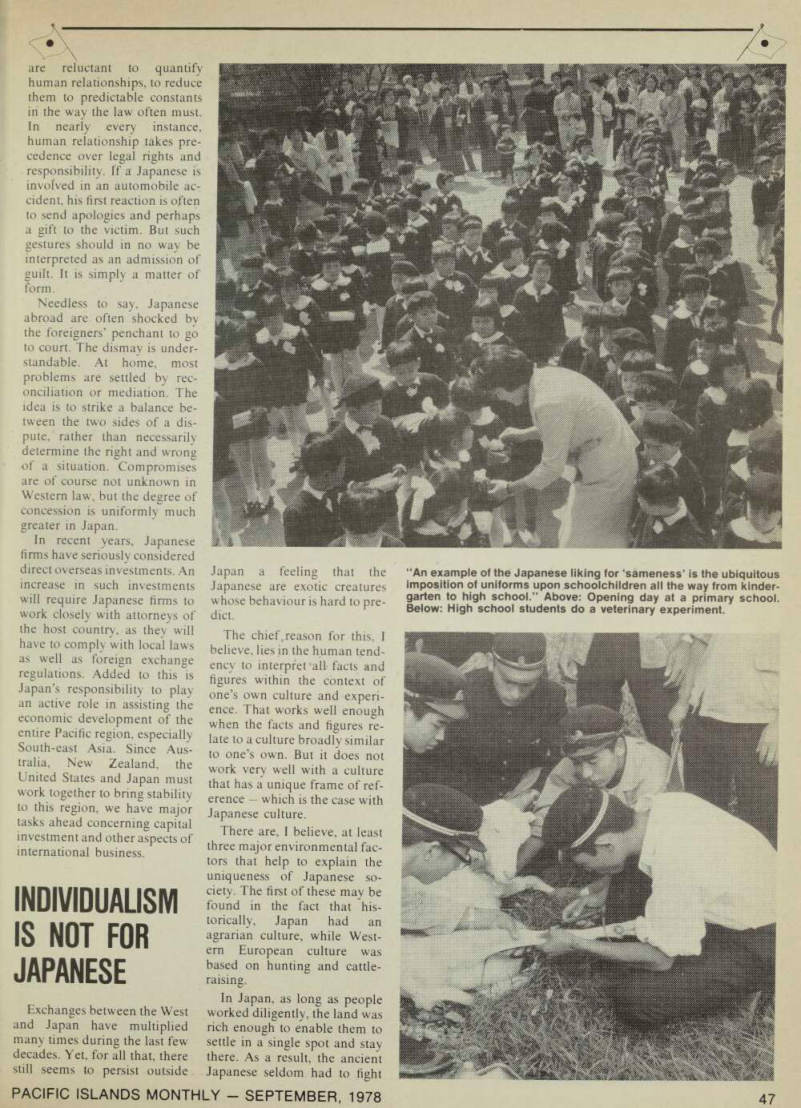
“An example of the Japanese liking for ‘sameness’ is the übiquitous imposition of uniforms upon schoolchildren all the way from kinder garten to high school.’’ Above: Opening day at a primary school.
Below: High school students do a veterinary experiment.
other tribes to get food and did
not develop the aggressiveness
required of hunting tribes.
Instead, they conceived their
surroundings to be basically
benign.
The most serious threats to the existence of the ancient Japanese were natural disasters such as typhoons, floods and earthquakes. Since there was no way of predicting the occur rence of such disasters and no means of effectively controll ing them, the Japanese people
accepted them with resig
nation. Over the years, they de veloped the resilience to cope
quickly with changing environ
ment.
By contrast, the productivity of land in most of Europe is only a fraction of what it is in Japan. Therefore, the ancient Europeans had to roam from
place to place to acquire suf
ficient food. And although they turned from hunting to cattle
raising quite early in history,
they often had to fight other tribes to secure pastureland or food. In the process,
Europeans developed a re
alistic approach toward estimating other people’s strength. Moreover, as nature was more stable in Europe than in Japan, people there were able to map out plans to conquer it. Hence, Europeans came to place great emphasis on being prepared and on taking initiatives, but it did not develop the adaptability the
Japanese acquired.
Japan is also unique among major nations in that it has only one ethnic group, one language and one culture. A con sequence of the ethnic hom ogeneity is a lack of indi vidualism among the Japanese.
Because people did not have
opportunities to mingle with
other groups, they did not de velop tolerance for individual differences in thought or be haviour. An example of the Japanese liking for “sameness” is the übiquitous imposition of uniforms upon schoolchildren all the way from kindergarten to high school.
On the other hand, because they have been trained from early childhood to subordinate their personal likes and dislikes
to those of the entire group, the Japanese have developed an unrivalled ability to work in groups . . .
Although Japan’s overall
population density (280 per
sons per sq km) is less than that of Belgium or the Netherlands only 16% of Japan’s total land area is arable, and only 3-4% is habitable, with the result that its people have always been heavily concentrated in narrow coastal strips. Today, approx imately 70% of the nation’s population lives in cities in the Pacific coastal zone which comprises only 3% of the total land area.
One impact of this popu lation pressure is a lack of economic opportunities. This, in turn, results in an emphasis on harmony a basic agree ment that “I won’t take your
opportunities, so please don’t
take mine”. Most Japanese or ganisations are structured in such a way that it is difficult to
pin responsibility on a specific
individual. Rather, decisions are made by a group of per sons, each suggesting minor changes here and there. By the time a proposal assumes its final shape, there is a general consensus regarding the objec tives and manner of execution of the project.
Ethnic homogeneity and lack of personal economic opportunities have also shaped Japanese attitudes towards
competition and struggle. Be
cause Europeans have had a long history of wars among eth nic groups and nation-states, they have come to accept them as a fact of life. On the other hand, the Japanese avoid open
competition and struggle as
much as possible. In an island country, all struggles tend to end in savage in-fighting. To avoid this, the Japanese have devised means of ritualising open confrontation so that at the end it is not clear which side
has won. Even in legal cases, the Japanese emphasise con ciliation and arbitration, whereas the Western concept of law requires adjudication as to which party was at fault.