Tokyo-Honiara Ties
pp. 41-42 · Read in the full issue
Grow In Diversity
Last year the joint fishing ven ture between the big Japanese Taiyo group and the govern ment earned Solomon Islands 7% of its recurrent revenue and contributed possibly as much as 10% to the country’s cash gross domestic product. In the same year Japan took around one quarter (SSI 7.4 million) of all Solomon Islands exports.
Japan is Solomon Islands’ most important export market by a long way and its fourth lar gest supplier of foreign goods, accounting for one-eighth of the country’s imports last year.
While Japan has been a vital export customer for many years, its role as a major inves tor is much more recent. As an important aid donor, its role is about to begin. With about $6 million tied up in the joint skipjack tuna fishing, and can ning company, Solomons Taiyo Limited, plus another $2 million that Mitsui Mining has sunk into the exploration and processing trials of Solomon Islands bauxite, Japan now ranks behind Britain as the sec
ond most important foreign
investor and is matched only by the United States which has invested about $8 million so far in a wet paddy rice project on the North Guadalcanal Plains.
Australia, although a major trading partner, has neither invested substantial capital nor disbursed much aid so far.
With the recent Japanese aid promise of $2 million this year, rising to $5 million over the next three years, Japan is likely
to become the country’s second most important source of bilat eral aid funds after Britain.
Japan’s interests in this scat
tered archipelago, densely for
ested and surrounded by 1.25 million square kilometres of ocean teeming with life, are only too obvious. Japan is a major importer of a wide range of raw materials and food stuffs, among them timber and fish, both of which are plentiful in Solomon Islands. With ex ploitation of these natural re sources only in its early stages or — as in the case of bauxite — not yet begun, the Japanese have the unique chance of coming in on the ‘ground floor’, able to influence
developments according to
their needs.
The backbone of Japan- Solomon Islands trade is tim ber. Well over 80% of Solomon Islands’ annual loggings of be tween 230 000 and 260 000 cubic metres go to Japanese sawmills. Unlike Europe, which seeks the higher quality Indonesian and Malaysian tim bers, Japan is, at least so far, prepared to take the rather lower quality Solomon Islands’ timber.
Unfortunately for Solomon Islands the nicely shaped, eas
ily workable dipterocarp,
which abounds in South-east Asia forests, it totally absent from Solomon Islands’ forests.
But serious marketing prob lems may be looming. South east Asia timber producers, for example, Sarawak, have begun to log their lower-grade tim
bers and have started to under cut Solomon prices.
Provided this competitive threat can be countered, Japan should remain an important market for Solomon Islands’ timber for a good many years to come. The development plan’s goal of an annual log ging rate of 400 000 cubic metres is expected to be exceeded in the early 1980 s by about 10%-15%, provided the country’s largest timber company, Unilever subsidiary Levers Pacific Timbers, man
ages to complete successfully
its present leasehold nego tiations with customary land owners for two new, large logging areas on New Georgia.
At an annual logging rate of 400 000 cubic metres the country’s present natural tim ber reserves are estimated to last at least until the beginning of the next century. After that, logging on reafforested areas should take over.
So far Japan has not invested in any substantial way in the forestry sector. Kalena Tim bers, the second biggest logger with a volume of 45 000 cubic metres last year, all of which was shipped to Japan, was owned by a Japanese trading house until it went bankrupt.
Now the only Japanese in volvement consists of two trial plots one on Kolombangara and one on Guadalcanal near Honiara—for the experimental cultivation of eucalyptus and pine for pulp. The Japanese say the trials are inconclusive and, with the Japanese pulp indus-
try in disarray and sitting on
huge overcapacities, a
Japanese pulp mill in Solomon Islands is not likely to be con sidered seriously for some time. In the longer term, how ever, demand for pulp is likely to focus attention on tropical countries and Solomon Islands may benefit.
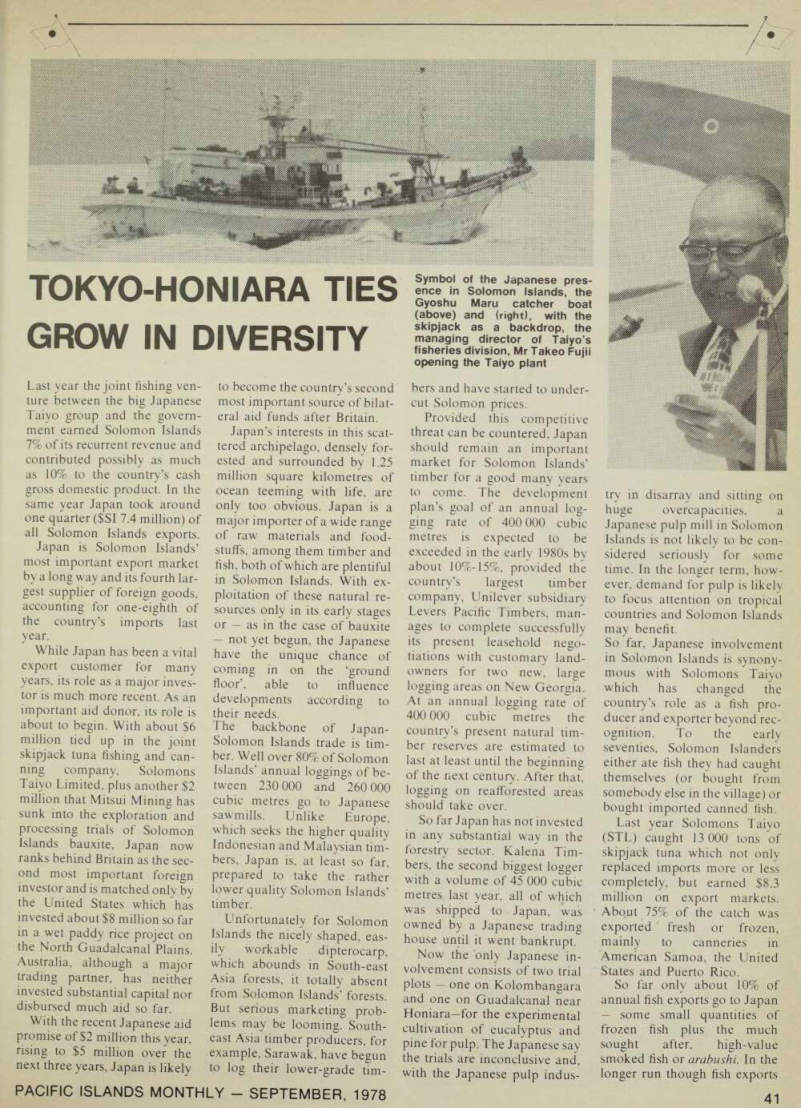
So far, Japanese involvement in Solomon Islands is synony mous with Solomons Taiyo which has changed the country’s role as a fish pro ducer and exporter beyond rec
ognition. To the early
seventies, Solomon Islanders either ate fish they had caught themselves (or bought from somebody else in the village) or
bought imported canned fish.
Last year Solomons Taiyo (STL) caught 13 000 tons of skipjack tuna which not only replaced imports more or less completely, but earned $8.3 million on export markets.
About 75% of the catch was exported fresh or frozen, mainly to canneries in American Samoa, the United States and Puerto Rico.
So far only about 10% of annual fish exports go to Japan some small quantities of frozen fish plus the much
sought after, high-value
smoked fish or arabushi. In the longer run though fish exports
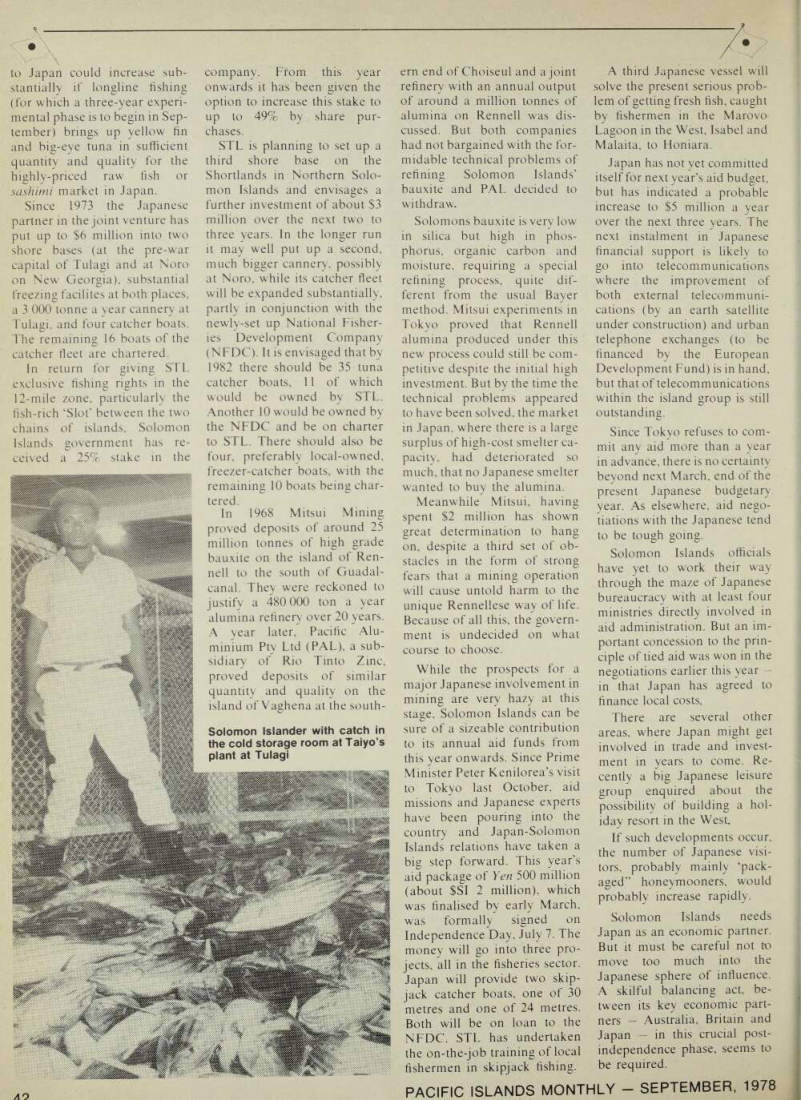
Symbol of the Japanese pres ence in Solomon Islands, the Gyoshu Maru catcher boat (above) and (right), with the skipjack as a backdrop, the managing director of Taiyo’s fisheries division, Mr Takeo Fujii opening the Taiyo plant
to Japan could increase sub
stantially if longline fishing
(for which a three-year experi mental phase is to begin in Sep tember) brings up yellow fin and big-eye tuna in sufficient quantity and quality for the highly-priced raw fish or sashimi market in Japan.
Since 1973 the Japanese partner in the joint venture has put up to $6 million into two shore bases (at the pre-war capital of Tulagi and at Noro on New Georgia), substantial freezing facilites at both places, a 3 000 tonne a year cannery at Tulagi. and four catcher boats.
The remaining 16 boats of the catcher fleet are chartered.
In return for giving STL exclusive fishing rights in the 12-mile zone, particularly the fish-rich ‘Slot’ between the two chains of islands, Solomon Islands government has re ceived a 25% stake in the
company. From this year onwards it has been given the option to increase this stake to up to 49% by share pur chases.
STL is planning to set up a third shore base on the Shortlands in Northern Solo mon Islands and envisages a further investment of about $3 million over the next two to three years. In the longer run it may well put up a second,
much bigger cannery, possibly
at Noro, while its catcher fleet
will be expanded substantially,
partly in conjunction with the newly-set up National Fisher
ies Development Company
(NFDC). It is envisaged that by 1982 there should be 35 tuna catcher boats, 11 of which would be owned by STL.
Another 10 would be owned by the NFDC and be on charter to STL. There should also be four, preferably local-owned, freezer-catcher boats, with the remaining 10 boats being char tered.
In 1968 Mitsui Mining proved deposits of around 25 million tonnes of high grade bauxite on the island of Ren nell to the south of Guadal canal. They were reckoned to justify a 480 000 ton a year alumina refinery over 20 years.
A year later. Pacific Alu minium Pty Ltd (PAL), a sub sidiary of Rio Tinto Zinc, proved deposits of similar quantity and quality on the island of Vaghena at the south-
ern end of Choiseul and a joint refinery with an annual output of around a million tonnes of alumina on Rennell was dis cussed. But both companies had not bargained with the for midable technical problems of refining Solomon Islands’ bauxite and PAL decided to withdraw.
Solomons bauxite is very low in silica but high in phos phorus, organic carbon and
moisture, requiring a special
refining process, quite dif ferent from the usual Bayer method. Mitsui experiments in
Tokyo proved that Rennell
alumina produced under this new process could still be com
petitive despite the initial high
investment. But by the time the technical problems appeared to have been solved, the market in Japan, where there is a large surplus of high-cost smelter ca pacity, had deteriorated so much, that no Japanese smelter wanted to buy the alumina.
Meanwhile Mitsui, having spent $2 million has shown great determination to hang on. despite a third set of ob stacles in the form of strong fears that a mining operation will cause untold harm to the unique Rennellese way of life.
Because of all this, the govern ment is undecided on what course to choose.
While the prospects for a major Japanese involvement in mining are very hazy at this stage, Solomon Islands can be sure of a sizeable contribution to its annual aid funds from this year onwards. Since Prime Minister Peter Kenilorea’s visit to Tokyo last October, aid missions and Japanese experts have been pouring into the country and Japan-Solomon Islands relations have taken a big step forward. This year’s aid package of Yen 500 million (about SSI 2 million), which was finalised by early March,
was formally signed on
Independence Day, July 7. The money will go into three pro jects, all in the fisheries sector.
Japan will provide two skip jack catcher boats, one of 30 metres and one of 24 metres.
Both will be on loan to the NFDC. STL has undertaken the on-the-job training of local fishermen in skipjack fishing.
A third Japanese vessel will solve the present serious prob lem of getting fresh fish, caught by fishermen in the Marovo Lagoon in the West, Isabel and Malaita, to Honiara.
Japan has not yet committed itself for next year’s aid budget, but has indicated a probable increase to $5 million a year over the next three years. The next instalment in Japanese financial support is likely to go into telecommunications where the improvement of both external telecommuni cations (by an earth satellite under construction) and urban
telephone exchanges (to be
financed by the European Development Fund) is in hand, but that of telecommunications within the island group is still
outstanding.
Since Tokyo refuses to com mit any aid more than a year in advance, there is no certainty beyond next March, end of the
present Japanese budgetary
year. As elsewhere, aid nego tiations with the Japanese tend
to be tough going.
Solomon Islands officials have yet to work their way through the maze of Japanese bureaucracy with at least four ministries directly involved in aid administration. But an im portant concession to the prin ciple of tied aid was won in the negotiations earlier this year in that Japan has agreed to finance local costs.
There are several other areas, where Japan might get involved in trade and invest ment in years to come. Re cently a big Japanese leisure group enquired about the possibility of building a hol iday resort in the West.
If such developments occur, the number of Japanese visi
tors, probably mainly ‘pack
aged” honeymooners, would probably increase rapidly.
Solomon Islands needs Japan as an economic partner.
But it must be careful not to move too much into the Japanese sphere of influence.
A skilful balancing act, be tween its key economic part ners - Australia, Britain and Japan - in this crucial post independence phase, seems to
be required.
Solomon Islander with catch in the cold storage room at Taiyo’s plant at Tulagi