Png Cautious To
pp. 37-39 · Read in the full issue
Keep A Share
Of The Cake
It’s a sure bet when you start talking about Japanese com mercial involvement in Papua New Guinea today that some one will trot out the old line of ‘‘losing the war and winning the peace”* But the rise of Japanese commerce, invest ment and technical expertise in the South Pacific, and par ticularly in PNG, is a story in its own right which didn’t really begin until 12 years ago, writes Gus Smales in Port
Moresby.
World War Two has become a fast-receding piece of history in relations with Japan and the
now politicaliy-independent
PNG, although its echoes cre ate some ironic twists on
today’s scene. Japan's biggest
export drive, for instance, could still be called the huge volume of aircraft, ships,
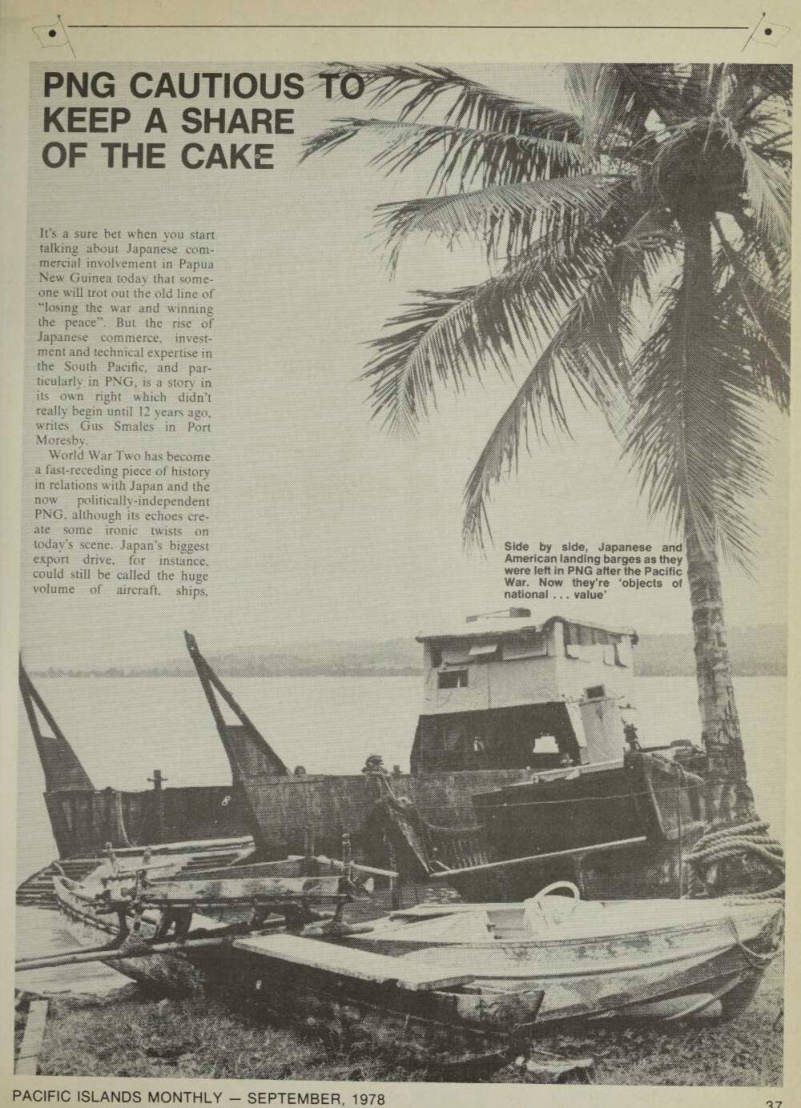
Side by side, Japanese and American landing barges as they were left In PNG after the Pacific War. Now they’re ‘objects of national ... value’
equipment and supplies poured into PNG during war
time occupation.
The aircraft lying around after the war were first valu able salvage, then rubbish on the face of the land, and now,
suddenly perhaps keeping
up with the new image of
Japan they are being legally
defined as “objects of national, cultural and/or historic value”.
An old Japanese Zero at the bottom of the garden can mean money in the pocket from tour ists, so the government has moved legally to protect what wrecks remain and to define the rights of villagers now con sidered to own them. If the new
breed of visiting Japanese
businessman has the time which is rarely he likes to take a good look at these relics and to go into their history.
This in itself is a sign of changed times because until re
cently Japanese visiting PNG
on business carefully shied away from any subjects con nected with the Pacific War.
It was not until about 12 years ago that the echoes of the Pacific War ceased to be im portant in the PNG national scheme of things, and today’s Japanese involvement dates from about then. Electronic goods, electric goods and motor vehicles were the first sign of the change in a move which at first was merely a
swing to Japanese exports by
already-established retailers.
The revolution on the roads was incredibly fast, with Aus tralian and British vehicles giv ing way to Japanese in a move which has now made Japan the main vehicle supplier to
Png.
A few Australian operators who could see the trends entered into business arrange ments with Japanese interests
but initially retailing of
Japanese manufactures
remained the main enterprise.
One vehicle distributor flew to London, argued with manufac turers there, and then dropped his entire UK franchise lines in favour of Japanese vehicles.
By the time the eve of self government had come in 1972, the emerging PNG Govern ment had already taken steps
which allowed the consoli dation of Japanese investment and involvement as well as the handling of Japanese exports.
Japan became one of the first countries to establish an
embassy in the newly
independent PNG, followed by an increasing program of in volvement in the economy.
Banking officials describe the flow of Japanese money into PNG projects as “restrained but quite significant, and likely to increase”.
There are now 23 Japanese
based companies actively
operating on a significant scale in PNG, although many are not
highly capitalised as they rep
resent export-import dealing
rather than development and production. But the rise of
Japanese-based development
and production interests in PNG is just round the corner, and is expected to produce a flow of new capital over the next two years.
Mitsubishi, Mitsui and Nissho-Iwai have come onto the PNG scene through their Australian subsidiaries, deal ing in building and construc tion materials, steel,
machinery, chemicals, equip
ment and some smaller retail ing operations. But the real Japanese presence in PNG today is in the timber and fish ing industries, where PNG itself is anxious to get a share of the expertise and the control.
PNG is anxious to establish its own fisheries industry, but
in the meantime it is licensing Japanese operators in a deal which this year alone is worth more than SAS million.
New Guinea Sohbu is one of the most widely-spread Japanese-based companies at present operating in PNG.
Through its own books it exports tuna and prawns, but the company’s strength lies in the subidiaries it holds. These include the famous old PNG firm of Commonwealth New Guinea Timbers, a pioneer manufacturer of plywood and also a cattle station owner. The
company’s history goes back
many years before Japanese interests achieved control.
Japanese technicians are now widely used in the ply wood works, but an intensive training program is bringing in
increasing numbers of Papua
New Guineans. Sohbu also has its fisheries in Gulf Sohbu and Pacific Sea Foods, the two
operating companies in sea
food production. Open Bay
Timber Company, a logging
and milling operation, is also part of the Sohbu string.
One of the major Japanese establishments is Jant Pty Ltd, the company with brought
large-scale woodchip oper
ations to PNG. Its chip mill is at Madang, and the chipping is
being conducted in conjunc
tion with a large reafforesta tion programme.
In keeping with the general practice of the motor industry, the Japanese vehicle giants are
not involved in retailing but there have been two tentative
appraisals for possible vehicle
assembly projects which would
require wider capitalisation.
Japan is now one of Papua
New Guinea’s major trading
partners, and its involvement in the PNG economy, as well as being a buyer and a seller, seems certain to increase although only on terms dicta ted by PNG. A number of fac tors have permitted this sudden rise to prominence in only a few years, some obviously con nected with Japan’s industrial and export expansion of the past 15 years. But the PNG situation was also affected by simultaneous changes which turned an Australian territory into an independent country.
This meant PNG widened its own horizons, looking for new buyer and seller markets. It was prepared to take in other brands rf investment and expertise which could help its
economic development.
Australia has never been a fishing nation, and island PNG. with waters teeming with fish, naturally began to talk business with one of the world’s most advanced fishery
technologies.
Japan has become an aid donor to PNG since indepen dence, and Papua New Guineans have been trained as technicians.
But for all this, and despite increasing investment, there are signs that both countries have a long way to go before any deep rapport is achieved.
Japan has been criticised by PNG politicians for tying its aid to specific projects or tar gets. Coastal Papua New Guineans are frequently angry
at Japanese fishing operations,
tacitly criticising the licences
issued by their own govern ment.
And one recent criticism is that the Japanese spend too much time sticking to the letter of agreements rather than to the spirit of them. Much of the criticism may be ill-founded but it is indicative of the prob lems PNG is facing as it tries to strike a balance between developing its resources on the one hand and keeping a share of them on the other.
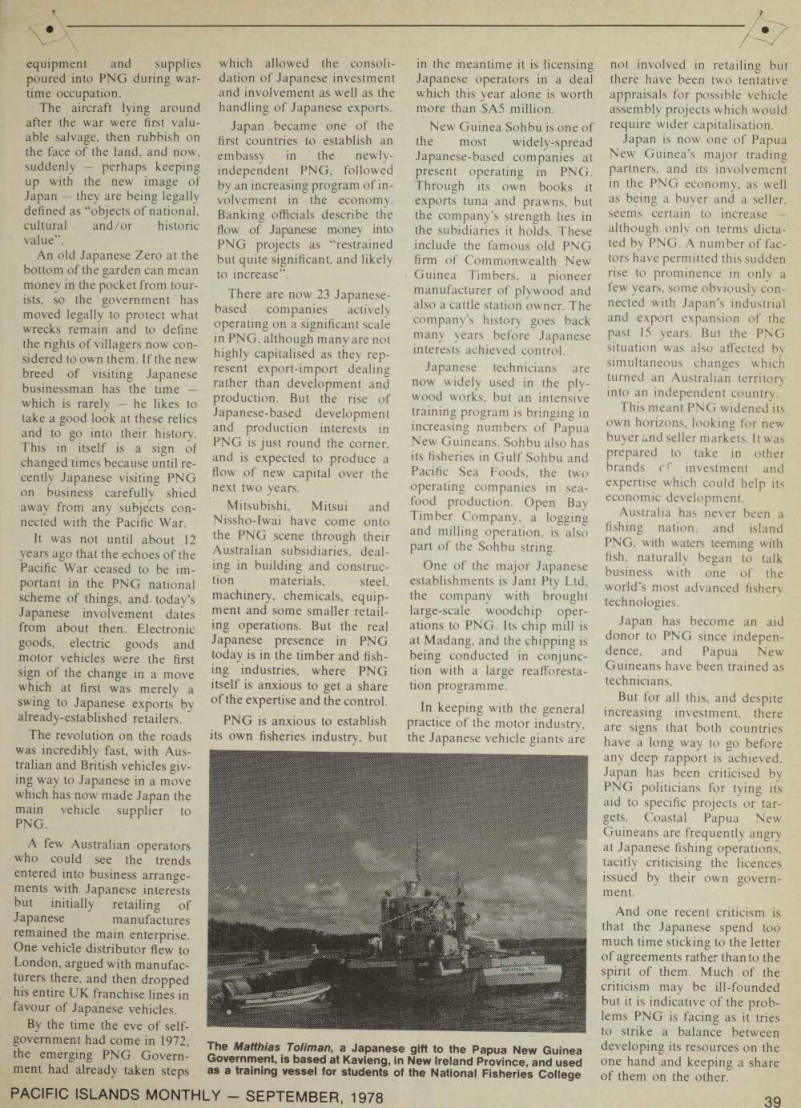
The Matthias Toliman, a Japanese gift to the Papua New Guinea Government, is based at Kavieng, in New Ireland Province, and used as a training vessel for students of the National Fisheries College