Pacific Century
pp. 43-45 · Read in the full issue
On The Way Up
Mr Jiro Tokuyama, managing director of the Nomura Research Institute, Tokyo, was in Australia in May on a lecture tour sponsored by the Australian Administrative Staff College. His comments below outline his view of the Pacific Basin as the world economic centre of the future. They also offer many insights into the civilisation which has shaped the Japanese view of the world.
These are of importance to all Pacific Island and other people who have dealings with Japan.
Mr Tokuyama’s remarks are based on an exclusive interview with PIM staff writer Malcolm Salmon and his various public lectures in Australia.
Let me explain the idea of the “Pacific Basin economy”, which embraces Australia, New Zealand and the Pacific coast of the United States, Japan and Pacific Asia.
My basic perception is that in 10 to 15 years this region will become the world’s most viable economic centre, where Australia. Japan and the United States will play a pivotal role.
And I am among those who are probing the conditions and ways to materialise this idea as a major task of Australia, Japan and the United States from now on into the twentyfirst century.
What considerations, then, prompt me to envision a century of the Pacific Basin economy, including the western half of the American continent, which will be the centre of world economy and industry?
The first is the history of civilisation as viewed by Arnold Toynbee. According to his view of history, a civilisation rises and falls in a cycle of about 800 years, with the Occidental and Oriental civilisations taking turns. As a matter of fact, the Greeks and Roman civilisation from the fourth century BC to the fifth century AD was followed by the Far Eastern civilisation that blossomed in the fifth to thirteenth centuries,
The succeeding European civi-
lisation in the thirteenth to twentieth centuries is in turn to be followed by the Asian civilisation in the twenty-first to
twenty-eighth centuries.
Indeed, this cycle is long enough to make our heads spin. But what is significant is that this theory points out the take-over of European civilisation by Pacific civilisation during the twentieth and
twenty-first centuries. If this point proves to be true, we may well expect Pacific civilisation. or non-European civilisation, to begin to prosper in the coming years. In fact, the for mer US Secretary of State, Henry Kissinger, speaks about the “beeline of the West” in the manner of Oswald
Spengler.
The second reason to foresee the century of the Pacific Basin economy lies in the historical consequences of changes in the world’s economic prime movers after the Industrial Revolution, Norman Macrae, associate editor of The Economist, made this point symbolically when he said that the British century of 1775 to 1895 based on the steam engine technology and the Bessemer steelmaking pro cess was replaced by the American century supported
by advanced technology on
automobiles, aircraft and com puters, and that the coming 100 years would the the Pacific cen tury on the basis of electronic communications, Such a view of history may be difficult to believe or sup port, depending on where one stands. Yet, if we see the pre sent as a stage towards the emerging globalism, the con cept of the Pacific century will become clearer, Since World War II colonial states have won independence one after another in many parts of the world. Today, some 150 different national flags flutter in front of the United Nations building in New York. How ever, since these states are too small to solve the problems of an international scale individually, there has been a
growing inter-dependence in a
trend towards regionalism.
This is an intermediate stage between individual states and globalism, and. at that, an
“open regionalism” and not
the blocs of prewar style.
We already have the Atlantic
community in our vocabulary.
and to link with it in the future there may well be the Pacific community and the Indian Ocean community. Such communities of course are difficult to realise, but they are worth attempting to visualise.
In terms of regionalism, the Pacific Basin economy excels others. For example. Africa will continue to hold considerable political and economic uncertainties for some time. and so will the Middle East, The problems of famine and destitution that confront India,
Bangladesh and Pakistan today
will not allow them to take off m the next 10 to 15 years. Latin
America, plagued by recurring
revolutions and persistent in flation, does not seem to rely on economic viability.
Europe is also in stagnation as exemplified by Britain. Italy and the Scandinavian nations, Due to great emphasis on wel fare, Europe, while in the grip of serious political difficulties
typified by Eurocommunism.
has lost its social and economic dynamism. The North Sea oil seems to have helped rejuven ate Britain temporarily, and the defeat of the Socialist- Communist grouping in the re cent National Assembly election in France is welcome, Europe as a whole, however, has reached a certain maturity at the cost of its former dyna mism.
All in all. only the Pacific re gion may be able to ensure major developments in the next 10 to 15 years. As I said be
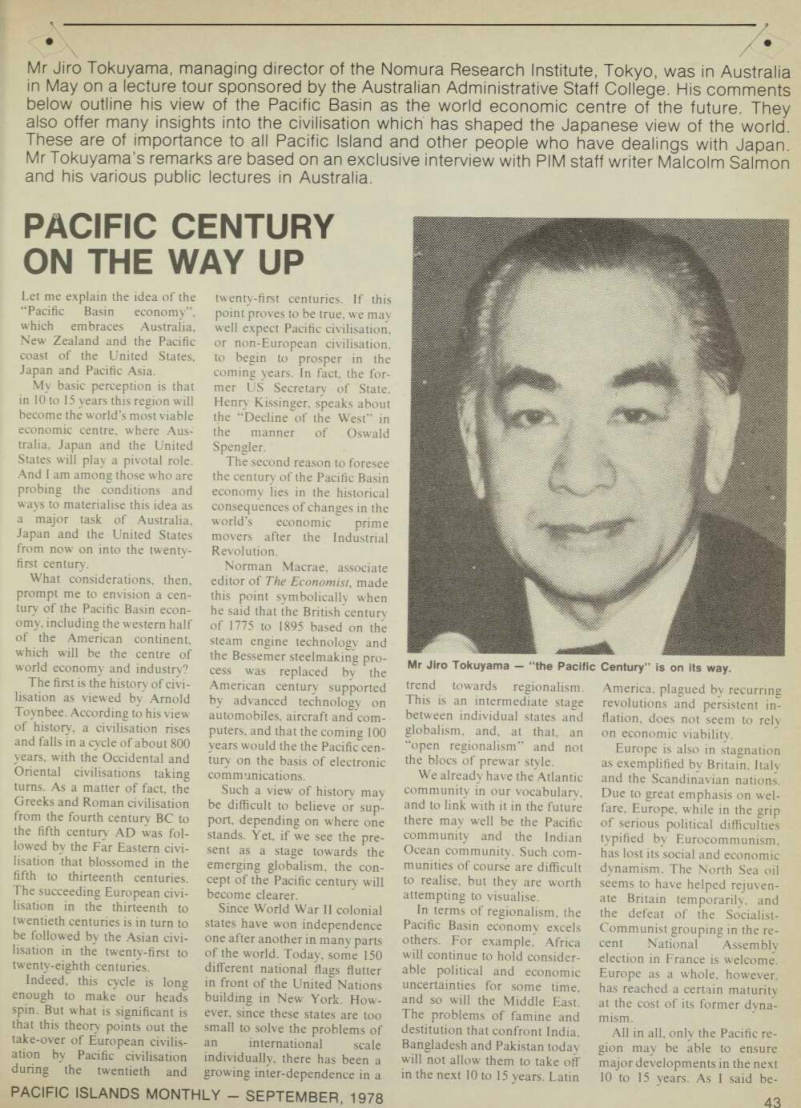
Mr Jiro Tokuyama - “the Pacific Century” is on its way.
fore, this region should include the western part of the United States because, in postwar years, there has been an unmis takable westward movement of American major industries.
As a matter of fact, 72% of American industrial pro duction came from the tra ditional industrial areas in the northeast of the country in the late 19405. In the 19705, the percentage declined to 46-47%, giving way to what is called the “sun belt” in the south, south west and west of the country.
Leading aircraft manufac turers have set up their head quarters on the Pacific coast, Boeing in Seattle and Lockheed in Burbank near Los Angeles. California is also the site for many computer and electronics manufacturers.
Texas is a huge production base for oil and natural gas, encompassing Houston, the centre of the space industry.
This westward movement of American industrial pro duction bases is significant when we look over the future
of the Pacific Basin econ omy ...
I understand that the establishment of a joint assist ance committee by the govern ments of Australia and Japan has been proposed to facilitate a joint approach to the development of, and assistance to, Asia and Oceania.