Political
pp. 19-23 · Read in the full issue


Currents
Noiseless
N-Tests
France resumed its contro versial nuclear testing at Mururoa Atoll, French Polynesia, in July, but readers of the printed media in Aus tralia would hardly have known. Although the news was featured in some radio reports, the country’s major news papers showed remarkable reticence on the tests, which in the past have caused big head lines and thrown heavy strain on relations between the French and Australian Governments.
A possible clue to this strange reserve on the part of the press lies in the fact that in the same month a visit was made to Australia by the French Delegate-General for Energy, Mr Paul Mentre. His mission was to discuss with Australian authorities the French interest in buying Aus tralian uranium and additional steaming coal, and in supplying mining equipment for Aus tralia’s Northwest Shelf oil and natural gas exploration pro jects.
Mr Doug Anthony, Aus
tralia’s Deputy Prime Minister and Minister for Trade and Re sources, in a statement on Mr Mentre’s visit, said that despite its energy conservation pro gramme France would still be importing 60% of its energy needs by 1985. In the same year France would be producing half of its electricity in nuclear power stations.
Mr Anthony went even closer to the bone when he added: “It is clear that France’s commitment to nuclear power is such that Electricite de France the French electricity authority will be a major and perhaps the single most im portant user of uranium in the world. The indications are that France is looking to buy be-
tween 10% and 15% of her uranium needs from Australia involving something like 1000 tonnes a year in the second half of the 1980 s.” (Canadian and African suppliers are France’s other main sources.) That Mr Anthony’s com plaisant approach to this pros pect is not shared by all Australians was clearly shown by a brief letter from a reader
appearing in a Sydney daily
newspaper. The letter said, in full; “If the federal govern ment is planning to sell uranium to the french, the first condition of sale should be an immediate stop to their nuclear testing in the Pacific regions.”
Solomons’
West Issue
The Moderator of the United Church in Papua New Guinea and Solomon Islands, Bishop Leslie Boseto, has spoken out on the political issues affecting the Western Solomons, writes Peter L. Young from Honiara.
Bishop Boseto is from the Western Solomons. His public standing is such that his name was widely canvassed earlier this year as a candidate for Governor-General of Solomon Islands.
Separatist sentiment in Western Solomons led to incidents during the new nation’s independence cele
brations in July. Two men were taken to hospital and 43 arrested at Gizo, the main town in Western Province, following a brawl in which people from the Western Solomons tried to prevent the raising of the new Solomon Islands flag.
In a long letter to the Solomons government news paper. News Drum, Bishop Boseto called for responsible action and sympathetic con sideration concerning the call for state government by the Western Province. In par ticular. he called for greater communication with the people of the province so that they may understand the issues involved. He urged “unity first, and negotiations second”.
He said that if the Honiara central government proved un
able to accommodate the con cerns of the Westerners then the province might be excused
for considering breaking away
from the Solomons nation. But, he added, “now is not the time”.
In an interview on Papua New Guinea’s National Broad casting Commission, Bishop Boseto also commented on the future relationship between PNG and Solomon Islands, saying; “One of the things I think the two governments should look more closely into is free access between Bougain ville and the Western Solomons because most of the people who are from the Shortlands. Fauro Island and Mono on the Solomon Islands side, and those inside Bougain ville, are related. They belong to the same tribe, some of them, and it will be very im portant for the two govern ments to recognise these ties.”
Speaking to overseas journalists after the indepen dence celebrations in July, Solomon Islands Prime Minis ter Peter Kenilorea gave the impression that Western Prov ince people should have little to fear on this score. Mr Kenilorea said his government had already held talks with the PNG Government about it, and that it was his govern ment’s policy to encourage free travel between groups with tra ditional ties on either side of
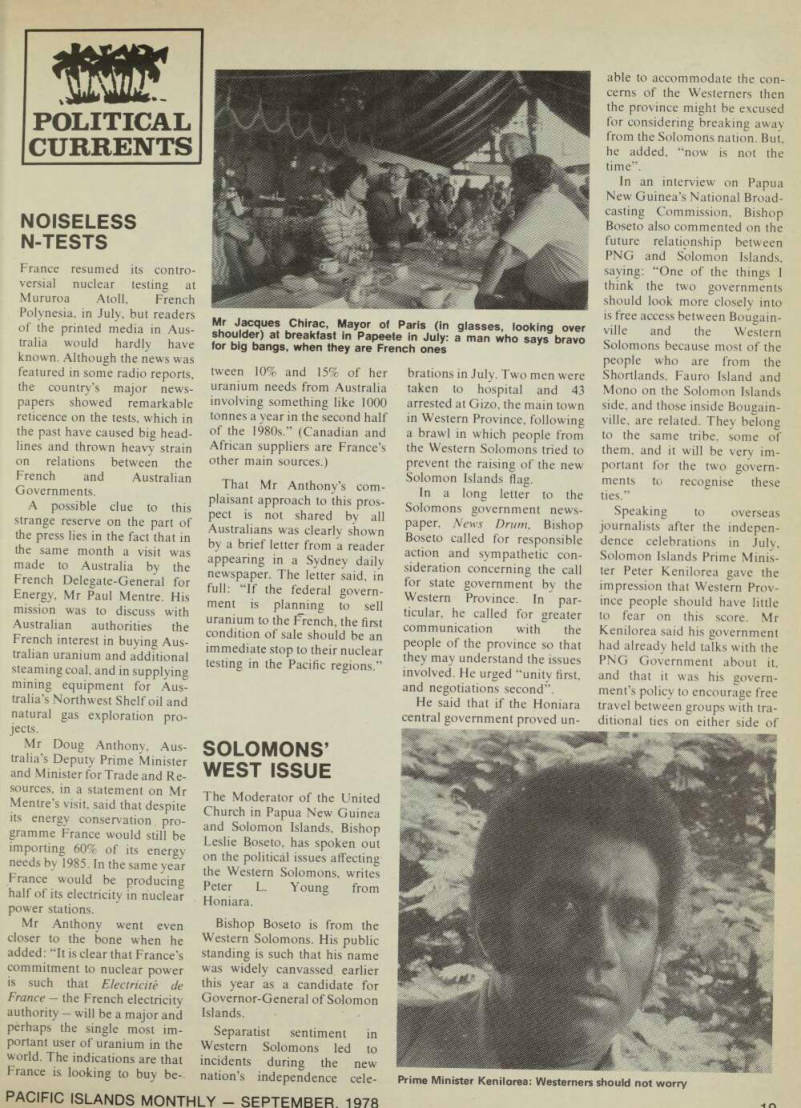
Mr Jacques Chirac, Mayor of Paris (in glasses, looking over shoulder) at breakfast in Papeete in July: a man who says bravo lor big bangs, when they are French ones
Prime Minister Kenilorea: Westerners should not worry
the border. This would be the principle on which his govern ment would operate.
Mr Kenilorea also said that health administrators from both sides had been in consul tation on the problem of cer
tain “illegal immigrants” into
PNG malaria-bearing mos quitoes from Western Solomons.
Mothballs
For Diors
The forecast in these columns (PIM July) that France’s new Secretary for Overseas Terri tories, Mr Paul Dijoud, would spring some surprises on New
Caledonians during his July
visit to the territory was amply borne out by events, writes Andre Chaville from Noumea.
Most people had expected the usual cocktail party, a trip to the Isle of Pines and the fare well dinner party at which the Minister would hand over the
badly needed cheque.
In fact, there never was a cocktail party with Rotary, the Lions or any of the other ex
pensive charitable organis
ations favoured by the local
aristocracy. Instead, Mr Dijoud
had a drink with Polynesian
immigrants who were building
their own social and cultural centre. He visited the technical school and sat down to a tray lunch in the cafeteria with students. He even walked
through the Department of
Labour, shook hands with un
employed workers queueing
for jobs, and talked to them about their problems.
Watching all this with
mounting dismay, the sup
porters of Rightwing leaders such as Lafleur put dinner jackets back in their ward robes, while their wives packed away their Dior dresses for a hoped-for “next time”.
Dijoud’s speech to the Terri torial Assembly was a master piece a 90-minute ad lib delivery of the sweetest pack age of home truths members had ever heard, with the Minis ter aided only by a few statistics jotted down on a piece of paper.
He announced that France would plough FF4,GOO million into the Caledonian economy during the next 18 months, pro vided the territory itself made some efforts at improving its own revenues. The money would be spent in such a way as to benefit the under privileged, first of all.
Wealthy businessmen, land holders and miners would not be forgotten, he said. Indeed, they would be expected to make the biggest contribution to territorial revenues. He sug gested that instead of transfer ring their money to discreet overseas investments which weakened the territory’s econ
omy, the wealthy minority
should contribute to the development of the island
itself, creating jobs, and
improving communications.
The motto should be; Courage,
Solidarity, Fraternity, he said.
Dijoud also spoke of the Melanesians, and the difficul ties he encountered in visiting some of the reserves. “These people feel deserted.” he said.
“They are abandoned, ignored,
or forgotten by the central ad ministration in Noumea.”
When rumours began to cir culate of the displeasure of cer tain political leaders at Mr Dijoud’s line of argument, he
responded by visiting the Loy
alty Islands in the company of two representatives of the Union Caledonienne, the party which is promoting Mel anesian emancipation and had
recently stated that indepen
dence was inevitable in the long term. Mr Dijoud point edly observed that when some people speak of independence
they might not necessarily
mean independence from France, but from certain cus toms and traditions. He ex pressed the view that most Melanesians did not want independence, but respect for their traditions and their cus toms, and true equality of rights and opportunities.
Mr Dijoud has not yet solved any problems. But he has declared a radical change in the
policy of the Metropolitan
government which will meet stubborn resistance from the
Rightwing parties, jealous of
their privileges, and the Left
wing parties, whose thunder he has largely stolen.
Insult was added to injury for the Rightwing when, two weeks after the Dijoud visit the specially invited guest of Mr Lafleur, Mr Jacques Chirac, Mayor of Paris, af firmed his unqualified support for Mr Dijoud’s ideas.
Norfolk’S
Clear Vote
Norfolk Island voters have so far been denied a referendum on their future form of govern ment, but the biennial council election in July was almost as good as one, writes Ed Howard.
The six councillors who led an 18-month fight against Aus-
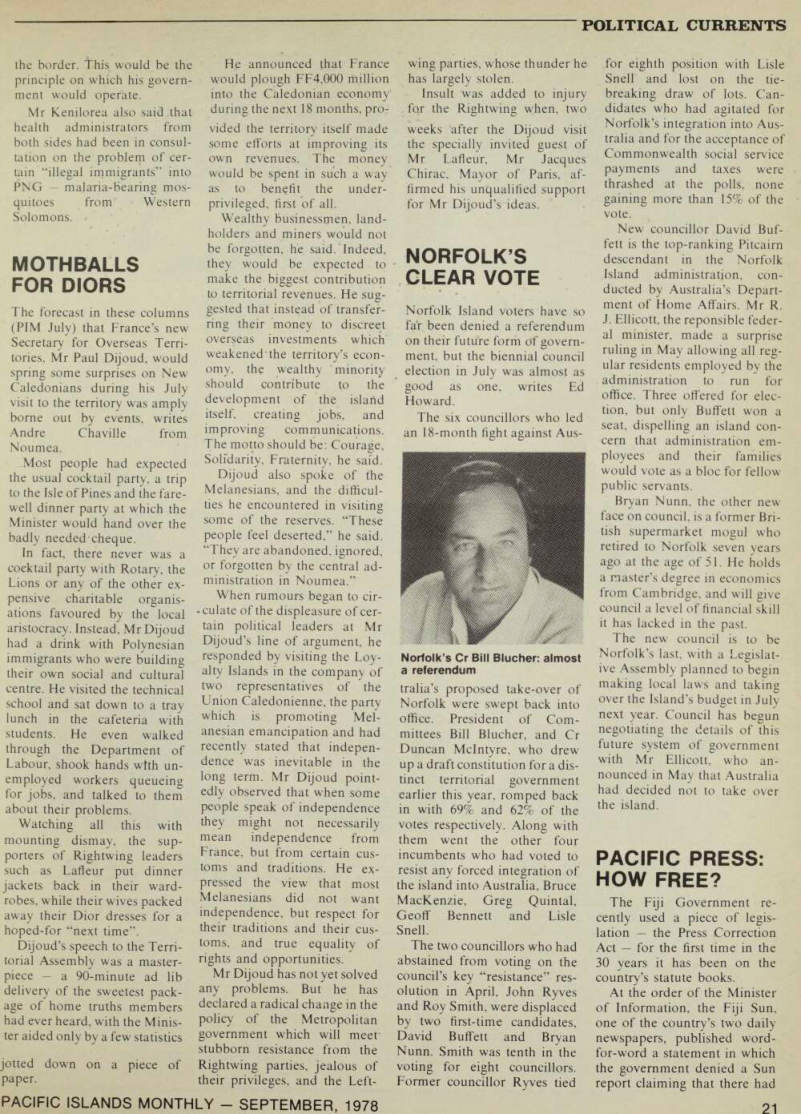
tralia’s proposed take-over of Norfolk were swept back into office. President of Com mittees Bill Blucher, and Cr Duncan Mclntyre, who drew up a draft constitution for a dis tinct territorial government earlier this year, romped back in with 69% and 62% of the
votes respectively. Along with
them went the other four incumbents who had voted to resist any forced integration of the island into Australia, Bruce Mackenzie, Greg Quintal, Geoff Bennett and Lisle Snell.
The two councillors who had abstained from voting on the council’s key “resistance” res olution in April, John Ryves and Roy Smith, were displaced by two first-time candidates, David Buffett and Bryan Nunn. Smith was tenth in the
voting for eight councillors.
Former councillor Ryves tied
for eighth position with Lisle Snell and lost on the tie breaking draw of lots. Can didates who had agitated for Norfolk’s integration into Aus tralia and for the acceptance of Commonwealth social service payments and taxes were thrashed at the polls, none gaining more than 15% of the vote.
New councillor David Buf fett is the top-ranking Pitcairn descendant in the Norfolk Island administration, con ducted by Australia’s Depart ment of Home Affairs. Mr R.
J. Ellicott, the reponsible feder al minister, made a surprise
ruling in May allowing all reg
ular residents employed by the administration to run for office. Three offered for elec tion, but only Buffett won a seat, dispelling an island con cern that administration em ployees and their families would vote as a bloc for fellow public servants.
Bryan Nunn, the other new face on council, is a former Bri tish supermarket mogul who retired to Norfolk seven years ago at the age of 51. He holds a master’s degree in economics from Cambridge, and will give council a level of financial skill it has lacked in the past.
The new council is to be Norfolk’s last, with a Legislat ive Assembly planned to begin making local laws and taking over the Island’s budget in July next year. Council has begun negotiating the details of this future system of government with Mr Ellicott, who an nounced in May that Australia had decided not to take over the island.
Pacific Press:
How Free?
The Fiji Government re
cently used a piece of legis
lation the Press Correction Act for the first time in the 30 years it has been on the country’s statute books.
At the order of the Minister of Information, the Fiji Sun, one of the country’s two daily newspapers, published word for-word a statement in which the government denied a Sun report claiming that there had
Norfolk’s Cr Bill Blucher: almost a referendum
been a meeting between government officials and rep resentatives of a company whose affairs were under
official investigation.
The newspaper had pub lished a previous government denial, as an ordinary news story, a few days earlier. The act compelled it to print another.
In an article in Pacific Islands Communication News letter, Robert Keith-Reid, chief reporter of the Fiji Times, who is now on a Pacific Islands News Association Fulbright Fellowship at the University of Hawaii, describes the incident as “a definite milestone in the
development of journalism in
Fiji”.
He writes: “It is far too early to see the government’s action as the writing on the wall for a free press.
“But it is evidence of grow ing government irritation with the Fiji press and is cause for the country’s journalists to start asking whether this irritation is justified and whether, in the long term, there is any threat to press freedom in the Pacific Islands in general and Fiji in
particular.”
Noting that the Fiji press is probably more free than in any other third-world country, and that journalists there need really consider little more than the confines of British libel law, he adds: “But as they be come more venturesome, they are finding out that, like small town journalism, small country journalism has its
pitfalls.”
He goes on: “In Fiji, a country which has been
independent for eight years,
local journalists are now
becoming used to being told by
indignant politicians and
government officials that it is their ‘duty’ to assist national
development.
“There is a distinct im pression that this means ‘don’t criticise’ or ‘only report what makes us look good’.
“There’s no doubt that many Island politicians are nervous, distrustful and unsure of them selves in dealing with reporters, and have not yet woken up to the realisation that they can use the press in furthering their
own affairs by working up a little coziness with its represen tatives.”
Exceptions to this negative approach to the press cited by Keith-Reid include Fiji’s Prime Minister Ratu Sir Kamisese Mara, Western Samoa’s PM Tupuola Efi, the young leaders of the Gilbert and Solomon Islands, and fig ures like Mahe Tupouniua, director of the South Pacific Bureau for Economic Co
operation.
Keith-Reid concludes: “Island governments seeking to curb or control the press would not have to resort to
naked censorship. Newspapers
could be easily brought to heel by the suggestion, for instance, that there might be difficulty in
importing newsprint; that
government advertisements might stop finding their way to a paper’s columns; that there might not be an immigration work permit coming for that
temporarily but badly needed
overseas journalist. These forms of retaliation have not been used in Fiji yet, but there have been suggestions that they could be ...
“In coming years, Pacific Island journalists, native and
expatriate, without being sub
servient, will have to develop a style of operation that sees all the news, good and bad, gets into print, yet making some al lowances for Pacific Island sen sibilities.
“They will have to learn how to get local leaders to accept criticism coolly and with the re alisation that a free press must often be cruel to be kind.”
Blunt Talk
From Japan
Pointed comments on the
Japan-New Zealand-Australia
relationship have been made
by the leading Japanese daily
newspaper, Asahi Shimbun.
The paper was editorialising on the repairing of Japan’s trade relations with New Zealand, and a recent broad statement made by the Japanese in con junction with Australia and New Zealand.
“Relations between Japan
and New Zealand have not matured as much as relations between Japan and Australia.” the paper said. “This is due in part to the fact that New Zealand, after it lost a stable market when Britain joined the European Economic Com
munity, has only let its living
standards gradually drop and
has not searched out a new way of life.
“Australia established both its position as a member of the Asia-Pacific region and a
mutually complementary re
lationship with Japan. But New Zealand does not have mineral resources like Australia. Also, Japan’s eating habits are basi cally different from those of Britain, and Japan cannot re place Britain as a market for foodstuffs,” it said.
“But despite such difficult
ies, Japan is sincerely searching
for a way to establish a long term situation of mutual dependence between the two countries. As in the case of the Asian countries, constant dia logue is necessary with Aus tralia and New Zealand.”
Australia’s new relationship with Japan was vividly con firmed by the special visit to Australia made in July/August by Japan’s Minister of State for External Economic Affairs. Mr Nobuhio Ushiba. His mission was to report to Australian Prime Minister Malcolm Fraser on the recently concluded summit meeting of the leaders of the United States, the major West European countries, Canada and Japan held in Bonn.
Following his talks with Mr Ushiba, Mr Fraser said; “It is
significant that of all the coun tries at the Bonn summit it is Japan that takes the trouble to come here to discuss it. Going back in the past one might have expected that the UK might have played this role. But it is a sign of 1978 that it was not the UK that saw fit to do this, but the government of
Japan.”
Spy Ring
At Ewc?
Honolulu’s East-West Center would hardly rank as a hotbed of student protest activity, but the month of June saw a student rally, a picket line and a small-scale student invasion of a meeting of the EWC Board of Governors. The issue was al
leged Kuomintang (Taiwan
Government) spying on cam pus, and student demands that the board take strong action to put an end to it. Existence of the KMT spy ring was first de nounced by Chen Yu-hsi, a Taiwanese student.
Following the rally and
picket line, which involved about 100 EWC students, rep resentatives converged on the governors’ meeting to present their protest. The meeting was
hastily adjourned, but by dint
of blocking most entrances to the meeting room demon strators obliged a number of the governers to hear their pro test.
It was eventually agreed that the board would set up an
“information-receiving mech
anism” to hear complaints and advise any victims of their legal
rights.
Honolulu’s East-West Center: “spy ring” charges