Indonesian
p. 18 · Read in the full issue
Overkill In
Irian Jaya
May to July saw another peak in Indonesian military activity to counter rebel operations in
the republic’s most easterly
province, Irian Jaya. PIM edi tor, Bob Hawkins, who has twice visited the province, once for the ‘Act of Free Choice ’ in 1969, and again in 1971, con siders the implications of recent events.
Money couldn’t buy the pub licity Indonesia’s heavyhan dedness has presented to Irian Jaya’s rebel movement in the past two months. Despite all protestations that dissidents in Indonesia’s most easterly pos session number only 2-300, sledgehammer tactics have left more than just the cynical won dering how big a thorn in Jakarta’s scheme of things are
Irian Jaya’s jungle freedom
fighters.
Bombing sorties by Indo nesian counter-insurgency, US-supplied OVIO Bronco air craft; the burning of villages on both sides of the Irian Jaya- Papua New Guinea border; Irianese refugees fleeing to the sanctuary of PNG’s West Sepik Province; and, belatedly, ex pression of Australian and US concern at Jakarta’s tactics, have brought the cause of the ‘de facto government of West- Papua New Guinea’ back to the headlines in a manner not matched since the ‘Act of Free Choice’ days of 1969.
The latest bout of hostilities in Irian Jaya was sparked in mid-May when rebels, in
advisedly many guerrilla tac
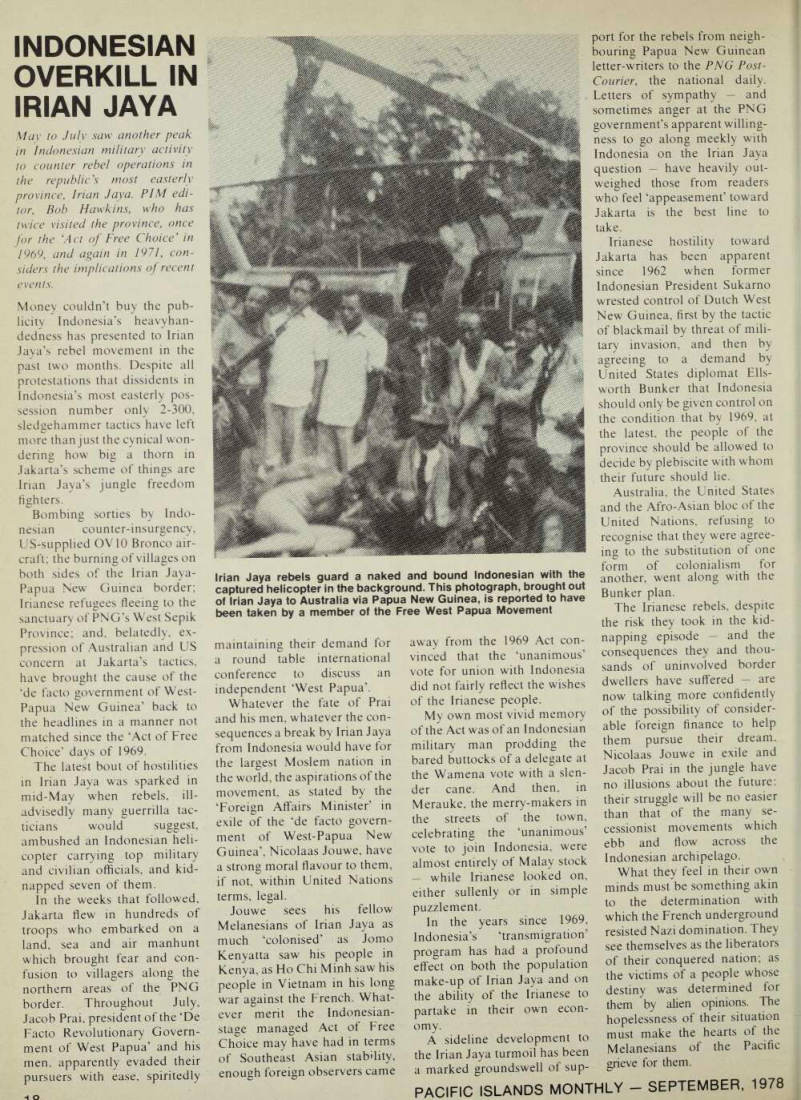
ticians would suggest, ambushed an Indonesian heli copter carrying top military and civilian officials, and kid napped seven of them.
In the weeks that followed, Jakarta flew in hundreds of troops who embarked on a land, sea and air manhunt which brought fear and con fusion to villagers along the northern areas of the PNG
border. Throughout July,
Jacob Prai, president of the ‘De Facto Revolutionary Govern ment of West Papua’ and his men, apparently evaded their pursuers with ease, spiritedly
maintaining their demand for a round table international conference to discuss an
independent ‘West Papua’.
Whatever the fate of Prai and his men, whatever the con sequences a break by Irian Jaya from Indonesia would have for the largest Moslem nation in the world, the aspirations of the movement, as stated by the ‘Foreign Affairs Minister’ in exile of the ‘de facto govern ment of West-Papua New Guinea’, Nicolaas Jouwe, have a strong moral flavour to them, if not, within United Nations
terms, legal.
Jouwe sees his fellow Melanesians of Irian Jaya as much ‘colonised’ as Jomo Kenyatta saw his people in Kenya, as Ho Chi Minh saw his people in Vietnam in his long war against the French. What ever merit the Indonesian stage managed Act of Free Choice may have had in terms of Southeast Asian stability, enough foreign observers came
away from the 1969 Act con vinced that the ‘unanimous’ vote for union with Indonesia did not fairly reflect the wishes of the Irianese people.
My own most vivid memory of the Act was of an Indonesian military man prodding the bared buttocks of a delegate at the Wamena vote with a slen der cane. And then, in Merauke, the merry-makers in the streets of the town, celebrating the ‘unanimous’ vote to join Indonesia, were almost entirely of Malay stock while Irianese looked on, either sullenly or in simple
puzzlement.
In the years since 1969,
Indonesia’s ‘transmigration’
program has had a profound effect on both the population make-up of Irian Jaya and on the ability of the Irianese to partake in their own econ omy.
A sideline development to the Irian Jaya turmoil has been a marked groundswell of sup
port for the rebels from neigh bouring Papua New Guinean letter-writers to the PNG Post- Courier , the national daily.
Letters of sympathy and sometimes anger at the PNG government’s apparent willing ness to go along meekly with Indonesia on the Irian Jaya
question have heavily out
weighed those from readers who feel ‘appeasement’ toward Jakarta is the best line to take.
Irianese hostility toward Jakarta has been apparent since 1962 when former Indonesian President Sukarno wrested control of Dutch West New Guinea, first by the tactic of blackmail by threat of mili tary invasion, and then by agreeing to a demand by United States diplomat Ells worth Bunker that Indonesia should only be given control on the condition that by 1969, at the latest, the people of the province should be allowed to decide by plebiscite with whom their future should lie.
Australia, the United States and the Afro-Asian bloc of the United Nations, refusing to recognise that they were agree ing to the substitution of one form of colonialism for another, went along with the
Bunker plan.
The Irianese rebels, despite the risk they took in the kid
napping episode and the
consequences they and thou sands of uninvolved border dwellers have suffered are now talking more confidently of the possibility of consider able foreign finance to help them pursue their dream.
Nicolaas Jouwe in exile and Jacob Prai in the jungle have no illusions about the future: their struggle will be no easier than that of the many se cessionist movements which ebb and flow across the
Indonesian archipelago.
What they feel in their own minds must be something akin to the determination with which the French underground resisted Nazi domination. They see themselves as the liberators of their conquered nation; as the victims of a people whose destiny was determined for them by alien opinions. The hopelessness of their situation must make the hearts of the Melanesians of the Pacific grieve for them.
Irian Jaya rebels guard a naked and bound Indonesian with the captured helicopter in the background. This photograph, brought out of Irian Jaya to Australia via Papua New Guinea, is reported to have been taken by a member of the Free West Papua Movement