history
pp. 25-28 · Read in the full issue
Tropicalities
A road rolls
over a family A Western Samoa family from the village of Faleatiu, after a court ruling that they be evicted from land required for a road, armed themselves with bushknives, sticks and stones, and demanded that the Public Works Department halt con struction of the road on land which the family claimed as their own.
The Central Investigative Branch of the police described the situation as “intense, viol ent and dangerous” and called in more police to help keep order. It was not long before six
people, including two women,
were arrested, and charged with having provoked a breach of the peace.
The court had ruled that the land legally belonged to the Western Samoa Trust Estates
Corporation. When the family
refused to budge, the matai of the family, Leniu Faisauvale, was gaoled for having failed to recognise the court ruling. He said in court the family would not leave because “we have lived there all our life and we will die there”.
The action of the family brought work on the road to a halt, with men and machines waiting for the signal to re sume.
Fiji looks to
the Mideast
There’s plenty of work avail able in oil-rich Arab countries and the Fiji Government is interested in getting some of these well-paid jobs for its unemployed nationals. But there’s a catch. Strict Islamic law provides for gruesome penalties for what would, in some cases, be regarded as petty crime in most other parts of the world.
Ratu David Toganivalu, Fiji s Labour Minister, said there will be talks this month between Fiji and British con tractors operating in the area.
Work could be available on port development and the in
stallation of a new telephone system in Saudi Arabia.
King Khaled of Saudi Arabia, a non-smoker and non drinker, enforces the ancient Islamic law rigidly. There were the recent notorious cases of two British workers being pub licly flogged and seven other Britons and Americans gaoled for possessing alcohol. Ratu David said that before he com mitted Fiji to anything he would make a close study of Islamic discipline. He would exercise great caution in nego tiations because of Islamic law.
He said he would not like to see Fiji workers submitted to the
possibility of public floggings,
even beheading, for petty offences.
Potted Pacific
history
PlM’s publisher Stuart Inder treated an audience of Sydney University graduates to a pot ted history of South Pacific re gional organisations when he
spoke at the university.
Said he: “The Islanders’ knowledge of other people’s
hangups their understanding
of human psychology has helped Island leaders in their
ongoing campaign to change
opinion in the metropolitan
countries. They’ve particularly
concentrated on transforming the South Pacific Commission (founded in 1947), establishing their own Forum and an econ omic arm, SPEC, so as to alter traditional trade patterns by
strengthening Island-based
trade.
“The Islanders themselves kept alive the South Pacific Commission. Before the com mission was out of its teens it was dying of hardening of the arteries, but in 1965 it got a life
saving injection following an
attack on it by Fijian leader Ratu Mara, who described it as an exclusive club of metropoli tan powers run by a committee of stuffy colonial adminis trators, which was true.
“His fearless lead got the Establishment on the run, and as a result the SPC is today a success accepted by all states
what it can’t do as for what it can do. Its inherent weaknesses have been recognised, and its
strengths used.
“It was the Islanders who established the Pacific Islands Producers Association, and in turn the South Pacific Forum.
PIPA was established by the major Island governments of the day as an effective arm of regional commercial ambition a simple pressure group which had as its aim the task of getting the best commercial deal for Islands produce, with the added and necessary re
sponsibility of making Island
producers more efficient.
“This organisation has de veloped into the larger, far more powerful South Pacific Bureau for Economic Co operation (SPEC), which also sells services. The Islanders created the South Pacific Forum, again outside the com mission, but not working against it, so they could discuss sensitive racial, social, com mercial and political issues at top level.
“The need for these new arms only became obvious as a result of their experience with, and their understanding of, the weaknesses of the SPC.
“The South Pacific Forum was launched in Wellington in August 1971 with a mem bership of five fully involved nations, plus Australia and New Zealand on the sidelines.
I was there in Wellington and I can assure you the Australian and New Zealand delegates
were wearing tolerant Friendly
Uncle expressions. They were
‘observing’, as the saying is.
“Within 12 months, the sec ond meeting, in Canberra, broke up with seven fully in volved members Australia and New Zealand had found themselves among the chess
pieces!
“The Island leaders of Fiji, Western Samoa, Tonga, Nauru and the Cook Islands had simply asked New Zealand for ‘a little advice’ about planning a loosely organised meeting of Island heads with Australia and New Zealand, ‘lsland fashion’. New Zealand invited this harmless group, without agenda or any real form, to meet in Wellington. The press
wasn’t invited, nor have they been to any Forum since.
“Around the table Ratu Mara said that one of the main
Island problems, which they
would like some help with, was that Pacific trade patterns were inherited from the colonial period, and this wasn’t a ‘suit able arrangement’ for indepen dent territories. (One can hear the charm even at this dis tance.) The colonial territories had produced for the factories of the colonial powers and any change or modification of the trade pattern could best occur if the people who controlled it could be influenced that is, Australia and New Zealand.
Although the Islands accepted aid gladly, he said, they pre ferred trade to aid.
“I haven’t the time, and you haven’t the inclination, to hear me go into the achievements of the South Pacific Forum over the last six years. But what the Islanders created was a new power bloc covering a huge area of the world’s surface.
“No important decisions affecting this area of the world can be made without the in volvement of the South Pacific Forum.
“The full emergence of the Forum has finally banished the isolation of the Islands.’’
Which doctor
knows best?
Among the many enlightened
laws in Papua New Guinea is one which distinguishes be tween curative and malicious sorcery. The role of the ma gician or sorcerer and his powers as a healer have now won the support of PNG Health Minister Korowi. How ever, the minister is not as en thusiastic as Mr Nuglai Frazer, president of the Highlands United Front, who believes the law in PNG should be changed
to allow magicians and sor cerers with recognised skills to practise in the Health Depart ment.
Commenting on Mr Frazer’s call, Mr Korowi was quoted as saying PNG’s culture was rich in the traditions of customary approaches to the cure of ill health. ‘I have a great respect for the curative powers of many of our traditional medi cines,’ he said. Senior officers in his department, said Mr Korowi, were discussing tra ditional medicine and the topic would be raised at the August meeting of the World Health Organisation’s Western Pacific
region members.
Colonel Hefford
signs off
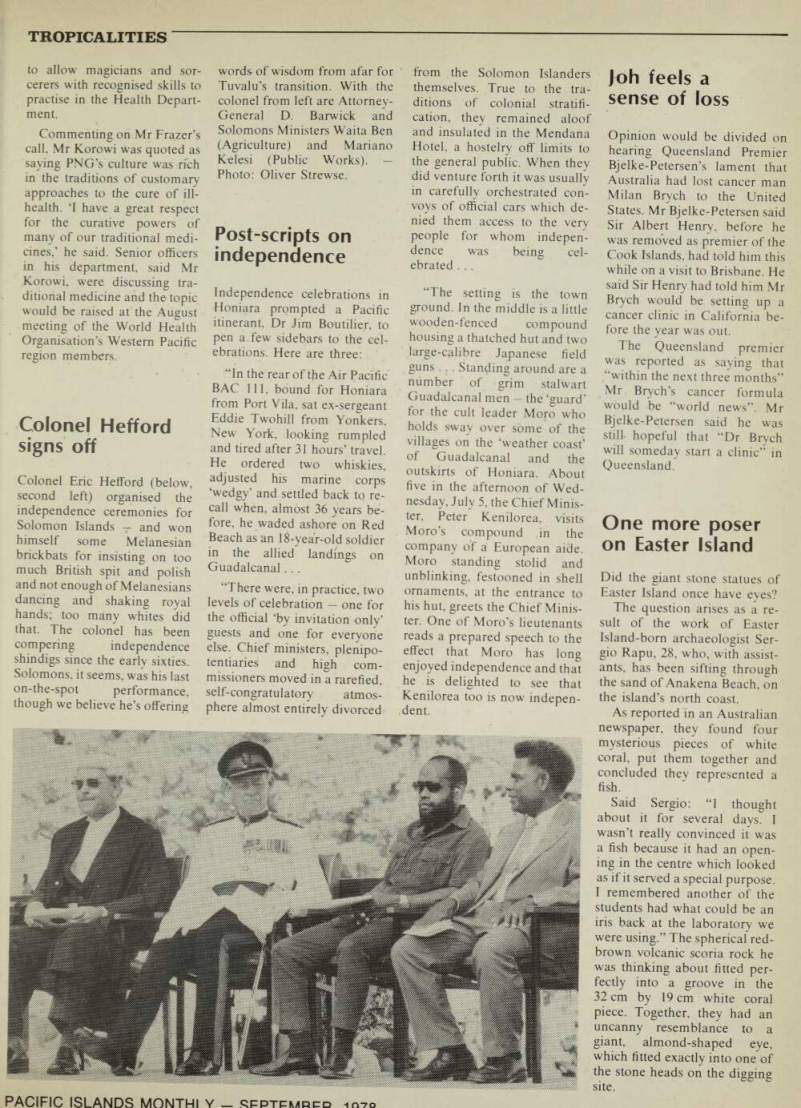
Colonel Eric Hefford (below, second left) organised the independence ceremonies for Solomon Islands and won himself some Melanesian brickbats for insisting on too much British spit and polish and not enough of Melanesians
dancing and shaking royal
hands; too many whites did that. The colonel has been
compering independence
shindigs since the early sixties.
Solomons, it seems, was his last
on-the-spot performance,
though we believe he’s offering
words of wisdom from afar for Tuvalu’s transition. With the colonel from left are Attorney- General D. Barwick and Solomons Ministers Waita Ben (Agriculture) and Mariano Kelesi (Public Works).
Photo: Oliver Strewse.
Post-scripts on
independence
Independence celebrations in Honiara prompted a Pacific itinerant. Dr Jim Boutilier, to pen a few sidebars to the cel ebrations. Here are three: “In the rear of the Air Pacific BAC 111, bound for Honiara from Port Vila, sat ex-sergeant Eddie Twohill from Yonkers, New York, looking rumpled and tired after 31 hours’ travel.
He ordered two whiskies, adjusted his marine corps ‘wedgy’ and settled back to re call when, almost 36 years be fore. he waded ashore on Red Beach as an 18-yea‘r-old soldier in the allied landings on Guadalcanal...
“There were, in practice, two levels of celebration one for the official ‘by invitation only’ guests and one for everyone else. Chief ministers, plenipo tentiaries and high com missioners moved in a rarefied,
self-congratulatory atmos
phere almost entirely divorced
from the Solomon Islanders themselves. True to the tra ditions of colonial stratifi cation, they remained aloof and insulated in the Mendana Hotel, a hostelry off limits to the general public. When they did venture forth it was usually in carefully orchestrated con voys of official cars which de nied them access to the very people for whom indepen dence was being cel ebrated . . .
“The setting is the town ground. In the middle is a little wooden-fenced compound housing a thatched hut and two
large-calibre Japanese field
guns . . . Standing around are a number of grim stalwart Guadalcanal men - the ‘guard’ for the cult leader Moro who holds sway over some of the villages on the ‘weather coast’ of Guadalcanal and the outskirts of Honiara. About five in the afternoon of Wed nesday, July 5. the Chief Minis ter, Peter Kenilorea, visits Moro’s compound in the company of a European aide.
Moro standing stolid and unblinking, festooned in shell ornaments, at the entrance to his hut, greets the Chief Minis ter. One of Moro’s lieutenants reads a prepared speech to the effect that Moro has long
enjoyed independence and that
he is delighted to see that Kenilorea too is now indepen dent.
Joh feels a
sense of loss
Opinion would be divided on hearing Queensland Premier Bjelke-Petersen’s lament that Australia had lost cancer man Milan Brych to the United States. Mr Bjelke-Petersen said Sir Albert Henry, before he was removed as premier of the Cook Islands, had told him this while on a visit to Brisbane. He said Sir Henry had told him Mr Brych would be setting up a cancer clinic in California be fore the year was out.
The Queensland premier was reported as saying that “within the next three months”
Mr Brych’s cancer formula would be “world news”. Mr Bjelke-Petersen said he was still hopeful that “Dr Brych will someday start a clinic” in Queensland.
One more poser
on Easter Island
Did the giant stone statues of Easter Island once have eyes?
The question arises as a re sult of the work of Easter Island-bom archaeologist Ser gio Rapu, 28, who, with assist ants, has been sifting through the sand of Anakena Beach, on the island’s north coast.
As reported in an Australian newspaper, they found four mysterious pieces of white coral, put them together and concluded they represented a fish.
Said Sergio: “I thought
about it for several days. I wasn’t really convinced it was a fish because it had an open ing in the centre which looked as if it served a special purpose.
I remembered another of the students had what could be an iris back at the laboratory we were using.” The spherical red brown volcanic scoria rock he was thinking about fitted per fectly into a groove in the 32 cm by 19 cm white coral
piece. Together, they had an
uncanny resemblance to a
giant, almond-shaped eye,
which fitted exactly into one of the stone heads on the digging site.
Rapu discovered that when the eyes were inserted and the great stone figures raised on
their temple platforms, they
would have been looking up to the sky. “This makes sense of the old traditional name for Easter Island Mataoho mila al siervo ‘the island with the eyes looking up to the sky’,” he said. So. There’s yet another angle to the time-honoured
question-and-answer game
about Easter Island.
Tall tale about
a deep hole
A vivid imagination is a strik ing characteristic of one of the 32 Papuan New Guinean porters working with the party of cavers who are exploring the Atea Kanada cave complex in Papua New' Guinea (PIM July).
Purpose of the expedition is to determine whether the caves in fact are the deepest in the world.
Entering into the spirit of the enterprise, the porter related how when in the area one morning not long ago he came upon a hole and threw a rock into it. He came back the next day, and it was not until late afternoon that he heard it hit the bottom ...
Cash to change?
Shop around
Back in Sydney after six days in Port Moresby, PI M’s Bob Hawkins could have been for given for thinking he was wit nessing an unexpected boom in Australian prosperity. The Bank of New South Wales teller at the airport offered him only $62 and a few cents for the 60 Papua New Guinea kina he had brought back with him (a rate of about 96 toea to the dol lar or about $1.04 to the kina).
He hadn’t heard anything on the radio suggesting a reversal of fortunes for the ailing Aus tralian dollar; there had been nothing in the newspapers. He suggested the teller should check the day’s exchange rate
again. Back came the same answer. Not being a believer in miracles, Hawkins took his money back, waiting until he got to a bank in the city.
At the ANZ branch on York and Erskine he was offered more than $72 for his K6O a sum he happily accepted.
Australia’s dollar was, as he had expected, still in the dol drums. After pocketing $72.31, he rang the City branch of the New South Wales to see if their airport teller had erred. It seemed he had. The City branch was offering a rate of about 86 toea to the dollar or $1.16 to the kina which would have returned him about $69 for his K6O. It seems, in this day of floating currencies, it’s worth shopping around the banks with your foreign paper cash. Islanders take note.
Truk steps aside
for old Mangaia
Evidence that Mangaia, in the Cook Islands, is the oldest island with outcropping vol canic rocks in the Pacific, is offered in a report by two geol
ogists from the Geophysical
Institute at the University of Alaska. Drs D. L. Turner and R. D. Jarrard, who worked in the southern Cook Islands last year, say that Mangaia’s age, according to the dating of radioactive elements in its rocks, is 21.4 million years.
Truk, in the Caroline Islands, was previously regarded as the oldest. In their report the geol ogists were profuse in their thanks for the help of Cook
Islanders, especially Ngametua
and Krudeem Kareroa of Mangaia and the Reverend Taa Kimi and Mrs Kimi of Atiu.
New assault on
dress barrier
Standard of dress, long a point of black-white friction in Papua New Guinea and other Islands came up again in the PNG Parliament re cently. A bill was before Parlia ment which would outlaw the
practice of refusing admission
to licensed premises because of unacceptable dress standards.
Outspoken Member for Y angora-Saussia John Jaminan introduced the Discriminatory Practices Amendment Bill. He said proprietors and managers of hotels, taverns, restaurants, clubs, theatres and other
establishments, frequently
imposed rules about dress which required people to wear clothes which were entirely foreign to the culture of Papua New Guineans and unsuited to the climate.
Most Papua New Guineans, he said, could not afford to spend the amount of money Europeans spent on clothes,
“yet dress regulations usually
lay down a standard which non-nationals are more likely to satisfy than nationals”. The result, he said, was discrimi
nation, ostensibly on grounds
of dress but really of a racial and economic nature. Mr Jaminan’s bill did not get to a vote in the last session of the
PNG Parliament but few would dispute that he has a
point.
A glass or two
among friends
The longer the pub stays open the more likely there is to be a fight. And, even more likely, at least one of the combatants will be an Islander. Without splitting hairs, that’s the mess age which emerges from the findings of a two-year study of drinking behaviour in New Zealand by two Auckland
University research psychol
ogists.
Mrs Vernetta Heem and Mr lulai Ahsan, both born in Samoa, spent more than 500 hours studying the habits of more than 200 drinkers European, Maori and Islander.
They found that the average staying power of a European was 71 minutes at a rate of 7.5 glasses an hour; of a Maori 109 minutes at 12.68 to the hour; and an Islander 108 minutes at 10.1 to the hour.
Of 400 incidents in pubs, the researchers found that the more serious clashes were be tween different racial groups Islanders versus Maoris or Islanders versus Europeans.
Noting that disputes got worse as drinkers got drunker and that there were more disputes in the final two hours before closing time than in any other
period, the psychologists sug
gested some way should be worked out to prevent people spending so much time in hotels.
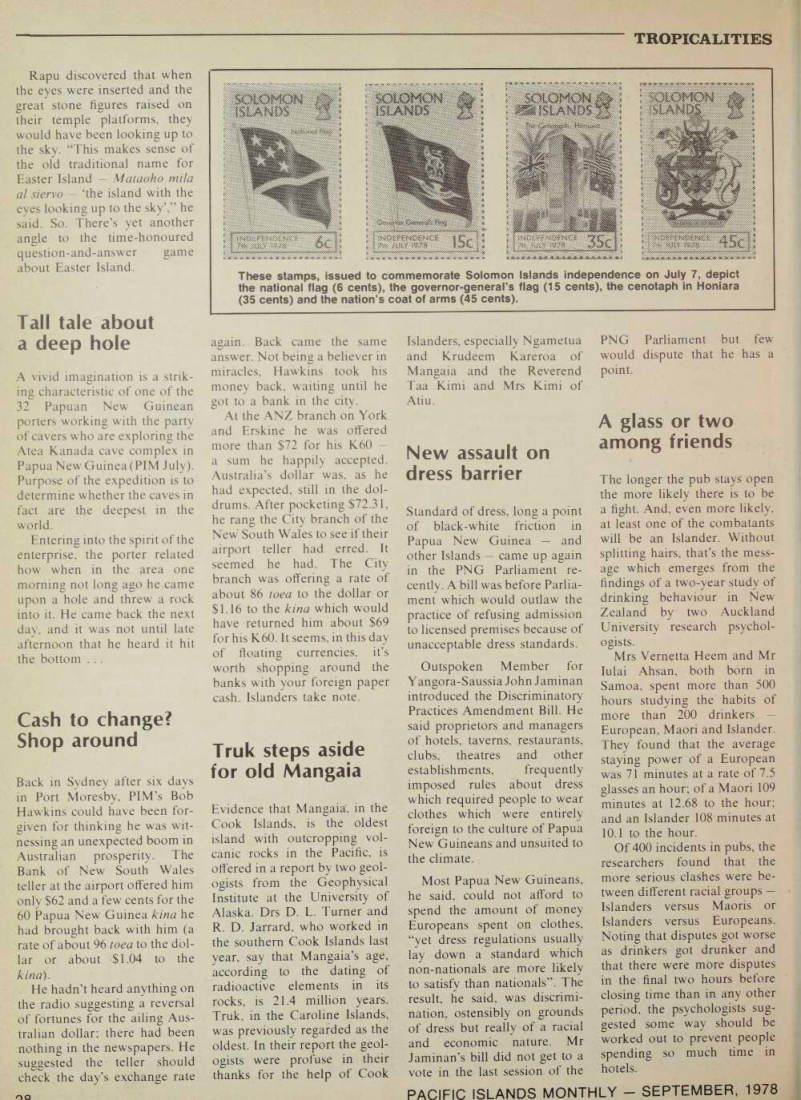
These stamps, issued to commemorate Solomon Islands independence on July 7, depict the national flag (6 cents), the governor-general’s flag (15 cents), the cenotaph in Honiara (35 cents) and the nation’s coat of arms (45 cents).