laughing”: PFL’s modest aim
pp. 77-79 · Read in the full issue
“If we break even, we’ll be laughing”: PFL’s modest aim
“We’re not out to make profits if we break even we’ll be laughing” such is the modest aim in life of the Pacific Forum Line, according to Mr Francis Hong Tiy, its commercial manager.
Interviewed by PIM during a recent visit to Sydney, Mr Hong Tiy reviewed the back ground to the first PFL voyage which began on May 6, when the Tauloto 11, of 4 800 dead weight tonnes, sailed from Melbourne with her Tongan crew and Norwegian master, inaugurating the operational life of the long discussed line.
She was to call at Suva, Lau
toka, Pago Pago, Apia and
Nukualofa. Another ship, the
Toa Moana, would shortly begin serving the same ports, but sailing out of New Zealand.
The two ships would provide the PFL’s South Pacific ser vice.
A Central Pacific service was also planned out of New Zealand, sailing to Fiji, the Gilbert Islands, the Solomons and Papua New Guinea.
These three services consti tuted “phase one” of the line’s operations, according to Mr
Hong Tiy.
“Phase two”, due to begin in 1979, would see the introduc tion of containerised cargoes.
The new ro-ro and 10-lo ships would be provided by the governments of Western Samoa and Tonga. They would be built with aid funds from Western Germany, adminis
tered through Hamburg’s
Columbus Line. The con tainerised service, to be known as the “Boomerang” service,
would call at Australian and New Zealand ports, and Tonga, the Samoas and Fiji.
Mr Hong Tiy was enthusi astic about the prospects of the PFL. He said; “There are eight members at present. The four
who provide ships Nauru,
Longa, Western Samoa and New Zealand are known as shipping members’. The other “our, who don’t are Papua New Guinea, the Gilberts, Fiji md the Cook Islands.” The government of the Solomon slands has made formal appli
:ation to join as a non-shipping
nember after independence in
uly.
He said; “One of our great trengths is that all members ay financial contributions of te same amount. So bigger ountries have no more say lan smaller ones. This across ic-board equality in our oper tion should, we hope, prevent
le growth of disillusionment
n the part of smaller coun ies.
“Another strong point work ig for us is the centralised laracter of our operation. Un-
like the regional airlines, which all have separate operational and control centres, our entire operation, using ships owned by Island governments, is centred in Apia.
“This gives the PFL a much more authentically regional character than other regional transport enterprises, it seems to us.’’
Mr Hong Tiy saw the main reason for the years-long delay in getting the PFL operational as the early lack of an in-depth study of the organisational and financial aspects of operating a
regional line. Early plans to
base the operation on existing Tongan and Nauruan mer chant shipping services foun dered on this rock adequate
feasibility studies, details of cash flows, etc, were simply not available to the interested governments.
The last of many experts on regional shipping to tackle the problems was Mr Bob de Vlaming, a retired director of Nedlloyds who was made available to the South Pacific Forum by the Netherlands Government and the Econ omic and Social Commission for Asia and the Pacific.
Subsequently, Mr Hong Tiy,
formerly an assistant research officer with the South Pacific Bureau of Economic Co operation, headed a team, which included two Papua New Guineans, one Fijian, and one Australian, in a feasibility study on the line.
Once the study was com pleted, and the principles were agreed upon the way was clear for the historic first voyage of the Tauloto 11.
Mr Hong Tiy, 40, was born in Fiji. Educated at Suva’s Marist Brothers’ High School, he later majored in geography at Auckland University.
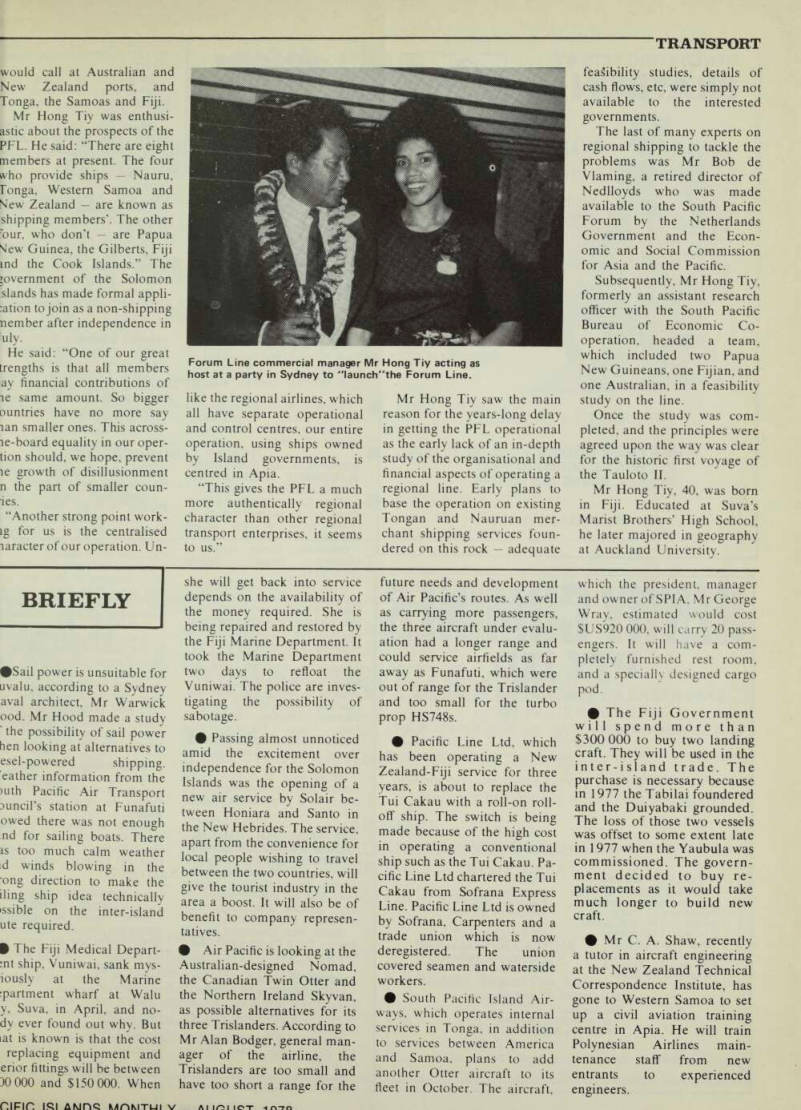
Forum Line commercial manager Mr Hong Tiy acting as host at a party in Sydney to "launch”the Forum Line.