Governments dither and American
p. 77 · Read in the full issue
Samoa’s tourist trade suffers
American Samoa is caught in the crossfire over Australia’s
procrastination over cheap air
fares and the US determination to de-regulate air transport, not only within the USA but on all routes serviced by US airlines.
American Samoa is eagerly
waiting for Continental Air lines to begin a service to its
Fafuna airport.
Continental has rights to fly nto Tafuna, but won’t go there ill rights are granted in Aus ralia. And Australia’s Trans >ort Minister, Mr Peter Nixon, i farmer, is dithering as usual, mable to make up his mind
ibout cheap fares, and calling
or a report about the effect Continental will have when it lies to the South Pacific, as it urely will, having been named he second US carrier to that >art of the world by President Carter.
Mr Nixon, naturally, wants ) protect Qantas, which will jffer to some extent from with two US air nes, which will increase seat
ipacity, without necessarily
uncrating much more traffic, le has a point, but the US hich, in June, agreed to buy
uge quantities of Australian
eef in these days of re
mrces diplomacy is likely to
:ek a quid pro quo, which )uld well relate to air traf- Mr Peter Tali Coleman, the overnor of American Samoa, ihappy at air services into his rritory, has filed with the US ivil Aeronautics Board
'AB) a reply to an application
' Continental Airlines to Jay inauguration of its scr ee into American Samoa and e South Pacific.
Mr Coleman does not
)pose outright an extension,
it argues that the CAB should >t grant an extension unless it ovides a better interim scr ee for American Samoa. He is asked the CAB to combine consideration of an earlier
nding action against Pan
Tierican World Airways for
iproved service with the
newer Continental application
for delay.
He is sympathetic with the problems Continental faces in starting its South Pacific ser vice, and does not formally oppose the application for delay. Neither does he support that application “because of the accelerating economic damage that is being visited upon this isolated piece of American soil by forces totally outside the control of the people of American Samoa.”
Visitor traffic has declined by 68%, comparing April, 1977, and April, 1978, which could mean a net loss of about SUS4OO 000 to the American Samoa tourist industry. Should such trends continue the econ omic loss to the American Samoan economy could be at least $1 million a year.
Mr Coleman noted the irony that, in spite of the clear and
unequivocal recognition of
American Samoa’s air needs by the CAB in earlier proceedings, ever since the decision to give South Pacific routes to Con tinental, the quantity and qual ity of American Samoa’s air service has consistently declined.
American Samoa is not likely to receive a Continental service this year. The viability of Continental’s South Pacific venture depends on when it is granted rights in Australia, and
even if they were granted right
away Continental could not mount a service for several months.
PAA has applied to the Civil Aeronautics Board for fares 25% to 50% below those now offered between New York and Los Angeles on its Aus-
Transport
tralia service. PAA wants to carry passengers between the two cities on its weekly New York-South Pacific flight.
At present only international passengers are allowed on the US section of the flight to Auckland, Sydney and Mel bourne. If the application is granted a reserved “coach fare” between New York and Los Angeles will cost SUSI6S compared with SUS22O.
Another comment about air lines came from a conference in Tahiti.
Islands between the United States and Australia and New Zealand could be starved of visitors because of budget fares and overflying policies of the trunk carriers, the Western Samoa Minister for Civil Avi ation, Mr Asi Eikeni, said at a Pacific Islands Tourism Development Council tourism conference in Tahiti.
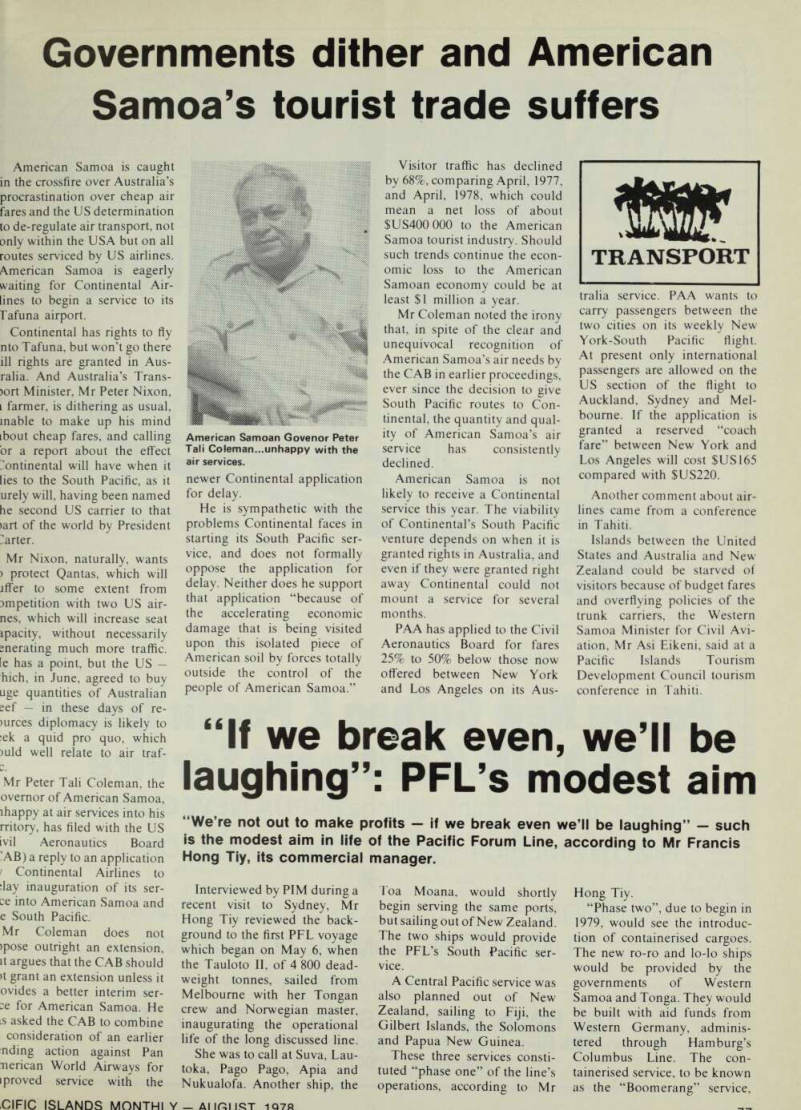
American Samoan Govenor Peter Tali Coleman...unhappy with the air services.