Australia and the Islands: a blueprint
pp. 35-37 · Read in the full issue


for total involvement
The Islands can expect increased involvement in the region by Australia, especially in plans to strengthen the Islands’ economic structures. This is clearly outlined in the report on Australia and the South Pacific by the Australian Senate Standing Committee on Foreign Affairs and De fence, which, based as it is on bipartisan lines, can expect full support in the Australian Parliament for its views. A commentary by Senator John Knight, a member of the committee, is below.
The immediate significance of the report on Australia and the South Pacific by the Senate Standing Committee on Foreign Affairs and Defence is that it is the first such report
completed by a committee
representing the Australian Parliament. It is important to note that the committee is bi partisan with three government and three opposition senators and that the report is a unani mous report of the committee chaired by Senator Sim (Lib, WA).
The committee deliberately
places considerable emphasis
on the processes of change which are now occurring throughout the South Pacific region and elsewhere. It is indicated at the outset that these include “complex pro posals for a new international economic order, adjustments in the network of relationships within the South Pacific and between the South Pacific, Australia and neighbouring re gions, the changing role and interests of the great powers and other nations in the region and the significance of the independent status of most South Pacific nations.”
The report then goes on to point out, “it is to this process of change that the committee has particularly addressed itself. The committee believes that this process is inescapable and that there are several as pects of it which deserve to be
encouraged and supported by
Australia. In many cases this is
already happening and con
firms evidence of changing attitudes in Australia and the region. The committee has
sought to give emphasis to the
consolidation of such construc tive change and has suggested some areas where Australia might give further attention, so
as to ensure that its changing role in the region will mean firm and effective relationships with the nations and peoples of the South Pacific region.”
This approach is consistent with the recognition of the accelerated pace of change in the international situation which was typified by the Whitlam government and has since been continued and con solidated if at a less hectic pace by the Fraser govern
ment, particularly by Foreign
Minister Andrew Peacock.
In his recent statement to the Australian Parliament on
foreign policy Mr Peacock
pointed out that this is a time
of “change and challenge”,
that “the world is in the midst of a period of change that could prove to be as significant as any in modem history .. .
There are no simple remedies or ready-made solutions for the
problems we face today.”
He also referred to the Sen ate Committee’s report as re
flecting, “the growing aware
ness in Australia of the coun tries and peoples of the South Pacific”. He might have added that it reflects this awareness on the part of the Australian Parliament.
The Senate Committee on Foreign Affairs and Defence has tried to produce a report which takes these changes into account in the relationship be tween Australia and its neigh bours in the South Pacific. Its aim is to suggest how this pro cess might be consolidated in the interests of regional development. It also assumes a commonality of purpose and a basis of mutual interest in issues that in fact affect the whole region and each member of it. It is an approach that has not been altogether prevalent in the past.
It is generally recognised
and the committee’s report indicates the bipartisan nature of this recognition - that Australia must continue to broaden its perspective on the world and keep up with rapidlychanging attitudes and approaches in international relations. At the same time, the senate committee has accepted and taken as a fundamental assumption that the island nations of the South Pacific have themselves in recent years broadened their horizons, par-
ticularly following self-
government and independence in so many of the countries, They have extended their international relationships, trade contacts, investment sources and have diversified their general political and cultural ties, This is probably a more difficult process for Australia in the South Pacific than in any other area of Australia’s external relationships. It is a truism that Australia has tended to dominate the South Pacific re-
gion economically and not
always in a benign fashion. But as the nations of the South Pacific have moved towards
independence they have
increasingly asserted their rights to determine their own destinies and Australia has now to behave as an equal
partner, This process was accelerated in the late 1960 s and has con tinued since. There has been
growing recognition of Aus
tralia’s obligations to the coun tries of the South Pacific. It has been reflected in rapidly
increasing development assist
ance commitments and in the extension of Australian diplo matic relations through the re gion. The South Pacific is now perhaps the region in which Australia’s diplomatic rep resentation is most intensive, There have also been continu ing efforts to find new areas for co-operation cultural, sport ing, environmental issues, fisheries, Law of the Sea, ship
ping.
The committee also places some emphasis on the role of
regional organisations and the
elements of regional identity
through, for example, the
South Pacific Forum and the changing South Pacific Com mission. But it is significant that the Australian Parliament can now produce a report in which all of these factors are taken as given and in which a bipartisan senate committee can look to the future with what only a few years ago were rather novel views but which are now rapidly gaining the status of basic assumptions.
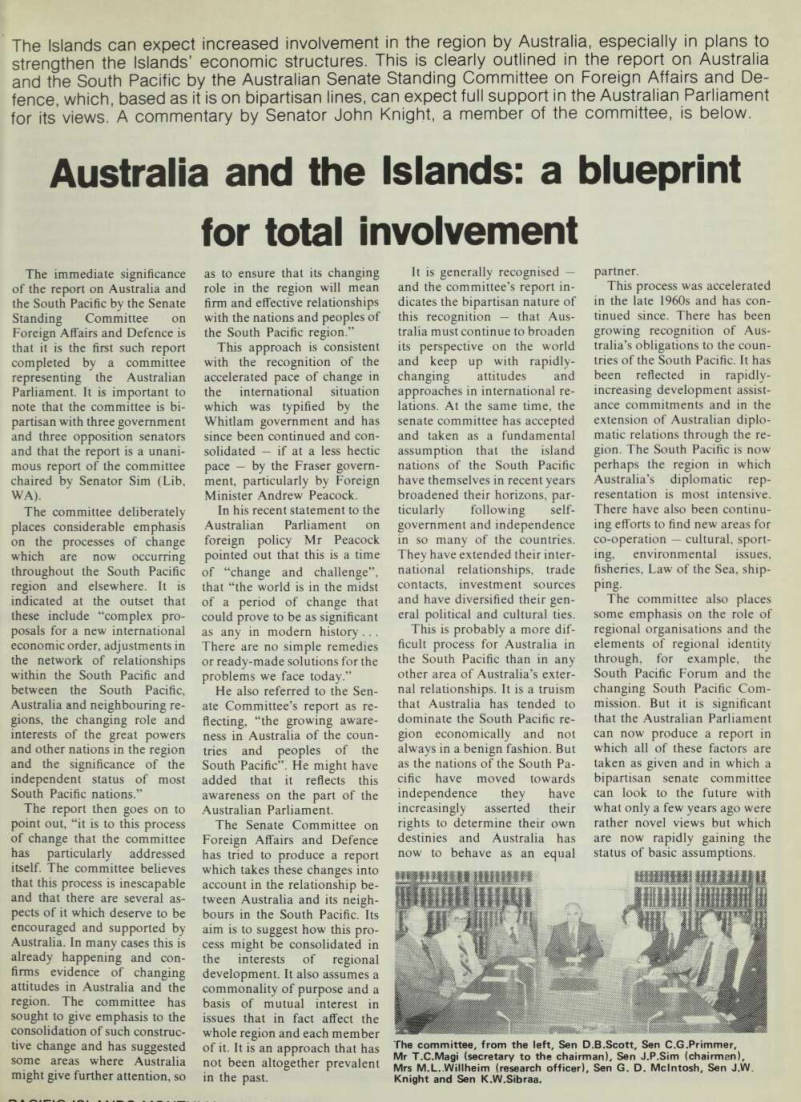
The committee, from the left, Sen D.B.Scott, Sen C.G.Primmer, Mr T.C.Magi (secretary to the chairman). Sen J.P.Sim (chairman), Mrs M.L. Willheim (research officer), Sen G. D. Mclntosh, Sen J.W.
Knight and Sen K.W.Sibraa.
The senate committee’s re port could do a good deal to consolidate these basic views.
That in itself would be import ant. Whatever contribution it
might make towards assuring
the continuing reality, of an
equal partnership between all
nations of the region will be the measure of its additional sig nificance. It will, of course, de pend to a great extent on the response of the Australian
Government. But only recently
Prime Minister Fraser an nounced that ministers are to
respond directly to parliamen
tary committee reports within six months of their presen tation to Parliament.
In its report, the committee has sought to put into perspec tive the relative roles of politi cal and economic relationships.
Economic matters have tra ditionally tended to dominate relationships and the percep tion of them. The report
deliberately begins by looking
at the region in its historical context and its relevance to Australia in that perspective, then at political and diplomatic relations.
It goes on to examine the many issues involved in econ omic relationships between Australia and the countries of the South Pacific, then to
examine regionalism and Aus tralia’s participation in it, and
finally development assist
ance.
The committee has not sought to suggest that econ omic relations are not still the most pervasive element in the links between Australia and the countries of the South Pa cific. In fact the bulk of the re port still deals with economic matters and development as sistance. What it has done, however, is to suggest that these can only be built on
effective political and diplo
matic links and stronger re
gional relationships.
It is this emphasis which has been emerging in Australian policy since about 1970 and which the committee has stressed.
The growth of Australia’s extensive diplomatic and rep resentative network in the South Pacific since about 1968 has been dramatic and in the last few years posts have been set up in Papua New Guinea, the Solomon Islands, the New Hebrides, Western Samoa and posts in Fiji and elsewhere have been expanded.
The committee, however, places some emphasis on the importance to Australia of having more representatives of
island countries in Australia and suggests that Australia should actively encourage this and give it support where ap propriate and if island govern ments seek it. At present Fiji and Papua New Guinea are represented in Canberra, Nauru in Melbourne and Tonga has an “honourary” rep resentative in Sydney.
The need for adequate staff within Australia’s Department of Foreign Affairs is also stressed. In fact, the report suggests that staffing in the Foreign Affairs section which deals with the South Pacific and in the Development Assist ance Bureau might now have become inadequate to handle the extensive network of rep resentatives and the growing
complexity of relationships
within the region. It is recom mended that this whole ques tion be reviewed both in the
department and the Develop
ment Assistance Bureau to assess staffing needs and priorities.
These points are all made in the context of the need to con tinue to strengthen Australia’s identity with the region and it is this emphasis on recent trends towards a more mature
relationship within the region
which pervades the report. It
reflects the importance which members of the committee attach to this process.
The concept of regionalism and a growing sense of regional identity are important in this process.
The report begins with a chapter giving some brief his torical background on the South Pacific region. The
fourth chapter refers specifi
cally to “regionalism and co operation”. This gives, in the Australian context, unusual prominence to regionalism and that an Australian parliamen tary committee should do so is significant in itself.
The report, by outlining the extent of existing and develop
ing regional arrangements, em
phasises the need for improved communications and consul tations at a multitude of levels.
The committee endorses the
development of regionalism
and suggests that transport and communications in the region
“must be improved through
closer co-operation within the
region”.
In this section the committee refers to the potential future role of fisheries and problems related to the 200 miles “exclusive economic zones”.
No specific recommendations are made as action is already
being taken in an effort to ensure practical co-operation.
By its comments, the com mittee makes it clear that it be lieves this should be Australia’s objective in these two very im portant issues.
Perhaps inevitably, the re port gives a lot of attention to development assistance. This programme is a manifestation of Australia’s changing atti tudes and acceptance of cer tain obligations towards its South Pacific neighbours. Be cause of the scale of the pro gramme it is likely to have an
increasing impact on many
facets of life in South Pacific countries and it was to this, in particular, that the committee gave attention. Its emphasis is on ensuring that assistance is provided in accordance with the priorities of South Pacific countries and that it is extended into new areas where it is relevant to the people’s needs.
The committee itself suggests some issues to which attention might be directed.
These include environmental matters, urbanisation and South Pacific cultures and tra ditions. At the same time there is in the report (as there is
among members of the com mittee) a clear recognition that when it comes to economic growth, development assist ance is not necessarily the panacea.
It is in this context, in par ticular, that the committee sought to suggest ways in which trade between Australia and the countries of the region might be extended. A number of recommendations are made, aimed at improving accessi bility to the Australian market for South Pacific products. For example, it is suggested that quarantine restrictions should be re-examined; that the Aus tralian system of Tariff Prefer ences be emphasised; that the services of the Market Advis ory Section of the Department of Trade and Resources be encouraged to ensure that South Pacific countries make use of its services; and that co operation be extended to South Pacific countries to improve their trade representation where Australia is able to pro vide such assistance.
On the question of tariffs the committee notes that close to 100% of exports from South Pacific countries to Australia
already enter duty-free. Thus,
measures to improve accessi
bility through revised
quarantine regulations, for
example - are of special relevance.
Consideration was given to the . activities of Australian business in the region. The committee (while commenting on Carpenter’s failure to pro vide a submission or give evi dence to the committee) expressed the view that the reputation of Australia’s business enterprises in the re gion seems much better than in the recent past. It was concluded that they are gener ally “working within the re quirements of host governments and are trans forming their operations in a manner which shows an increasing awareness of the need to localise if they are to remain viable and welcome in these countries”.
During the committee’s preparation of this report three of its members were able to visit several countries of the re gion. However, because funds are not available for overseas
visits by parliamentary com
mittees, the committee as a whole was not able to obtain first-hand evidence, though considerable efforts were made to involve people from the
South Pacific countries. Diplo matic representatives in Aus tralia were consulted and a Tongan post-graduate scholar at the Australian National University acted as committee consultant.
There are gaps and inadequacies in the report.
That is inevitable. Perhaps the most fundamental and sig nificant points are that the Aus tralian Parliament has finally got around to addressing itself to the South Pacific as a region of great importance to Aus tralia (and a parliamentary
delegation though not the
committee visited 11 coun tries and territories in the re gion in June and July last year); the committee has assumed a period of change and has sought to suggest con structive directions for Aus
tralian policy including that
of private and commerical groups to consolidate recent developments; and the com mittee has assumed a relation
ship of equality, looking for
ways for Australia, not just to protect its interests in the re
gion though that is a legit
imate purpose which all governments must pursue but to meet its obligations to its near-neighbours in the South Pacific.