‘With the spirit behind you’-Fijians
pp. 31-33 · Read in the full issue

dance their way into the past
CULTURE - Fiji, in terms of cultural awareness, is at last coming of age. Its national Dance Theatre, which as a mere fledgling gave a command performance in Britain before the Queen, has teamed up with a multi-million dollar cultural centre project near Suva to create an artful setting of pre-European Fiji. George Rubine tells the story.
The Dance Theatre of Fiji is led by a talented choreogra pher who feels the perform ance is partly for “the spirit behind you .. . the ancestral
power”.
And the Cultural Centre and Marketplace of Fiji, scheduled to open at Deuba in December as part of the Pacific Harbour resort complex, is following a spirit of the past, re-creating a pre-colonial way of life in what will be a living museum.
The emphasis in both cases is on authenticity and preser vation of the country’s rich
heritage.
Director and Producer of the Dance Theatre of Fiji and now Director of Presentations at the new cultural centre is Manoa
Rasigatale, a 30-year-old ex
rock and roll singer, ex journalist, whose career took a turn toward tradition with the first South Pacific Festival of Arts, held in Suva in 1972.
The Australian-trained (in the Ensemble Theatre, Sydney)
choreographer returned to Fiji
and began an intensive study of the traditions of Fijian dance and culture.
Manoa and his group of 26 Fijian men and women are dedicated to keeping those tra ditions alive. In the times be fore European contact, dance in Fiji was a ceremonial affair,
created by the village
daunivucu (meke creator).
Each village had its own dis tinctive dance forms.
It was for the daunivucu to decide the format of dances in some cases a dance which propelled the village into war.
His inspiration for these dances came from the spirit god, called the vu in Fijian.
There are several interpret ations of the spirit god concept.
Manoa Rasigatale talks about “the person you are and the person who is behind you”.
He says: “When you are per forming, you are not only
dancing for the people in front of you, but you are also per forming for the spirit behind you. This spirit offers mana, or ancestral power. Those who possess it must be very careful with it and respect it.”
The vu was the god of the vil lage and could take the form of a dog, shark, woman or man
just about anything the village
would accept through the
priest.
In essence, the vu was the first ancestor from which all other ancestors and the current
villagers sprang.
In Bau, the kingly island to some Fijians, the vu was the dadakulaci, or seasnake. It is poisonous, but its fangs are far receded, which makes it basi cally harmless. No one would dare kill one it would be like killing a relative.
In former times, according to Fijian tradition, the priest would be told by the spirit that a dance commemorating a special occasion must be per formed.
The daunivucu would choose some men and tell each about certain aspects of the dance. They would commit to memory a song verse to be used and rehearsed to the daunivucu’s satisfaction. They would then bring in more dancers and the dance would become another item in the vil lage’s particular repertoire.
Giving an example of how dances are distinct, Manoa contrasts the spear dance from Macuata in Fiji’s second lar gest island, Vanua Levu, with the club dance from his home village, Nabuli. Macuata used
the spear in war, Nabuli the club.
Manoa says two dances his theatre has not learned are the dance to the moon and the
kingdom dance.
The moon dance is the most dangerous one a person can attempt and the dancer usually performs it in secret. If he is seen and yelled at, he would immediately die. “You were
dancing with your spirit,”
Manoa says.
The kingdom dance is one by an entire province to show its collective power. It would show the king of another prov ince how wise and powerful the people were. It was both a warning (“if you want war, we are ready”) and an entertain ment (look how smart our daunivucu is”).
Villagers would visit neigh
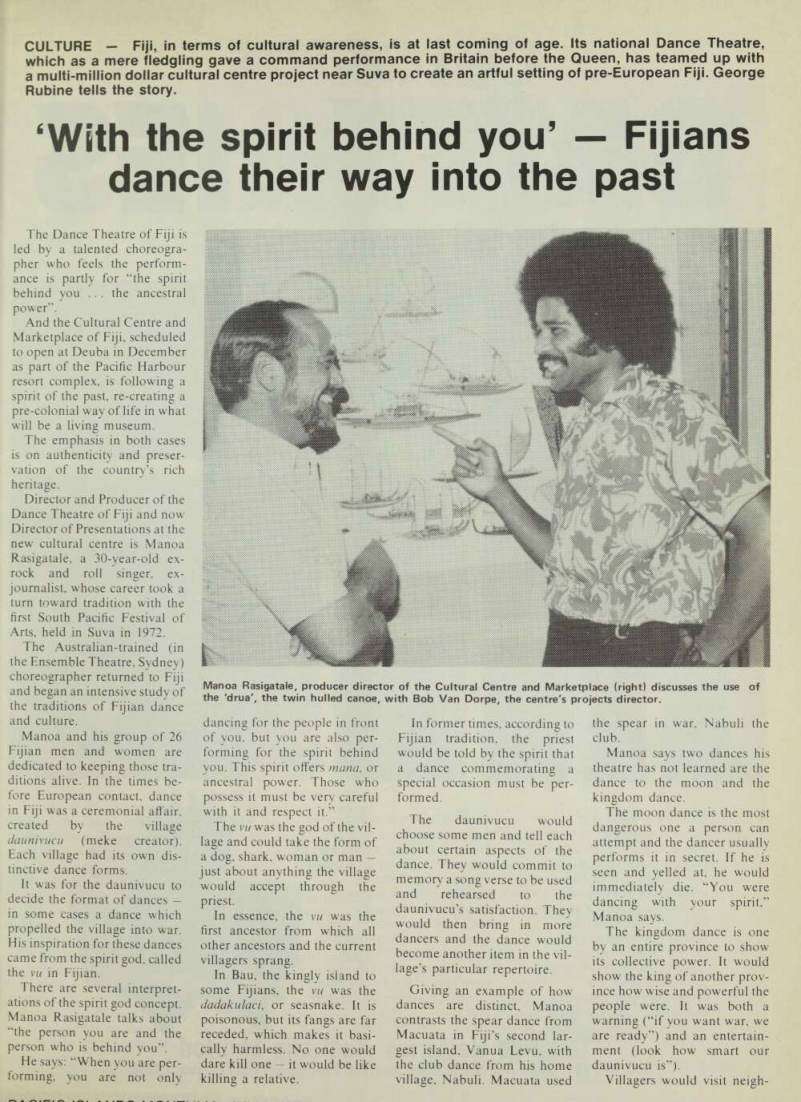
Manoa Rasigatale, producer director of the Cultural Centre and Marketplace (right) discusses the use of the 'drua', the twin hulled canoe, with Bob Van Dorpe, the centre's projects director.
bouring villagers for important
weddings or festivals and might perform one of their mekes.
It was the peaceful way to show village power. Manoa says there were mekes to show how brave the warriors were in war.
The mana in the dance warned others to be careful. If the dance was great, those dancers possessed a lot of power and were, therefore, great warriors.
Sexual mekes rewarded the warriors when they returned from a fight. Some might call this an orgy, but warriors saw it as the chiefs reward.
For the Dance Theatre of Fiji, the reward came from another high chief: a command
performance at Buckingham
Palace during the group’s 1974 tour of Britain.
Undoubtedly, that invitation stemmed from their debut a year earlier in Australia after a
performance following the
Queen’s official opening of the
Sydney Opera House.
Since the British tour, the Dance Theatre of Fiji has per formed in Tahiti, twice more in Australia, and of course at home.
But, presumably, working in
the cultural centre in a totally authentic re-creation of the past, the spirit and mana should move them as it has no where else.
And why not?
They’ll be performing in an
island setting essentially the
same as that of their ances tors.
Fijians will be clad in Masi (bark cloth) and pandanus leaves; summoned by the beat ing of huge wooden drums to the bare kalou , the priest’s house which, like other tra ditional structures on the island, is so painstakingly authentic that Manoa says he senses the power.
On the waterway surround
ing the island, a giant sailing
war canoe, a drua capable of carrying 100 warriors (to be built over a year’s period) will be dwarfed only by the thick tropical flora which shelters the entire centre.
Across that waterway is
something else, a different world. It is the other half of the project, the first encounter for the visitor journeying into the past.
The Cultural Centre and Marketplace is a combination of the new and the old: the Fijian experience of the pre colonial era; and the Market place, a blend of architecture and landscaping reminiscent of
those buildings introduced by
Fiji’s earlier European settlers.
Inside those Victorian arcades will be a wide selection of pro duce new to both visitors and residents of Fiji.
Botanical gardens, fern lined walkways, an aviary of rare and beautiful tropical birds of Fiji, and one of the
world’s largest private collec
tions of orchids will keep the transition ‘gentle’.
To literally ‘bridge’ the span between old and new is the unique tree-house restaurant overlooking the historic island of Beqa and the rich landscap ing and waterways of the cul tural centre.
For the Dance Theatre of Fiji it is a homecoming; an
awareness that finally they
have found a cultural setting that will allow them to fully ex
plore their heritage.
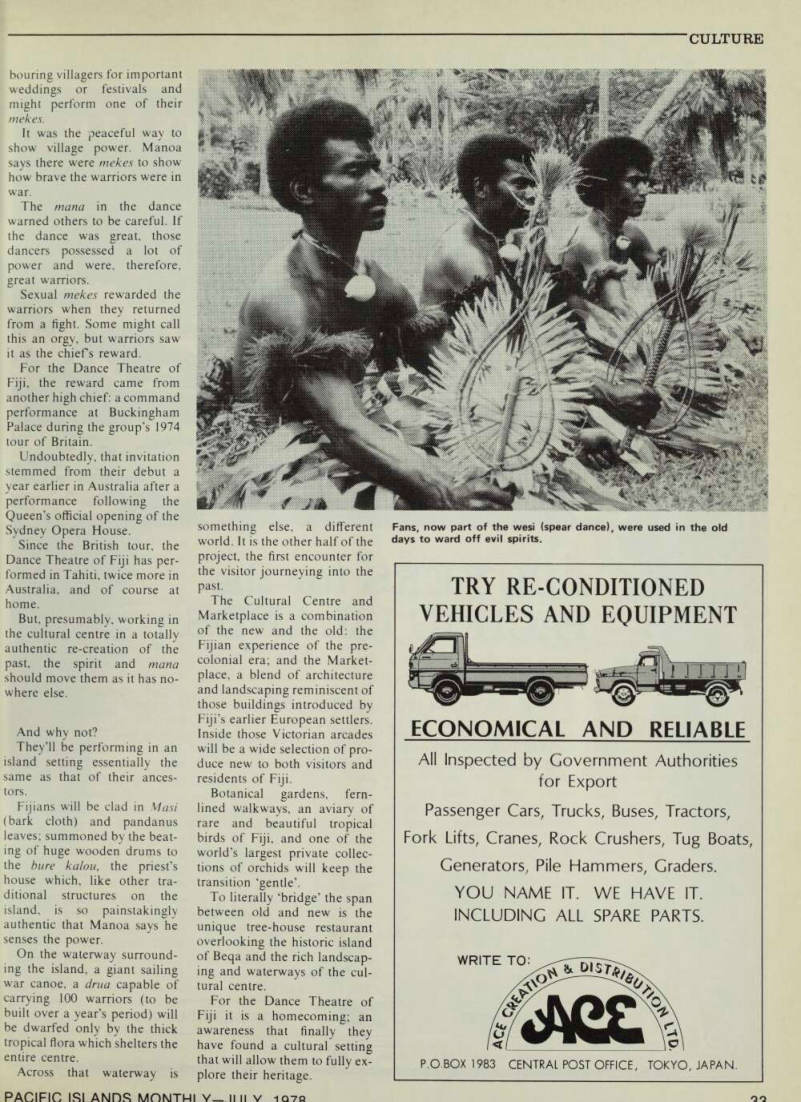
Fans, now part of the wesi (spear dance), were used in the old days to ward off evil spirits.