nostalgic round
pp. 23-26 · Read in the full issue
Tropicalities
Tigers in
the Cooks!!!
The things people say when they’re hot and bothered like when the Cooks had a visit from Hurricane Charles.
The radio announcer came out with these two gems: • Police remind all motorists using the Takuvaine Valley Road to be careful of the three tigers outside the meeting house (pause) oh! that should read ‘fighters’. • The report from Palmerston says the seas were rough in the la goon but not on the land.
It’s a bit late but worth record
ing.
A butterfly
on a flag Papua New Guinea’s most beautiful and rarest birdwing butterfly, the Alexandrae, is one of the two main features of
the flag adopted by the Oro
Provincial Government.
The green-coloured flag fea
tures the Alexandrae butterfly in the middle and the tra
ditional tapa-cloth design
lining on the margin on its end.
The Premier of the Oro Provincial Government, Mr Edric Eupu, said the Provincial Executive Council accepted the green colour of the flag, be cause it symbolised the prov ince’s wealth and prosperity in the oil palm industry while the Alexandrae butterfly, the lar gest birdwing butterfly in the world, showed that the North ern Province was famous as it was only in this part of Papua New Guinea that this rare species was found.
Mr Eupu said the traditional
tapa-cloth design in the flag
also signified that the prov ince’s links and continuity in the artifact while the black and red colours showed that although the province has its own flag, it was still part of the sovereign state of Papua New Guinea.
The winner of the flag com petition was the Popondetta Provincial High School. It had won the first and second prizes for designing the flag which
carried a prize money of K5O and K 23 respectively.
The final design of the flag was the combination of the two
prize-winning designs. The flag
competition was organised by
the Oro Provincial Govern ment and all the schools in the Northern Province took part in
the competition.
"Forgotten war"
on film?
A group of Australian film makers has been travelling around Papua New Guinea and the Solomons looking for possible locations for a film, writes Peter L. Young from Honiara. The film is to be based on a story entitled The Ridge and the River by West Australian author Tom Hun
gerford.
Hungerford’s story is based
on his experiences during
World War II when he was part of the Australian contingent on Bougainville. The film will look at this aspect of what has become, for Australia, “the for gotten war”.
By the middle of 1944 US forces were beginning to probe deep into the Pacific. New Guinea had ceased to be a vital front. From this time on Aus tralian forces were confined to
mopping up Japanese resist
ance in this backwater.
Although it would have been easier for the Australians to have set up a defensive per imeter around the Japanese forces, who were depleted by disease and malnutrition, the Australian troops were ordered to attack. As Captain Robert O’Neill, now head of the Aus tralian National University’s Institute of Strategic Studies, has written: “For a number of reasons, all of which are both
comprehensible and compli
cated, but with which it is dif ficult to agree, the Australian Government decided to follow
a vigorous, aggressive policy in
dealing with the Japanese rem nants. Perhaps it was thought that a display of great activity would give Australia a more important voice in the final surrender settlement.” The de cision to leave the Australians
behind was probably that of MacArthur who is said to have
had great difficulty working
with them and to have regarded Australians as unre liable troops.
Hungerford’s story describes the fate of a patrol of Aus
tralians on Bougainville during
“the forgotten war”. The story is about an ill-fated patrol which finds itself pursued by the Japanese and slowed down by a wounded comrade. It tells of the thoughts of these soldiers as they make their “life and death” decisions.
The “forgotten war” on Bougainville cost 516 Aus tralian dead.
After looking at sites near Port Moresby, Kieta, Honiara and Madang, the film company, Ridgeriver Films (based in Perth), went on to survey locations in Queensland. The result of their study seems to be that Queensland sites or Madang offer the best locations in terms of availability of communi cations and transport.
The crew is expected to
begin shooting in August.
At present it seems that the film will have a British director and will include Australia’s major movie star of the pre sent, Jack Thompson.
Ex-Fiji expats'
nostalgic round
The nineteenth took the lon gest time to play when ex-Fiji golfers had a reunion in Auckland in May.
About 40 players, mostly for mer members of the Fiji Golf Club in Suva, who now live in NZ, renewed old friendships over 18 holes of golf at Pukekohe Club where ex-PWD divisional engineer “Sandy” Sims was assistant secretary until recently. A nos talgic social get-together at the club afterwards lasted longer than the game. A number of
non-golfers, including the
wives of the players, joined in
the socialising.
It was the first reunion of its kind in Auckland and was so successful it is to become an annual event. The idea origin ated with John Cooper who
with “Sandy” Sims and Joe Shephard, ex-Teal flying-boat captain, did most of the work in organising and running the event. John and Joe are hoping to take some of the players and their wives back to Fiji for a golfing holiday.
Top scorer in the event was Tom Stout, several times Fiji golf champion. However, so many prizes were donated by supporters, including Air NZ, that every player received something.
During the day an appeal was made for clubs and other equipment to help caddies at Fiji Golf Club who are now encouraged to play golf there.
Competitors in the event were: David Crowe, John Aitken, Jim Jury, “Sandy”
Sims, “Boots” Oliver, Neil Freear, Dave Edmonds, John Maplesdon, Marcia Rickard, Wendy Cooper, Mary Dell, Audrey Jordan, Murray Blyth, Jack Colclough, Paddy Wad dingham, Jim Aitkenhead, George Jordan, Joe Shephard, Eric Chivers, John Wisdom, Tricia Sawyer, Jackie Nichol son, Tom Stout, Ron Cox, Basil Heath, John Cooper, Shona Rickard, Pat Riley, Doreen Nash, Rae Shephard, George Rawnsley, Bill Bygrave, John Claydon, “Buster” Jordan, Reg Smith, Don Waddell, Al Reimer and lan Nicholson.
Somare: Defence,
then attack
Parents alone have the right to decide where their children should be educated, and what type of education they should receive, according to Papua New Guinea’s Prime Minister, Michael Somare.
Mr Somare said: “It is quite natural for parents to be con cerned about their children’s education, and the majority
want the children to receive the best education possible.”
He was commenting on news reports attributed to the PNG Teachers’ Association which claimed that many top public servants and national leaders including the Prime Minister had sent their children overseas for education instead of utilis ing the country’s education sys tem.
Mr Somare used the occasion to fire a shot or two himself, saying: “From my ex periences and what I have wit nessed, the standard of education in Papua New Guinea schools is not as high as it should be.
“I hope that teachers, and experts who advise the Minis ter for Education, realise this and advise the Minister accord
ingly.
“Many teachers today are
not working as hard as they should be, and I believe it is also time to look into this so that those who are not pre pared to do their best for the country are replaced.”
The land divers
of Pentecost
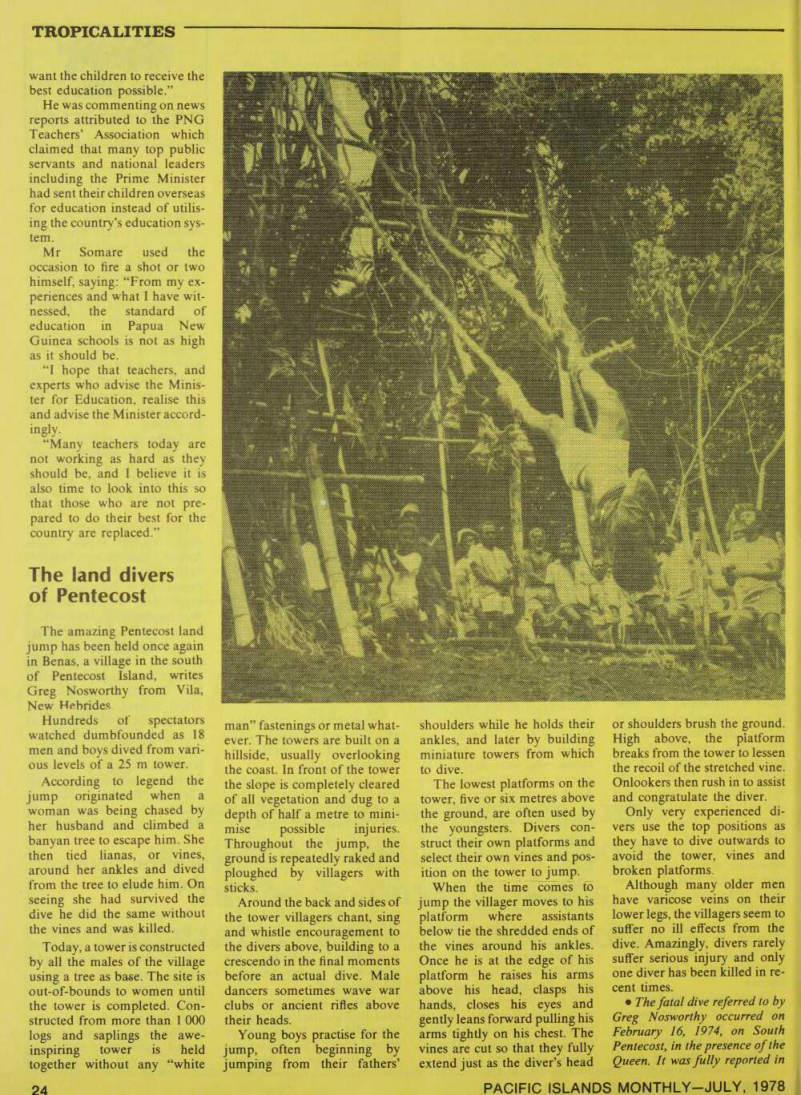
The amazing Pentecost land jump has been held once again in Benas, a village in the south of Pentecost Island, writes
Greg Nosworthy from Vila,
New Hebrides Hundreds of spectators watched dumbfounded as 18 men and boys dived from vari ous levels of a 25 m tower.
According to legend the
jump originated when a
woman was being chased by her husband and climbed a banyan tree to escape him. She then tied lianas, or vines, around her ankles and dived from the tree to elude him. On seeing she had survived the dive he did the same without the vines and was killed.
Today, a tower is constructed by all the males of the village using a tree as base. The site is out-of-bounds to women until the tower is completed. Con structed from more than 1 000 logs and saplings the awe inspiring tower is held together without any “white
man” fastenings or metal what ever. The towers are built on a hillside, usually overlooking the coast. In front of the tower the slope is completely cleared of all vegetation and dug to a depth of half a metre to mini
mise possible injuries.
Throughout the jump, the
ground is repeatedly raked and
ploughed by villagers with
sticks.
Around the back and sides of the tower villagers chant, sing and whistle encouragement to the divers above, building to a crescendo in the final moments before an actual dive. Male dancers sometimes wave war clubs or ancient rifles above their heads.
Young boys practise for the
jump, often beginning by
jumping from their fathers’
shoulders while he holds their ankles, and later by building miniature towers from which to dive.
The lowest platforms on the tower, five or six metres above the ground, are often used by the youngsters. Divers con struct their own platforms and select their own vines and pos ition on the tower to jump.
When the time comes to jump the villager moves to his platform where assistants below tie the shredded ends of the vines around his ankles.
Once he is at the edge of his platform he raises his arms above his head, clasps his hands, closes his eyes and gently leans forward pulling his arms tightly on his chest. The vines are cut so that they fully extend just as the diver’s head
or shoulders brush the ground.
High above, the platform
breaks from the tower to lessen the recoil of the stretched vine.
Onlookers then rush in to assist and congratulate the diver.
Only very experienced di vers use the top positions as they have to dive outwards to avoid the tower, vines and broken platforms.
Although many older men have varicose veins on their lower legs, the villagers seem to suffer no ill effects from the dive. Amazingly, divers rarely suffer serious injury and only one diver has been killed in re cent times. • The fatal dive referred to by Greg Nosworthy occurred on February 16, 1974, on South Pentecost, in the presence of the Queen. It was fully reported in
PIM (April 1974, p 3). John Mark Tabi, about 38, broke his spine as the vines snapped and he plunged into the ground dur ing a special land diving exhi bition for the royal visitor.
During an investigation into his death by a British District Agent, South Pentecostians offered several explanations for the fatal accident. These in cluded: • Tabi had broken a tabu in insisting that he jump from a platform constructed by another person (Obid of Ran wash). • The vines selected by Obid, who was small and light, were not suitable for Tabi, a rather stocky man. • The jumping site was on
tabu ground.
• There were too many super visors and confusion arose. Asa result the vines attached to the jumper's ankles were not well measured. • Tabi jumped with massing (love potion) in his briefs. This was the explanation given for the death of Barakon of Lond ible village who died in a similar accident many years before.
The British official came to the conclusion there was nothing mysterious about the accident juat plain human error.
Picture: Greg Conley
Tonga, cradle
of Polynesia?
Contrary to popular belief in Polynesia, Samoa, may not be the cradle of the Polynesians in the South Pacific. It might be Tonga.
Students from Tonga’s ‘Atenisi University have been doing a lot of digging at an ancient dwelling site near the
Police Academy compound in
Nukualofa and have found fragments of pottery, the Lapita type, and other artifacts.
It is believed that some of the pieces could be 3 000 years old.
According to experts using the carbon-dating method, the oldest was made about 1140 BC.
The Lapita trail seems to have started somewhere around New Britain in Papua
New Guinea, passed through
New Caledonia and Fiji to Tonga and then to Samoa where it ends. Pottery found in Samoa, going by the carbon dating method, is not as old as that found in Tonga, which suggests that Tonga was settled
by the Polynesians before
Samoa.
Now it’s up to the Samoans to find something older than what the Tongans possess.
Pitcairners
lose an island!
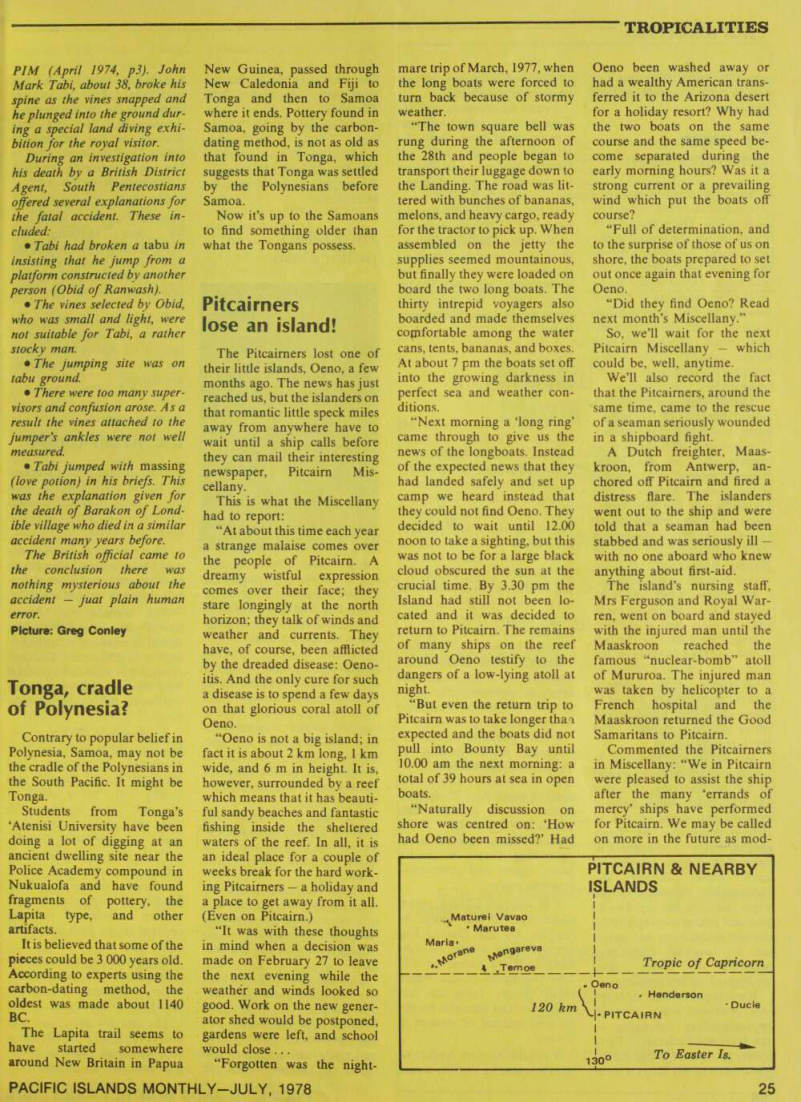
The Pitcairners lost one of their little islands, Oeno, a few months ago. The news has just reached us, but the islanders on that romantic little speck miles away from anywhere have to wait until a ship calls before they can mail their interesting newspaper, Pitcairn Mis
cellany.
This is what the Miscellany had to report: “At about this time each year a strange malaise comes over the people of Pitcairn. A
dreamy wistful expression
comes over their face; they stare longingly at the north horizon; they talk of winds and weather and currents. They have, of course, been afflicted by the dreaded disease: Oeno itis. And the only cure for such a disease is to spend a few days on that glorious coral atoll of Oeno.
“Oeno is not a big island; in fact it is about 2 km long, 1 km wide, and 6 m in height. It is, however, surrounded by a reef which means that it has beauti ful sandy beaches and fantastic fishing inside the sheltered waters of the reef. In all, it is an ideal place for a couple of weeks break for the hard work ing Pitcairners a holiday and a place to get away from it all. (Even on Pitcairn.) “It was with these thoughts in mind when a decision was made on February 27 to leave the next evening while the weather and winds looked so good. Work on the new gener ator shed would be postponed, gardens were left, and school would close ..,
“Forgotten was the night
mare trip of March, 1977, when the long boats were forced to turn back because of stormy weather.
“The town square bell was rung during the afternoon of the 28th and people began to transport their luggage down to the Landing. The road was lit tered with bunches of bananas, melons, and heavy cargo, ready for the tractor to pick up. When assembled on the jetty the supplies seemed mountainous, but finally they were loaded on board the two long boats. The
thirty intrepid voyagers also
boarded and made themselves comfortable among the water cans, tents, bananas, and boxes.
At about 7 pm the boats set off into the growing darkness in perfect sea and weather con ditions.
“Next morning a ‘long ring’
came through to give us the news of the longboats. Instead of the expected news that they had landed safely and set up camp we heard instead that they could not find Oeno. They decided to wait until 12.00 noon to take a sighting, but this was not to be for a large black cloud obscured the sun at the crucial time. By 3.30 pm the Island had still not been lo cated and it was decided to return to Pitcairn. The remains of many ships on the reef around Oeno testify to the dangers of a low-lying atoll at
night.
“But even the return trip to Pitcairn was to take longer tha i expected and the boats did not
pull into Bounty Bay until
10.00 am the next morning: a total of 39 hours at sea in open boats.
“Naturally discussion on shore was centred on: ‘How had Oeno been missed?’ Had
Oeno been washed away or had a wealthy American trans ferred it to the Arizona desert for a holiday resort? Why had the two boats on the same course and the same speed be
come separated during the
early morning hours? Was it a strong current or a prevailing wind which put the boats off course?
“Full of determination, and to the surprise of those of us on shore, the boats prepared to set out once again that evening for Oeno.
“Did they find Oeno? Read next month’s Miscellany.”
So, we’ll wait for the next Pitcairn Miscellany which could be, well, anytime.
We’ll also record the fact that the Pitcairners, around the same time, came to the rescue of a seaman seriously wounded
in a shipboard fight.
A Dutch freighter, Maas kroon, from Antwerp, an chored off Pitcairn and fired a distress flare. The islanders went out to the ship and were told that a seaman had been stabbed and was seriously ill with no one aboard who knew anything about first-aid.
The island’s nursing staff, Mrs Ferguson and Royal War ren, went on board and stayed with the injured man until the Maaskroon reached the famous “nuclear-bomb” atoll of Mururoa. The injured man was taken by helicopter to a French hospital and the Maaskroon returned the Good Samaritans to Pitcairn.
Commented the Pitcairners in Miscellany: “We in Pitcairn were pleased to assist the ship after the many ‘errands of
mercy’ ships have performed
for Pitcairn. We may be called on more in the future as mod-
em ships are tending less and less to carry qualified medical
personnel.”
Fiji sugar
generates heat
Sugar has often been a sub ject to generate heat, not sweet ness, in Fiji. There was a lot of ill-feeling in elections for the new Sugar Advisory Council which will take office in July, and some of this erupted at one of the last meetings of the old council. In fact, it erupted to such an extent that two mem bers threw punches at each other, forcing other council members to intervene and re store order.
The meeting was then post poned because of the atmos phere which had been created.
The row started, according to reports, when Mr Abu Bakar Koya, a brother of Mr Siddiq Koya, former Leader of the Opposition in the Fiji Parlia ment who came within an ace of becoming Prime Minister in 1977, questioned the right of Swami Rudrananda to rep resent farmers in the council.
Mr Siddiq Koya has been active in sugar affairs for more than 20 years, first as a union representative back in the late 19505, and then working on be half of growers. Swami Rudrananda is the growers’ senior representative. Mr A. B.
Koya challenged the swami to prove he had a mandate from the farmers.
Mr Koya was reported to have moved close to the swami as he was speaking, at which Mr Ram Sami Pillay, another
growers’ representative, rose to
defend the swami. Mr Koya and Mr Pillay were reported to have then thrown punches at each other, forcing the independent chairman of the sugar industry, Mr lan Thom son, and others members of he council to intervene and separ ate the two. Mr Koya was reported to have later
apologised to the meeting.
It was reported that Mr Koya
was provoked when growers’
representatives belonging to
the National Federation Party flower group and Kisan Sangh group moved Mr Koya’s chair
and refused to let him sit as a
growers’ representative.
Swami Rudrananda and Mr Koya were re-elected to be on a panel of 10 from whom the Minister of Agriculture, Mr Charles Walkers, will choose five to serve on the new coun cil.
In the early 19605, when the late Mr A. D. Patel was leader of growers who refused to cut their cane, two of his closest as sociates were Swami Rudrananda and Mr Siddiq Koya. Out of the cane strike came the National Federation
Party.
Oscar for
the governor
The Governor of Guam, Mr Ricardo J. Bordallo, a travel bureau, a church parish com mittee, an airport authority and an airline received “Oscars” from the Guam Visitors Bu reau for outstanding contri butions to the island’s tourist industry in 1977.
Governor Bordallo received the Golden Latte award, for the individual who contributed most to tourism over a cumu lative period. It was he who first saw Japan as a market for Guam long before air transport became a reality. In his official capacity as a legislator and later as governor he made many contributions to the tour
ist industry.
Other “citations” were: • Japan Travel Bureau, of
Tokyo, the Outstanding Over
seas Promotion award for sending more than 20 000 visi tors to Guam annually, and
conducting a nine-city “Bridal
Festival” featuring entertainers promoting Guam to media, travel agents and prospective
honeymooners;
• St Joseph’s Church parish committee, of the village of
Inarjan, for the Outstanding
Local Project award for cre ating Lanchon Antigo, an old time Chamorro village, where older people carry on tra ditional island activities for the cultural interest of visitors to Guam; • Guam Airport Authority,
the Outstanding Facility award
for renovating the airport in appearance, expansion and
efficiency;
• Continential/Air Micro nesia, the Outstanding Medium award for production of a film, Discover Mirconesia, promoting travel to Guam and Micronesia.
Fiji's latest
publication
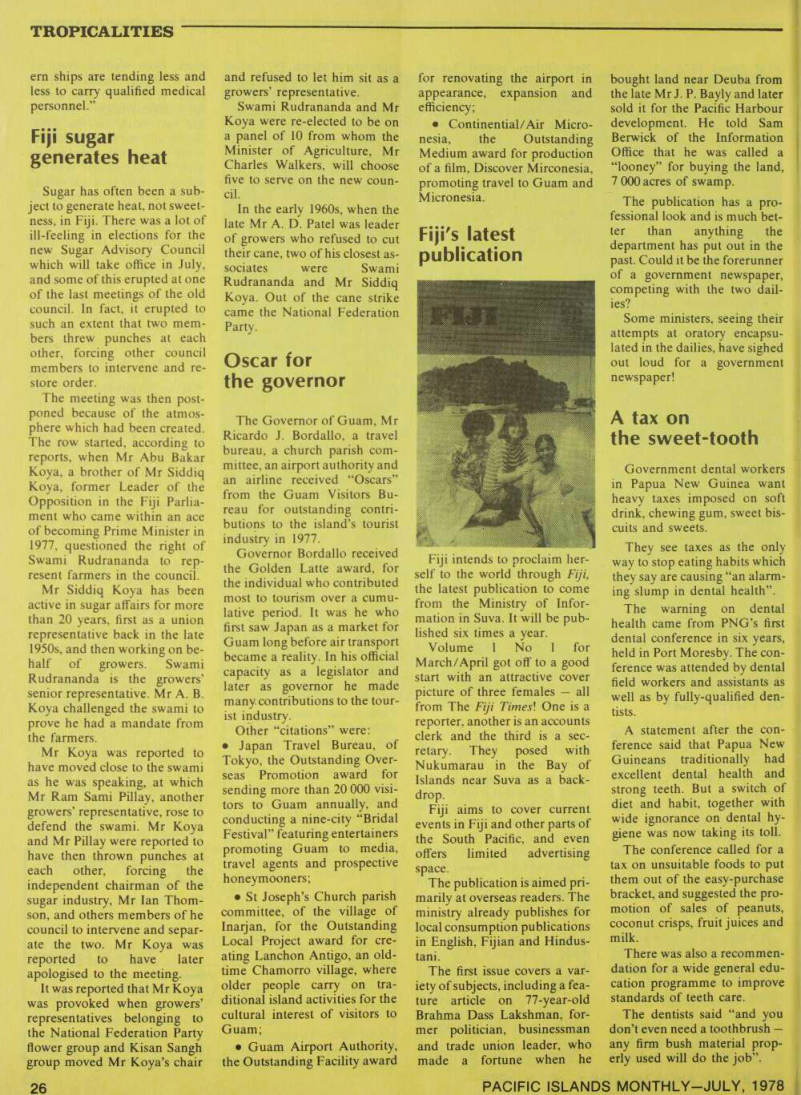
Fiji intends to proclaim her self to the world through Fiji, the latest publication to come from the Ministry of Infor mation in Suva. It will be pub lished six times a year.
Volume 1 No 1 for March/April got off to a good start with an attractive cover picture of three females all from The Fiji Times'. One is a reporter, another is an accounts clerk and the third is a sec
retary. They posed with
Nukumarau in the Bay of Islands near Suva as a back
drop.
Fiji aims to cover current events in Fiji and other parts of the South Pacific, and even offers limited advertising space.
The publication is aimed pri marily at overseas readers. The
ministry already publishes for
local consumption publications
in English, Fijian and Hindus tani.
The first issue covers a var
iety of subjects, including a fea
ture article on 77-year-old Brahma Dass Lakshman, for mer politician, businessman and trade union leader, who made a fortune when he
bought land near Deuba from the late Mr J. P. Bayly and later sold it for the Pacific Harbour development. He told Sam Berwick of the Information Office that he was called a “looney” for buying the land, 7 000 acres of swamp.
The publication has a pro fessional look and is much bet ter than anything the department has put out in the past. Could it be the forerunner of a government newspaper, competing with the two dail ies?
Some ministers, seeing their attempts at oratory encapsu lated in the dailies, have sighed out loud for a government
newspaper!
A tax on
the sweet-tooth
Government dental workers in Papua New Guinea want heavy taxes imposed on soft drink, chewing gum, sweet bis cuits and sweets.
They see taxes as the only way to stop eating habits which they say are causing “an alarm ing slump in dental health”.
The warning on dental health came from PNG’s first dental conference in six years, held in Port Moresby. The con ference was attended by dental field workers and assistants as well as by fully-qualified den tists.
A statement after the con ference said that Papua New Guineans traditionally had excellent dental health and strong teeth. But a switch of diet and habit, together with wide ignorance on dental hy giene was now taking its toll.
The conference called for a tax on unsuitable foods to put them out of the easy-purchase bracket, and suggested the pro motion of sales of peanuts, coconut crisps, fruit juices and milk.
There was also a recommen dation for a wide general edu cation programme to improve standards of teeth care.
The dentists said “and you don’t even need a toothbrush any firm bush material prop erly used will do the job”.