the end of a great experiment?
pp. 21-27 · Read in the full issue
Education in the Solomon Islands: the end of a great experiment?
EDUCATION The politicians are in danger of ruining a promising plan for education in the Solomons, writes Dr Robert Waddell, senior lecturer in the University of New South Wales and, for six years, in the Department of Political Studies at the University of Papua New Guinea. Below, Dr Waddell presents the case for “Hands off the New Secondary Schools”.
Post-colonial history re sounds with the noise of stable doors being tightly shut long after the horses have bolted.
This is especially true in the field of education where des perate attempts are made sev eral years too late to adapt or remould the schools to ‘fit the realities’ of the African/Asian/ Pacific situation.
A recent and welcome exception to the rule was the establishment of New Second ary Schools in the Solomon Islands.
This was an imaginative and bold innovation designed to avoid the problems which have arisen in almost every other ex colonial territory as a result of continuing with an educational
system designed by a foreign
power for its own particular ad ministrative and commercial ends.
The Solomon Islands, it seemed, had dared to face the future and to plan an edu cational system to fit its own self-chosen ends of self reliance and decentralised rural development. The New Secondary Schools were the outcome of a review which resulted in the publication in 1974 of a report entitled Edu cation for what?
No doubt many papers with similar titles had been written in the past but what distin
guished this particular docu
ment from its predecessors was that the Solomon Islands’
Ministry of Education actually
put its main recommendations into practice. The Solomon Islands were thus set to make educational history. The recommendations were pre sented to the members of the
Legislative Assembly in a
White Paper in 1974 and ap proved by them. In 1976 the first four schools were opened.
They were followed by four more schools in 1977. It was the
aim eventually to establish one New Secondary School in each area of about 5000 people.
The novelty of the concept of New Secondary Schools was that they were designed to do precisely what all educational institutions are supposed to do, namely, to prepare people to play a useful role in life, not as it is lived in London or Sydney or even Honiara but as it is lived in Vella Lavella, Makira, Santa Ysabel and all the other islands where the vast majority of Solomon Islanders live and work.
The schools were designed, and their curriculum and staff chosen, to help to fit children and to a growing extent the wider community into an
essentially rural society in
which unavoidable and largely desirable changes would de mand of them new knowledge, skills and habits of work.
To appreciate fully the bold ness of this concept one has to realise that the history of edu cation in the Solomon Islands had thus far followed a well worn track: starting with a long period in which the churches made all the running and end ing with a much shorter period in which the colonial govern ment, in a belated burst of
activity, created a national edu cation system.
The system was pyramidal and at its apex were five high schools or national secondary
schools namely King George
VI, Selwyn, Goldie, Tenaru and Su’u. The Seventh-day Adventist School, Betikama, contrived to remain separate.
The scene, in other words, was set for the classic post colonial situation in which, after one or two years of independence, a shocked government discovers that it has a terrible and seemingly unavoidable school-leaver problem on its hands, ac
companied by irresistible
pressure from the electorate for the establishment of yet more schools.
Such a position has already been reached in Papua New Guinea. We read in the National Public Expenditure Plan 1978-1981 that ‘the achievement of universal pri mary education is one of the major aims of government’ and that ‘secondary education has expanded and will continue to expand’ while at the same time and in the same section it is admitted that ‘over half of the primary school-leavers will not be able to continue on to further education or find wage
employment’ and that ‘the number of grade 10 (ie Form IV) school-leavers is already in excess of the demand for skilled manpower and any expansion of enrolments at sec ondary level will increase the number of school-leavers un able to find wage employ ment’.
The architects of the New Secondary Schools had the wis dom to benefit from the mis takes of others and to take appropriate action. While they acknowledged the need for producing a limited number of people trained in clerical, ad ministrative and scientific skills they saw that the existing National Secondary Schools were likely to be able to fulfil
this requirement.
On the other hand they realised that primary schools alone would not produce people with either sufficient maturity or skill to promote the kind of development in the rural areas of which the poli ticians and planners so often
spoke.
Originally, and perhaps
more accurately called Area Training Schools, the New Sec ondary Schools were intended to be the normal sequel to pri mary schools. As at present constituted they offer two-year courses of considerable flexi bility a necessity when one considers the wide variety of geographical and other circum stances encountered in the Solomon Islands. The main areas in which various modules are available are: homecraft, including health, first aid and diet; handicraft, which covers design as well as manufacture;
agriculture and fishing, includ
ing both theory and practice as
well as the techniques of run ning a business such as mar
ket gardening; development
studies, which is designed to give students an understanding
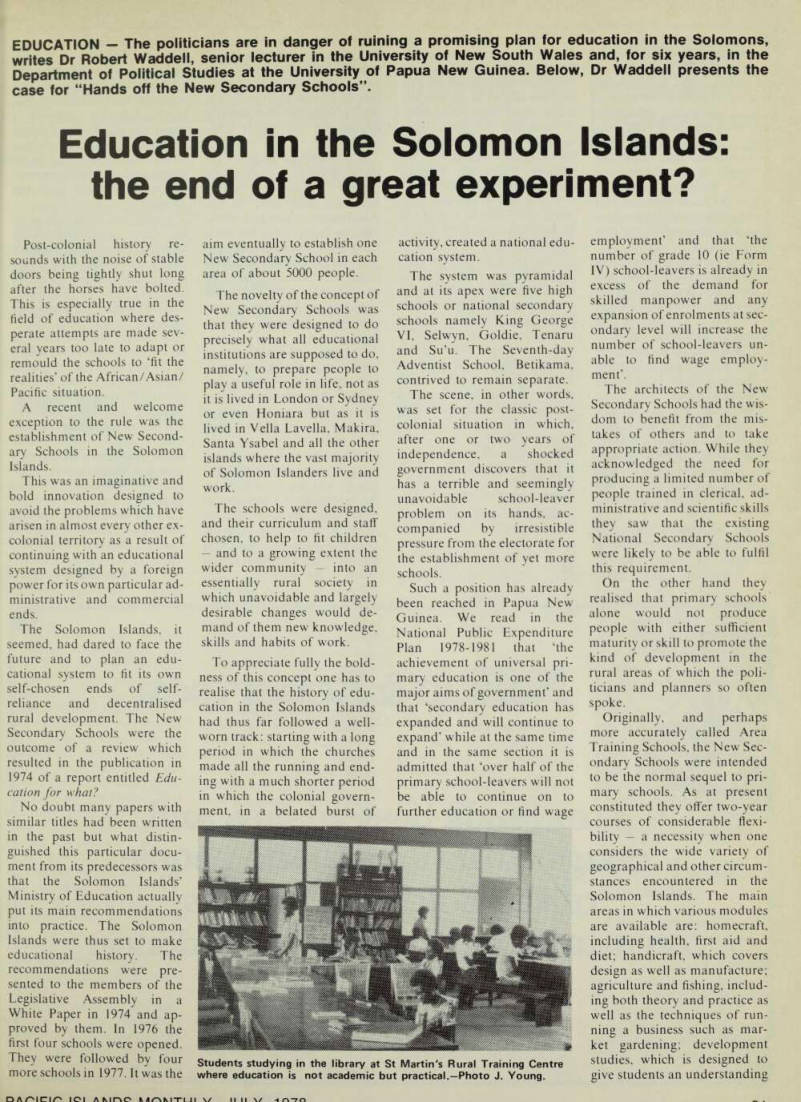
Students studying in the library at St Martin's Rural Training Centre where education is not academic but practical. Photo J. Young.
of local and national develop ment plans, the ability to exam ine proposals critically, and an awareness of the various other options which may be open to them; physical education, including the arts of refereeing and organising games and competitions; and, most im portantly in the Solomonese context, religious studies in which the local churches play an important part, although no school is attached to any par ticular church.
It can be seen from this all too-brief summary of the cur riculum that these schools are no mere vocational schools but places which are designed to
produce intelligent citizens
with practical skills, equipped
to play a useful part in both the economic and political life of the country. ‘We must ask the people what they think’ is a common cry in Solomonese politics; people trained in New Second ary Schools are able to give informed answers and advice to their elected represen tatives.
Two important principles
are that the schools should be practical and local. To ensure that the schools remain prac
tical the staffs have been chosen for their practical rather than their academic abilities; they have been chosen because they are skilled in the arts and crafts which they are required to teach and not, for instance for their ability to teach the conventional staples of the academic schools, English, mathematics and science.
This is not to say that such subjects will not be learned as by-products of subjects such as
agriculture and development
studies. Teachers are, however,
required to undergo a training
course in teaching methods and a certain amount of instruction
in key subjects before they are
sent out to join their schools.
The principle that schools should be local is very import ant. The intention here was to break with the tradition that children were sent away from their home environment to school, as if school was some thing exotic and far removed,
both physically and psycho
logically, from everyday life.
The new schools were intended to be part and parcel of the local scene, as indeed the best of the church schools had been. It was envisaged that when the new schools were
spread throughout the country
and there were plans for at least 20 of them on the drawing board they would serve not just as schools but as meeting places, libraries, and resource centres for the whole com
munity.
It is important to point out that because the schools did not prepare people for further schooling there were no ter minal examinations and, there fore, no failures. On the other hand the schools did profess to prepare people for the real world and it was, therefore, im portant that there should be opportunities for them to exer cise their talents in the vil
lages.
The provision of such oppor tunities was not the responsi bility of the schools, since they lacked the resources for a proper follow-up programme, but it was or should have been the responsibility of the government, both central and local, in co-operation with the schools and the parents. From the beginning the Ministry of Education made strenuous attempts to see that as many people as possible in the com munity were involved in the affairs of the schools.
Whatever dreams the edu cational planners may have had about their new schools were shattered in the closing weeks of April when the Legis lative Assembly debated a paper put out by the Council of Ministers in which the whole educational scene came under review and certain recommen dations for change were put forward.
Among the most important of these recommendations were that all secondary schools should be officially called Sec ondary Schools, with no prefix such as ‘New’ or ‘National’; that the former New Secondary Schools should provide a three year course; that there should be a nation-wide examination at the end of the third year to determine who should proceed to Form IV at one of the former National Secondary Schools; and that all schools should pro vide a common-core curric ulum, which was almost certain to be the familiar trinity of sci ence, mathematics and
English.
As the debate progressed, it became apparent to at least one observer that few of the par
• Continued on page 27
ticipants were aware that what they were about to approve was not some kind of ‘fine tuning’ but a fundamental change; they were, in fact, about to strangle, almost at its birth, one of the few progressive edu cational experiments to have appeared in recent times.
While it is impossible to forecast all the consequences which will flow from this de cision, some of the more obvious can be readily predicted. The almost inevi table introduction of a conven tional academic curriculum means that the (New) Second ary Schools will become a mere link (and an inferior one at that) in the primary-secondary tertiary chain; the change in curriculum will mean the im portation of new teachers since the existing teachers are in no way suitably qualified to teach ‘straight’ science, mathematics and English; the new teachers will almost certainly have to come from abroad which will be an expensive and from the point of view of both the local isation programme and the de sire to make the schools ‘local’ in every sense of the word a
retrograde step; the existing
staff, who have hitherto been
inspired by the thought that
they were taking part in a great and worthwhile experiment in education for rural develop ment, may well lose heart and wish to abandon their posts; the introduction of a national examination at the end of the third year will mean that the great majority of the pupils predominantly those from the (New) Secondary Schools will not only fail because the number of places available in Form IV will remain un changed for some time but will come to regard themselves as failures instead of, as pre viously, people who have been educated to make a practical and valuable contribution to the development of their home areas.
The addition of a third year to the (New) Secondary Schools will mean a reduction in the number of people who can receive post-primary edu cation since the schools are only designed to house and cater for 210 pupils each.
The new scheme will involve great additional expenditure both because the new teachers.
whether national or expatriate, will have higher salaries than the existing ones and because if there is to be any semblance of parity between (New) and (National) Secondary Schools the facilities of the former will have to be vastly upgraded how many expatriate teachers, for example, would be pre pared to live in a leaf house in a remote area lacking any mod ern conveniences?
The extra cost of upgrading the existing schools will prob ably mean the indefinite post ponement of plans to cover the whole country with secondary schools; the new scheme may also involve the government in delicate and possibly embar
rassing negotiations with the
principal aid-givers who, one
understands, made substantial financial contributions to the costs of establishing New Sec ondary Schools on the under standing that the latter would retain their essentially rural and local character; and, finally, there is the under mining of the whole admirable concept of an education truly suited to local needs.
Why have the parliamen
tarians voted in favour of this
drastic change? Perhaps be
cause the full implications were not made clear to them or be cause in their inner hearts they, like so many before them, be lieve that the only worthwhile jobs are those very few which lie at the end of the old familiar academic trail or because they believe that the town and not the country is where all pro gress and modernisation are to be found. And perhaps people everywhere will continue to make this choice until some en
ergetic and far-seeing govern
ment puts its whole weight behind the promotion of genu ine rural development instead of hoping that it will somehow come about as the by-product of capital-intensive, foreign run, large-scale, industrialised agriculture, mineral extraction,
fishery and timber mining.
It is a great pity that such a fate should seemingly be in store for the Solomon Islands, one of the most attractive and tranquil countries in the world.
Corruptio optimi pessima. But perhaps even now it is not too late to follow an established Solomonese custom and to ‘ask the people what they think’.