The last liner sails-end of
pp. 63-65 · Read in the full issue

an era in the South Pacific
Transport
SHIPPING Where have all the lovely line ships gone to the breakers everyone, or nearly everyone. Today, the jumbo aircraft serve the Pacific and the line ships have almost all disappeared. James L. Shaw, of Portland, Oregon, USA, bids a nostalgic farewell to the ships.
The end of an era in sea transportation has almost come about in the South Pacific. With the recent ter mination of passenger services by Lloyd Triestino Line, Chandris and Pacific Far East Line, long-distance liner ser vices in the region have been reduced to only a few scheduled sailings a year. At one time the great ships were often the only means of transportation in or out of the Islands. Today, they are but anachronisms of an earlier age. To be sure, passenger ships are still to be seen in the major ports of the Pacific, but today’s vessel is most often a “cruise liner’’, operated for pleasure rather than purpose relaxation rather than transportation.
Only two companies con tinue to operate line services that touch at island ports, and these are on a season basis.
CTC Line, using Russian flag vessels, offers two sailings a year between Europe and Australia via Panama and Fahiti. P & O Line schedules he 42 600 tonne Oriana hrough Honolulu and Suva wice a year on her position ng voyage to Australia and he United Kingdom. These, lowever, are but a small rem nant of the past services op erated by such lines as Shaw Savill. Royal Dutch Mail, Line, China Navigation tnd others. Ships whose names were known by every ichoolchild are now largely »one while their owning com lanies have diversified into )ther trades.
Perhaps the best known of he liner companies are Eng and’s P & O Line and Orient -ine. Created in the early 1800 s by merchant Arthur
\nderson and ship broker
3rodie M’ghie Wilcox, Penin mlar & Orient Lines grew apidly to become one of the
vorld’s largest shipping lines,
n 1954, shortly after the last rans-Pacific sailing of Cana iian Australasian Line’s \orangi (scrapped in 1953), Orient Line extended its route tcross the Pacific making Regular calls at Honolulu and Suva. Liners with the far off
European names of Oronsay, Orcades and Orsova, became well-known and welcome guests at island ports. P & O joined in with ships such as Himalaya, Arcadia and Iberia. Then the two lines merged to become P & O Orient. In 1960, two new vessels slid down the ways to join this impressive fleet.
Oriana and Canberra, two of the world’s largest passenger ships, began regular round the-world services that car ried them through the South Pacific every few months.
In less than a decade, the introduction of jet aircraft on world air routes, however, dictated a change in passenger ship marketing that had far reaching effects. Cruising, once only the pastime of the rich, was tried on a larger scale, and succeeded. P & O's great liners were quickly adapted to this new trade.
Voyages were no longer point-to-point but round cir cle trips which brought the passengers back to their original starting points. The “cruise ship”, a holiday vessel rather than a means of transportation, was born.
Through the late 1960 s and early 19705, P & O liners were increasingly taken off line runs and placed into cruise service. Yet even this more lucrative trade could not stem the inevitable rising costs and uneconomical design of several of the older vessels. In 1972, Iberia became the first of P & O’s post-war liners to go to the breakers. She sailed on her last voyage for the scrapyards of Taiwan on June 28, 1972, followed exactly six months later by the slightly older Orcades. Next to go was Orsova, a successful cruise ship which was replaced on the round-the-world itinerary by the newer and larger Can berra. Orsova reached Kaoh siung on February 14, 1974, in turn followed by Himalaya on November 28 of the same year. In 1975 it was Oronsay’s turn. This popular ship left the United Kingdom in August of that year on her final voyage to Hong Kong, Taiwan and extinction. To
day, only Arcadia,Oriana and Canberra are left of P & O's large liners. All have been pressed into cruising. Arcadia taking up Oronsay’s former position out of Sydney while Oriana comes South from England each November and returns to the northern cli mates in April. Canberra now passes through only once a year on her annual world cruise.
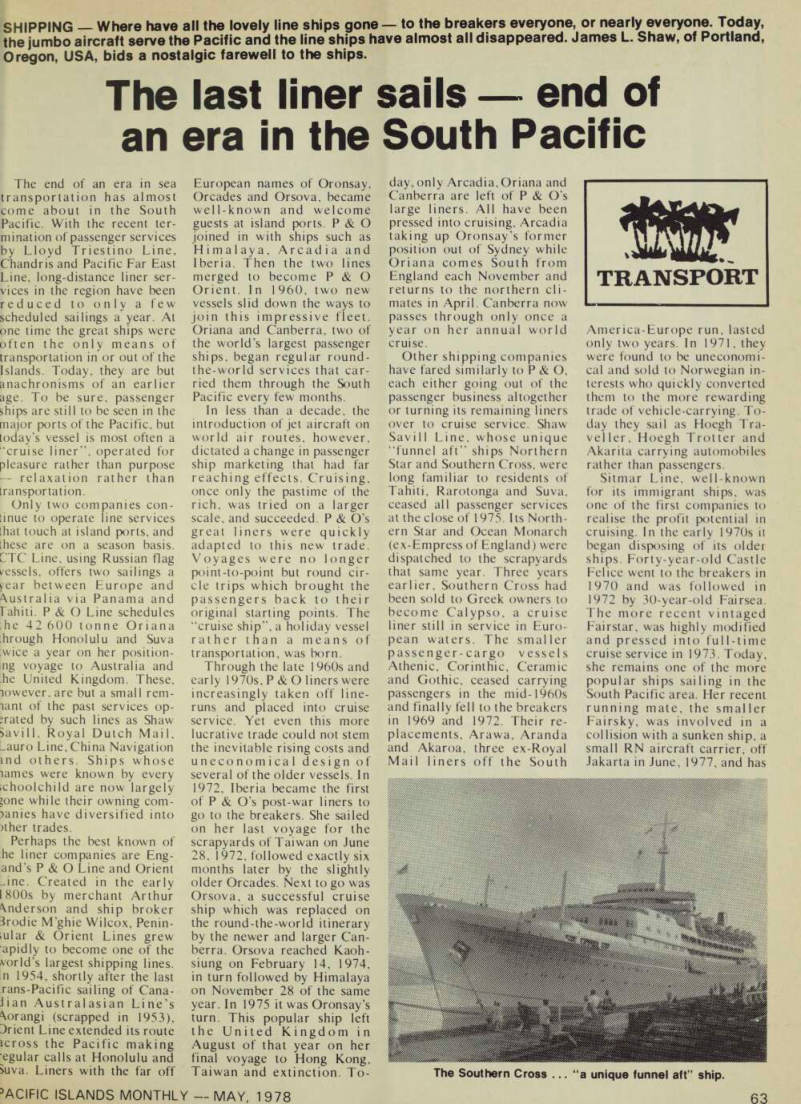
Other shipping companies have fared similarly to P & O, each either going out of the passenger business altogether or turning its remaining liners over to cruise service. Shaw Savill Line, whose unique “funnel aft” ships Northern Star and Southern Cross, were long familiar to residents of Tahiti, Rarotonga and Suva, ceased all passenger services at the close of 1975. Its North ern Star and Ocean Monarch (ex-Empress of England) were dispatched to the scrapyards that same year. Three years earlier. Southern Cross had been sold to Greek owners to become Calypso, a cruise liner still in service in Euro pean waters. The smaller passenger-cargo vessels Athenic, Corinthic, Ceramic and Gothic, ceased carrying passengers in the mid-1960s and finally fell to the breakers in 1969 and 1972. Their re placements, Arawa, Aranda and Akaroa, three ex-Royal Mail liners off the South
America-Europe run. lasted only two years. In 1971, they were found to be uneconomi cal and sold to Norwegian in terests who quickly converted them to the more rewarding trade of vehicle-carrying. To day they sail as Hoegh Tra veller. Hoegh Trotter and Akarita carrying automobiles rather than passengers.
Sitmar Line, well-known for its immigrant ships, was one of the first companies to realise the profit potential in cruising. In the early 1970 s il began disposing of its older ships. Forty-year-old Castle Felice went to the breakers in 1970 and was followed in 1972 by 30-year-old Fairsea.
The more recent vintaged Fairstar, was highly modified and pressed into full-time cruise service in 1973. Today, she remains one of the more popular ships sailing in the South Pacific area. Her recent running mate, the smaller Fairsky, was involved in a collision with a sunken ship, a small RN aircraft carrier, off Jakarta in June, 1977, and has
The Southern Cross... “a unique funnel aft” ship.
since been removed from Sit mar cruise brochures.
The sleek liners of the Italian Lloyd Triestino Line were said to be some of the most beautiful ships in the South Pacific trade. The twin sisters Gugliemo Marconi and Galileo Galilei made several exploratory runs through the South Pacific in the early
1970 s touching at Auckland,
Noumea, Suva and Papeete.
This route soon became stan dardised and the two ships were welcome additions to the Pacific Island transportation picture. In 1976, however, Marconi was transferred to Italia Line and began plying the route between South America and Europe for that :ompany. In late 1977, both liners were unexpectedly withdrawn from service leav ing thousands of passengers stranded. A short announce ment stated that the two vessels were to be converted aver to cruising for the North American market.
The other Italian liners which have now disappeared from the South Pacific are the 'Xngelina Lauro and Achille Lauro. Converted from the former Dutch liners, Oranje and Willem Ruys which op erated the Royal Dutch Mail service until 1964, the two Lauro ships and their bright blue hulls pioneered a new route from New Zealand to Europe by way of the Strait of Magellan at the tip of South America. Though considered usable for passenger service ?nly a few months out of the /ear (the weather not being :onducive to suntans) the •oute was popular and has low been undertaken by CTC Line’s Shota Rustevali once a /ear. Lauro Line itself bowed lut of the liner service to con :entrate on full-time cruising n the Caribbean and Mediterranean.
For many years the French taperated several passenger liners into the South Pacific from Panama, lacing together the French ports of Papeete, Vila and Noumea to Sydney.
They were smaller vessels than the British or Italian ships, usually carrying cargo as well as passengers. By 1971, however, they were gone. The elderly Melanesien, a ship of many names, went to the breakers in 1963 followed several years later by the Oceanien. Sister vessels Caledonien and Tahitien con tinued in service until the
start of the 1970 s when they were both retired from service and sold to Greek owners.
Tahitien lives on in the Mediterranean as cruise ship Atalante while Caledonien slowly decays in Perama Bay outside Athens, as Island of Cyprus. Even little Polynesie, a small cargo-passenger vessel on the Sydney-Noumea run, has now gone to Singaporean owners as Golden Glory, a cargo-only vessel.
New Zealand, like France, operated a number of smaller liners in the Pacific trade, and like those of the European country, all were also cargo carriers. New Zealand Ship ping Co operated five liners between Europe and New Zealand until 1962 when the elderly sisters Rangitata and Rangitiki were both sold for scrap. The newer Rangitane, Rangitoto and Ruahine con tinued on until 1968 when all three were sold to the Taiwanese-based Orient Overseas Line. They con tinued to trade as Oriental Esmerelda, Oriental Car nivale and Oriental Rio until the mid-1970s when all were finally sent to the breakers.
The stalwart little passenger vessels of Union Line of New Zealand met a similar fate.
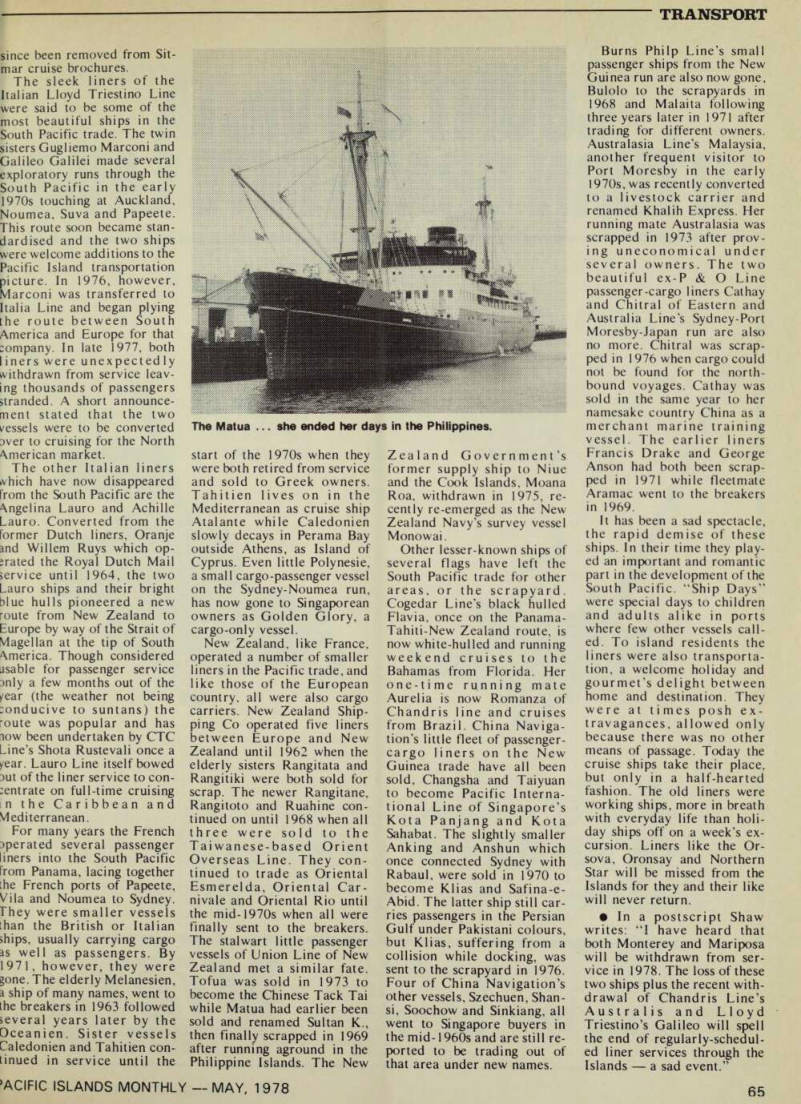
Tofua was sold in 1973 to become the Chinese Tack Tai while Matua had earlier been sold and renamed Sultan K., then finally scrapped in 1969 after running aground in the Philippine Islands. The New
Zealand Government’s former supply ship to Niue and the Cook Islands, Moana Roa, withdrawn in 1975, re cently re-emerged as the New Zealand Navy’s survey vessel Monowai.
Other lesser-known ships of several flags have left the South Pacific trade for other areas, or the scrapyard.
Cogedar Line’s black hulled Flavia, once on the Panama- Tahiti-New Zealand route, is now white-hulled and running weekend cruises to the Bahamas from Florida. Her one-time running mate Aurelia is now Romanza of Chandris line and cruises from Brazil. China Naviga tion’s little fleet of passenger cargo liners on the New Guinea trade have all been sold, Changsha and Taiyuan to become Pacific Interna tional Line of Singapore’s Kota Panjang and Kota Sahabat. The slightly smaller Anking and Anshun which once connected Sydney with Rabaul, were sold in 1970 to become Klias and Safina-e- Abid. The latter ship still car ries passengers in the Persian Gulf under Pakistani colours, but Klias, suffering from a collision while docking, was sent to the scrapyard in 1976.
Four of China Navigation’s other vessels, Szechuen, Shan si, Soochow and Sinkiang, all went to Singapore buyers in the mid-1960s and are still re ported to be trading out of that area under new names.
Burns Philp Line’s small passenger ships from the New Guinea run are also now gone, Bulolo to the scrapyards in 1968 and Malaita following three years later in 1971 after trading for different owners.
Australasia Line’s Malaysia, another frequent visitor to Port Moresby in the early 19705, was recently converted to a livestock carrier and renamed Khalih Express. Her running mate Australasia was scrapped in 1973 after prov ing uneconomical under several owners. The two beautiful ex-P & O Line passenger-cargo liners Cathay and Chitral of Eastern and Australia Line’s Sydney-Port Moresby-Japan run are also no more. Chitral was scrap ped in 1976 when cargo could not be found for the north bound voyages. Cathay was sold in the same year to her namesake country China as a merchant marine training vessel. The earlier liners Francis Drake and George Anson had both been scrap ped in 1971 while fleetmate Aramac went to the breakers in 1969.
It has been a sad spectacle, the rapid demise of these ships. In their time they play ed an important and romantic part in the development of the
South Pacific. “Ship Days’’
were special days to children and adults alike in ports where few other vessels call ed. To island residents the liners were also transporta tion, a welcome holiday and gourmet’s delight between home and destination. They were at times posh ex travagances, allowed only because there was no other means of passage. Today the cruise ships take their place, but only in a half-hearted fashion. The old liners were working ships, more in breath with everyday life than holi day ships off on a week’s ex cursion. Liners like the Or sova, Oronsay and Northern Star will be missed from the Islands for they and their like will never return. • In a postscript Shaw writes: “I have heard that both Monterey and Mariposa will be withdrawn from ser vice in 1978. The loss of these two ships plus the recent with drawal of Chandris Line’s Australis and Lloyd Triestino’s Galileo will spell the end of regularly-schedul ed liner services through the Islands a sad event.”
The Matua... she ended her days in the Philippines.