had numbers instead of names
pp. 59-62 · Read in the full issue
Life on Malden, where the guano workers had numbers instead of names
In July, 1938, HMS Wellington called at Malden, one of the uninhabited Southern Line islands. A diary covering the period 1904-1910 was found in the deserted office once occupied by the manager of the Melbourne company mining the guano deposits. It turned out to be a rare and valuable record of early island life and was deposited in the archives of the Western Pacific High Commission in Suva. During research on the Melbourne company, which held the Malden guano lease, A. M. Quanchi, of Melbourne’s Monash University, came across the diary.
His story below is based on what he found in the diary.
Situated just south of the equator in the central Pacific, Malden has remained one of those distant little specks listed in marine charts and colonial balance sheets but otherwise forgotten. Yet, as this diary kept by the island manager of the guano com pany illustrates, its formation and history are as fascinating a story as could be told.
Of coral atoll formation and roughly square, the longest northern side extends for 10 km. No part of the is land exceeds 10 m above sea level. Unoccupied for most of its existence, it is dry, windswept and infertile and home only to thousands of birds which use it as a tempor ary refuge in their oceanic wanderings.
The ocean floor falls away so drastically that a stone throw off-shore an 80 fathom chain is needed to touch bot tom. Remains in stone and dry wells indicate the presence of early Polynesians who could not have numbered more than a few hundred, while today a second set of remains has join ed the ruined maraes of earlier centuries. Beginning in the 1860 s Malden was mined extensively for guano, the phosphate which fertilized English, Australian and New Zealand soils at costs ranging from $24 a tonne in the good years down to $4 a tonne until after the turn of the century when Ocean Island phosphate began to dominate the Australasian market.
As recently as 1974, when a Gilbertese expedition visited Malden, the remains of tramlines, sheds, jetties and equipment bore witness to the endeavour and hardship of the Cook and Niue islanders who wqrked the guano fields under the supervision of up to a dozen European overseers, carpenters, chemists and man agers.
Malden was not overly hospitable to its guests. Dur ing the five years and seven months recorded in the diary, a ship’s cook and overseer’s wife died of dysentery, nine labourers fell victims to venereal disease, dysentery and “general decline”, and in mid-1 907 the manager, Charles Karlsen, was forced to report between 14 and 18 men on the sick list each day for five weeks, suffering from colds and pneumonia.
Considering the hazards of blasting and extracting the guano, carting it across the is land to the jetty and, not the least, loading it aboard heav ing ships in rough seas, it is surprising that so few acci dents were recorded. Only a broken leg and broken arm, a crushed foot and a skull injury caused by a mis-directed pick merited recording, although reference to colds and scurvy were quite frequent. On the occasion of one of the rare deaths, Karlsen wrote “Monday Aug 6th 1906.
Moderate NE breeze Ther. 84 Bar. 30.014 Smooth sea.
Carpenter making coffin and sundry Jobs. Nelson (an overseer) at Rongo and Frankston (guano fields) col lect ing guano. Wharfinger and gang drying guano. Have to report one Aitutaki native died at 10.30 on the sth ins tant after an illness of three weeks from newmonia. Was buried this morning, native missionary holding service.
Light showers of rain during the day. ”
A year later merely, “Niue boy No 35 died of dysentery” was entered in the diary.
Aitutaki No 6, Niue No 105 and Aitutaki No 49, and two other Niue men were similarly listed, all having died from venereal disease.
Karlsen was not as cold and dispassionate as this might seem and he regularly broke
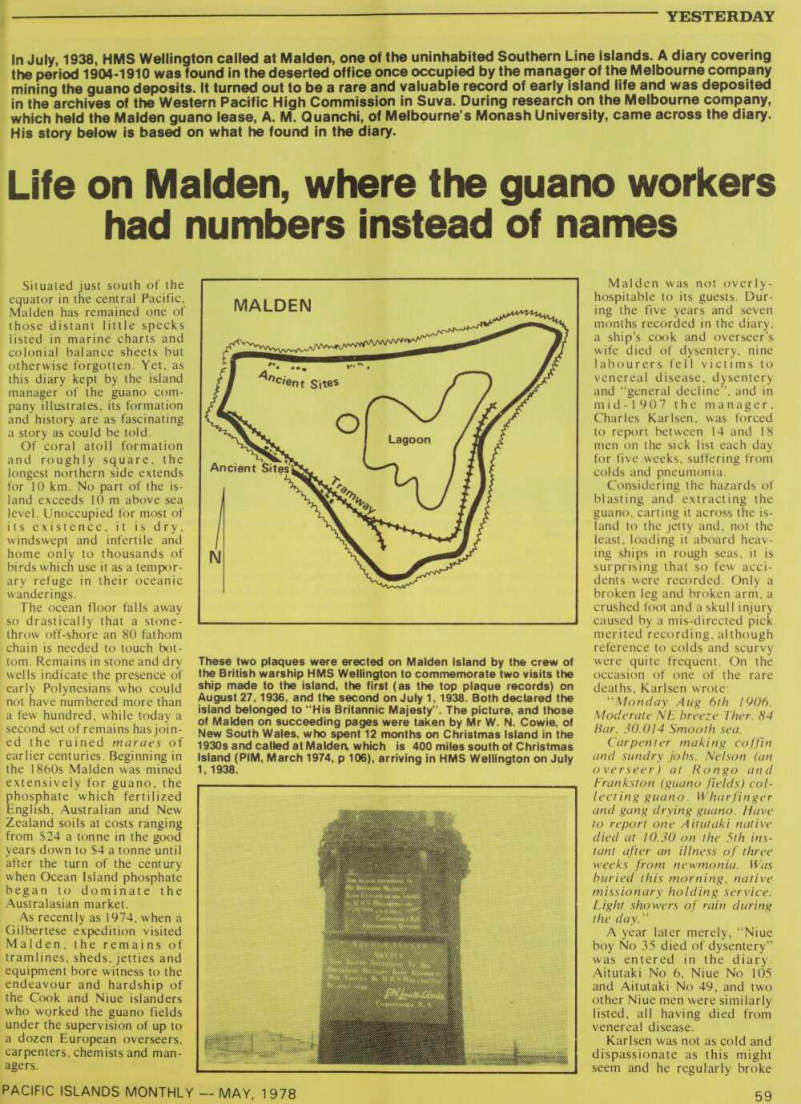
These two plaques were erected on Malden Island by the crew of the British warship HMS Wellington to commemorate two visits the ship made to the island, the first (as the top plaque records) on August 27, 1936, and the second on July 1, 1938. Both declared the island belonged to “His Britannic Majesty”. The picture, and those of Malden on succeeding pages were taken by Mr W. N. Cowie, of New South Wales, who spent 12 months on Christmas Island in the 1930 s and called at Malden, which is 400 miles south of Christmas Island (PIM, March 1974, p 106), arriving in HMS Wellington on July 1, 1938.
the monotony of five and a half days work every week by issuing extra meat rations or a round of gin to all hands, Saturday afternoon and Sundays were rest periods but the labourers could only look to Good Friday and Christmas Day to break the cycle of their one year contract. However, when work was hampered by rough seas or gangs worked late into the night to assist the berthing of a ship, small rewards were offered.
“Sat 10th Oct 1906 Light NE breeze Ther 85 Bar 30.096 Fine smooth sea. The old gang finished their twelve months today so gave all hands a holiday as they had done good work. One man sick.
“Sat 26 May 1907 Mod NE Breeze Fine Ther 86 Bar 30.072 Flalf day holiday for natives. Carpenter making a set of points for Frankston line (sails fitted to tramway carriages were used to let the wind push the loaded wagons along two sets of tramlines from the digging areas to the Jetty) SS Dramenseren sighted at 10.00 am. Made fast to the bouy with two hawsers at 2.30 pm. Maki and ten natives worked from 10.00 am to 5.00
pm. I would not allow them time off for it so paid Maki 21and the other ten men ll each overtime.”
The gangs worked in groups digging the guano, after which it was trucked to holding sheds near the jetty on the lee side of the island. There it was dried, screened, sorted and bagged in preparation for the next ship to call. Smaller par ties repaired sails, maintained the tramlines and loading facilities at the Jetty, or sewed bags. An appointed Cook Islander used a small outrig ger to fish in the off-shore waters.
Working conditions were good and only on a few occa sions did the manager find it necessary to record that the staple supplies onions. pumpkin, salted beef and pork, coconuts and tobacco were in short supply. Water was distilled using a 2 130 L condenser and. in emergen cies, was obtained from tanks which captured the rare falls of rain.
Once Karlsen recorded the unusual fact that the normally constant northeast breezes had failed to fill the sails on the guano trucks. “No wind again today the men having to
push the trucks the whole five miles in the blazing sun. Ter rible work.” On other occa sions there was too much wind.
“ Thurs 22 Feb 1906 Strong E wind Fine Ther 87 Bar 29.099 The Olive came up about 9.00 am Sent out two lighters with rations and water. One lighter missed the ship and with two boats tow ing was blown five miles out to sea before the vessel could pick them up. They got back all safe at 5.00 pm and the vessel stood off for the night.
Made up men’s account and paid off 57 men. (The Olive was used for regular supply and labour runs.) “Fri 20 Nov 1908 Strong E wind Fine Ther 84 Bar 30.066 Moderate surf. Laid out 75 fathoms chain over the reef at the south ship mooring. Want to put out a contrivance to keep the ship (the Ariel) closer in while loading as with strong east winds always blowing it is hard pulling the lighters back to the wharf such a long distance.”
In August, 1908, the cap tain of the SS Grassmere com plained that the loading gangs worked so fast that his crew could not keep up, but on
another occasion Karlsen returned from three months leave to find the standard of replacement labourers had declined in his absence. In smooth seas he noted that the gang could only manage to load 110 tons or 2 808 bags of guano. When they finally finished the loading he wrote, “The poorest work I ever saw done here. The labourers are all young boys and it takes three to four to lift a bag of guano, (approx 651bs)”
During the period covered by the diary 32 vessels loaded 38 250 tonnes of guano from Malden. The record loading for one day being 266 tons or 8 260 bags, a hard days work by any standard considering it meant loading the lighter at the jetty and then manhan dling the bags from the rolling seas up over the side of the waiting vessel. That vessel, the SS Grassmere took out 3 362 tonnes, the largest load during the period of the diary.
She had been berthed for 24 days, losing only three days due to heavy surf when the lighters were unworkable.
Three other days were lost when ballast was off-loaded.
Other ships were not so luc ky, often laying off the island
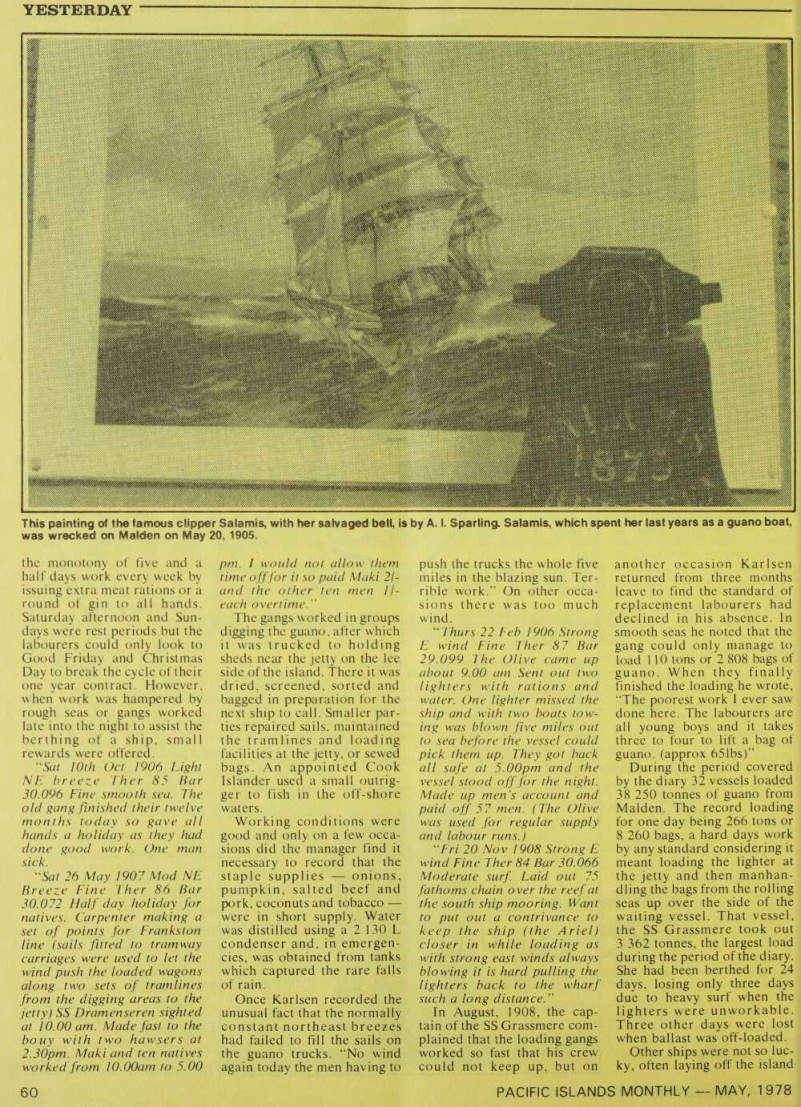
This painting of the famous clipper Salamis, with her salvaged bell, is by A. I. Sparling. Salamis, which spent her last years as a guano boat, was wrecked on Malden on May 20, 1905.
for weeks waiting for fine weather before they could berth, and then up to a month waiting for loading to be com pleted. As the bottom fell away so steeply, normal anchorage was impossible.
However, the prevailing easterlies provided the answer. Chains from anchors on the beach were let out to large buoys floating off-shore.
Ships moored to these buoys and the easterlies pushed them away from the surf and reef. A tricky operation, but as Malden Island guano fetch ed a good price the risk was justified.
To return to Karlsen’s labour problems in November, 1907, he com plained that, “this gang of Niue men is the poorest gang of labour, black or white, that I have ever seen”. Four days before this he had inspected the diggings and wrote, “Went up to the guano fields this morning with Mr Crocker (chemist and medical officer).
Found the fields that had been worked since I left on leave have not been cleared up, only the bulk of the stuff taken off, and the holes and bottom stuff which is generally the best has been left on the field.”
However, only twice did he record admonishing a labourer the first being a boy who ran away to an un worked part of the island without permission, and the second when four Niue men reported sick and he suspected they had been il legally eating the sea birds (mostly unpalatable) which colonised the eastern part of the island.
The number of labourers on Malden varied between 150 and 200. During the period of the diary 204 Cook islanders from Aitutaki and Atiu, and 152 Niue islanders arrived, and for the same period 227 Cook islanders and 165 Niue islanders returned home as their contract had expired.
Although there seemed to be no difficulty in recruiting labour, Karlsen could see the supply was running thin. As well as being critical of their youthfulness, he also noted the prevalence of venereal disease in each newly-arriving gang.
The .myth that the Pacific was ravaged by venereal dis eases in the wake of the Euro pean explorers and traders has been well disproved and Karlsen’s comments call for
some explanation. Niue Islan ders had long been serving in various parts of the Pacific and might have been expected to be more susceptible to con tagious venereal diseases, but demographic studies of Atiu and Aitutaki do not reveal the extent, or the fatalities which Karlsen’s comments hint at.
While he may have mistaken the symptoms on the arriving labourers there was no ques tion that venereal disease had been the cause of the deaths he later recorded for seven of the nine labourers who died on the island during this period.
Despite the poor quality, and perhaps because of it, when shortages began to affect the loading schedules Karlsen despatched the Alice on a special recruiting trip to the Cooks. As an indication that servitude abroad was still popular, Karlsen recorded that five weeks later she returned with 70 men from Atiu and Aitutaki.
Apart from the 32 vessels which off-loaded the guano, 10 other ships made regular supply runs to Malden and on 12 occasions Karlsen noted “sail-ho” in the margin when four masted ships in full sail passed to the north and south west. Malden was not, however, a safe port of call even for those who had made fast to a heaving buoy on earlier, often stormy occa
sions. In one disastrous incident in May, 1905, two vessels ran aground and were wrecked on the lee shore. The Victor and Salamis had been berthed for over seven weeks as rough seas had prevented loading, and when the winds turned to the west Karlsen noted with unconcerned brevity that they were in danger of being driven ashore. With heavy rain and more than a week of constant westerlies the ship’s moorings began to part and on May 17 and 18 they swung so much on the buoys that they began to collide. Finally at 9.00 am on the 19th the Victor , after attempting to make sail and clear the island, dragged her moorings and went aground.
"Fri 19th May 1905 Fresh W to NW and rainsqualls Bar 29.984 Ther 84. The Victor dragged her moorings and got ashore on the S W spit at 9.00 am and broke her rudder. c , . , , , , , m JMr Started to take the mens , r , , rr I effects and provisions off her.
Ship bumping hard at times.
Salamis let go her starboard anchor with 75 fathoms of chain. Alwul I.oopm Victor’s sternpost broke and she filled quickly and heeled over so that we could not get any more out of her .. . She is now a total wreck. Ihe crew is all ashore. Carpenter at Frankston shifting native
house. Frcmkston usual field work. ”Sat 20th May 1905 Fresh W with heavy rain squalls Bar 30.00 7 her 80 The Salamis went on the rocks this morn ing and commenced to take water fast. Sent men out to help at the pumps and save provisions, etc. Got the most of her provisions ashore and the mens clothes and the vessel went up on the rocks and became a wreck. Both vessel’s officers and crew is now ashore. Heavy rain all day. The Victor is nearly all broke up now.”
No lives were lost but along a shore line already littered w i t h enough debris to “keep t h e island in firewood for years”, two more victims were added to the list. Later, letters passed between the Colonial Office, the Victorian Gover nor and the WPHC but the Melbourne firm who held the guano lease. Grice Sumner. were not able to prompt any . K .. K , / action on improving Ma den s * ® D now infamous anchorage. By the i9 2 os. the list had lengthened and among the ten recorded wrecks the Salamis and Victor were joined by the Fram, Annie Larsen and John Murray.
During World War I no vessels could be provided for the Malden run but a small party continued to work the fields. After the war the num-
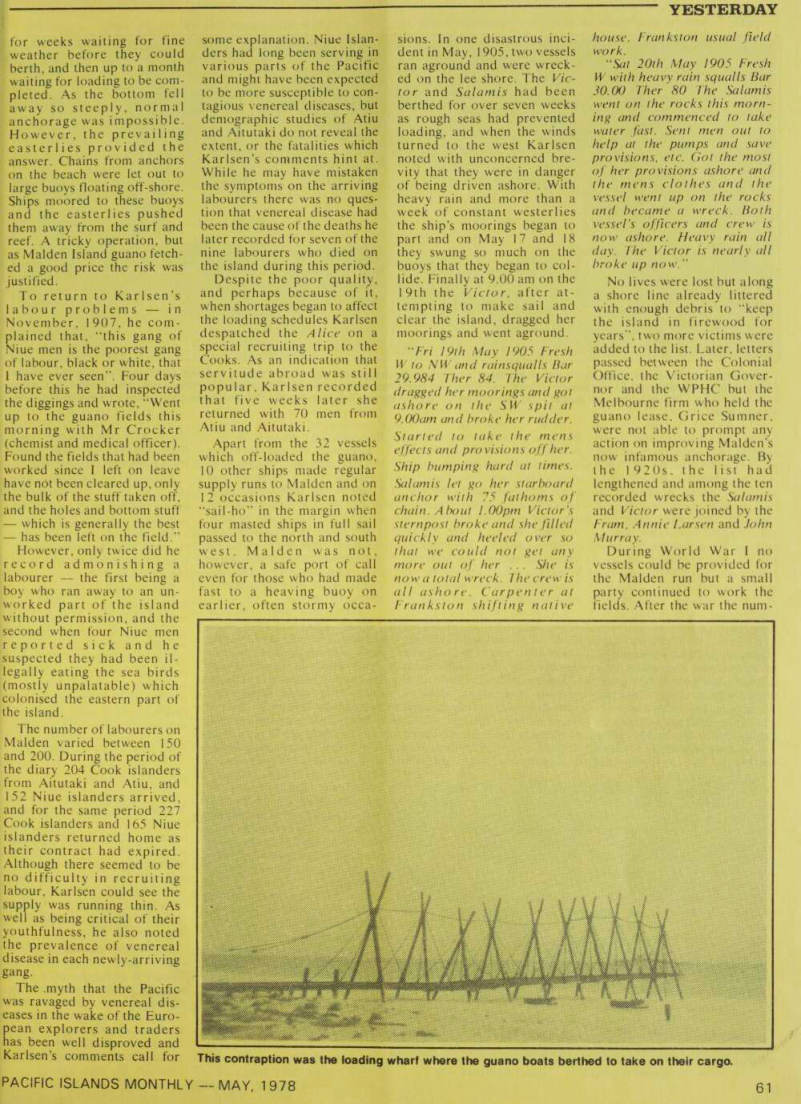
This contraption was the loading wharf where the guano boats berthed to take on their cargo.
her of vessels calling declined rapidly. Another diary in the possession of the WPHC Archives does indicate that two vessels were chartered as late as 1926 to collect guano that had been mined but not yet shipped out. This diary, running from June to Septem ber 1926, provides an in teresting sequel to the events unfolded in Karlsen's diary of 20 years before. As the ex tracts from the monthly sum maries illustrate, life on Malden, the technical problems of mining and the problems with the labour line did not alter a great deal even over the 20-year span between the diaries, or. for that matter, has not perhaps altered so geatly from the mid-1860s when mining began. The following two extracts are taken from the 1926 diary.
“Summary for July. Load ing commenced on the 13th and up to the present the work has not been wonderful by any means. The gang is green and imbued with the idea more days, more dol lars. Owing to the ships in ability to heave in to the stern mooring, which was put out but never used, it means a long trip to the ship as she is swinging about with the cur rent, being a mile away very often. The crowning catastrophe is the wet guano.
There has been so much rain the last months that the guano is saturated, (despite the under 25" annual rainfall this had always been a problem)
We are drying as much as possible hut it is heart break ing work. Plant has been put in working condition hut re pairs to line are badly wanted.
There is a curious sickness amongst some of the boys, a swelling in the lower limbs, accompanied by fever some times. However, we seem to be getting the matter in hand.
Total shipped for the month 1028 tons. Total rain 5.21".
"Summary for August.
Total shipped in 17 working days 1521 tons. Three Satur days and we have had six (heavy) surf days. Labour is not working well. The trouble is more days, more dollars.
Managed to get them on con tract work. The greatest problem is the bags. Although we had nearly 1000 new and old shipping bags and 900 field bags, dry rot has got them badly. Am using canvas bags made out of old sails.
Have used up all the canvas having made about 300 bags .. . Practically all outside stuff has been screened not because it was dirty but because screening in the hot sun makes drying almost in stantaneous. Health is none too good, the boys are as usual rotten with syphilis.
White health is good. Food stocks, native. running low .. . Was forced to throw away 700 lbs of biscuits, almost two weeks rations. The Gustav is in the same predicament, her tanked foodstuff is weavily and uneatable .. . Total ton nage 2500 tons .. . allowing
five surf days. Rain 0.78"
Although life was obviously not easy, the material rewards induced both Europeans and Islanders to suffer the hardships. As Karlsen recorded one stormy day in March, 1905, when Malden may have seemed even more isolated and desolate than usual, hardship was something one accepted when serving in the isw a o!?' ,ons , i n n Vi. -7 t 0 1.00 pm The wind came from y 4 i, . ' ■ the west blowing and raining hard. Bar steady a, 19.942 the sea roaring hut nothing can be seen outside as if is quite <? rk 7 ,n ‘‘ ‘ md ram flymg through,he houses as there is neither doors or windows,hat c ™ b J sbu '- 4 {° pm f' nd f NtA Fresh Rough seas. Wharf sttll standing although lookmg very d,lap,dated . . wharfinger with three men at the wharf securing as much as possible of it. Carpenter working a, the small (drying) shed to try and keep the water out ... One gang of boys clearing grass off the tramline ’’
For the labourers, pushing trucks five miles in the blazing sun and clearing grass during a storm, which sent the overseers to the safety of their houses, were part of the contract. While European staff were often accompanied by their wives the labourers were denied all contact with women for the term of their contract, but in Karlsen’s eyes they were happy enough with
their own companions, and their pastors, the latter look ing to their spiritual needs, Thirteen years later when t he John Murray was wreck ed on the NE reef, one of the survivors described the scene a t the jetty as it was then, but i t m ay well have been any time in the previous 60 years, He wrote .., did no , , ook „ very inviting place, being nothing like those picturesque ~, • , and charming coral islands w read * ahou , books am{ A „ we cou/rf J<J£ , a , , he mome „, a colleclion of hro ken-down. sheds, a narrow , Q some , ow cov * r< £ wilh coarse grass, a roughly constructed » ,* > u J / ntooring-huoys half huri > d . , h J nd „ , .
The manager s diary from Malden adds to a growing col leetlon - whlch as ,. n^. w dlS ‘ coveries come to light every now and then give all who are interested in the Pacific an in sight into P ast events anc * into ‘ he involvement of both Islan ders and Europeans, whether the attraction was gold, cot ton> co P ra or guano, Although Karlsen wrote on that stormy afternoon that “nothing could be seen as it was quite dark outside’. by recording that comment and others, he has allowed us to see more clearly what life was like in the years which PIM now bylines as “Yesterday.
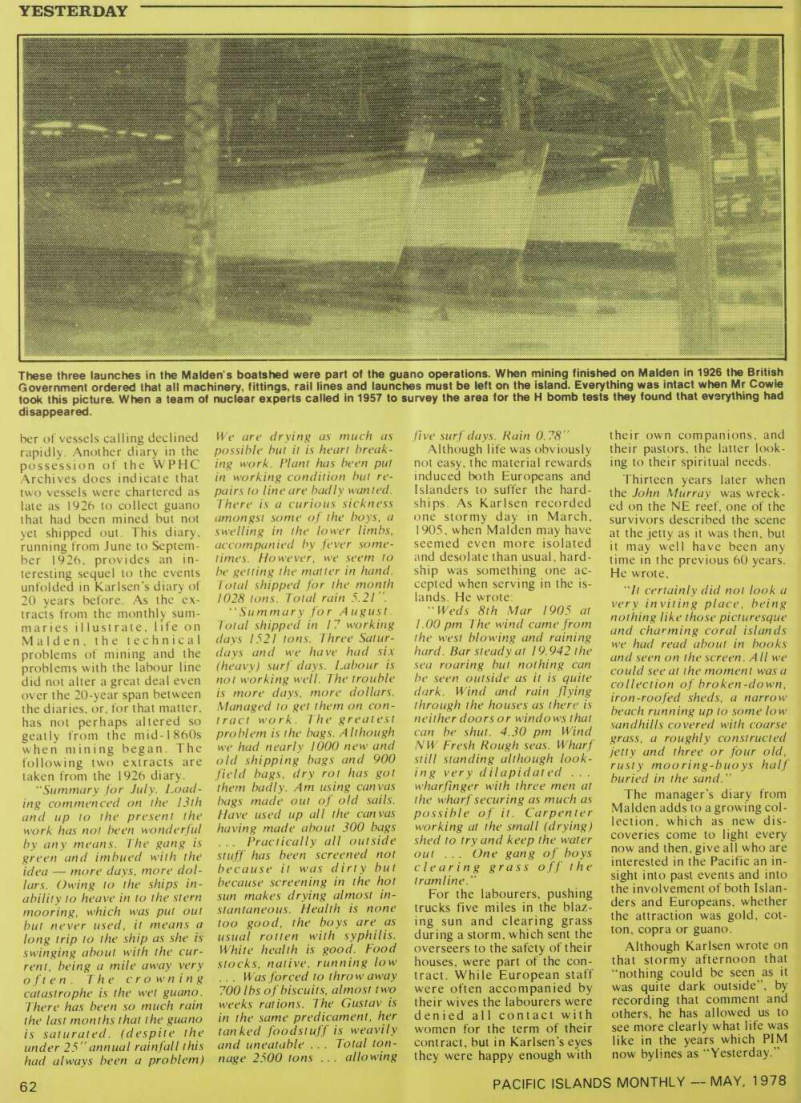
These three launches in the Malden's boatshed were part of the guano operations. When mining finished on Malden in 1926 the British Government ordered that all machinery, fittings, rail lines and launches must be left on the island. Everything was intact when Mr Cowie took this picture. When a team of nuclear experts called in 1957 to survey the area for the H bomb tests they found that everything had disappeared.