Why Tiva’s maidens are ‘very beautiful
pp. 61-62 · Read in the full issue
like Castilians’
Robert Langdon, author of ‘The Lost Caravel’ and a former assistant-editor of RIM, was on the island of Raiatea, in the Leewards, a few months ago. From the airstrip he saw, a few kilometres away, Raiatea’s sister isle, Tahaa. During his stay he was told the story of the beautiful girls of Tiva, on Tahaa. Below, he tells that story and of what he discovered when he, detective-like, probed the background of the legend of the Spanish qalleon and the beautiful maidens.
Being a historically-minded fellow myself, it is frequently
my practice when visiting
some new island in the South Seas to seek out whoever is re puted to be the local re pository of hi stor ical knowledge and to ask him or ler a question or two.
So it was that when I paid ny first visit a few months ago o Raiatea, some 200 km lorth-west of Tahiti, I was icon told that the man I hould see was Charles Jrotherson. ‘lf Charles doesn’t know, hen nobody knows,' my infor nant said. And he went on to ell me that Charles Brother on was a descendant of a )anish seaman who had settl don Raiatea about 100 years go: that his brother. Philippe, yas the mayor of Uturoa, Uiatea's chief settlement: nd that Charles himself ran a iarber’s shop in Uturoa, from fhich he also hired out motor coolers.
All this sounded like a pro mising set of qualifications. So set off for the Brotherson
airdressing salon hopeful
hat. although I wanted
either a haircut nor a motor :ooter, I might be vouchsaf d a few secrets of Raiatean istory that I was particularly iterested to know.
My Brotherson proved to e a most affable, com lunicative man, and as in
ariably happens when one
»eets such a person, I finished p learning a good deal more bout this and that than I had )ught to learn.
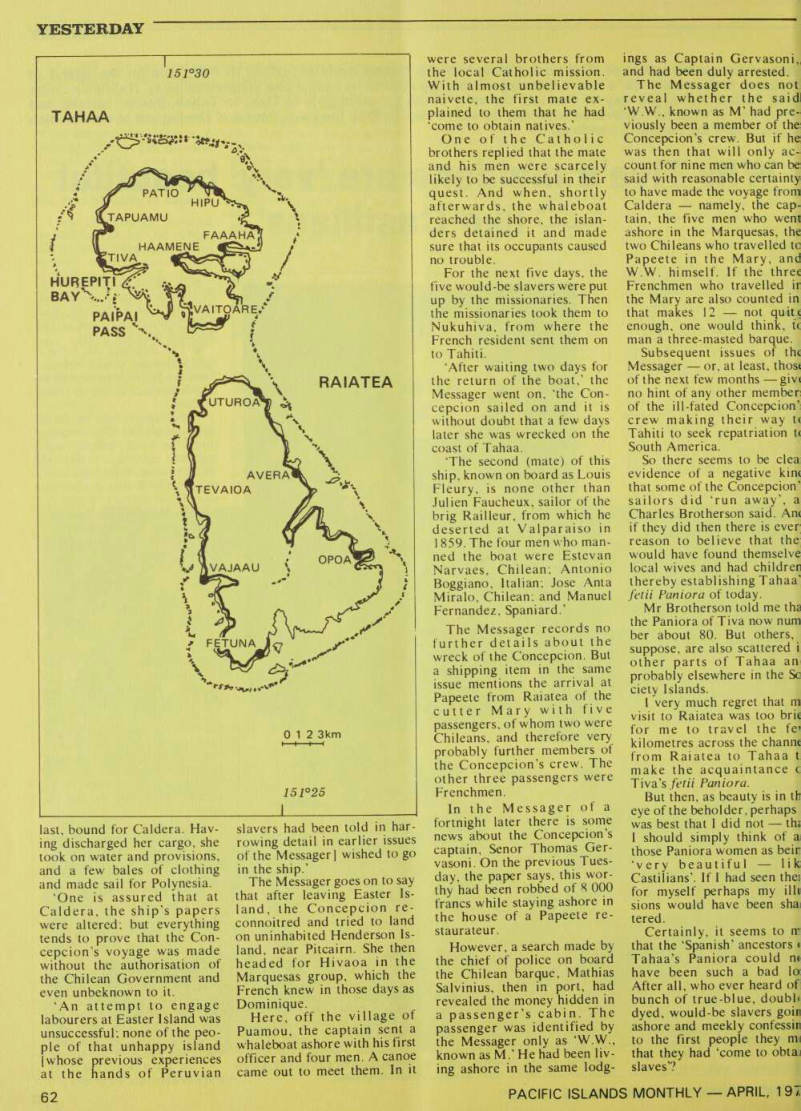
It was during our interview. )r example, that I first heard f the ladies of Tiva, a village fi the west coast of Tahaa. ahaa is Raiatea’s sister is
md, a .roughly-circular an
ent volcano that lies only a w kilometres north of it and enclosed by the same reef.
The question of Tiva’s la ies came up when Mr rotherson was telling me
about his interest in skin-div ing, and how, over the years, he had located a number of wrecks on Raiatea’s reefs and had brought up such things as anchors and chain cables.
This prompted him to tell me that over at Tahaa some one had recently recovered the anchor of a Spanish galleon’ that had been wreck ed off the village of Tiva, and that the anchor was now at the French administrator's house. ‘Some of the seamen from this galleon ran away and married local women,' Mr Brotherson went on. Their
descendants still live at Tiva today and are known as the fetii Paniora the Spanish clan. The woman are all very beautiful like Castilians.’
Mr Brotherson told me all this with such obvious sinceri ty that I checked my in clination to say that the idea of a Spanish galleon being wrecked at Tahaa sounded rather improbable to me. In stead, I asked him how long ago the galleon was supposed to have been wrecked. When he replied, ‘four generations,' I immediately suspected what had happened;
• A ship that could never, in its own time, have been classified as a galleon, had been romantically converted into one over the years. • The ship had not been a Spanish vessel at all, but one from the Spanish west coast of South America either Chile or Peru.
These suspicions of mine were not simply idle specula tions, for I remembered hav ing once read that a Chilean or Peruvian ship had been wrecked at Tahaa in the six ties of last century. I also re called that this ship had had something to do with the notorious slave raids on Easter Island and other is lands in the eastern Pacific when many hundreds of Polynesians were kidnapped to provide cheap labour for the plantations and guano is lands of Peru.
I mentioned my suspicions to Mr Brotherson and added that when I got back to Australia I would try to locate details of the wreck in the Messager cie Taiti, the Tahi tian weekly newspaper of last century, in which I thought I had read of it. I said I thought it highly probable that the Tiva wreck and the one that I had in mind were one and the same.
Well, I have just had leisure to browse through the Messager for 1862/63 in the National Library of Australia, and I now have little doubt that the two wrecks are the same. The news item I had in mind is in the issue of the Messager for Saturday, June 27, 1863. Translated from French, it begins as follows: The three-masted Chilean barque Concepcion has been lost at Tahaa (Raiatea). The crew has been saved and the ship, it is said, has been sold to speculators in the spot where she was after the wreck.
The Concepcion left Valparaiso on February 7
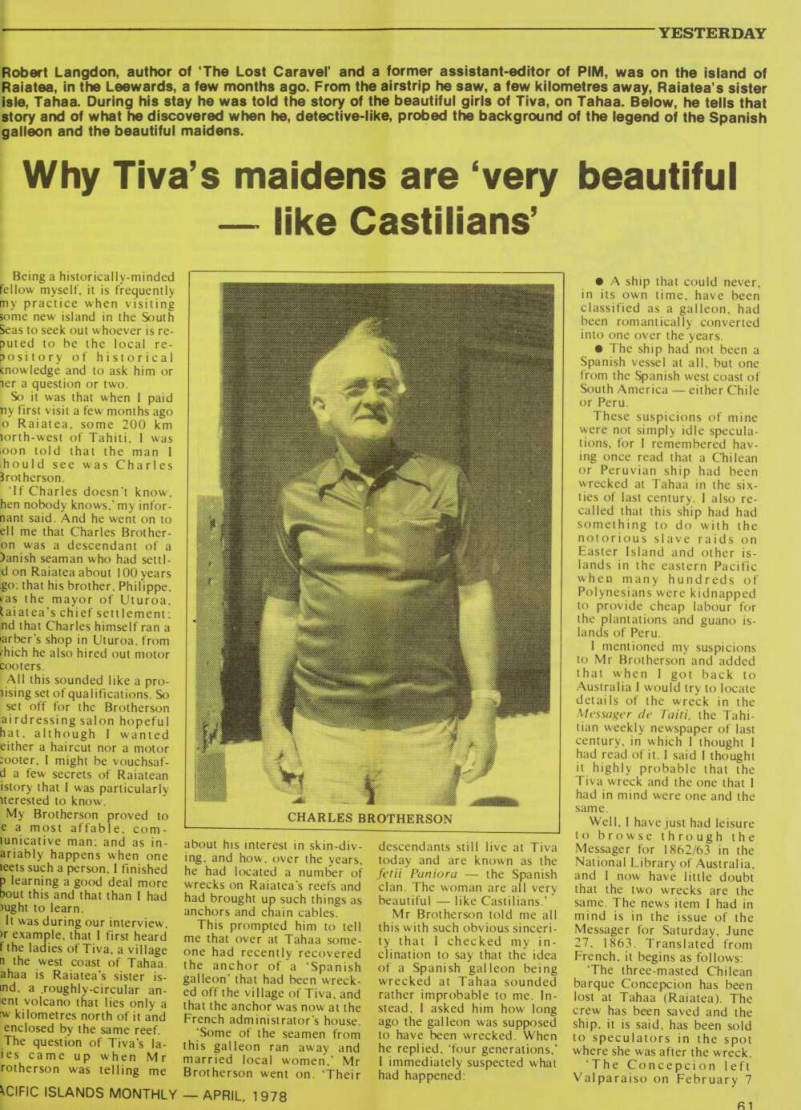
Charles Brotherson
last, bound for Caldera. Hav ing discharged her cargo, she took on water and provisions, and a few bales of clothing and made sail for Polynesia. ‘One is assured that at Caldera, the ship’s papers were altered; but everything tends to prove that the Con cepcion’s voyage was made without the authorisation of the Chilean Government and even unbeknown to it. ‘An attempt to engage labourers at Easter Island was unsuccessful; none of the peo ple of that unhappy island [whose previous experiences at the hands of Peruvian
slavers had been told in har rowing detail in earlier issues of the Messager] wished to go in the ship.' The Messager goes on to say that after leaving Easter Is land, the Concepcion re connoitred and tried to land on uninhabited Henderson Is land, near Pitcairn. She then headed for Hivaoa in the Marquesas group, which the French knew in those days as Dominique.
Here, off the village of Puamou, the captain sent a whaleboat ashore with his first officer and four men. A canoe came out to meet them. In it
were several brothers from the local Catholic mission.
With almost unbelievable naivete, the first mate ex plained to them that he had ‘come to obtain natives.’
One of the Catholic brothers replied that the mate and his men were scarcely likely to be successful in their quest. And when, shortly afterwards, the whaleboat reached the shore, the islan ders detained it and made sure that its occupants caused no trouble.
For the next five days, the five would-be slavers were pul up by the missionaries. Then the missionaries took them to Nukuhiva, from where the French resident sent them on to Tahiti. ‘After waiting two days for the return of the boat,' the Messager went on, ‘the Con cepcion sailed on and it is without doubt that a few days later she was wrecked on the coast of Tahaa. ‘The second (mate) of this ship, known on board as Louis Fleury, is none other than Julien Faucheux, sailor of the brig Railleur, from which he deserted at Valparaiso in 1859. The four men who man ned the boat were Estevan Narvaes, Chilean; Antonio Boggiano, Italian; Jose Anta Miralo, Chilean; and Manuel
Fernandez, Spaniard.’
The Messager records no further details about the wreck of the Concepcion. But a shipping item in the same issue mentions the arrival at Papeete from Raiatea of the cutter Mary with five passengers, of whom two were Chileans, and therefore very probably further members of the Concepcion’s crew. The other three passengers were Frenchmen.
In the Messager of a fortnight later there is some news about the Concepcion’s captain, Senor Thomas Ger vasoni. On the previous Tues day, the paper says, this wor thy had been robbed of 8 000 francs while staying ashore in the house of a Papeete re staurateur.
However, a search made by the chief of police on board the Chilean barque, Mathias Salvinius, then in port, had revealed the money hidden in a passenger’s cabin. The passenger was identified by the Messager only as ‘W.W., known as M.'He had been liv ing ashore in the same lodg
ings as Captain Gervasoni,, and had been duly arrested.
The Messager does not reveal whether the saidl ‘W.W., known as M' had pre viously been a member of the Concepcion’s crew. But if he was then that will only ac count for nine men who can be said with reasonable certainty to have made the voyage from Caldera namely, the cap tain, the five men who went ashore in the Marquesas, the two Chileans who travelled to Papeete in the Mary, and WAV. himself. If the three Frenchmen who travelled ir the Mary are also counted in that makes 12 not quite enough, one would think, tc man a three-masted barque.
Subsequent issues of the Messager or, at least, those of the next few months —give no hint of any other member; of the ill-fated Concepcion’; crew making their way tc Tahiti to seek repatriation tc South America.
So there seems to be clea evidence of a negative kinc that some of the Concepcion” sailors did ‘run away’, a Charles Brotherson said. Anc if they did then there is ever reason to believe that the would have found themselve local wives and had children thereby establishing Tahaa” fetii Paniora of today.
Mr Brotherson told me tha the Paniora of Tiva now num ber about 80. But others, suppose, are also scattered i other parts of Tahaa an probably elsewhere in the Sc ciety Islands.
I very much regret that mi visit to Raiatea was too brie for me to travel the fe* kilometres across the channe from Raiatea to Tahaa t make the acquaintance c Tiva’s fetii Paniora.
But then, as beauty is in th eye of the beholder, perhaps was best that I did not th* I should simply think of ai those Paniora women as beitr ‘very beautiful lik; Castilians’. If 1 had seen thei for myself perhaps my illv sions would have been shai tered.
Certainly, it seems to nr that the ‘Spanish’ ancestors » Tahaa’s Paniora could nc have been such a bad la After all, who ever heard of] bunch of true-blue, doubb dyed, would-be slavers goin ashore and meekly confessin to the first people they mi that they had ‘come to obtai slaves’?