In Papua and New Guinea we differed
pp. 59-60 · Read in the full issue
and how!
lalf a century ago Papua and New Guinea were separate territories and the separation was something more nan a border line. Ethnically, economically, in language, in outlook, in almost everything they were poles apart, hat old New Guinea hand, Bert Weston, tells a story which underlines those differences .
The pre-war Territories of Papua and the Mandated Ter ritory of New Guinea had a few things in common. They were both tropical regions oc cupying the mainland of New Guinea and adjacent islands and both governed by admin istrations responsible to the Commonwealth of Australia.
Here the similarity ended and the various factors dividing the two territories were at their peak around 50 years ago.
Papua was far from wealthy and in the late 1920 s its ex ports totalled $7OO 000 and imports $BOO 000 as against &1.5 million and $1.6 million respectively for New Guinea.
Papua’s main revenue came Torn an annual grant of &80 000 from Canberra and he spending activities of jeveral oil search companies.
Papua’s copra was produced from 20 235 ha of coconut jlantations whereas New Guinea possessed 80 940 ha; n only one direction did Papua overtop its neighbour, his was in its 1928 figure of 1 240 ha of rubber planta ions, an industry which never lot off the ground in New juinea.
Three hundred former Ger nan-owned coconut planta ions in New Guinea were in he hands of generally young ind vigorous Australian eturned soliders, most of hem actively engaged in bearing and planting ad litional areas.
In the same year the value )f gold won in Papua was less han $2O 000 compared with >BOO 000 in the Mandated ferritory rising to over $4 nillion some years later; the )rice of gold being then about >8 an ounce.
So the position then was hat of an impoverished J apua, jealous and somewhat esentful of its increasingly lold-rich and prosperous leighbour and the world-wide mblicity it was receiving for ts successful and record leaking activities in use of
aircraft for heavy air-freight ing.
The cleavage was aggra vated by the almost total lack of communication between the while populations of both territories divided as they were by the almost impassable barrier of the Owen Stanley mountain chain or otherwise by days of ocean travel. Those few from the Mandated Ter ritory who had ever visited Port Moresby in Papua refer red to it derisively as “That suburb of Townsville” which it resembled in topography, arid terrain, vegetation and style of building construction.
The Burns Philp shipping line ran completely separate services to each territory. The 1 900 tonne Morinda served
Papua with a monthly sailing from Sydney calling at Queensland ports, Port Moresby and Samarai in Papua thence via Norfolk Is land and Lord Howe Island back to Sydney.
The New Guinea service was carried out by the 10-knot coal burning steamers Mar sina of 1 940 tonnes and Mon toro of 4 060 tonnes, each taking a full load of passengers and general cargo from Sydney every six weeks and returning with an equally full passenger list and copra fillea holds.
My first trip from Sydney to Salamaua in 1928 followed a typical timetable. SS Montoro called at Brisbane, Samarai, Rabaul, Kavieng, plantations
at Lorengau and Lombrum in the Admiralty Islands, and Tomleo and Seleo Island near Wewak, Madang and Alex ishafen, Singaua plantation in the Huon Gulf and finally, after 23 days, reached Salamaua. From there it returned to Rabaul via Lin denhafen plantation on the South Coast of New Britain before heading back to Australia.
The fare for those 23 days, covering transport, meals and accommodation was $52 or $1.30 a day, barely enough to cover two days bed and breakfast at a present-day motel. And it was said that few passenger ships anywhere in the world on regular runs had to be as self-sufficient in coal, food supplies and liquor for almost six weeks as did the hard-worked steamers of the BP New Guinea service.
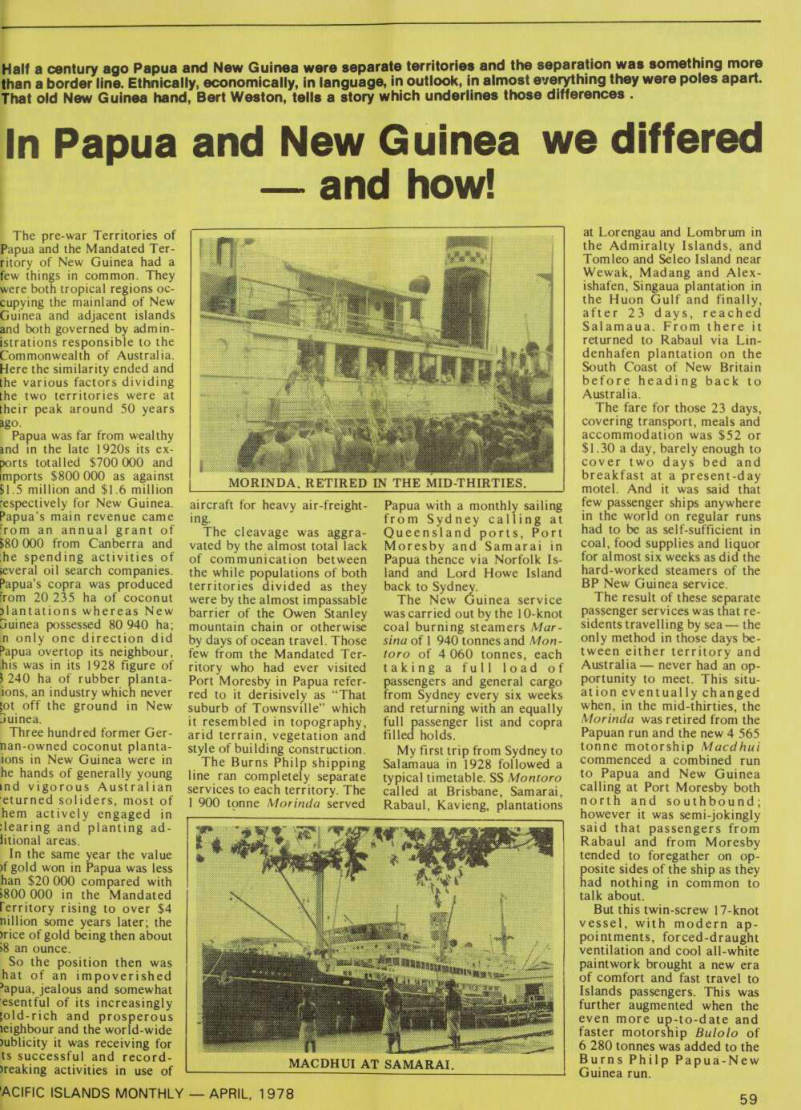
The result of these separate passenger services was that re sidents travelling by sea— the only method in those days be tween either territory and Australia— never had an op portunity to meet. This situ ation eventually changed when, in the mid-thirties, the Morinda was retired from the Papuan run and the new 4 565 tonne motorship Macdhui commenced a combined run to Papua and New Guinea calling at Port Moresby both north and southbound; however it was semi-jokingly said that passengers from Rabaul and from Moresby tended to foregather on op posite sides of the ship as they had nothing in common to talk about.
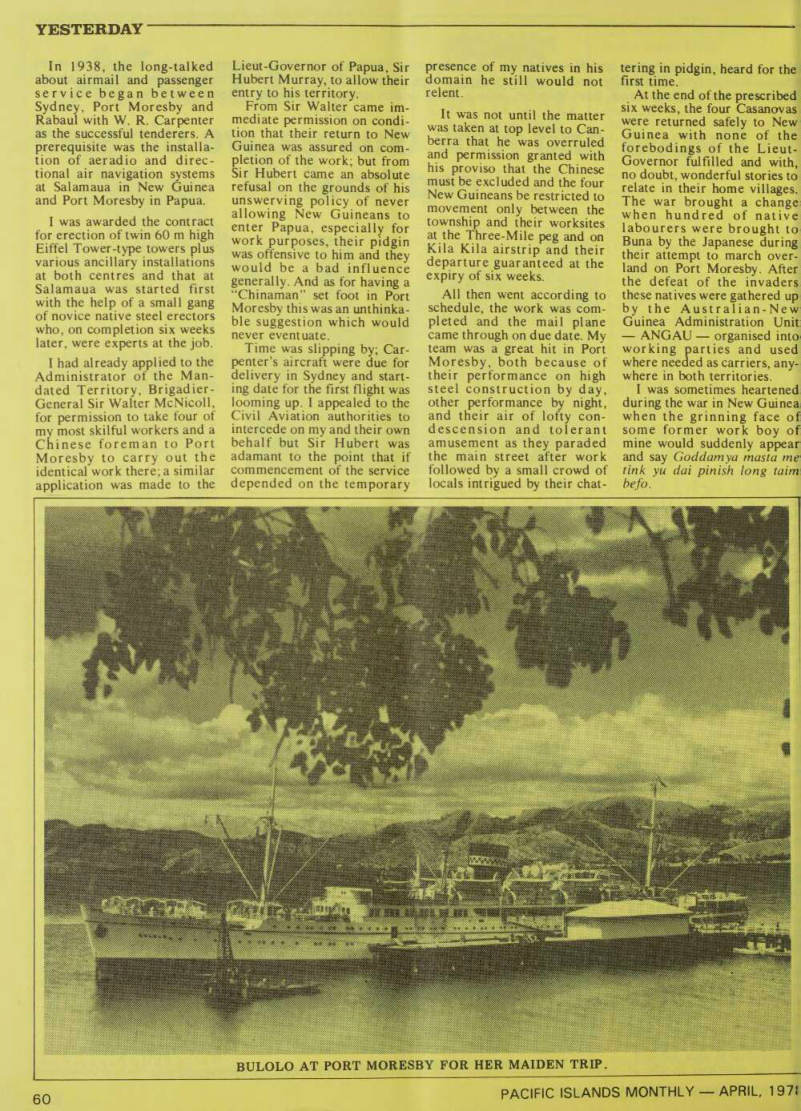
But this twin-screw 17-knot vessel, with modern ap pointments, forced-draught ventilation and cool all-white paintwork brought a new era of comfort and fast travel to Islands passengers. This was further augmented when the even more up-to-date and faster motorship Bulolo of 6 280 tonnes was added to the Burns Philp Papua-New Guinea run.
Morinda, Retired In The Mid-Thirties.
Macdhui At Samarai.
In 1938, the long-talked about airmail and passenger service began between Sydney, Port Moresby and Rabaul with W. R. Carpenter as the successful tenderers. A prerequisite was the installa tion of aeradio and direc tional air navigation systems at Salamaua in New Guinea and Port Moresby in Papua.
I was awarded the contract for erection of twin 60 m high Eiffel Tower-type towers plus various ancillary installations at both centres and that at Salamaua was started first with the help of a small gang of novice native steel erectors who, on completion six weeks later, were experts at the job.
I had already applied to the Administrator of the Man dated Territory, Brigadier- General Sir Walter McNicoll, for permission to take four of my most skilful workers and a Chinese foreman to Port Moresby to carry out the identical work there; a similar application was made to the
Lieut-Governor of Papua, Sir Hubert Murray, to allow their entry to his territory.
From Sir Walter came im mediate permission on condi tion that their return to New Guinea was assured on com pletion of the work; but from Sir Hubert came an absolute refusal on the grounds of his unswerving policy of never allowing New Guineans to enter Papua, especially for work purposes, their pidgin was offensive to him and they would be a bad influence generally. And as for having a “Chinaman” set foot in Port Moresby this was an unthinka ble suggestion which would never eventuate.
Time was slipping by; Car penter’s aircraft were due for delivery in Sydney and start ing date for the first flight was looming up. I appealed to the Civil Aviation authorities to intercede on my and their own behalf but Sir Hubert was adamant to the point that if commencement of the service depended on the temporary
presence of my natives in his domain he still would not relent.
It was not until the matter was taken at top level to Can berra that he was overruled and permission granted with his proviso that the Chinese must be excluded and the four New Guineans be restricted to movement only between the township and their worksites at the Three-Mile peg and on Kila Kila airstrip and their departure guaranteed at the expiry of six weeks.
All then went according to schedule, the work was com pleted and the mail plane came through on due date. My team was a great hit in Port Moresby, both because of their performance on high steel construction by day, other performance by night, and their air of lofty con descension and tolerant amusement as they paraded the main street after work followed by a small crowd of locals intrigued by their chat
tering in pidgin, heard for the first time.
At the end of the prescribed six weeks, the four Casanovas were returned safely to New Guinea with none of the forebodings of the Lieut- Governor fulfilled and with, no doubt, wonderful stories to relate in their home villages.
The war brought a change when hundred of native labourers were brought to Buna by the Japanese during their attempt to march over land on Port Moresby. After the defeat of the invaders these natives were gathered up by the Australian-New Guinea Administration Unit: ANGAU organised into* working parties and used where needed as carriers, any where in both territories.
I was sometimes heartened during the war in New Guineai when the grinning face of some former work boy of mine would suddenly appear and say God dam ya mast a me tink yu dai pinish long taim befo.
BULOLO AT PORT MORESBY FOR HER MAIDEN TRIP.