Pacific Navigation of Tonga
pp. 63-65 · Read in the full issue
A king’s dream ship menaces Pacific Navigation of Tonga
King Taufa’ahau Tupou IV wants to shift the Tongan Government’s interest in overseas shipping from the tangible Kalia, operated by Pacific Navigation of Tonga, to a ship yet to be built. At tracted by the Columbus Line’s offer to Western Samoa of a ship which may be char tered to the Pacific Forum Line, he is seeking a similar deal for Tonga.
He said in his Christmas message it was necessary to review Tonga’s engagement in shipping because of an offer of assistance by the West Ger man Government in pro viding marine engineering, dockyard and other facilities.
West Germany calls its as sistance for undeveloped and
under-developed countries
economic co-operation. It is advised in shipping matters in the South Pacific by the Ham burg-based Columbus Line.
He considers that as Tonga is involved with the Pacific Forum Line, and because of West German (or Columbus) assistance to Western Samoa it would be beneficial to as sociate with Columbus. Ap parently, a new ship would be owned by the Shipping Cor poration of Polynesia, in which Columbus has a 60% interest. The Tongan Govern ment holds the other 40%. (In Western Samoa, the govern ment and Columbus are equal partners in a new company, Samoan Shipping Services Ltd, which will charter to the Pacific Forum Line a new ship now being built).
The king said Pacific Navigation of Tonga would :ontinue to operate, “but it would be to Tonga’s advan tage to extend shipping ac tivities over a wider field”. He also said Tonga would like to withdraw from its ar rangement with Pacific Navigation of Tonga and join Columbus.
He obviously takes the view hat if the Pacific Forum Line )perates a service covering he Australian east cost, Fiji, >amoa and Tonga there will >e no room for Pacific Navigation of Tonga, which il ready operates the service.
However, P & O, the J.
Lauritzen group, of Denmark, and Mr Alwyn Ellem, a Sydney business consultant, have good reason to feel ag grieved at the latest moves.
Tonga’s overseas shipping line, Pacific Navigation Co Ltd, was fast going broke when P & O and Mr Ellem were called in. P & O pro vided Mr George Fulcher to act as general manager of the shipping line while Mr Ellem took stock.
After a thorough investiga tion of the position it was de cided to form a new company, Pacific Navigation of Tonga, with Mr Fulcher as general manager.
In the second half of 1977, Pacific Navigation of Tonga started a five-weekly service from ports along the Australian east coast to Fiji, Tonga and Samoa with the Kalia of 9 150 tonnes. The new company is owned by the government and the J.
Lauritzen group, with Tonga
Transport
holding the major interest.
Pacific Navigation of Tonga has no financial or any other connection with Pacific Navigation Co Ltd, which is owned by the Tonga Govern ment. The new set-up seemed a nice tidy arrangement, back ed by experts, and was all set to operate profitably, once it was established. Mr Ellem, in the middle of 1977, said to PIM: “It (Pacific Navigation of Tonga) will operate profitably. It was just a matter of doing our homework and bringing sound, qualified management to the operation and the known shipping ex pertise of J. Lauritzen. The new firm will be soundly bas- When asked to comment on
the effect of Pacific Navigation of Tonga on the Pacific Forum Line, he said: “That is something for the separate governments to decide. In my opinion, if the Forum Line merely acted as a co-ordinating body, it would „ e ,K h i r i he , h . '"7 ° f the Islands. I don t believe the Forum Line can act as an op-
erator for all the Pacific Is lands nations”.
Some parts of the Pacific are now over-tonnaged.
Tonga itself is a good example with the Warner Line con sidering limiting some of its v * c ® s NWEW Zealand.
There is this to be said; Pacific Navigation of Tonga has a s hip and it is operating a via ble service.
Fiji captains in trouble over shipping mishaps
Two courts of marine inquiry in Fiji in January into shipping mishaps pointed to a lack of “tight ship” control by masters. One master lost his certificate and another was severely reprimanded, along with two senior officers. The president of the court in each case was Mr Kenneth Moore, a magistrate.
The vessels concerned were the Tabusoro, owned by the Marine Department, which went aground in Momi Passage, near Nadi, in September, 1977, and a barge, GM 10, owned by Marine Pacific Ltd, which capsized while under tow by a tug, the Wallacia, and sank in 750 fathoms about five nautical miles from Yanuca Island.
The court found that the grounding of the Tabusoro was solely the fault of the master, Captain Peni Tuitoma, and was caused by his incompetence. He failed to navigate his ship with the standard of care and competence required by the holder of a Master Fiji Islands Certificate.
He did not appear to have been alert enough to see a number of faults were rectified, yet from the time he took command he had problems with the main engine, the compass and the lights. He could not operate the ship s radar so left that to junior members of the crew.
Mr Moore said the ground ing appeared to have been caused by Tuitoma allowing the Tabusoro to drift while the generator belt was being repaired. He failed to clear the passage because he did not line the ship up with the lead ing lights and sail straight ahead. That showed he acted in a most incompetent man ner.
Jess James Dunn, chief engineer of the Tabusoro, was severely reprimanded as he had put to sea in the Tabusoro at a moment’s notice without familiarising himself with the workings of the machinery.
In the case of the GM 10, the court was unable to say with any degree of certainty why it sank. It was valued at $45 000 and was carrying two mechanical diggers, valued at $l3O 000, and about 426 000 L of fuel oil worth $52 000.
The court severely rep rimanded the master, Captain Anare Vuibureta, and the mate, Solomone Tokalau.
Mr Moore said it seemed fairly certain the barge was lost because of flooding of the swim end, resulting in trim by the stern. Possible causes were inadequate sacking in the spurling pipe to prevent water going into the barge, move ment of one of the diggers, causing a crack in the deck through which water entered; a partly-open hatch cover forced further open by water
going across the deck; and movement of a digger across the deck upsetting the trim.
The court found that Marine Pacific regulations about sealing the spurling pipes (through which the anchor chain passes) were not followed. Lashings holding the diggers were secured to a bar in a freeing port (which allows water aboard to run back into the sea).
Mr Moore said that although Marine Pacific’s in structions to employees who operated barges and tugs seemed adequate, the com pany was lax in not ensuring they were carried out. The court was concerned that a junior shipping clerk super vised what went aboard the barge. Although the barge was carrying 50 tonnes more than it usually did, it was not over loaded.
Cooks’ Ship
Wrecked
The 13.2 m steel-hulled fishing vessel, Stella Maris (Star of the Sea), of the Cook
Islands Roman Catholic Church, was wrecked on the southern reef of Manihiki Is land, in the northern Cooks, in January. Early reports said that the vessel was a writeoff, but that there was no loss of life.
Stella Maris left Rarotonga for Manihiki, Rakahanga and Suwarrow with Captain Bruce Carnaham, engineer Dave McCormick, four other crew and an American specialist in tuna fishing and his wife. The vessel arrived at Manihiki on January 8 and took shelter near the southern reef islet of Porea. A change in wind direction during the night drove Stella Maris on to the reef, but passengers and crew reached the islet safely. A large hole had been made in the hull near the fuel tanks and attempts at salvage failed.
The captain and crew removed as much of the ship’s expensive gear as possible, then all the castaways were as sisted by local people to reach the main, inhabited island.
Stella Maris was used for fish ing and transporting priests around the Cooks.
As Manihiki is 1 045 km from Rarotonga, the extensive repairs needed could not be carried out.
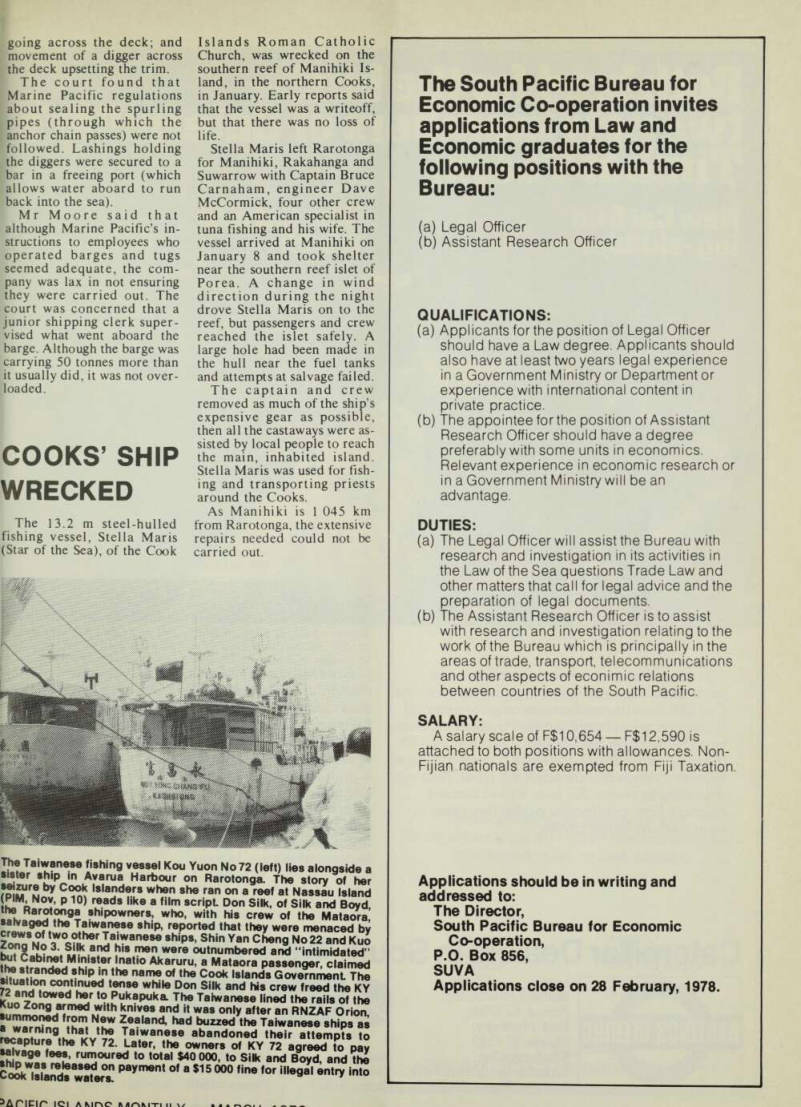
The Taiwanese fishing vessel Kou Yuon No 72 (left) lies alongside a sister ship in Avarua Harbour on Rarotonga. The story of her seiz ure by Cook I slan de rs when she ran on a reef at Nassau Island (PIM, Nov, p 10) reads like a film scri pt. Don Silk, of Silk and Boyd, the Rarotonga shipowners, who, with his crew of the Mataora, salv a ged the Tawanese ship, reported that they were menaced by crews of two other Ta iwanese ships, Shin Yan Cheng No 22 and Kuo Zong No3. Si lk an d hi s men were outnumbered and "intimidated” but Cabinet Minister Inatio Akaruru, a Mataora Passenger, claimed the stranded ship in the name of the Cook Islands Government The situation continued tense while Don Silk and his crew freed the KY 72 and towed her to Pukapuka. The Taiwanese lined the rails of the Kuo Zong armed with knives and it was only after an RNZAF Orion, summoned from New Zealand, had buzzed the Taiwanese ships as a warning that the Taiwanese abandoned their attempts to recapture the KY 72. Later, the owners of KY 72 agreed to pay salvage fees, rumoured to total $40 000, to Silk and Boyd, and the ship was released on pay ment of a $15 000 fine for illegal entry into Cook Islands waters.