of wrecked Runic
pp. 59-62 · Read in the full issue
Yesterday
No mink coats from the holds of wrecked Runic
Australian master mariner, Captain JOHN WARD, tells the strange story of an abortive attempt to salvage the Shaw Savill Line’s giant refrigerated cargo vessel Runic wrecked in 1961 on Middleton Reef, just over 480 km off Coffs Harbour, on the east coast of Australia.
Runic, the world’s largest refrigerated cargo liner at the time, went aground on Mid dleton Reef in February, 1961. My wife and I heard the news in Christchurch, New Zealand. Disturbing as the event was, I was sorry from a more personal point of view to learn that her Master was Cyril Sendall, whom I remem bered as being mentioned in despatches for a particularly bright piece of work while serving as a junior officer in one of our Mediterranean convoys during World War 11.
On March 26, after several attempts to drag Runic free had failed, she was abandoned by her master and crew, as she was lying in the path of a vicious tropical cylone.
I was back at home in Sydney on Good Friday, March 31, when the telephone rang. It was a friend who wanted to come to see me to discuss an important proposi tion. It was that I should board the Runic, establish claims to her under the laws of salvage, affect the salvage, and an idea that already placed me in my own mind in the super income tax scale for my efforts I would receive one-third of any profits accru ing from the venture.
Once all this was settled, another friend sent an urgent radio message to his trawler Hunter, recalling her to Sydney. Several of us then went shopping around for food and necessary gear, not an easy task on a public holi day, but accomplished, nevertheless.
We set off to join the Hunter with food, portable stove, lamp, torches, naviga tion tables, charts and the rest. My heart did a double flip when I saw the Hunter for the first time. She was a wooden ex-American yacht minesweeper. Her sole navigational aids consisted of a tiny compass (which I
thought wriggled when you stared at it) and a fish-detect ing echo-sounding apparatus.
However, nothing ventured, nothing gained.
After calming my wife, who was enough of a sailor to realise that the Hunter was no Queen Mary, I set-to with the others: Jack, Master of Hunter, lan (deckhand and general factotum), Jim (navigator for Hunter’s return trip to Sydney), and Jerry (engineer, who was to remain with me on the Runic, always assuming we could get on board). We shipped drums of diesel oil bunkers, fresh water (two 44-gallon drums), a two way transmitter -receiver radio set, odds and ends of food, a .303 rifle and 500 rounds of ammunition, and one case of beer.
At 1 am on April 1, 1961 I’m sure we were all so busy thinking in terms of weekly
trips to Monte Carlo and mink coats for our wives that we entirely overlooked the fact that it was All Fool’s Day we cast off and headed down Sydney Harbour en route for Coffs Harbour.
Clear of Coffs on April 2 we headed south for the benefit of any sticky-beaks watching our departure, and then off all lights and full speed in the general direction of Mid dleton Reef.
The weather gradually wor sened to gale force SE winds and very rough seas. Jack, lan and Jerry lapped this up but to Jim and me, used to ships of 10 000 to 20 000 tons, it was a nightmare.
But, hardships aside, on the evening of April 3 we found ourselves 40 miles north of Runic. We headed due south, and, before we had run the distance, Jim and 1 perched ourselves on top of the
wheelhouse and stared through our binoculars until our eyes were like organ stops.
We both spotted Runic together.
When Jack stopped the engines at my request, we could all hear the sea break ing against her hull and the sound of a flag flapping in the breeze.
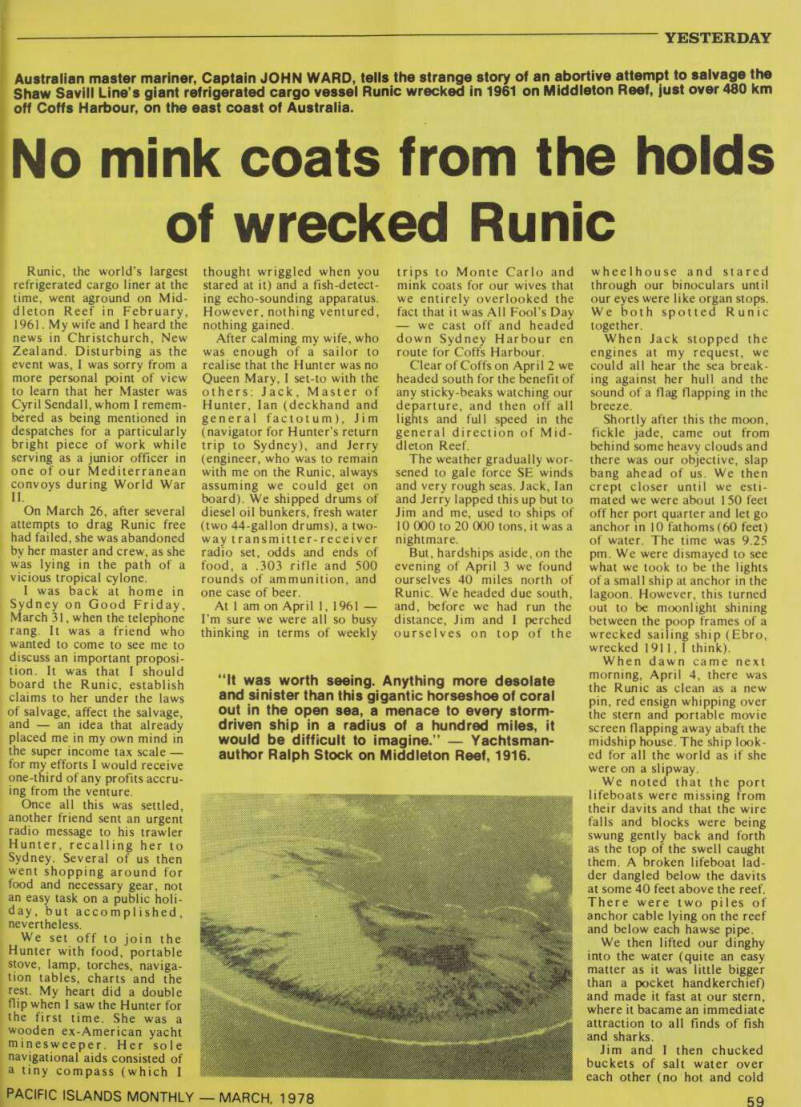
Shortly after this the moon, fickle jade, came out from behind some heavy clouds and there was our objective, slap bang ahead of us. We then crept closer until we esti mated we were about 1 50 feet off her port quarter and let go anchor in 10 fathoms (60 feet) of water. The time was 9.25 pm. We were dismayed to see what we took to be the lights of a small ship at anchor in the lagoon. However, this turned out to be moonlight shining between the poop frames of a wrecked sailing ship (Ebro, wrecked 1911,1 think).
When dawn came next morning, April 4, there was the Runic as clean as a new pin, red ensign whipping over the stern and portable movie screen flapping away abaft the midship house. The ship look ed for all the world as if she were on a slipway.
We noted that the port lifeboats were missing from their davits and that the wire falls and blocks were being swung gently back and forth as the top of the swell caught them. A broken lifeboat lad der dangled below the davits at some 40 feet above the reef.
There were two piles of anchor cable lying on the reef and below each hawse pipe.
We then lifted our dinghy into the water (quite an easy matter as it was little bigger than a pocket handkerchief) and made it fast at our stern, where it bacame an immediate attraction to all finds of fish and sharks.
Jim and I then chucked buckets of salt water over each other (no hot and cold
“It was worth seeing. Anything more desolate and sinister than this gigantic horseshoe of coral out in the open sea, a menace to every storm driven ship in a radius of a hundred miles, it would be difficult to imagine.” Yachtsman author Ralph Stock on Middleton Reef, 1916.
on the Hunter), sneaked a mug of hot water off the stove and had a shave, the first since leaving Sydney. We then examined the results of the efforts of Jerry and lan, who had done some fishing the previous night. The result was a tasty breakfast.
Against my advice, as there was a nasty surge at bow and stern of Runic, Jack and Jerry shoved off in our dinghy to have a closer look at the big ship. Jerry, being an athletic type, tried to shin up the port anchor cable, and failing to do so, then tried to do the same at the stern, where we could see three or four heavy wires dangling into the water, These efforts were loudly cheered (derisively and otherwise) by us on the Hunter.
They then rowed up to the port main sea inlet —as big as an ordinary door where Jerry hopped into the recess, He wasn’t left long in doubt as to what course of action to pursue, as a larger swell simply lifted him off his feet and decanted him into the engine room. We had visions of having to tell his widow the sad story of his demise. However, within a few moments he stuck his head out again and shouted to Jack, who had backed away to fetch us.
Jim and I were a trifle dubious that the dinghy would support three of us, but it did with about two inches of freeboard, so off we went arm ed with torches and cigarettes, We arrived off the sea inlet, and except for getting a wet behind when the swell rose above my waist, I landed beside Jerry. Jim followed suit moments later, The three of us then headed to the deck and were pleased to find a lifeboat ladder, still in its canvas sling, on the port boat deck, We lowered this down to Jack, but he could not make the 70 foot climb, so he head ed back to the Hunter.
We then went to the bridge, dug out an Australian Ensign from the flag locker and hoisted it above the monkey island. Whilst the other two were foraging about, I went to the captain’s day room, found the key of the safe in the usual place that all British ship masters use as a parking spot, opened the same expecting to find all kind of folding money, and took out a telescope and some ap prentices’ indentures, which comprised its entire contents, Shortly afterwards, Jack and Jim arrived alongside with a boatload of stores and
towing our two drums of fresh water. Jack managed the lad der on this occasion. Just before dark Jack and Jim returned to the Hunter, whilst Jim, Jerry and I went to bed in the chiefs, second officer’s and captain’s bed re spectively.
April 5 we spent examining the damage to the Runic and taking soundings around the ship. There was an 18-inch slit in the shell plating on the port side in way of the fore peak tank. The main sea inlet valve and chest had been bodily removed with chain blocks and the engine room was thus open to the sea just as well, as this was our front and main entrance. The shell-plating shaft in the inlet was fractured and buckled for a distance of about 10 feet. Several ship side-valves on the starboard side of the engine room had also been removed. Number 3 hold was also open to the sea, apparently from damage to the bottom. The bottom of No 6 hold was literally peppered with rivets and rivet heads from the port side shell plat ing, showing that there was a local area of support for the hull in this region. The poop deck ’tweenside port side was flooded. All double-bottom tank top manhole covers were
off and lying adjacent to the apertures. Nearly all hatches on all decks were unshipped, as also were a lot of the beams. Almost every port, window and door throughout the ship was open. Thus, with these conditions, had Runic ever floated free of the reef, she would have filled with water and sunk like a stone.
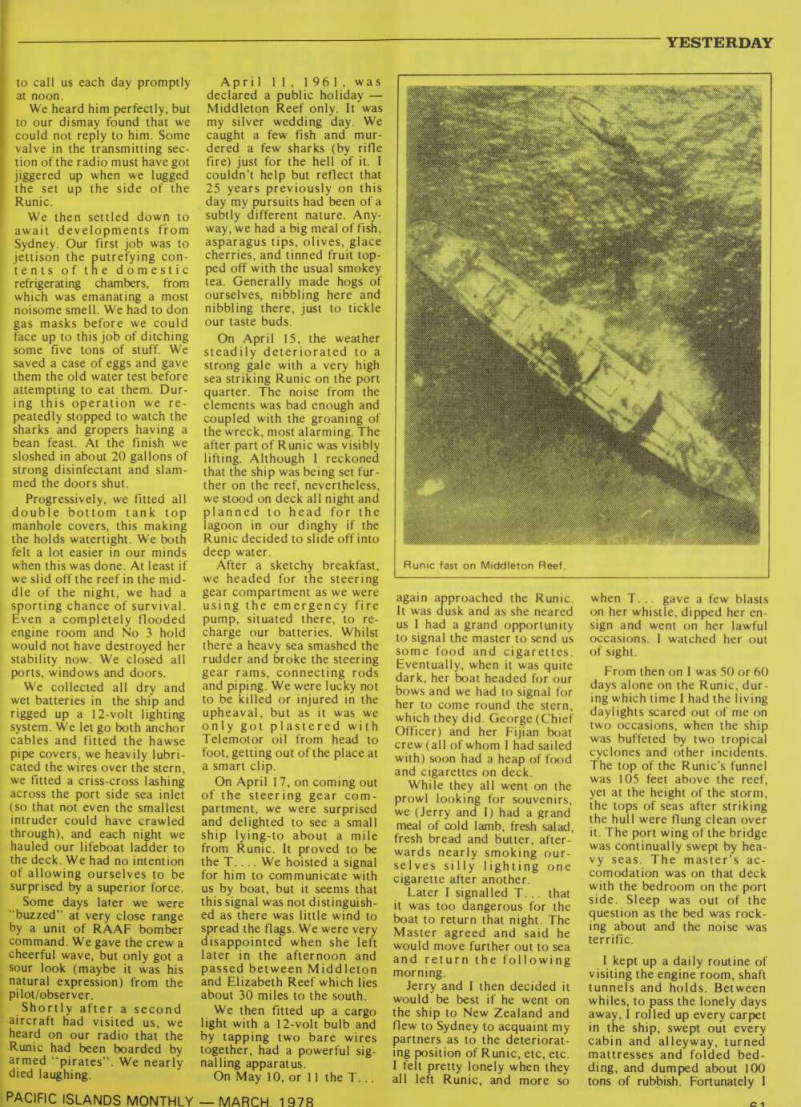
From evidence on board we found that the Runic had struck the reef on a course of 119 degrees true, at a speed of about 17 knots. She had over ridden the reef for a distance of 75 feet before being stop ped by the coral. Even at that, some 450-500 feet of her length was in water capable of floating the ship. Unfor tunately, at some stage she was allowed to pivot over an arc of 58 degrees, until she was heading 061 degrees true, thus lying parallel to and with most of her length on the reef.
At 10 am on April 6, the Hunter set sail for Sydney, carrying my report that with luck and a lot of dynamite we could blast the Runic off the reef as a complete unit. Fail ing this it would be my inten tion to sever the ship at No 3 hold and salvage the aft sec tion containing main engines and boilers.
We had arranged with Jack
Runic before the disaster, as she left her Belfast builders.
to call us each day promptly at noon.
We heard him perfectly, but to our dismay found that we could not reply to him. Some valve in the transmitting sec tion of the radio must have got jiggered up when we lugged the set up the side of the Runic.
We then settled down to await developments from Sydney. Our first job was to jettison the putrefying con tents of the domestic refrigerating chambers, from which was emanating a most noisome smell. We had to don gas masks before we could face up to this job of ditching some five tons of stuff. We saved a case of eggs and gave them the old water test before attempting to eat them. Dur ing this operation we re peatedly stopped to watch the sharks and gropers having a bean feast. At the finish we sloshed in about 20 gallons of strong disinfectant and slam med the doors shut.
Progressively, we fitted all double bottom tank top manhole covers, this making the holds watertight. We both felt a lot easier in our minds when this was done. At least if we slid off the reef in the mid dle of the night, we had a sporting chance of survival.
Even a completely flooded engine room and No 3 hold would not have destroyed her stability now. We closed all ports, windows and doors.
We collected all dry and wet batteries in the ship and rigged up a 12-volt lighting system. We let go both anchor cables and fitted the hawse pipe covers, we heavily lubri cated the wires over the stern, we fitted a criss-cross lashing across the port side sea inlet (so that not even the smallest intruder could have crawled through), and each night we hauled our lifeboat ladder to the deck. We had no intention of allowing ourselves to be surprised by a superior force.
Some days later we were “buzzed” at very close range by a unit of RAAF bomber command. We gave the crew a cheerful wave, but only got a sour look (maybe it was his natural expression) from the pilot/observer.
Shortly after a second aircraft had visited us, we heard on our radio that the Runic had been boarded by armed “pirates”. We nearly died laughing.
April 11, 1961, was declared a public holiday Middleton Reef only. It was my silver wedding day. We caught a few fish and mur dered a few sharks (by rifle fire) just for the hell of it. I couldn’t help but reflect that 25 years previously on this day my pursuits had been of a subtly different nature. Any way, we had a big meal of fish, asparagus tips, olives, glace cherries, and tinned fruit top ped off with the usual smokey tea. Generally made hogs of ourselves, nibbling here and nibbling there, just to tickle our taste buds.
On April 15, the weather steadily deteriorated to a strong gale with a very high sea striking Runic on the port quarter. The noise from the elements was bad enough and coupled with the groaning of the wreck, most alarming. The after part of Runic was visibly lifting. Although I reckoned that the ship was being set fur ther on the reef, nevertheless, we stood on deck all night and planned to head for the lagoon in our dinghy if the Runic decided to slide off into
deep water.
After a sketchy breakfast, we headed for the steering gear compartment as we were using the emergency fire pump, situated there, to re charge our batteries. Whilst there a heavy sea smashed the rudder and broke the steering gear rams, connecting rods and piping. We were lucky not to be killed or injured in the upheaval, but as it was we only got plastered with Telemotor oil from head to foot, getting out of the place at a smart clip.
On April 17, on coming out of the steering gear com partment, we were surprised and delighted to see a small ship lying-to about a mile from Runic. It proved to be the T... We hoisted a signal for him to communicate with us by boat, but it seems that this signal was not distinguish ed as there was little wind to spread the flags. We were very disappointed when she left later in the afternoon and passed between Middleton and Elizabeth Reef which lies about 30 miles to the south.
We then fitted up a cargo light with a 12-volt bulb and by tapping two bare wires together, had a powerful sig nalling apparatus.
On May 10, or 11 the T...
again approached the Runic, It was dusk and as she neared us I had a grand opportunity to signal the master to send us some food and cigarettes, !i H a f qUi,e dark, her boat headed for our bows and we had to signal for her to come round the stern, which they did. George (Chief Officer) and her Fijian boat crew (all of whom I had sailed with) soon had a heap of food and cigarettes on deck.
While they alI went on the prowl looking for souvenirs, we (Jerry and I) had a grand meal of bold lamb, fresh salad, fresh bread and butter, afterwards nearly smoking our-
selves silly lighting one
cigarette after another.
Later I signalled T... that it was too dangerous for the boat to return that night. The Master agreed and said he would move further out to sea and return the following morning.
Jerry and I then decided it would be best if he went on the ship to New Zealand and flew to Sydney to acquaint my partners as to the deteriorating position of Runic, etc, etc.
I felt pretty lonely when they all left Runic, and more so
when T. . . gave a few blasts on her whistle, dipped her en sign and went on her lawful occasions. I watched her out of sight.
From then on I was 50 or 60 .„, D • . days ?‘°" e ‘ h ® i- d “ ‘ ng * h '" h t,me ‘ had th f e I,vlng dayllgh,s *«“«* ° ul °. me ° n ' w ° ° C “ S ; W^ en he shl P was . buffe,ed by two ' r, ;>P lcal and other incidents The °P ° f f ,be * unic , S u funne ‘ * as !“ . r6ef ' yet at the beight the . s, ° rm ’ ‘°P S of seas afte f s,riklng bcbu J we , re flung<dea " °^ er The P ort *! ng of tbebr ‘ dge was conll ™ ally hea vy seas / The mast ® r sac ; c^ odat, . on . was on that deck b ci bedroom on , the P < ? rl s.de Sleep was out of the S**™ h,h WaS r ° Ck ‘ " g ab ° ut Was I kept up a daily routine of visiting the engine room, shaft tunnels and holds. Between whiles, to pass the lonely days away, I rolled up every carpet in the ship, swept out every cabin and alleyway, turned mattresses and folded bed ding, and dumped about 100 tons of rubbish. Fortunately I
Runic fast on Middleton Reef.
now had thousands of cigarettes.
Each day at noon I listened to the small ships programme, Finally I was pleased to hear Jack (of the Hunter) report his position to Sydney radio. I guessed then that he was on his way to me. Two days later Sydney radio asked Jack his position and destination, and I was delighted to hear Jack reply, “40 miles west of Middleton Reef and heading for the Runic”.
Being so high out of the water I spotted the Hunter long before they saw Runic, As it was getting dark and the weather was deteriorating, I fired off two parachute rockets and saw the Hunter turn towards the source of origin. I then joined the bare wires of my signalling lamp together and this gave him a steady guiding beacon to steer for. I think it was about 8 pm when Jack brought the Hunter as close as he dared alongside Runic and shouted, “Are you all right John?” On receiving my affirmative reply he then said he would anchor in the lagoon and return at daylight if weather permitted. He was as good as his word and was first up the ladder to greet me,
bringing most welcome letters from my wife and partners. lan and three strangers also boarded; of these one has acted as navigator, and the other two were to relieve me and remain on Runic until further orders, Jack told me that he and lan had fully expected to find a corpse (mine) when they boarded. Oddly enough 1 never for a moment thought that Runic would ever cost me my life.
However, Jerry had told them that I took a daily trip down the engine room (flood ed to floor plate level) and alongside the propeller shaft tunnels. Here again I was luc ky. One day in fairly bad weather, I was groping my way along the port tunnel with only a small torch for il lumination, when the deck plating above and ahead of me started to collapse. I knew then that Runic was crum pi ing aft along the port side.
Actually I guessed this for some time because the port propeller shaft was lifting clear of its bearings, Another lucky escape was when the welding of No. 6 port derrick shoe collapsed, permitting the derrick to
crash to the deck. I invariably used the port ladder to the poop (thus passing repeatedly under this derrick) because the region at the top of the starboard ladder was clut tered up with ropes and wires.
However, on this morning and for no particular reason, I used the starboard ladder. As I passed under No. 6 star board derrick, No. 6 port derrick crashed to the deck. If 1 had kept to my usual routine I would have finished up with a 12-ton derrick on my head.
I spent a couple of days showing the new recruits the general layout and then went on board the Hunter. On rounding the stern of the Runic I noticed that the rud der was in two parts and jam med up against the cone of the starboard propeller, and the shell-plating abaft the engine room on the port side was crumpled above the bilge keel for a distance of about 300 feet. Thus a noble ship was dying. In the three months or so that I had been on the Runic she had deteriorated from a fine looking ship to a somewhat tawdry wreck, although a valuable one. I dare say for 100 years after her shell structure has disap
peared, her huge turbines and boilers will still be visible on the reef.
I entrained at Coffs Har bour on a Sunday evening (I forget this date) and was met at Sydney Central by my friend who drove me home where I arrived at 6 am. My wife got the shock of her life as I hadn’t rung her from Coffs Harbour. I had left home weighing 182 lbs and arrived back weighing 148 lbs. However, she recognised me and let me into the house.
In conference with my friends later, I was informed that they had been unable to obtain the interest of Japanese salvage companies, and suspected that pressure had been applied by either the British or Australian Govern ment, to prevent them as sisting us. Legally, I think we would have won our case if we had resorted to litigation.
Since 1 853, when the übi quitous Captain Benham, RN, surveyed the reef, neither Bri tain nor Australia have claim ed sovereignty over it. No doubt exists in my mind that we could have salvaged the Runic had the matter been proceeded on with all dis patch.
Shortly after this, some Sydney business purchased the Runic and fitted out a 200-ton auxiliary schooner, to strip the wreck of valuable equipment. I heard that they lost on the deal.
In 1964, my wife arranged to meet a friend in her hus band’s office. She was surpris ed to see a few photographs of the Runic aground. On inqu iry this fellow informed my wife that he had purchased the Runic from the Sydney group and made a fortune on the: deal. Noting her interest, he: asked the reason and was as tounded when she told him that I had spent over three months on the ship after her abandonment. This chap then told her if I ever wanted to return to the Runic he would give me clear title to her. I may yet recoup something in repayment for my original en deavour.
FOOTNOTE: Not one of th€ original boarding party took their cameras with them. W« had a movie camera belong ing to one of my friends, bu through lack of knowledge ruined all the film. I nevei ate fish for over two year* after leaving Runic.
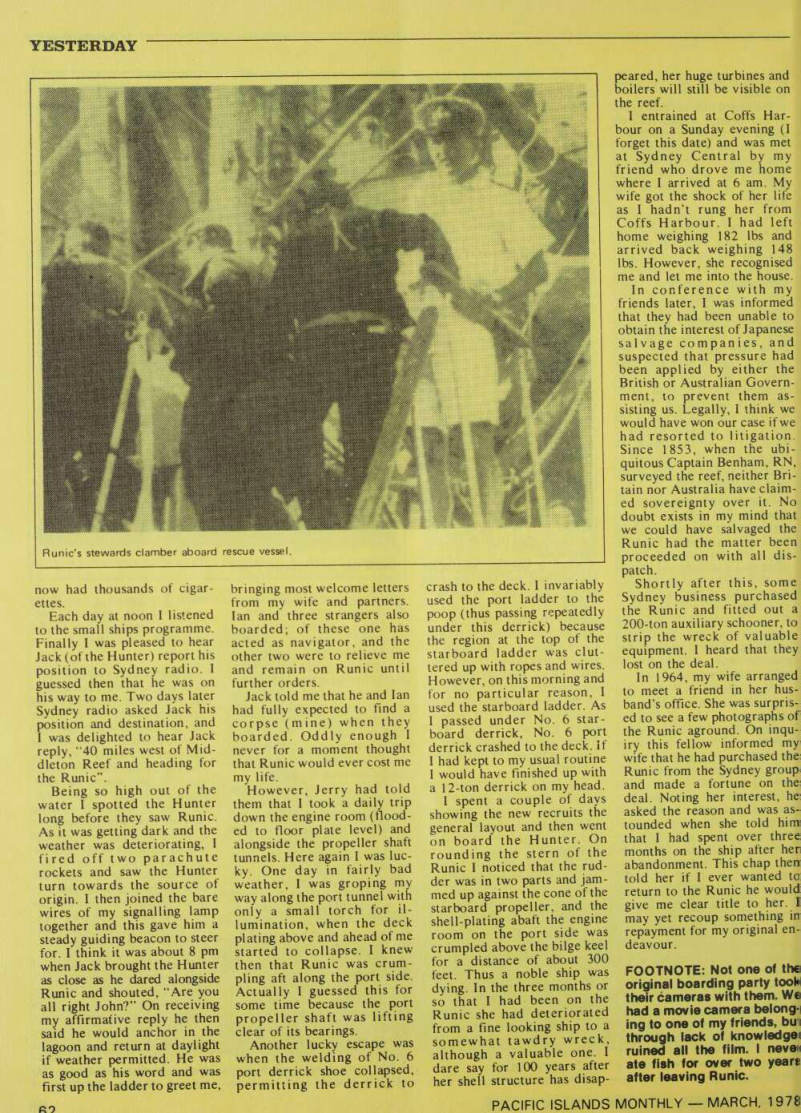
Runic's stewards clamber aboard rescue vessel.