An Entrepreneur?
pp. 44-45 · Read in the full issue
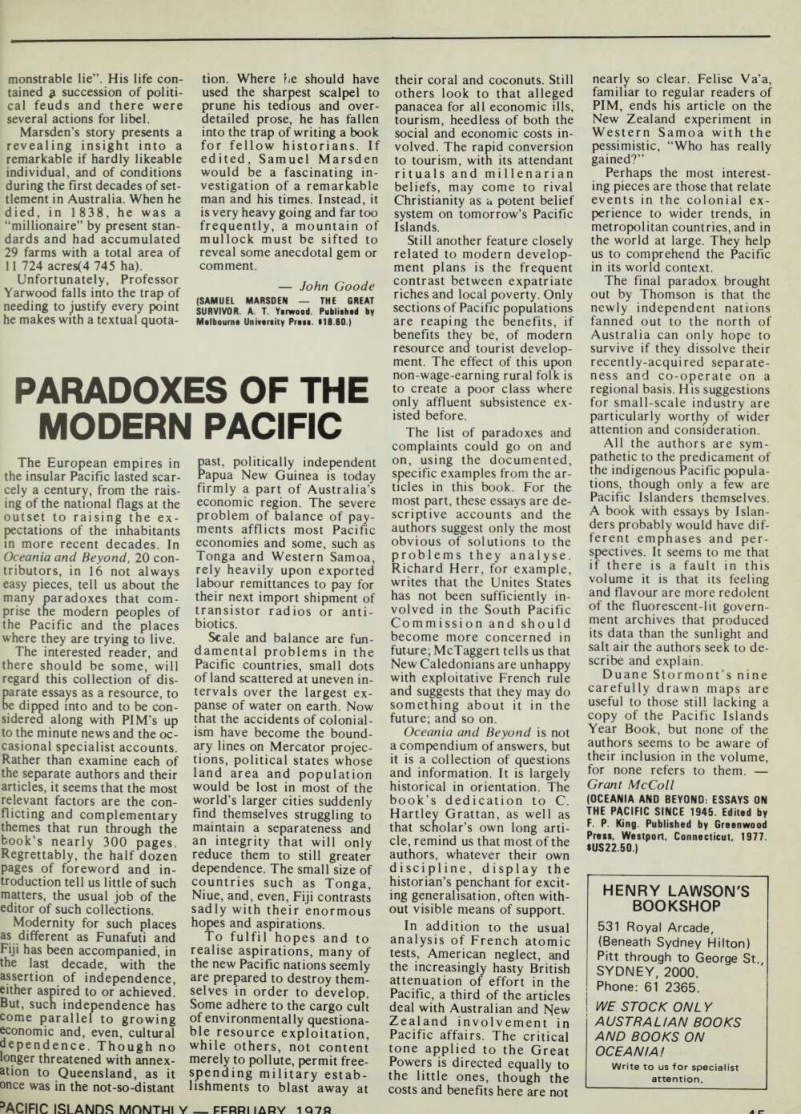
Samuel Marsden
Evangelist Or
When the colonial secretary of the Sydney Bible Society said in 1828, “The name of Samuel Marsden would always stand connected with the introduction of Christianity to the South Seas, and would be transmitted with honour to the remotest posterity,” he was exaggerating.
In Australia, Marsden was a virulent and controversial politico-clergyman with an ability to survive and succeed during the first four decades of settlement. So far as the Pacific Islands were concerned, he was more an ambassador and proyendor for British missionaries of the London Missionary Society who went to Tahiti and other islands in Polynesia from 1798 onwards.
Marsden’s personal voyages were restricted to the Tasman Sea although he ensured that his home at Parramatta became a retreat for those
men and women driven from the Islands by the antagonism G f the local people, or who sought refuge from the ravages of tropical diseases, As an explorer and active missionary, Marsden’s mis sion was limited to New Zea iand which he visited seven times. Not only did he become fi uent i n the Maori language but i n 1820, at the age of 55, be explored 600 miles of the North Island in six weeks. He was directly responsible for tbe establishment of the earliest mission staff and de spite protestations, Marsden was not unaware of his subor dinates’ shortcomings. These included Kendall’s penchant f or Maori mistresses and a i C ohol, and for largely self supporting men established in infertile land to survive by supplying the Maoris with guns in exchange for food, Marsden was a pragmatist an d opportunist with the
strongest instinct for survival.
A blacksmith’s son given a scholarship to Cambridge, he was Wilberforce’s last choice as an “evangelically-minded assistant” for Richard Johnson, chaplain to the First Fleet. When Marsden arrived in Sydney in 1794, he dis covered that only by acquir ing power as a magistrate could he then attempt to per form his duties by imposing punishment for open con tempt of the Sabbath.
Professor Yarwood, the author, spent 14 years in com piling this biography and, with those forms of financial aid available only to academic writers, he has en deavoured to record every document pertaining to Marsden. In his introduction, he quotes, a colleague who asked why he was studying such a “mean bastard”. In this book, the author certainly justifies the research and proves that Marsden was a figure of major importance and influence on Australian history.
Like his arch-enemy John Macarthur, Marsden was soon given a land grant and con victs to provide a workforce.
With remarkable foresight, he appreciated that the early set tlers had to make the colony self-sufficient in food, and that if sheep could be bred to withstand the harsh en vironment, they would supply meat and would also allow wool to be exported to mills in his home county of Yorkshire.
Marsden was a foundation member and senior vice president of the Agricultural Society of NSW from its for mation in 1822 and in this role, did not object to eman cipists being members. But there were very close limits to any traces of egalitarianism and he would not let these men share the magistrate’s bench with him.
Although the author claims he is not an apologist for his subject, he suggests that Marsden had a two-fold in centive to concentrate his efforts on sheep-breeding.
Primarily, it gave him some thing constructive to do in the early days when faced with the “massive indifference of felo ny and officials”, and could perform his religious duties only in the most abbreviated manner.
Secondly, his activities not
only provided food for his growing family but, as they prospered, enabled Marsden to become a man of property and wealth. When an oppor tunity arose, Marsden did what he could by then current standards to perform the “zealous evangelism” to which he had been trained.
Throughout the text, it is overwhelmingly apparent that not only did Marsden lack the tact needed to maintain the power he needed, but as late as 1814, Governor Macquarie (only one of the clergyman’s many enemies) was sneering at the chaplain’s “low rank and Methodistical Principles’’.
The author says it would not be difficult to compile a black and white credit and debit list for Marsden. His efforts to save illegitimate daughters of convicts from a life of inevitable prostitution were praiseworthy. Yet they contrasted with his utter dis interest in the local Aborigines because they “were not capable of taking the necessary first step towards conversion by adopt ing the white man’s material values” the foundations of Marsden’s own faith.
Similarly, his success in estab lishing the Anglican Church in Australia must be set against his lack of charity (in deed brutality) when permit ted to serve on the bench.
Professor Yarwood cri ticises other writers who “pre sent complex historical figures in simple monochromatic terms”.
Given the contradictions of Marsden’s record, he makes ai fair attempt to explain the; causes for this man’s in consistencies.
Marsden was both remarka ble and despicable. He, noti Macarthur, sent the first com mercial shipment of wool from the colony to England in 1811. Like many of his con temporaries, his bigotry against Roman Catholics from Ireland was matched, in lateit life, by an equal preparedness to “tell a deliberate and de
monstrable lie”. His life con tained & succession of politi cal feuds and there were several actions for libel.
Marsden’s story presents a revealing insight into a remarkable if hardly likeable individual, and of conditions during the first decades of set tlement in Australia. When he died, in 1 838, he was a “millionaire” by present stan dards and had accumulated 29 farms with a total area of 11 724 acres(4 745 ha).
Unfortunately, Professor Yarwood falls into the trap of needing to justify every point he makes with a textual quota
tion. Where he should have used the sharpest scalpel to prune his tedious and over detailed prose, he has fallen into the trap of writing a book for fellow historians. If edited, Samuel Marsden would be a fascinating in vestigation of a remarkable man and his times. Instead, it is very heavy going and far too frequently, a mountain of mullock must be sifted to reveal some anecdotal gem or comment.
John Goode
(Samuel Marsden The Great
SURVIVOR. A. T. Yarwood Published by Melbourne University Press. $18.60.)