'Kakamora'goes Home
p. 33 · Read in the full issue
Qtorgt Atkin, a Naw Zaaland-trained Solomon Islands journalist, pays tributa to Dr Charlas Elliot Fox: Dr Charles Elliot Fox, a legendary figure in the Solomon Islands because of the lifetime he spent there, has died at the age of 99 (PIM, Jan, p 5).
Otherwise known as Kakamora, or the Old Man of Melanesia, Dr Fox spent 70 years in the Solomons and only left at the age of 94, when, because of his deteriorating health, it was decided to send him to a geriatric hospital in New Zealand.
It was there that he died on October 28, 1977. Four days later his body was returned to the Solomon Islands for burial, as he had requested. Crowds gathered in tribute at the Henderson Airport and along the seven miles of Mendana Avenue. People were obviously very moved by the return of the body of this man who had devoted so much of his life to them.
The funeral service was held in St Barnabas Anglican Cathedral which was packed for the occasion. Large numbers of people had to stand outside. The next morning a simple burial ceremony was held at Tambalia, the home of tne Melanesian Brotherhood of which Dr Fox was a member.
Dr Fox was born in Dorset, England, in 1878, and migrated to New Zealand with his parents at the age of five. As a child he was in ill health and did not go to school until he was 14. However, he was a very clever scholar and in 1900 obtained first class honours in the University of New Zealand in science and theology.
Ever since 1893, when he first met a cricket team from Melanesia, he had dreamed of going to their country and working with them. However, initially he was to be
disappointed.
He was ordained as an Anglican priest in 1903 and he asked to be sent to Melanesia as a missionary. But permission was refused on the grounds of his precarious
health. Instead he went to Norfolk Island and taught Melanesian children there. Finally the authorities relented and a year later he landed in the Solomons to take charge of Pamua School on Makira, an island well known for its cannibalism in the old days.
During his stay on Makira he was adopted into the Arosi tribe (that’s where I come from). He exchanged names with a young chief and lived as a member of his household. He took part in the everyday work of the village and acquired a unique knowledge of Arosi custom and language, which culminated in several publications including the Arosi dictionary.
In 1933 Dr Fox joined the Religious Order of the Melanesian Brotherhood and went to live on Malaita, an island which was greatly feared because of the hostility of its people. It was there that he was stationed when World War if broke out and he became a coastwatcher. The Japanese always tried to catch him, but he was always warned of their approach in time and was able to escape into the interior where the Japanese were afraid to follow because of the hostility of the natives.
A sportsman, scholar, writer, and anthropologist, Dr Fox was a great missionary who never accepted a position of high authority. It was a very sad day when, in 1974, this man, who was small in stature but great in his work and deeds, finally left the country he dearly loved.
Around April, 1977, Dr Fox asked the Solomons Government to allow his return as a citizen of the Solomons. This was refused as the country lacked appropriate medical facilities to take care of him.
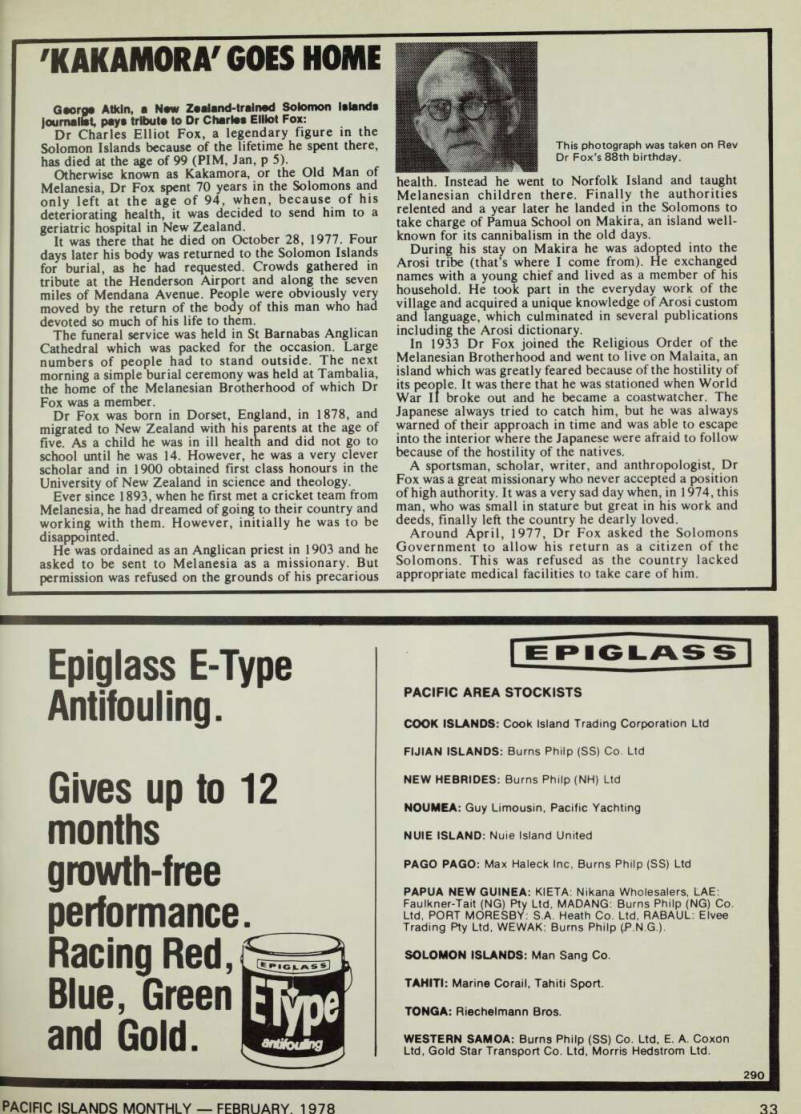
This photograph was taken on Rev Dr Fox's 88th birthday.