Political
pp. 18-26 · Read in the full issue
Currents
Changes At
The Top
In Tonga?
Major changes at top levels in the Tongan Government seem to be in the offing.
It is no secret that the Prime Minister, Prince Tu’ipelehake, has not been in good health for some time. He saw overseas specialists dur ing 1977, and medical opi nion is that he should retire as soon as possible. Prince Tu’ipelehake has been Prime Minister since 1966 when his brother, the present king, suc ceeded to the throne after the death of their mother, the late Queen Salote.
Interested people have been speculating as to who should succeed the prince should he retire. While the appointment of a successor is the sold pre rogative of his Majesty King Tupou IV, most people believe that the Deputy Prime Minister, Hon Tuita, is the logical successor.
Apart from being Deputy Prime Minister, Hon Tuita has held the most difficult portfolio of Lands and Survey for several years. The consen sus of opinion has it that no one else can handle this ex tremely tough portfolio (in a land-hungry nation such as Tonga) as well as Hon Tuita has done and is doing.
Most civil servants agree that one of his outstanding qualities, which separates him from other ministers, is being decisive in what he does an important leadership prere quisite. He demands no less than the best of performance from those under his authori ty, and it is common knowledge in the kingdom that he is never late for work.
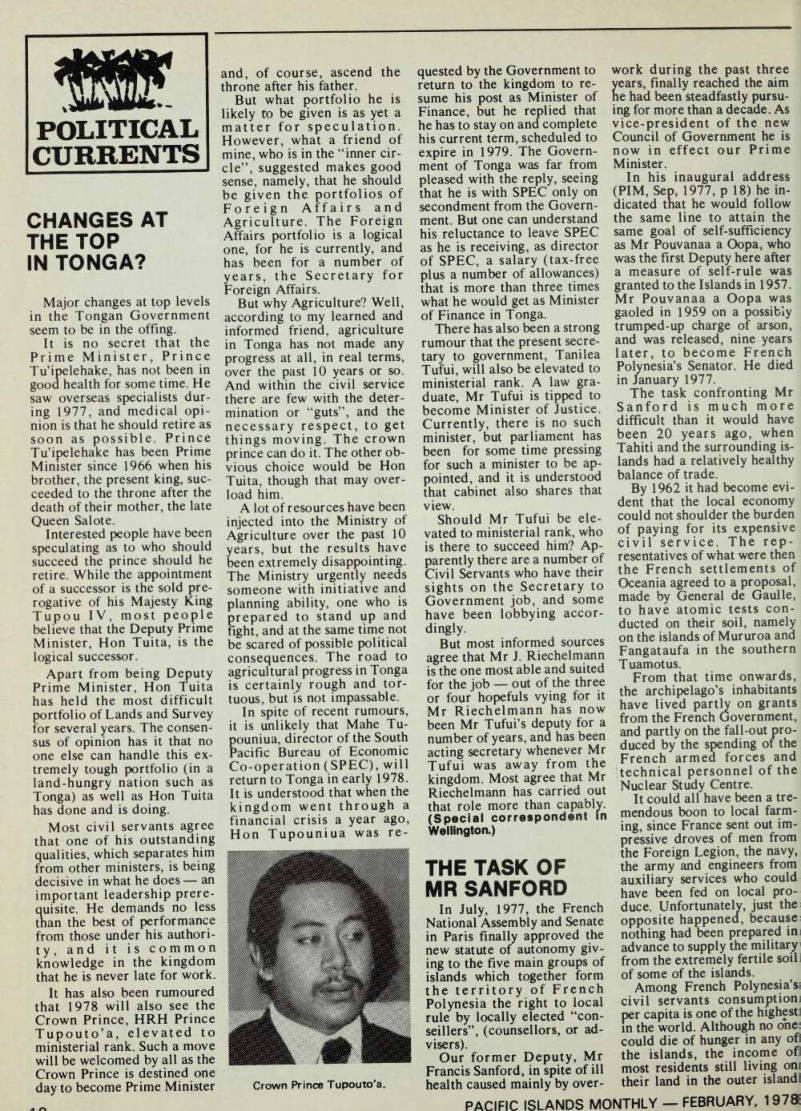
It has also been rumoured that 1978 will also see the Crown Prince, HRH Prince Tupouto’a, elevated to ministerial rank. Such a move will be welcomed by all as the Crown Prince is destined one day to become Prime Minister
and, of course, ascend the throne after his father.
But what portfolio he is likely to be given is as yet a matter for speculation.
However, what a friend of mine, who is in the “inner cir cle”, suggested makes good sense, namely, that he should be given the portfolios of Foreign Affairs and Agriculture. The Foreign Affairs portfolio is a logical one, for he is currently, and has been for a number of years, the Secretary for Foreign Affairs.
But why Agriculture? Well, according to my learned and informed friend, agriculture in Tonga has not made any progress at all, in real terms, over the past 10 years or so.
And within the civil service there are few with the deter mination or “guts”, and the necessary respect, to get things moving. The crown prince can do it. The other ob vious choice would be Hon Tuita, though that may over load him.
A lot of resources have been injected into the Ministry of Agriculture over the past 10 years, but the results have been extremely disappointing.
The Ministry urgently needs someone with initiative and planning ability, one who is prepared to stand up and fight, and at the same time not be scared of possible political consequences. The road to agricultural progress in Tonga is certainly rough and tor tuous, but is not impassable.
In spite of recent rumours, it is unlikely that Mahe Tu pouniua, director of the South Pacific Bureau of Economic Co-operation (SPEC), will return to Tonga in early 1978.
It is understood that when the kingdom went through a financial crisis a year ago, Hon Tupouniua was re-
quested by the Government to return to the kingdom to re sume his post as Minister of Finance, but he replied that he has to stay on and complete his current term, scheduled to expire in 1979. The Govern ment of Tonga was far from pleased with the reply, seeing that he is with SPEC only on secondment from the Govern ment. But one can understand his reluctance to leave SPEC as he is receiving, as director of SPEC, a salary (tax-free plus a number of allowances) that is more than three times what he would get as Minister of Finance in Tonga.
There has also been a strong rumour that the present secre tary to government, Tanilea Tufui, will also be elevated to ministerial rank. A law gra duate, Mr Tufui is tipped to become Minister of Justice.
Currently, there is no such minister, but parliament has been for some time pressing for such a minister to be ap pointed, and it is understood that cabinet also shares that view.
Should Mr Tufui be ele vated to ministerial rank, who is there to succeed him? Ap parently there are a number of Civil Servants who have their sights on the Secretary to Government job, and some have been lobbying accor dingly.
But most informed sources agree that Mr J. Riechelmann is the one most able and suited for the job out of the three or four hopefuls vying for it Mr Riechelmann has now been Mr Tufui’s deputy for a number of years, and has been acting secretary whenever Mr Tufui was away from the kingdom. Most agree that Mr Riechelmann has carried out that role more than capably. (Special correspondent in Wellington.)
The Task Of
Mr Sanford
In July, 1977, the French National Assembly and Senate in Paris finally approved the new statute of autonomy giv ing to the five main groups of islands which together form the territory of French Polynesia the right to local rule by locally elected “con seillers”, (counsellors, or ad visers).
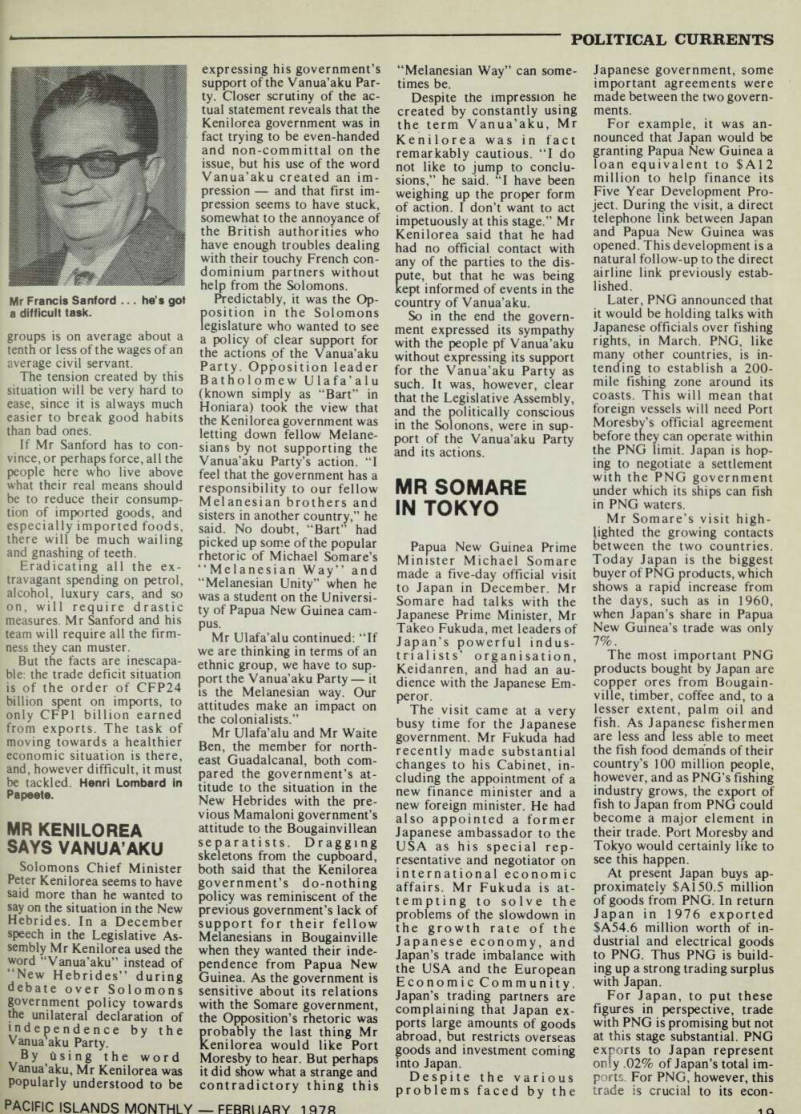
Our former Deputy, Mr Francis Sanford, in spite of ill health caused mainly by over
work during the past three years, finally reached the aim he had been steadfastly pursu ing for more than a decade. As vice-president of the new Council of Government he is now in effect our Prime Minister.
In his inaugural address (PIM, Sep, 1977, p 18) he in dicated that he would follow the same line to attain the same goal of self-sufficiency as Mr Pouvanaa a Oopa, who was the first Deputy here after a measure of self-rule was granted to the Islands in 1957.
Mr Pouvanaa a Oopa was gaoled in 1959 on a possibly trumped-up charge of arson, and was released, nine years later, to become French Polynesia’s Senator. He died in January 1977.
The task confronting Mr Sanford is much more difficult than it would have been 20 years ago, when Tahiti and the surrounding is lands had a relatively healthy balance of trade.
By 1962 it had become evi dent that the local economy could not shoulder the burden of paying for its expensive civil service. The rep resentatives of what were then the French settlements of Oceania agreed to a proposal, made by General de Gaulle, to have atomic tests con ducted on their soil, namely on the islands of Mururoa and Fangataufa in the southern T uamotus.
From that time onwards, the archipelago’s inhabitants have lived partly on grants from the French Government, and partly on the fall-out pro duced by the spending of the French armed forces and technical personnel of the Nuclear Study Centre.
It could all have been a tre mendous boon to local farm ing, since France sent out im pressive droves of men from the Foreign Legion, the navy, the army and engineers from auxiliary services who could have been fed on local pro duce. Unfortunately, just the
opposite happened, because
nothing had been prepared in advance to supply the military from the extremely fertile soil of some of the islands.
Among French Polynesia’s civil servants consumption per capita is one of the highest in the world. Although no one could die of hunger in any of: the islands, the income of most residents still living om their land in the outer island!
Crown Prince Tupouto'a.
groups is on average about a tenth or less of the wages of an average civil servant.
The tension created by this situation will be very hard to ease, since it is always much easier to break good habits than bad ones.
If Mr Sanford has to con vince, or perhaps force, all the people here who live above what their real means should be to reduce their consump tion of imported goods, and especially imported foods, there will be much wailing and gnashing of teeth.
Eradicating all the ex travagant spending on petrol, alcohol, luxury cars, and so on, will require drastic measures. Mr Sanford and his team will require all the firm ness they can muster.
But the facts are inescapa ble; the trade deficit situation is of the order of CFP24 billion spent on imports, to only CFPI billion earned from exports. The task of moving towards a healthier economic situation is there, and, however difficult, it must be tackled. Henri Lombard In Papeete.
Mr Kenilorea
Says Vanua’Aku
Solomons Chief Minister Peter Kenilorea seems to have said more than he wanted to say on the situation in the New Hebrides. In a December speech in the Legislative As sembly Mr Kenilorea used the word “Vanua’aku” instead of “New Hebrides’’ during debate over Solomons government policy towards the unilateral declaration of independence by the Vanua aku Party.
By using the word Vanua’aku, Mr Kenilorea was popularly understood to be
expressing his government’s support of the Vanua’aku Par ty. Closer scrutiny of the ac tual statement reveals that the Kenilorea government was in fact trying to be even-handed and non-committal on the issue, but his use of the word Vanua’aku created an im pression and that first im pression seems to have stuck, somewhat to the annoyance of the British authorities who have enough troubles dealing with their touchy French con dominium partners without help from the Solomons.
Predictably, it was the Op position in the Solomons legislature who wanted to see a policy of clear support for the actions of the Vanua’aku Party. Opposition leader Batholomew Ulafa’alu (known simply as “Bart” in Honiara) took the view that the Kenilorea government was letting down fellow Melane sians by not supporting the Vanua’aku Party’s action. “I feel that the government has a responsibility to our fellow Melanesian brothers and sisters in another country,” he said. No doubt, “Bart” had picked up some of the popular rhetoric of Michael Somare’s “Melanesian Way’’ and “Melanesian Unity” when he was a student on the Universi ty of Papua New Guinea cam pus.
Mr Ulafa’alu continued; “If we are thinking in terms of an ethnic group, we have to sup port the Vanua’aku Party— it is the Melanesian way. Our attitudes make an impact on the colonialists.”
Mr Ulafa’alu and Mr Waite Ben, the member for north east Guadalcanal, both com pared the government’s at titude to the situation in the New Hebrides with the pre vious Mamaloni government’s attitude to the Bougainvillean separatists. Dragging skeletons from the cupboard, both said that the Kenilorea government’s do-nothing policy was reminiscent of the previous government’s lack of support for their fellow Melanesians in Bougainville when they wanted their inde pendence from Papua New Guinea. As the government is sensitive about its relations with the Somare government, the Opposition’s rhetoric was probably the last thing Mr Kenilorea would like Port Moresby to hear. But perhaps it did show what a strange and contradictory thing this
“Melanesian Way” can some times be.
Despite the impression he created by constantly using the term Vanua’aku, Mr Kenilorea was in fact remarkably cautious. “I do not like to jump to conclu sions,” he said. “I have been weighing up the proper form of action. I don’t want to act impetuously at this stage.” Mr Kenilorea said that he had had no official contact with any of the parties to the dis pute, but that he was being kept informed of events in the country of Vanua’aku.
So in the end the govern ment expressed its sympathy with the people pf Vanua’aku without expressing its support for the Vanua’aku Party as such. It was, however, clear that the Legislative Assembly, and the politically conscious in the Solonons, were in sup port of the Vanua’aku Party and its actions.
Mr Somare
In Tokyo
Papua New Guinea Prime Minister Michael Somare made a five-day official visit to Japan in December. Mr Somare had talks with the Japanese Prime Minister, Mr Takeo Fukuda, met leaders of Japan’s powerful indus trialists’ organisation, Keidanren, and had an au dience with the Japanese Em peror.
The visit came at a very busy time for the Japanese government. Mr Fukuda had recently made substantial changes to his Cabinet, in cluding the appointment of a new finance minister and a new foreign minister. He had also appointed a former Japanese ambassador to the USA as his special rep resentative and negotiator on international economic affairs. Mr Fukuda is at tempting to solve the problems of the slowdown in the growth rate of the Japanese economy, and Japan’s trade imbalance with the USA and the European
Economic Community.
Japan’s trading partners are complaining that Japan ex ports large amounts of goods abroad, but restricts overseas goods and investment coming into Japan.
Despite the various problems faced by the
Japanese government, some important agreements were made between the two govern ments.
For example, it was an nounced that Japan would be granting Papua New Guinea a loan equivalent to SAI2 million to help finance its Five Year Development Pro ject. During the visit, a direct telephone link between Japan and Papua New Guinea was opened. This development is a natural follow-up to the direct airline link previously estab lished.
Later, PNG announced that it would be holding talks with Japanese officials over fishing rights, in March. PNG, like many other countries, is in tending to establish a 200mile fishing zone around its coasts. This will mean that foreign vessels will need Port Moresby’s official agreement before they can operate within the PNG limit. Japan is hop ing to negotiate a settlement with the PNG government under which its ships can fish in PNG waters.
Mr Somare’s visit high lighted the growing contacts between the two countries.
Today Japan is the biggest buyer of PNG products, which shows a rapid increase from the days, such as in 1960, when Japan’s share in Papua New Guinea’s trade was only 7%.
The most important PNG products bought by Japan are copper ores from Bougain ville, timber, coffee and, to a lesser extent, palm oil and fish. As Japanese fishermen are less and less able to meet the fish food demands of their country’s 100 million people, however, and as PNG’s fishing industry grows, the export of fish to Japan from PNG could become a major element in their trade. Port Moresby and Tokyo would certainly like to see this happen.
At present Japan buys ap proximately $A150.5 million of goods from PNG. In return Japan in 1976 exported $A54.6 million worth of in dustrial and electrical goods to PNG. Thus PNG is build ing up a strong trading surplus with Japan.
For Japan, to put these figures in perspective, trade with PNG is promising but not at this stage substantial. PNG exports to Japan represent only .02% of Japan’s total im ports. For PNG, however, this trade is crucial to its econ
Mr Francis Sanford... he’s got a difficult task.
omic development. PNG’S trade surplus with Japan in 1976 was so great that it could have financed 25% of the PNG government’s budget for that year.
Despite the disparity in economic strength between the two countries, Mr Somare in the past has been quite clear on the basis of Japan’s deal ings with his government. He said in 1971: “Papua New Guinea must drive home to the Japanese that trade on as equal a basis as possible is the goal we expect our trading partners to follow.’’
Mr Somare has stressed that Japan cannot regard PNG simply as a nation to be ex ploited. The Japanese Government on the other hand realises that the image of Japanese business in the developing countries has not been good, and is trying to im prove this situation through beefing up its aid programme.
In 1974 Japan despatched a study mission to Port Moresby to look at the various ways in which Japan could provide developmental aid to PNG. A number of aid projects have been developed since that time and these have done a substantial amount to cement relations between the two governments beyond com mercial contacts.
Between 1975 and 1977 Japanese experts surveyed the potentialities and problems of construction of a hydro electric project on the Purari River. This survey is con tinuing and has already cost Japan approximately $A2.5 million.
Other recent Japanese aid projects have concentrated on the development of fishing and timber industries in PNG.
Obviously in these projects Japan is as much looking to her own raw material and food needs as to PNG’s econ omic development. These projects have included feasibility studies concerning the establishment of fisheries bases at Kavieng and Rabaul, aid for a fisheries college at Kavieng, and a reafforestation study at Madang. In 1976 these projects cost Japan $A25.8 million.
In addition to financial aid, Japan has been providing technical assistance through the despatch of experts. In 1976 Japan despatched five experts to PNG and 18 to the Pacific as a whole. This does
not include the 36 members of various survey parties in pro jects mentioned previously.
Although Oceania only re ceives about 1% of Japan’s Bilateral Official Develop ment Assistance funds, its share is increasing and PNG is gaining the major share.
A Question
Of Loyalty
The French territory of New Caledonia is not only the long cigar-shaped island, but also the small islands in cluded in the general term “...and dependencies’’. The inhabitants of what the English missionaries first call ed the Loyalties, and which have a total surface of 2 000 square kilometres, are differ ent from the mainlanders.
The Polynesian invaders have left their mark, and the people of Lifou, Mare or Ouvea are physically distinct from the Melanesians of the mainland. The LMS mission aries were influential in that cricket, and a few words of the English language, have also been adopted by the Loyal tians.
But the most important re sult of their work is that the majority of the islands are Protestant, while the inhabi tants of the mainland were converted to Christianity by the French, and thus Roman Catholic, missionaries.
A final touch that dis tinguishes the Loyalty Islands from the rest of the territory; they have remained unspoiled by European colonialisation in that the tribes remain un disputed owners of the re serves and practically no Europeans live there, apart from the gendarme, the clergyman, the odd public servant and an occasional tra desman living on leased pro perty. Perhaps the islands were of no little interest, hav ing no mineral wealth and lacking in water.
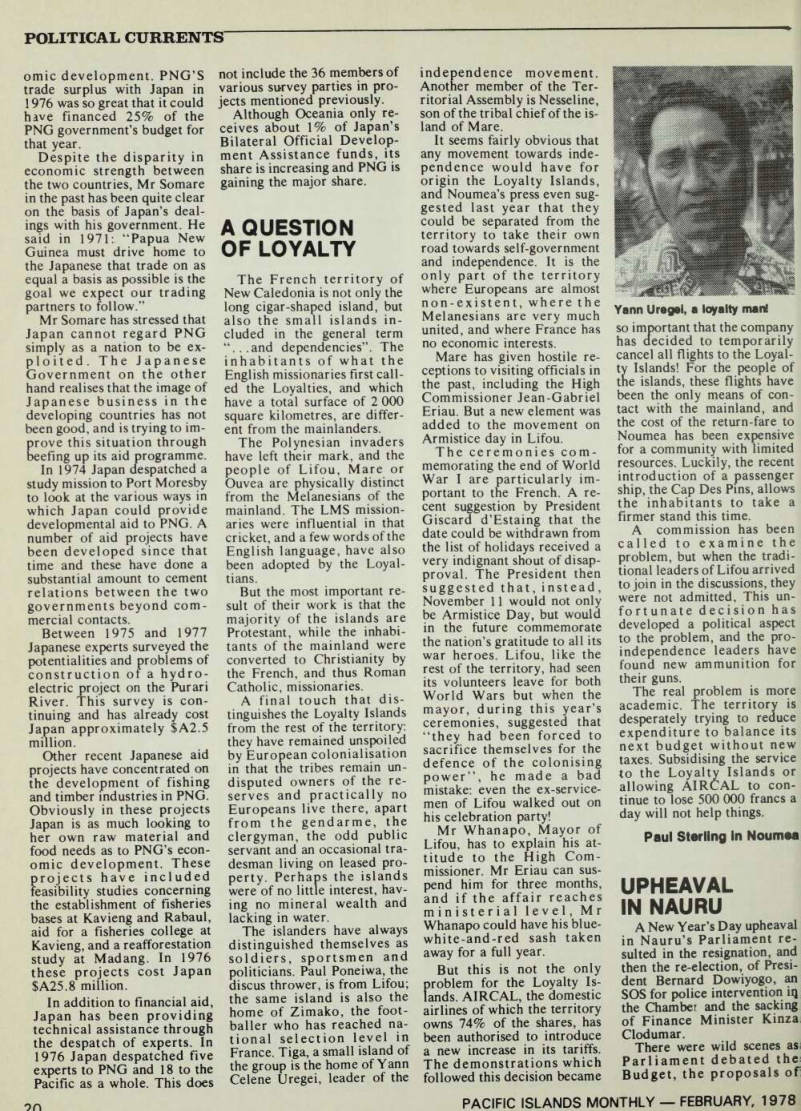
The islanders have always distinguished themselves as soldiers, sportsmen and politicians. Paul Poneiwa, the discus thrower, is from Lifou; the same island is also the home of Zimako, the foot baller who has reached na tional selection level in France. Tiga, a small island of the group is the home of Yann Celene Uregei, leader of the
independence movement.
Another member of the Ter ritorial Assembly is Nesseline, son of the tribal chief of the is land of Mare.
It seems fairly obvious that any movement towards inde pendence would have for origin the Loyalty Islands, and Noumea’s press even sug gested last year that they could be separated from the territory to take their own road towards self-government and independence. It is the only part of the territory where Europeans are almost non-existent, where the Melanesians are very much united, and where France has no economic interests.
Mare has given hostile re ceptions to visiting officials in the past, including the High Commissioner Jean-Gabriel Eriau. But a new element was added to the movement on Armistice day in Lifou.
The ceremonies com memorating the end of World War I are particularly im portant to the French. A re cent suggestion by President Giscard d’Estaing that the date could be withdrawn from the list of holidays received a very indignant shout of disap proval. The President then suggested that, instead, November 11 would not only be Armistice Day, but would in the future commemorate the nation’s gratitude to all its war heroes. Lifou, like the rest of the territory, had seen its volunteers leave for both World Wars but when the mayor, during this year’s ceremonies, suggested that “they had been forced to sacrifice themselves for the defence of the colonising power”, he made a bad mistake: even the ex-service men of Lifou walked out on his celebration party!
Mr Whanapo, Mayor of Lifou, has to explain his at titude to the High Com missioner. Mr Eriau can sus pend him for three months, and if the affair reaches ministerial level, Mr Whanapo could have his blue white-and-red sash taken away for a full year.
But this is not the only problem for the Loyalty Is lands. AIRCAL, the domestic airlines of which the territory owns 74% of the shares, has been authorised to introduce a new increase in its tariffs.
The demonstrations which followed this decision became
so important that the company has decided to temporarily cancel all flights to the Loyal ty Islands! For the people of the islands, these flights have been the only means of con tact with the mainland, and the cost of the return-fare to Noumea has been expensive for a community with limited resources. Luckily, the recent introduction of a passenger ship, the Cap Des Pins, allows the inhabitants to take a firmer stand this time.
A commission has been called to examine the problem, but when the tradi tional leaders of Lifou arrived to join in the discussions, they were not admitted. This un fortunate decision has developed a political aspect to the problem, and the pro independence leaders have found new ammunition for their guns.
The real problem is more academic. The territory is desperately trying to reduce expenditure to balance its next budget without new taxes. Subsidising the service to the Loyalty Islands or allowing AIRCAL to con tinue to lose 500 000 francs a day will not help things.
Paul Sterling in Noumea
Upheaval
In Nauru
A New Year’s Day upheaval in Nauru’s Parliament re sulted in the resignation, and then the re-election, of Presi dent Bernard Dowiyogo, an SOS for police intervention iij the Chamber and the sacking of Finance Minister Kinza Clodumar.
There were wild scenes as Parliament debated the Budget, the proposals of
Yann Uregel, a loyalty man!
which were opposed tooth and nail by ex-president Hammer Deßoburt and his supporters.
From the opening of the new Parliament in November, after the elections, Head Chief Deßoburt has refused to accept parliamentary pro cedure, the Speaker’s ruling and has continued to harass the government at every turn.
It was his refusal to accept any budget proposals which caus ed the President to resign just after midnight on New Year’s Day.
President Dowiyogo had refused to submit proposals to the Committee of Supply and threatened that if the Budget was not approved by midnight he would resign. Midnight came, the Budget was still held up and the President re signed. He was re-elected almost immediately and with his one-man majority he forc ed Budget proposals through around 4 am.
Head Chief Hammer and his supporters had called for the dropping of Finance Minister Kmza Clodumar and to obtain some semblance of order and the appeasement of the Opposition, Mr Clodumar was dropped from the Cabinet.
Mr Ruben Kun, Parliamen tary Works Minister, was ap pointed in his place, Mr Leo Keke becoming the Works Minister. Mr Lagumot Harris continues as Education and Health Minister with the ad ditional portfolio of Minister assisting the President. Mr Kenas Aroi remains Minister for Island Development and Industry and Civil Aviation.
The situation in the Republic remains tense as Head Chief Hammer Deßoburt continues to attack the government, to walk out of parliamentary committee meetings and con tinues to declare that the deci sion of the electorate in November to return to power President Dowiyogo’s Nauru Party is wrong.
Storms Ahead
In The Cooks?
In the Cook Islands there have been two events which could very much affect the balance of power between the Cook Islands Party and the Democratic Party, writes a Cook Islands political corres pondent.
Several months ago one of
the members of the Legisla tive Assembly, Pomani Tangata, the Democratic Party member for Atiu, found himself in difficulties with the authorities in Fiji, as a result of his alleged behaviour at a motel.
The Cook Islands Govern ment sent two Cook Islands doctors to Fiji and they escorted Mr Tangata to Auck land, where eventually he was committed to Oakley Psy chiatric Hospital. As a result of the committal the acting Speaker of the Legislative As sembly of the Cook Islands declared Mr Tangata’s seat for Atiu void and steps were taken to initiate a by-election on Atiu.
There have now been three legal hearings in respect to Mr Tangata’s claim that he was incorrectly committed and that as a consequence his seat should not have been declared void. The outcome of the hearing in respect of the case held in Rarotonga towards the end of 1977 is of considerable importance as the possibility of Mr Tangata being successful with his peti tion could be an embarrass ment to both parties.
The significance of by-elec tions at this stage of the life of present Legislative Assembly of the Cook Islands, is that the Cook Islands Party remains eager to win a 2 /ards majority in the House, which would allow it to carry out constitu tional amendments, partic ularly those relating to the position of Head of State.
In the period leading up to December there was a cam paign mounted for a seat in the Takitumu electorate on Rarotonga, which resulted from the death of Tiakana Numanga, a Deputy Premier of the Cook Islands.
At no time previously has it seemed likely that the Cook Islands Party would be de feated in the Takitumu elec torate and the party put up as its candidate Matapo Matapo, planter and businessman very well-known in the Titikaveka district. Standing in opposi tion was laveta Short, a law yer trained in Auckland, and a partner in the local legal firm of Short and Tyler.
The outcome of the election is very significant. It is worth recalling that in the last elec tion only a few votes sepa rated candidates for the two parties and that it would not
need a swing of more than a handful of votes to change the balance of power.
In the end, laveta Short won the by-election by 485 votes to 457. While on the surface it may seem that the election has been a success for the Democratic Party perhaps laveta Short’s election to the Assembly has a deeper sig nificance. It may well herald a fundamental change in the political power structure in the Cook Islands. In the im mediate future it means that under the terms of the con stitution the Cook Islands Party will not be able to make the amendments it has been seeking to accomplish for several years.
Aftermath
Of Tears
Following teargas and a near-riot in Vila, the New Hebrides has begun 1978 in nervous and uncertain fashion, with at least the knowledge that the widely predicted violence and re criminations following “Gas Day, November 29” did not eventuate.
There are still strong possibilities, of course, that trouble could break out, but, to date, action has been largely low-key lobbying and much behina-closed-doors strategy re-thinking, partic ularly by the Vanuaaku Party.
The result, of course, is a lameduck Representative As sembly, the certainty that another expensive election will have to be called and thirdly, that the tension will not go away. Eyes remain on Vanuaaku, because with its previously-proven voting sup port (perhaps less now) it re mains a prerequisite to the peaceful transition of the New Hebrides to independence.
Two points come home most sharply following the November and December hassles, which, incidentally, were exaggerated by overseas media.
The first is that strong feel ings are certainly visible con cerning the political paths the condominium should go.
There are several different at titudes here and avenues should be construed so that all, or most, can be heard in a more sane atmosphere.
The second is that the New Hebrides is not the tinderbox observers would have most
think. Violence was certainly possible and only fairly ex treme action stopped it. But trouble were largely in one spot, involving very much a minority. Except for about an hour at the most, business was as normal in Vila. Also, the much-forecast retributions, and follow-up violence simply didn’t eventuate. There was admittedly a lot of ap prehension and residents didn’t venture far from their homes at night. Liquor sales were banned for a week, a measure which undoubtedly contributed to the peace.
A predicted foray on the Second Representative As sembly never took place.
The British Government played things very low-key.
The French, with a bigger propaganda machine, pub lished a special edition of Nabanga newpaper on December 3, showing graphic pictures of the British police and the teargas action.
This could have hardly have improved the image of the British who got little credit for the action of their police, but British chief infor mation officer, Geoff W.
Stevens, described the French reporting of the near-crisis on November 29 as “very fair”.
Big business, such as the retailers and the banks (Vila is the most over-banked town in the Pacific) were non-com mittal and very few ex ecutives could be quoted.
One exception here was a venerable but very energetic Reece Discombe who says he has $1 million invested in Efate and Santo who said that land remained the key to the political unrest.
New Zealand-born and a resident of the condominium for nearly 30 years, he forecast that all rural land would go back to the New Hebrideans. He noted that he had no plans to leave and was, instead, looking for new in vestments in the con dominium. “We’re here to stay, it’s our home and we like the place,” he concluded.
Keith Cooke, another busi nessman of long standing, couldn’t agree less and forecast further and worsen ing troubles, including much violence.
Mr Cooke, a former major store owner, owns a promi nent snackbar in downtown Vila. He noted that he would be departing, after he had sold his business,
Off the beaten
tourist track
A village on the Trobriand Islands has a special project to encourage tourists. They have build three small guest houses, capable of accom modating one person in each house.
The cost to stay in one of these houses is K 5 a night (all inclusive) and the tourist can share meals with the villagers, help with garden chores, fish with the villagers and
generally participate in all
aspects of local life as well as spending time at their own leisure on the island.
FOOTNOTE: The girls of the Trobriand Islands are among the most attractive in the South Pacific.
Micronesian
girls in Fiji
Several women from the US Trust Territory were selected by the South Pacific Com mission to attend the 1978 Home Economics Course in Suva, Fiji.
They include Valeria Remoket and Augustina Mesubed of Palau, Carmen Taitano of the Northern Marianas, Carmen Guchol and Lydia Sawyog of Yap, and Tarbo Hemos of the Marshalls.
They went to Fiji in January and will study there for nine months. Home Economics, Baby Care, Home Cooking, Sewing and Home Gardening are some of the courses offered.
The course is funded par tially by the South Pacific Commission. People from the member nations of the South Pacific Commission will also take part in the course.
Moscow er,
Honiara calling
The man at the Australian Security Intelligence Organ isation headquarters put down his earphones and gave his radio monitor a thump. “Darn thing must be playing up,” he mumbled to himself. He had been told to monitor the Solomon Islands Broadcast ing Corporation and all he was getting was news from Radio Moscow.
“Still, better to be sure than sorry,” he said to himself as he
picked up the telephone and dialled the Security and In telligence Service in Wellington. Perhaps their monitor was working properly and they’d picked up the news programme from Honiara.
Perhaps they’d whizz over a tape to prevent the boss from suspecting that he’d been sleeping on the job.
But the ASIO man blanch ed. Wellington had been get ting Radio Moscow too. It was coming from SIBC. What had happened a pro-Soviet coup out there in our Pacific Ocean? He ran down the cor ridor shouting “The Russians are coming!”
Well, anyway, if an ASIO man had been listening to SIBC one night in December he would have heard Honiara’s radio station broadcasting news from Moscow and sharing with listeners a few thoughts from Mr Brezhnev as well. But it wasn’t due to a coup. Simply a tuning mistake. SIBC nor mally takes its international news broadcast from Radio Australia, but someone slip ped up on the tuning and the news came from Radio Moscow’s English-language shortwave broadcast instead.
It took about 10 minutes before someone woke up that something was amiss. It was when the female announcer launched into a very long piece on a very long speech Mr Brezhnev had given re cently, that it became clear this wasn’t the ABC.
Then a few days later peo ple listening to the SIBC for the relay of Radio Australia’s international news heard a cheery voice with a strong American accent say; “Hullo Africans, welcome to African Safari.” The gremlins had been at it again ... or perhaps there had been a coup at SIBC on behalf of the Voice of America, overthrowing whoever it was had turned the dial to Radio Moscow.
Apia's case of
wages fraud
The Western Samoa Public Accounts Committee is not at all happy with procedures for paying wages in the Public Works Department. In fact the way some officers went about it was in breach of Treasury instructions, and led
to a loss of $43 882, which the committee called “a fraud”.
The committee noted a paragraph in the audit report which said that the same per son prepared the paysheet, drew up the voucher, uplifted the cheque, cashed the cheque at the bank, put the money in pay envelopes and attended to the pay-out.
It considered that senior of ficers of the department did not carry out their duties in line with Treasury instruc tions. In fact, one witness told the committee that one of the certifying officers used to bor row unclaimed wages for his private use. In many cases he had never paid the money back. ‘‘No wonder this particular certifying officer never check ed the paysheets when return ed for final certification,” the committee commented. ‘‘The result of this irresponsible at titude was a loss of govern ment revenue amounting to $43 882”.
This fraud was explained by “one of the culprits” to the committee as follows; on Sun days he (a former salary clerk) and his collaborator (former costing clerk) took the paysheets to their houses and prepared them there. On Mondays they would bring the prepared paysheets to the of fice and usually the account ant would certify the voucher.
The accountant then made the arrangements with the Treasury for the processing of the voucher, after which the former salary clerk and cost ing clerk would “uplift the cheque”, cash it at the bank, put the money on envelopes and attend to the payout.
The drooping
of the colours
In the Cook Islands, the Public Service Act has been amended to allow the Cook Islands Police Force to have a greater degree of autonomy, and the Government decided that it should give public re cognition to this increased in
dependence by presenting col
ours to the police.
And so it was on a fine morning in the first week of December, that the colour parade was held on the historic grounds of Takamoa, the site of the London Mis sionary Society’s theological college. A pavilion was set up
Tropicalities
and a large number of invited guests were seated to best ad vantage while many other people and the children of the nearby Avarua Primary School took up vantage
points.
Apart from Superintendent Lester Khan and two other senior officers, who were seated in the pavilion, the whole of the Rarotongan force, both policemen and
policewomen numbering
perhaps 40 in all, stood on parade to await the arrival of the Premier, Sir Albert Henry. The official entourage arrived and the Premier in spected the parade. A prayer was said, the colours were dedicated and then the Pre mier formally handed the col ours to two of the police of ficers.
Sir Albert mounted the rostrum to address the parade and to bring to the notice of the people the very significant role that the police force plays in the maintenance of law and order.
It was all very like Lon don’s Trooping of the Colour, all very formal, all very proper and all according to Hoyle. Even to the fainting troopers. Hardly had the Pre mier begun his oration than a hefty sergeant fell log-like through the ranks and had to be removed by several of his colleagues to be revived under a nearby tree.
A few minutes later one of the policewomen in the front rank was also overcome and quietly crumpled into an inert heap in front of Sir Albert.
She also was dragged from the parade and at this juncture Dr Tom Davis, the Leader of the Opposition, had his role to play. He rose to his feet, strode across to the insensible victims and gave his advice to those who were rendering them first-aid.
Yet, it was all very im pressive and was iust one more indication of the extent to which the leaders and peo ple of the Cook Islands wish to indicate their desire to es tablish their own traditions and their own pomp and cir cumstance.
It's off with
somebody's head
When Queen Elizabeth II left Papua New Guinea during her jubilee tour of the Islands last year, she took with her a set of human skulls which the PNG Government considered was a fit and proper gift for Britain’s monarch. After all, several of her royal ancestors collected not a few heads dur ing their respective reigns.
Now, it transpires, some body broke the law of Papua New Guinea. According to Mr John Haugie, Director of the National Cultural Coun cil, the Natural Cultural Pro perty Ordinance bans the ex portation of skulls from Papua New Guinea.
The Prime Minister’s pro tocol staff neglected to inform the National Museum that they were presenting the skulls to the Queen, said Mr Haugie. He added that the council should have been con sulted about the gift and that, therefore, the skulls had left the country illegally.
“It is true that the skulls left the country illegally when the Queen took them with her,”
Mr Haugie said. “Literally, the Queen is the figurehead of this country so she was prob ably entitled to such gifts, although there is nothing in the ordinance to say that figureheads had such pri vileges.”
Strictly, of course, the Queen did no wrong. As sovereign she is the maker of all laws, and all offences com mitted in her realm are com mitted against her “peace and sovereignty”. Ergo, she can’t offend against herself!!
NZ's " grizzlin
gifts'' slammed
A visiting Methodist clergy man lashed out in Christchurch at “New Zea land’s grizzling gifts” to the Pacific Islands.
Dr Amanaki Havea, prin cipal of the Pacific Theologi cal College in Suva, ridiculed “aid, New Zeal and-style” pouring primary produce into the Islands yet closing the door on the Pacific’s most marketable product, its labour force. * “New Zealand is exporting millions of dollars worth of goods to the Pacific and is tak-
ing only a small percentage in return,” he said.
“The Islands’ only resource is their people their sweat, tears and blood and to shut them out is not a fair ex change.”
“The Islands do not have the land available to support the returning overstayers, he said. “The young don’t return to the land, they drift into the cities and beg.”
The villain - pot,
no it's bingo!
“Legs eleven, all the sixes clickety-click, top o’ the house, 17 the age we like em.”
Any bingo enthusiast will re cognise the jargon. It echoes through the halls in thousands of cities, towns and villages throughout the world not least, apparently, in American Samoa.
Bingo is big business there and a big headache, at least for its retiring Governor H.
Rex Lee. In one of his last ad dresses to the Fono, just before Christmas, he called for a bingo ban, or its control, on the grounds that had become a “serious problem”.
“While bingo started out (not only here but in other places) as a means to raise limited funds for church and other charities, it has become big business here in American Samoa and has not been pro perly regulated,” Governor Lee said. “The effect of this
has been that many people have squandered their money, but more important their time, on the excessive playing of bingo. In recent months, it has come to my attention that there has been child neglect, educational neglect, and other serious problems because of the excessive use of this game.
Furthermore, there has been inadequate control on the use of the proceeds.
“I am confident that many bingo games have been pro perly run and the proceeds properly spent for charity but I am equally confident that in some instances, there may have been improper con trol of funds with the direct result that money has been collected for personal gain or other than for the original purpose.
“While I know that this will come as a shock to many peo- Cle, I would recommend that ingo be abolished on this is land. If you as the Legislature feel that you cannot bring yourselves to do this, then I would cut back its use to its original purpose of limited religious and highly selected charity use, with strict control on the number of times such events can take place.
“Failing in this, then I would strongly recommend a heavy tax on all such games with strict enforcement and high penalties for defiance of this law. By this last alterna tive you would at least have a means of stopping any illegal funneling of funds into per sonal hands and it would pro
vide needed revenue. This would not solve the problem of needy people squandering their time and neglecting their more important obligations.”
A complete ban would probably worry the churches who rely on the game for in come. In fact, bingo is now one of the major feasts, and Catholics, who often joke about religion tell the story of the old lady who, in con fession, told the priest she had missed Mass once and bingo twice.
Cooks say "out"
to Kiwi builder
A New Zealander who has lived in the Cook Islands for almost six years was ordered to leave Rarotonga in Decem ber. Mr R. A. Hall arrived in the Cooks as a carpenter employed to work on the con struction of the international airport in 1972. Since then he has built from practically nothing a business valued at $6O 000. Mr Hall, who is separated from his wife, a sister of the Minister of Finance, Mr Geoffrey Henry, said he was given no reason why he had to leave.
Mr Hall admitted that in itially it was his fault that he “clean forgot” to renew his permit. The authorities sent him a reminder and then refused to renew it. He was given several “deadlines” which were later extended.
University is a
first for Tonga
In their caps and red gowns, they looked like six typical university students on gradua tion day. But in an historic December ceremony attended by King Taufa’ahau Tupou, they became the first six Tongans ever to receive university-level degrees in their home kingdom.
To symbolise dedication to a dual goal of educational ad vancement and cultural preservation, the ceremony touched on many time honoured European gradua tion customs while being car ried out to a background of traditional Tongan dancing, singing and feasting.
The day-long ceremony at tracted more than 3 000 per
sons, including official rep resentatives from Australia, Fiji, Great Britain, Taiwan, the Gilbert Islands, the Federal Republic of Germa ny, and the United States.
The conferring of three As sociate of Arts and three As sociate of Science degrees marked the first time that degrees of higher education have been awarded by an in stitution within the kingdom.
For the six students, the facul ty and the founders of ’Atenisi University, a small English language college west of the capital city of Nukualofa, the day was the culmination of years of work.
T. Futa Helu, director of ’Atenisi Institute, traced the long and difficult history of his small, independent school, which began in 1966, upon his return to Tonga from studies at the University of Sydney.
“It has been an abiding goal for us to establish a school system independent of Church and State and yet with a degree of harmony with the other institutions in society,”
Mr Helu said. He said the King’s presence at the gradua tion ceremony symbolised an acceptance of the institution by Tongan society.
The King, in an unusually long address, praised the work of the students and the institution and encouraged the continued pursuit of their goals.
Tnoke Hu’akau, elected representative of the graduat ing class, said: “This diploma will serve as a first step toward continuing education to promote academic excel lence, personal integrity and social advancement for all people. It is our goal to use the education we acquire to further Tonga’s progress in a rational way.”
Following the morning ceremony, broadcast live throughout the island kingdom over Radio Tonga, came an afternoon of feasting.
Guests were seated around more than 350 polas or large tables of food, piled high with fruits, yams, lobster, roast suckling pig and other tradi tional dishes. Students danc ed, sang and presented gifts of tapa cloth and mats to the king.
From a night school in a rented building, ’Atenisi has grown to a major high school, now with more than 800 stu dents. In 1971, the institute’s
board of directors decided to begin a university division, starting with non-credit university courses. Eight full time students began the first degree programme in 1976.
There are now about 45 stu dents in the university, a spokesman said.
Modelled after the com munity college system used in the United States, the as sociate of arts and science programmes provide a broad backgrounding to prepare stu dents for local jobs or further education, Dr Thomas Schneider, Associate Pro fessor of Humanities, said.
“The students must fill in missing background material before they can compete with overseas students in specialis ed areas,” he added.
To date, the school’s academic standards have paid off in recognition by universi ties in Australia, New Zea land and the United States.
Students trasferred credits to the US and Australia last year.
Of the six graduates in this year’s class, four plan to transfer credits to New Zea land, where they have been accepted for work toward ad vanced degrees. The other two 1977 graduates have been offered teaching jobs in Tonga.
Tonga's grandees
at house-warming
The opening of a residence for the Honourable Fakafanua, in Maufunga, Nukualofa, Tonga, was no everyday affair. It warranted the presence of royalty, plus a long list of local and other VIPs. The house, 33.5 m by 29.6 m, with its furniture, cost more than STIOO 000.
It is one of the most beautiful and expensive houses in Tonga. One room has been allocated to Crown Prince Tupouto’a and another to Princess Salote Pilolevu Tuita and her daughter Lupepau’u, Most of the build ing was erected by the late Filimoehala and the people of Maufanga. It was completed by the construction division of the Commodities Board, King Taufa’ahau Tupou of ficially opened the house, and later with his wife, Queen Halaevalu Mata’aho, and other members of the royal
family, attended the housewarming ceremonies, which were attended by about 1 000 guests. Among the guests were ministers, nobles, the UK High Commissioner, the West German Consul and the Taiwanese Charge d’Affaires.
The feast was prepared by the people of Maufanga. Traditional dances of Tonga were performed as part of the celebrations, followed by a bit of variety in a Spanish dance by an American girl.
P 79 twzrkl&rl inr
-if I
r/VCi tribal tight A 40-day tribal war in the Papua New Guinea highlands put 872 people in gaol.
Magistrates gave this figlre in December It the end of a series of court hearings which followed the bitter fighting.
The fight - which started from an argument over a woman involved the Goligop and Kumai clans on the border between the Chimbu and Western Highlands provinces.
It began in October and continued until late November and defied all early attempts by police, government officers and peace-keeping groups to restore order.
Most of the charges heard by the courts were for rioting, and the jail sentences averaged three months. Government officials said that a big keep-
the-peace operation was now in progress in the area where the fight occurred. Some of the tribesmen involved had ceremonially burned their weapons and had pledged not to re-open the fight.
Introducing tllG
i • Anybody who has read any thing about the US Mafia knows how it leans on people to achieve its multiple evil ends. Western Samoa has a
Mafia-type organisation,
which also does a bit of lean
'ni. physically.
T , he mo t dus is to P ,ck , vlct ? 1 ? *" A P la , mar , k K et ’ and ‘hen follow them tIH th 7 are , ed |. ed ln , t .° a v ! nlen * Bpot Then lb * y ‘,f an al . nst ‘ h f P ers ? n ’ and ’ w , hlle he 18 dls ' radted ' hls Packets picked of money and other va 'u abl <-S- Tbe th ! eves do mos . t of ,l ! e . lr work when there is a big cro , wd , ln th ? market. This makes it easier for them to perform their nefarious tasks, and to disappear in the crowds, The market caretaker, Mr Laulua Ma’ilata, said he and market officials had been keeping a watch on the gang for some time. There about 15 in it, of an average age of 12, but the leader was an adult of 40. The leader had been arrested, and he had
Apia market... Mafia territory!
been warned never again to set foot in the market.
But that did not stop the other members operating, They were skilful and extremely dangerous, and worked in close co-operation.
Bob Parer,
"firsts" specialist
Bob Parer, brother of Papua New Guinea aviation pioneer Ray Parer, specialised in “firsts” in his long career in Papua New Guinea dating from March, 1929.
His brother Ray was the first man to put a plane in the air in New Guinea. Bob, his mechanic, was the first certificated airframe fitter in Australasia, the first to bring a car to Wewak, the first European to set up in business — a freezer works at Wewak and, probably, the first safeblower on Bougainville.
It all happened this way.
After a boyhood in Melbourne, working in a local bank and, later, as a sheep station manager around Longreach in Queensland, Bob joined his brother Ray in the aviation business in New Guinea. Pacific Aerial Transport was formed with the Parer family holding all the shares. It was sold to Carpenters who renamed it Mandated Air Lines and it was later acquired by Ansett at which time Bob was the only Parer holding shares in it.
After a brief spell gold mining with Harry O’Kane at Black Cat Creek, he returned to aviation as mechanic for Taylor and Ross who brought an all-metal Junkers plane with a Junkers engine from England. He also took a wife, marrying Molly Yates, of Melbourne, in 1933.
While with Taylor and Ross he gained his aircraft certificates. When the Junkers was sold, Bob went back to gold mining, working first on the Upper Watut and then in the Sepik district. He was at Yakamul village in the Aitape area in July, 1937, when he learned that his wife had given birth to twins (Carolin and Robert) at Wau.
Perhaps that persuaded him to leave the goldfields and install a freezing works at Wewak, where he established another “first” a second set of twins (Sheila and lan) who were the first European children to be born in the Sepik.
When war was declared in Europe and the shipping service was cut he had to close his freezer. He and a friend, George Taylor, went to Bougainville gold prospecting on a section of the present Panguna mine site. Failing to strike it rich, they tried creeks going to the coast and finally found a promising one at Atomo village, They sent their parcel of gold to District Officer Jack Read for shipment to the
bank. Japan had then joined in the war and there were Japanese warships around the top of Bougainville. Bob and George Taylor went to Kieta, finding things in a mess there with the looting of stores. As Jack Read was in the bush and they were unable to contact him, they blew the safe containing the gold. They did a perfect job. After packing the dynamite into the keyhole and sealing it with clay they blew it. The door flew open. The gold and one thousand pounds of government money were undamaged.
By that time, Drummond Thompson had arrived in a launch from Numa Numa plantation and Jack Read had come in from the bush. Bob handed the money to Read and the party left in two launches for the long trip to Tulagi Before leaving Kieta he sent a note to Paul Mason volunteering to join him as a coastwatcher but he was advised to go to Australia as he had a wife and family who would have been unprovided for had he joined Mason.
He arrived in Sydney via New Caledonia about July,
1942, and had a happy reunion with his family. His wife had been told by the Red Cross that he was missing, presumed dead. It was then that he learned that his brother, Kevin, who was operating Parer’s Sepik Airways with four aircraft had been killed in the first air-raid on the mainland at Salamaua late in January, Bob Worked with Ansett in Melbourne for a short time before being appointed in charge of aircraft overhauls, both Australian and American, in Brisbane. The war over he acquired the joinery works of Shearer and Brown at Wooloongabba and put in a sawmill at Doboy.
Two more children (Teresa and Michele) arrived about this time, About June, 1954 he returned to Aitape and was engaged in plantations and trading with his son Robert On PNG’s national day, September 16, 1977, his son Robert stepped forward to receive the Independence Medal on behalf of his father.
Bob wasn’t there. He died last July.
Bob Parer at the wheel of his “all-purpose" vehicle at Wewak.
Just a few of the many colourful stamps newly arrived in the Islands.