exploring the Sepik
pp. 15-17 · Read in the full issue

A new, but not a cheap, way of exploring the Sepik
GEORGE LYNCH tells the story of an 1 100 km journey up New Guinea’s great Seplk River
It was a makeshift hut erected in the shadow of the high haus tambaran, the spirit house. Two men played flutes, Another did a sort of dance in a stamping way. A fourth just stood by with his eyes on the fifth, the carver of the mask.
In this place on the Sepik, a tambaran mask had recently been sold to a dealer, but without the contained spirit of an ancestor. What to do with the spirit, restless and a gadfly to the conscience of the village? Carve another mask, and keep the spirit happy with flute playing and dancing until the carver puts down his tools, when, with some ceremony, the spirit would take up residence. When?
Perhaps in two weeks; but whenever, the playing and the dancing had to go on, with
only short breaks in every 24 hours.
This was one of the ex traordinary happenings in an 1 100 km journey up the Sepik and its tributaries in the swampy humid lowlands of New Guinea, a river high with uncommon rain in August, a mile wide in parts, carrying menacing logs and too much Sepik “lettuce” for the filters of the houseboat, really a mobile pension with accom modation for 20 passengers in unexpected style, Fewer than 900 people a year embark in the houseboat, Sepik Explorer I, and they cover between 720-800 km.
We were lucky. We had for company an august band of Americans: a president and trustees, and affluent mem bers of museum societies, led
by a young curator, an authority on primitive arts, and cosseted by their San Francisco travel agent.
So, we covered the extra miles for the curator to search out, to buy and make movies, for the flock to learn, and for all of us to purchase with ampie time to consider the mask, a piece of brittle pottery, the standing figure. But there was never enough time to gain confidence about getting the stuff out, into port of entry and intact into our homes, However, I now believe the TV ads for a certain glue.
The houseboat made hard going of it three knots against a four-and-a-half knot current. The exploring was done in 30-knot river “trucks” flat-bottomed boats that could go anywhere, and
even churn their way through what looked like fields of the “lettuce”, known in Egypt as Nile “cabbage”, the curse of the Aswan Dam.
There was every camera under the Japanese sun, with one or two concessions to European excellence. I took no pictures, but these are my word snaps, • The widow who has just given half a million to the Academy of Science goes across to the curator, who is fiddling with his light meter.
“Now, Tom ... I don’t know what budget you have .. . (mumble). Well, if there’s
anything you particulaly like,
we can discuss it.” • Everyone has a word for the mosquitos on the Sepik. I was told before I left Sydney; “They’ll literally carry you
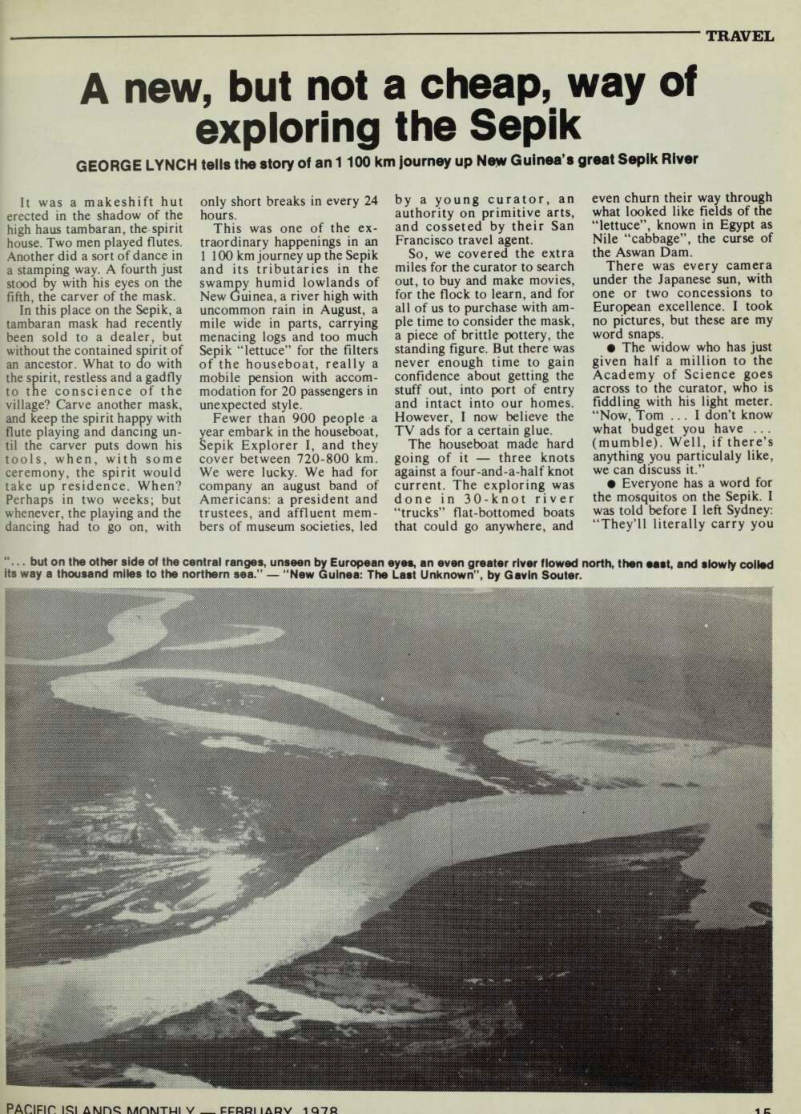
"... but on the other side of the central ranges, unseen by European eyes, an even greater river flowed north, then east, and slowly coiled its way a thousand miles to the northern sea."-“New Guinea: The Last Unknown”, by Gavin Souter.
away”. Even on Nob Hill, San Francisco, they know about them two of the Americans brought beekeeper’s headgear. My contribution to the lore is: when you smack one, it’s like cracking a blood bank. Souter, in his fine book, refers to mossies “swarming like clouds of brown gas”.
One remembers Gurkha of ficers, ex-Burma, and says to his cabin mate: “For God’s sake, remind me to take those pills on Thursday!” Am still taking them, three weeks later. • Kids carrying the babyest of crocodiles with rubber bands around their snouts.
Crocs are apparently born with teeth. They’re called “puk puks”, which is Pidgin.
No canoe is without a carved croc’s head on the prow, and one realises that this reptile is the most powerful being, although now depleted, in or out of the river. The Govern ment has banned the killing of crocs aged six years and over because that’s when they start breeding. • A figure walks out of the jungle denim shorts, bare feet, chain and cross, beard, pack. A young Canadian has opted out of management con sulting in Toronto, taking two years to walk around the world. Here, he is walking the length of the Sepik, living and working with the hospitable villagers, fishing, even swim ming without fear.He hitches a water ride to the next village, and we give him a chilled can of beer, downed without touching the sides. • We run into packs of Germans and Japanese. We are told how the Japanese go into the Baiyer River Wildlife and Bird Sanctuary, with
folding butterfly nets hidden
from the keeper and his staff.
We are told of one group who handed out cigarette lighters and other gifts, and then said they wanted to take a Bird of Paradise. The keeper hands back the goodies no bird.
Incidentally, shotguns are out you may down a Bird of Paradise in the wild only with a bow and arrow. I did not ap preciate, earlier up at Mount Hagen, why white kids were
so diligently, but dangerously,
practising archery.
• Food with a difference.
We stock up at the villages each day with sweet potatoes, melons, bananas, pumpkins, and eggs that taste like eggs
used to taste. Nineteen fish cost only two kina, about $2.30. These are tilapia, an African fish, introduced to the Sepik about nine years ago to give the villagers a higher protein diet. • Three Americans check their light meters against a portrait of Somare in the houseboat lounge. One is to learn that Somare is a Sepik boy, and we go to his village.
The “Vote Somare” posters look out of place pasted beneath the spirit house.
• The egrets stand, still and straight on the Sepik’s banks, spaced well apart as if measured by a sergeant-major of the Guards; like sentinels.
But when, quite early, we head up a narrow tributary for the Cambri Lakes and the pot tery village of Ambon, they take off, forming a cloud of grace, while duck skim the surface and fish plop. All cameras working. • Village cigarettes are still rolled in newspaper. Am told that airmail editions of the
London press are much in de mand. • And what about the villagers? I had expected an unattractive people. All I can now remember are smiles, bellyloads of laughter, and kids taking to the water like seals, after our balloons plain balloons, without a hap py “created” face or market ing slogan.
It remains as extraordinary that this journey into another time and tempo is only a few hours’ flight away. It is not cheap, it is not for everyone, but it must remain, for us, un forgettable. Bob, the American travel agent, said the Sepik experience would leave the Amazon for dead, and he is pragmatic.
Peter Barter, owner-skipper of Explorer I, wanted us to become “involved”, and we visited so many villages, each distinctive, that I would not be astonished if a Sepik spirit has taken up lodgings in this strained and alien city mask.
The trouble is, I cannot play a flute. And as my wife says, I’m not much good at dancing, either.
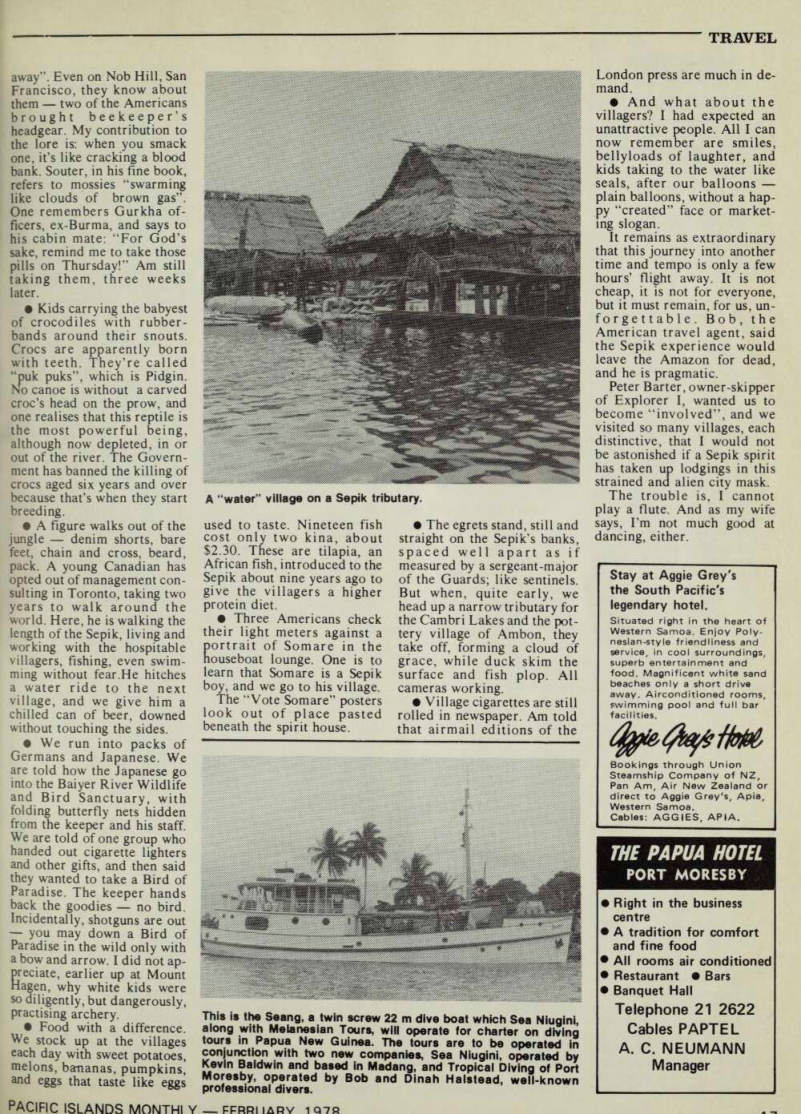
A “water” village on a Sepik tributary.
This is the Seang, a twin screw 22 m dive boat which Sea Niugini, along with Melanesian Tours, will operate for charter on diving tours in Papua New Guinea. The tours are to be operated in conjunction with two new companies, Sea Niugini, operated by Kevin Baldwin and based in Madang, and Tropical Diving of Port Moresby, operated by Bob and Dinah Halstead, well-known professional divers.