Or Practical Training, Asks Coppell
pp. 12-13 · Read in the full issue
Should The Emphasis Be On Academic
In his submission, Pene Baba, writes Dr W. G. Coppell, quite rightly directed the attention of the senators to several matters which are central to the whole business of assessing the development of educational provisions throughout the Islands. He emphasised, in particular, the need for creating a regional examinations board, the need for a greater degree of regional co-operation, particularly at the tertiary level; the role the South Pacific Commission should play in the educational field and the role of expatriate teachers working in the Islands.
The very nature of his background as a staff member of the University of the South Pacific and his involvement in curriculum development meant that Pene Baba was constrained to devote himself to very wide-ranging issues and to give emphasis to broad principles of aid that the metropolitan countries can most sensibly contribute to the educational system of the Islands.
However, there are many areas of concern, common to the Pacific, which in their own way reflect, sometimes in delayed fashion, the educational problems that are now bedevilling the developed, industrial societies.
First, and foremost, there is the question of deciding on priorities in education. For instance, should there be a continuing emphasis upon an academic form of education,
when it is already quite ob vious in many island nations that there is an over-supply of academically-trained people?
In countries like the Cook Islands, a crisis point is being reached in the labour market, demographic factors, such as the easy access to New Zea land, having drastically diminished the working sector of the population. The sec ondary school system has con tinued, by and large, to emphasise academic subjects, and the graduates of the schools have continued to look to the government and the large stores for employ ment in administrative and clerical positions, A consequence of this orientation in training is the strain being placed upon the pineapple industries which have been developed on the islands of Mangaia and Atiu.
The canning factory on Rarotonga is working to about half its capacity, there is a strong likelihood that the ships will not be able to uplift the output of pineapples from the two islands and the growers’ confidence in the in dustry’s future will suffer a setback all a consequence, to a significant extent, of a labour shortage. One of the answers to the emphasis on the academic subjects is an econ omic one it is probably much cheaper to mount courses in English literature, in geography, in history, than to establish on a fully-funded basis the more practical ly oriented courses. These
courses require expensive equipment, if they are to be presented in more than token form and they require ade quately-trained staff to direct them.
On the other hand, care must be taken to ensure that the Islands do not fall into the trap which has ensnared many industrial societies, that of the over-production of graduates destined for professions and occupations that cannot pro vide employment. In Australia there is clear evidence that there has been an over-production of law yers. It is suggested that for every two law graduates in Australia, there are positions for only one. In several island nations there seems to be a similar position likely to arise concerning the training of lawyers.
The Cook Islands is making a belated attempt to divert some of its students into trade training by establishing an ap prenticeship scheme, with the intention of reaching stan dards which will receive equivalency recognition over seas.
But the Cook Islands must be on the horns of a dilemma just how many skilled tra desmen can a population of just over 18 000 absorb? The question that must face the Cooks is, are these ap prentices to be trained to work in their own country, or will the training they receive make it easier for them to find employment in New Zealand?
It is useful for the Cooks to have a population safety valve, but there are unfor tunate consequences of a brain drain of the more able members of the population.
Pene Baba made the point in his submission that “we need people of this calibre in the South Pacific now”.
In the New Hebrides, the French education system has made a dramatic attempt in its centre at Vila to come to grips with the problems of pro viding technical training for New Hebrideans. However, the number of milling machines at the centre out numbers quite considerably the number of milling machines that are in govern
merit and commercial use throughout the New Hebrides.
There must be a danger of producing skilled artisans for whom work will not exist.
Thus, the attention of politicians and educators in the Pacific is thrust back to the proposition that more stu dents should be trained to ac cept the idea that agriculture offers them a secure future.
This may be so, but there is need for substantial incentives to make a village life more at tractive to young people than the pull of the bright lights and possible financial rewards of the towns and cities.
The agricultural training that is given must be enlightened and the island governments in several cases will have to face up to ques tions of changing the land tenure systems, if graduates of agricultural training courses are to feel a sense of security concerning the land they develop and the crops they grow.
This is an issue that is well illustrated in the booklet Land Tenure on Niue, re cently produced at the University of the South Pacific. Adapting the land tenure system may well be a priority in education that is of paramount importance.
Whenever the question of adapting educational systems in the Pacific Islands comes up some of the indigenous leaders raise their voices in ire. They say, and perhaps quite logically, that their countries were given educa tional systems by the metropolitan countries. The> say that anyone who suggests a move away from the
academically-based cur
riculum is advocating a denigration of education foi Islands peoples.
This is the core of the problem that Pene Baba raise; concerning a South Pacific Is lands Examinations Board. I such a board could establish standards for the teaching o subjects relevant to life in the Islands it would be a totalb estimable objective. However the opposition will come froir those leaders who would set such a scheme as in some waj denying to islanders the op
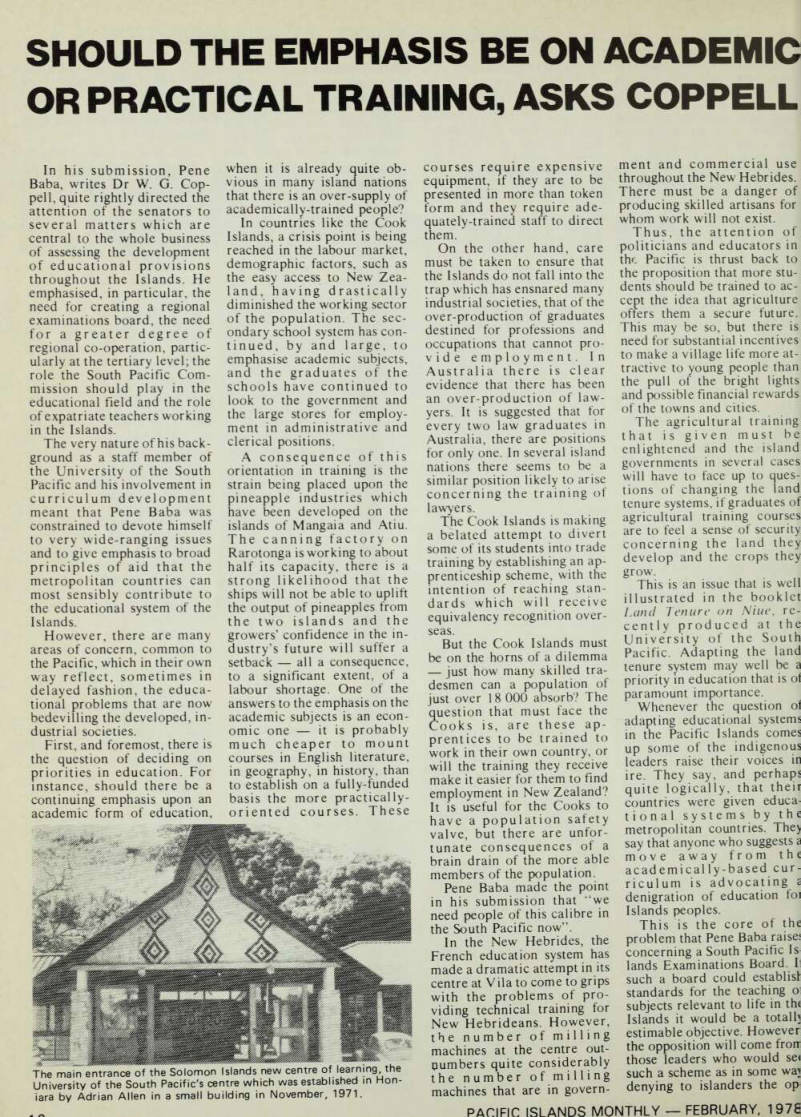
The main entrance of the Solomon Islands new centre of learning the University of the South Pacific's centre which was established in Hon iara by Adrian Allen in a small building in November, 1971.
portunity to acquire the qualifications that the Euro pean seems to so much covet and admire.
Therefore, if there is to be a move to establish a regional examinations sytem that is different but equal, the system adopted for a regional examinations structure must be capable of establishing equivalency standards with the systems used outside the Pacific region.
Pene Baba focuses much of his attention on the problems of tertiary education, and it is at this level that the most im mediate results can be most speedily achieved. There are other areas upon which a much greater weight of at tention must come. To date, the primary area has received a lesser share of support and remedial measures.
In a number of countries the standards of teacher train ing, the provision of teaching materials and the develop ment of community-related curricula leaves much to be desired. A basic problem in several instances is the lower level of training of many of the teachers who are in charge of classrooms.
Their own levels of educa tional achievement are in finitely lower than those of students who are now gra duating from the secondary schools and who cannot find jobs as teachers as the posi tions were largely filled, perhaps 10 years ago, by poorly-prepared teachers, who may well remain in the service for another 20 or 30 years.
Educators are therefore faced with making a choice, should the status quo be preserved? Should many of the poorly-trained teachers be given substantial additional training; should efforts be made to replace in some way
these less-than-adequate
teachers?
The metropolitan countries remain prepared to give as sistance to the various educa tional systems, but they are continually beset with the quandary of deciding how best to give that assistance.
Perhaps understandably, the
powers that be in distant places wish to maintain some form of control over the help they render. Traditionally, the easiest way of giving help has been to make available skilled expatriate officers.
This form of assistance is ex tremely expensive, salaries are high, fares have to be paid,
housing has to be provided.
Unfortunately for many ex patriate teachers, a period of service in the Islands is just an interlude in a career in the “normal” teaching service in their own countries. The general pattern today is for the expatriate teacher to serve a two-year term in the Islands.
It takes a year at least for the teacher to even come to grips with a strange environment and in his second year his thoughts, quite naturally are turning away towards his home-country and his future prospects there.
There are few expatriate teachers, who now see ahead of themselves a career of teaching in the Islands. A good case could be made out for diverting much of the funds presently used on ex patriate staff into projects such as the preparation of community-related cur
riculum materials, which may well in the long run have a greater impact than the ser vices of many of the expatriate teachers.
In his submission Pene Baba on a number of occa sions made reference to the need for regional co-op eration in education. That co operation needs to be on several planes. First, there needs to be a recognition that there are two perfectly worth while forces at work among the islands people. There is a growing pride in national achievement and there is also an increased awareness of the interrelationship and the in terdependence that exists be tween the island nations.
In education there is a need to sponsor these feelings of identity. Organisations such as the South Pacific Com mission, the United Nations Development Programme and the Pacific universities need
to sponsor and develop cur riculum materials concerned with the Pacific Islands com munities and which give real recognition to those two planes of identity.
Finally, education in the Is lands faces the same problems that assail education systems in the developed countries.
Gone are the days when there seemed to be a cornucopia which would respond im mediately and with a great outpouring to any request for monies to be spent on educa tion. Today we are in a real era of cost-benefit analysis, almost universally there is a questioning of the value to so ciety of an ever-increasing ex penditure on education.
Pacific islands politicians and educators, like their counterparts elsewhere, need to examine their programmes, to re-assess their priorities and come up with solutions which are conducive to the overall advancement of their countries.
In 1976 about 8% of government expenditure in Western Samoa was spent on education. For agriculture the figure was 2%. This alone would be an area in which priorities might well be re-as sessed, especially when it is realised that in 1975 the coun try imported food, tobacco and beverages to the value of
Sws2 316 000.
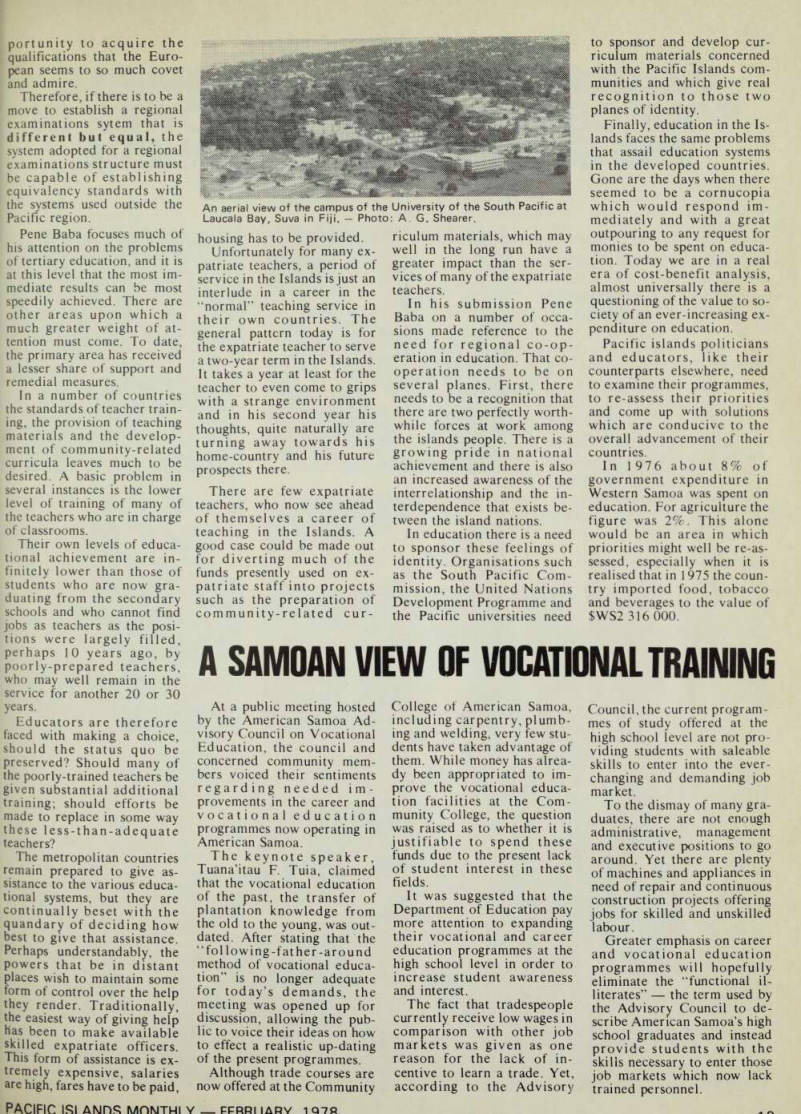
An aerial view of the campus of the University of the South Pacific at Laucala Bay, Suva in Fiji. Photo: A. G. Shearer.