Educatio:
pp. 10-11 · Read in the full issue

New Partnership
Wanted In Islands
What should be the priorities on Education in the South Pacific islands? Is there too much emphasis on educating people for “white collar” jobs? These questions and others are examined in these two articles, one of which comes from extremely critical submissions made by University of South Pacific Lecturer in Education, Mr Tupeni Baba, to the Australian Senate Standing Committee on Foreign Affairs and Defence. Mr Baba also attacked the South Pacific Commission. A second article, by another lecturer in education, Dr W. G. Coppell, of Macquarie University (NSW) takes a close look at educational dilemmas.
“Would you weep if the South Pacific Commission ceased to exist?”
“No.”
The scene was Sydney, August, 1977. The questioner was Senator Peter Sim, chair man of the Australian Senate’s Standing Committee on Foreign Affairs and Defence.
The question was addressed to Mr Tupeni Baba, Lecturer in Education at the University of the South Pacific. The ex change took place in the con text of the committee’s work on its brief, “The need for an increased Australian com mitment in the South Pacific”.
Mr Baba’s reply was consis tent with a number of trenchant criticisms he made of the commission, especially in the field of his particular interest, education.
Extracts from his submis sions follow: Australia is always quick to recognise a need for its in volvement in the South Pacific, but somehow it tends to be slow in acting, and not highly sensitive to its changing role in relation to its Pacific Island neighbours. Generally, it seems to be less in touch with the South Pacific coun tries than its neighbour, New Zealand.
In matters of trade, church and mission activities, educa tion and so forth, Australia or Australian citizens undertook initiatives in many of the is lands of the South Pacific, but in many cases, particularly in Fiji, Tonga, Samoa and so forth, it has always been New Zealand or the New Zealan ders who have developed or fostered lasting ties and rela tionships.
This does not necessarily mean that the New Zealanders have helped or assisted the Pacific countries more than Australia. It may merely mean
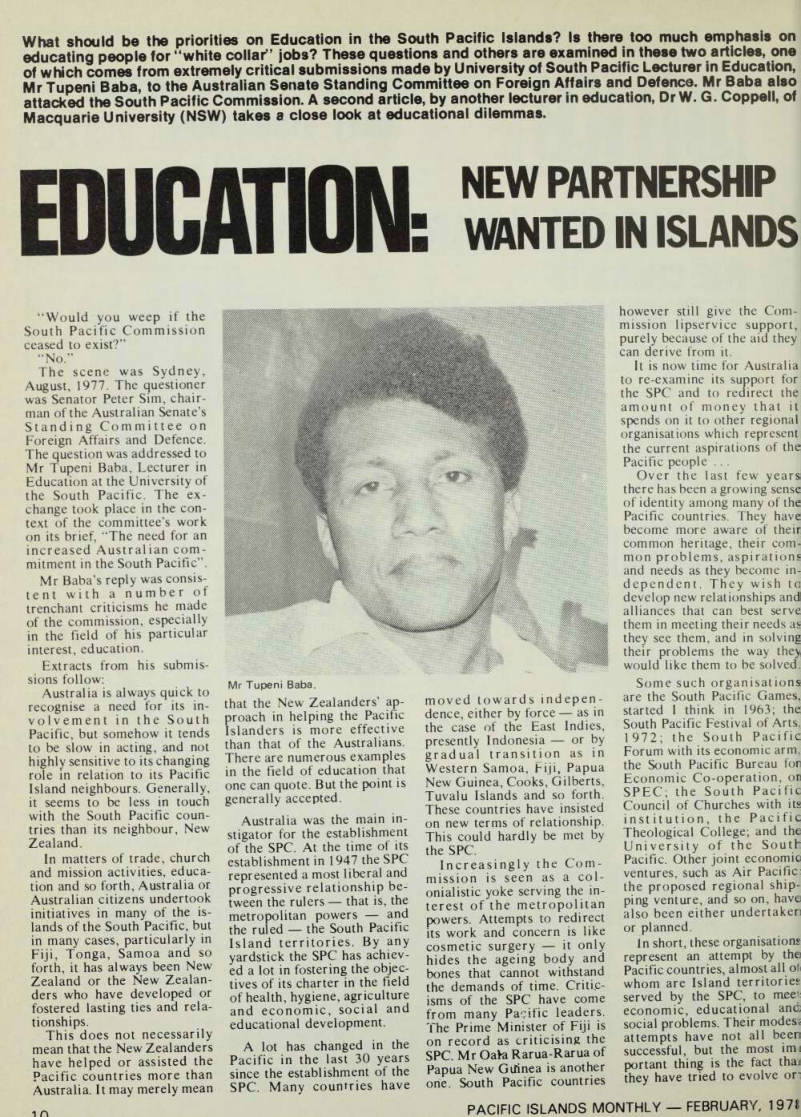
Mr Tupeni Baba. that the New Zealanders’ ap proach in helping the Pacific Islanders is more effective than that of the Australians.
There are numerous examples in the field of education that one can quote. But the point is generally accepted.
Australia was the main in stigator for the establishment of the SPC. At the time of its establishment in 1947 the SPC represented a most liberal and progressive relationship be tween the rulers that is, the metropolitan powers and the ruled the South Pacific Island territories. By any yardstick the SPC has achiev ed a lot in fostering the objec tives of its charter in the field of health, hygiene, agriculture and economic, social and educational development.
A lot has changed in the Pacific in the last 30 years since the establishment of the SPC. Many countries have
moved towards indepen dence, either by force as in the case of the East Indies, presently Indonesia or by gradual transition as in Western Samoa, Fiji, Papua New Guinea, Cooks, Gilberts, Tuvalu Islands and so forth.
These countries have insisted on new terms of relationship.
This could hardly be met by the SPC.
Increasingly the Com mission is seen as a col onialistic yoke serving the in terest of the metropolitan powers. Attempts to redirect its work and concern is like cosmetic surgery it only hides the ageing body and bones that cannot withstand the demands of time. Criti.c isms of the SPC have come from many Pacific leaders.
The Prime Minister of Fiji is on record as criticising the SPC. Mr Gate Rarua-Rarua of Papua New Gifinea is another one. South Pacific countries
however still give the Com mission lipservice support, purely because of the aid they can derive from it.
It is now time for Australia to re-examine its support for the SPC and to redirect the amount of money that it spends on it to other regional organisations which represent the current aspirations of the Pacific people ...
Over the last few yearsi there has been a growing sense of identity among many of the Pacific countries. They have become more aware of their common heritage, their com mon problems, aspirations and needs as they become in dependent. They wish to develop new relationships andl alliances that can best serve them in meeting their needs as they see them, and in solving their problems the way they would like them to be solved.
Some such organisations are the South Pacific Games, started I think in 1963; the South Pacific Festival of Arts, 1 972; the South Pacific Forum with its economic arm, the South Pacific Bureau for Economic Co-operation, on SPEC; the South Pacific Council of Churches with its institution, the Pacific Theological College; and the University of the Sou tin Pacific. Other joint economic ventures, such as Air Pacific: the proposed regional ship ping venture, and so on, have also been either undertaken or planned. in short, these organisations represent an attempt by the Pacific countries, almost all of whom are Island territories served by the SPC, to meet: economic, educational and] social problems. Their modest attempts have not all been successful, but the most imi portant thing is the fact thai they have tried to evolve on
ganisations and institutions themselves to meet their own problems. In certain areas one can argue that they can be even more successful if the SPC genuinely co-operates with them and does not stand in their way, particularly in the areas of education, re search and social develop ment.
On this last question of education, the best way to be involved in the Pacific coun tries at the moment is through the organisations that have emerged from within the South Pacific Islands them selves. This calls for a new relationship, a new partner ship between the Pacific Is lands and the metropolitan powers.
For example, four new universities have emerged the University of Guam, the University of Papua New Guinea, the University of Technology in Lae, and the University of the South Pacific. These universities have developed research units to do the kind of research that formerly had been done by the
Spc.
Some of the universities, and notably USP, are strug gling in terms of money and finance. The new Centre for Applied Studies and Develop ment in the USP attempts to do research that is requested by any of the countries that are served by the university.
UPNG is in a slightly better situation financially.
Another area of priority in education is the development of a new comprehensive cur riculum for the South Pacific countries. This project was lo cated at USP and funded by the United Nations Develop ment Programme in New York.
At the moment some of the UNDP personnel are com pleting their work, but the continuation of the cur riculum unit to oversee the dissemination, evaluation and curriculum research could hardly be met because of the lack of personnel at the university. This is a priority area that has been emphasised in numerous conferences in the South Pacific.
Another area, teacher education at the secondary
level, has been adequately
catered for by USP. The area of primary teacher education, however, has not been so suc cessful. The plan put forward in the Robert Morris Report 7- (Morris is a member of the Overseas Development
Agency) for some assistance to Pacific countries by the university was not fully im plemented.
Hence many primary teachers still come to Australia for in-service train ing. The sooner all training is done at USP or UPNG the better it will be for all con cerned. This implies a supply of teacher educators and training of local Pacific Islan ders to take over the task.
One of the most discussed areas is the establishment of the South Pacific Exam inations Board, to provide relevant examinations at the school certificate and univer sity entrance level to replace the current United Kingdom, Australian and New Zealand examinations.
Already two reports by ODA in the United Kingdom have been devoted to this problem, but it appears that the shortage of funds again has caused the project to be shelved.
The South Pacific Com mission has interfered with many USP projects, and some of its personnel have at tempted to sabotage their establishment.
A notable example is the plan for the establishment of the South Pacific Exam inations Board. As a result, this examinations board has yet to be established. Some of the islands have become desperate to get more relevant examinations for their children and they have gone on their own to get Australian and New Zealand help. The Solomon Islands is a case in point here.
From the educational, economic and long-term view of the situation, it would be better for the South Pacific Islands to have a common examinations board to cater for all the examinations now provided by New Zealand, the United Kingdom and Australia.
Other areas of common concern include training in agriculture and forestry. This has been catered for by USP in conjunction with the Tropical College of Agriculture in Fiji and the Agricultural College in Samoa.
These institutions together award diplomas and degrees in agriculture and forestry re spectively. Students from all over the South Pacific are coming to these institutions. I may also add that the agricultural and forestry col leges in Papua New Guinea
are also providing the training for the people needed in that area in that country ...
I am critical of the SPC because of the way it still tends to operate. Although we have some local staff at the SPC in Noumea, it is still seen by the majority of people as a colonialist organisation. The metropolitan powers must be aware of such resentment and I do not know why they have not taken steps to abolish the
Spc.
In my area of education I have come in contact with people who work in the SPC who resent the increased in volvement of regional organ isations like the USP in some of the work that could be done by the SPC. 1 suppose they are worried that we are removing the mat from under them in doing some of the work they can do.
Most of the staff of the SPC are expatriates; most of ours are regionals. The develop ment of regional organisations like USP is a threat to the ex istence of the SPC and naturally they resent the development of our regional organisations . . .
In many ways they work against regionalisation. They do not want to see certain things that they usually do taken over by regional organ isations like the University of the South Pacific. This was very evident when we were debating the establishment of the South Pacific Exam inations Board to develop examinations for the whole of the South Pacific.
That is my feeling anyway. I feel they were trying to in fluence the various countries of the South Pacific not to adopt or approve its proposal and the fact that we do not have a South Pacific Exam inations Board as yet is indicative of some of the SPC’s influence. I do not want to mention names on this mat ter ...
The UPNG and USP are not really in competition but they have not been working as closely as should be expected.
One of the main problems is that the University of Papua New Guinea is staffed mainly by Australians at least up to a few years ago whereas at the University of the South Pacific there is a lot of New Zealand and United Kingdom and American influence. The two universities have at tracted people from different
academic backgrounds. But I think the regional staff mem bers from the South Pacific and Papua New Guinea are beginning to look to one another for help. I think this is a very interesting and a very useful trend .. .
The implications of what I am saying are numerous, par ticularly with respect to Australian aid in the South Pacific.
The gist of it is that Australia needs to identify the general organisations that have evolved in the Pacific in the last few years and, after identifying those, must assist them. This means assistance by way of training and providing money, even at the level of PhD and Masters’ degrees, to enable these regional institutions to carry out their work.
It is important to realise the general need for the Pacific Islands to regard themselves as a regional unit, as ex pressed by the numerous or ganisations that have come up in the last few years.
If the South Pacific cannot find people to work in these areas and cannot find money to fund these important areas, it will begin to talk to other countries, countries which did not originally support the South Pacific Commission, and you know what countries I mean.
Later, Senator Sim asked Mr Baba. Do you see any value in the SPC if it were reorganised?
Mr Baba: There is a value definitely if it is reorganised.
It can be a research organ isation related to USP, re searching the problems of the South Pacific because they have facilities and libraries we can use.
Senator Sim; But could not the South Pacific Forum and the SPC be amalgamated and those facilities be made availa ble to the South Pacific Forum?
Mr Baba; That would be very good except that perhaps the educational aspects could be shifted more to USP, and other aspects might be shifted to other areas instead of the whole group being amalga mated with the Forum. I say that because at the moment the Pacific Forum is basically concerned with economic matters. There are other dimensions which are not so important. There is, for exam ple, a lot of medical and health research that can be shifted to the medical school.