Png Mining Guidelines
p. 71 · Read in the full issue
“Fair” But “Tough”
Papua New Guinea will this year adopt a new overall policy governing foreign investment in mining projects, ending the previous practice of negotiating individual agreements. Gus Smales in Port Moresby takes a first look at the new policy.
Papua New Guinea is to enact new financial and tax laws to cover all future major mining developments. The new laws will mean the end of the present system under which individual agreements have been negotiated with developers.
Existing agreements with the big mining operator, Bourgainville Copper Ltd, and with the developers of the Ok Tedi copper prospect, will not be affected.
The government’s intention was announced in parliament in November in a statement directed to the international mining investment market as much as to the people of PNG.
The Finance Minister, Mr Holloway, who made the an nouncement, said the policies involved would be “as fair as they need to be, and as tough as they ought to be”.
The new legislation will be based on policies which PNG has already developed as guidelines in individual negotiations.
Briefly, the policies mean that PNG wants a reasonable equity (details to be negoti
ated) in any mine, a royalty of 1.25% fob on the value of sales, a 15% withholding tax on dividends remitted over seas, and an additional profits tax on unexpectedly high returns.
In return, PNG will guarantee the free con vertibility of its currency for payments overseas, it will charge standard income tax on normal earnings, and it will guarantee freedom from imposts, discriminatory taxes and discriminatory import duties.
PNG will also guarantee to provide the infrastructure for a mining development, but will insist on getting a return from this possibly in the form of equity in the mine.
The policies behind the legislation are set down in a White Paper Statement of In tent, tabled by Mr Holloway in parliament.
Mr Holloway invited the international mining invest ment market as well as the people and investors to make submissions on the paper. The submissions would be taken into account when the legisla
tion was introduced in the course of 1978, he said.
The minister said that PNG recognised the need to attract foreign investment for the mining of its resources. This meant the country had to adopt policies which were fair, but in the national in terest, the government could not be over-generous.
The proposed legislation would reflect this attitude.
The concept of establishing a single legislative policy to cover mining investment was thought to be in the best in terest of PNG and would clearly define to the interna tional mining community where PNG stood.
He said that PNG’s minerals policy was based on the view that large mines were not useful for the direct benefits they brought, but for the contribution they made to achieving other national goals. In this way, PNG hoped to use the mining industry to lessen its dependence on other countries, and to develop its self-reliance.
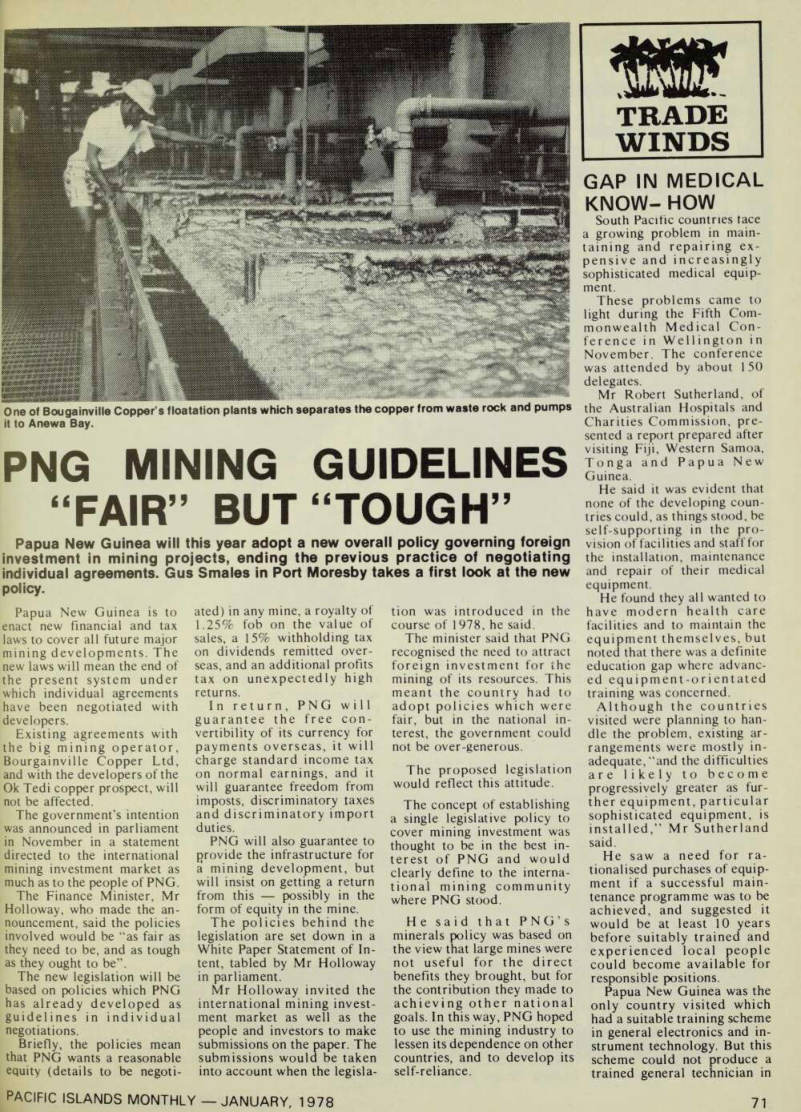
One of Bougainville Copper’s floatation plants which separates the copper from waste rock and pumps it to Anewa Bay.