Pandora: An 18th century horror tale
p. 70 · Read in the full issue
The November 1977 discovery of the 186-year-old wreck of HMS Pandora on Australia’s Barrier Reef (see PIM, Tropicalities) revived memories of her fateful journey from Britain to the Pacific in search of Bounty mutineers.
Here, PIM recounts the Pandora story, one off the grimmest known to Pacific history.
The sinking of the Pandora is one of the grimmest episodes in the annals of the Pacific, and one of the numerous chapters in the sto ry of the mutiny on the Boun ty- Thirty-five lives were lost when the ship went down, in cluding those of four members of the Bounty’s crew; and the commander of the Pandora, Captain Edward Edwards, displayed a callousness on that occasion that has been described as “inhuman”, “barbaric” and “disgraceful”.
The wreck occurred while the Pandora was on her way from Tahiti to Timor. She had left Tahiti on May 19, after arresting 14 members of the Bounty’s crew.
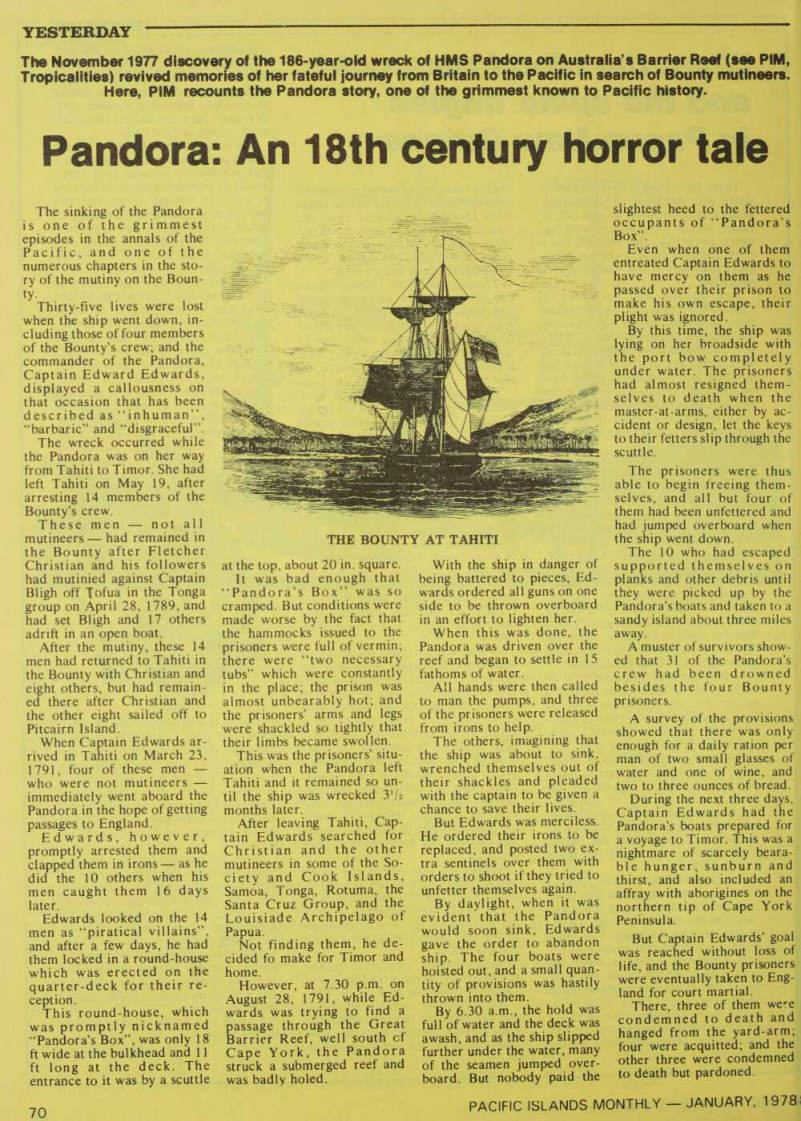
These men not all mutineers had remained in the Bounty after Fletcher Christian and his followers had mutinied against Captain Bligh off Tofua in the Tonga group on April 28, 1789, and had set Bligh and 17 others adrift in an open boat.
After the mutiny, these 14 men had returned to Tahiti in the Bounty with Christian and eight others, but had remain ed there after Christian and the other eight sailed off to Pitcairn Island.
When Captain Edwards ar rived in Tahiti on March 23, 1791, four of these men who were not mutineers immediately went aboard the Pandora in the hope of getting passages to England.
Edwards, however, promptly arrested them and clapped them in irons— as he did the 10 others when his men caught them 16 days later.
Edwards looked on the 14 men as “piratical villains”, and after a few days, he had them locked in a round-house which was erected on the quarter-deck for their re ception.
This round-house, which was promptly nicknamed “Pandora’s Box”, was only 18 ft wide at the bulkhead and 11 ft long at the deck. The entrance to it was by a scuttle
at the top, about 20 in. square.
It was bad enough that “Pandora’s Box” was so cramped. But conditions were made worse by the fact that the hammocks issued to the prisoners were full of vermin; there were “two necessary tubs” which were constantly in the place; the prison was almost unbearably hot; and the prisoners’ arms and legs were shackled so tightly that their limbs became swollen.
This was the prisoners’ situ ation when the Pandora left Tahiti and it remained so un til the ship was wrecked 3 l h months later.
After leaving Tahiti, Cap tain Edwards searched for Christian and the other mutineers in some of the So ciety and Cook Islands, Samoa, Tonga, Rotuma, the Santa Cruz Group, and the Louisiade Archipelago of Papua.
Not finding them, he de cided fo make for Timor and home.
However, at 7.30 p.m. on August 28, 1791, while Ed wards was trying to find a passage through the Great Barrier Reef, well south of Cape York, the Pandora struck a submerged reef and was badly holed.
With the ship in danger of being battered to pieces, Ed wards ordered all guns on one side to be thrown overboard in an effort to lighten her.
When this was done, the Pandora was driven over the reef and began to settle in 15 fathoms of water.
All hands were then called to man the pumps, and three of the prisoners were released from irons to help.
The others, imagining that the ship was about to sink wrenched themselves out of their shackles and pleaded with the captain to be given a chance to save their lives But Edwards was merciless.
He ordered their irons to be replaced, and posted two ex tra sentinels over them with orders to shoot if they tried to unfetter themselves again.
By daylight, when it was evident that the Pandora would soon sink, Edwards gave the order to abandon ship. The four boats were hoisted out, and a small quan titv of provisions was hastily thrown into them.
By 6.30 a.m., the hold was ful 1 of water and the deck was awash, and as the ship slipped further under the water, many of the seamen jumped over board. But nobody paid the
slightest heed to the fettered occupants of “Pandora’s Box”.
Even when one of them entreated Captain Edwards to have mercy on them as he passed over their prison to make his own escape, their plight was ignored.
By this time, the ship was lying on her broadside with the port bow completely under water. The prisoners had almost resigned them selves to death when the master-at-arms, either by ac cident or design, let the keys to their fetters slip through the scuttle.
The prisoners were thus able to begin freeing them selves, and all but four of them had been unfettered and had jumped overboard when the ship went down.
The 10 who had escaped supported themselves on planks and other debris until they were picked up by the Pandora’s boats and taken to a sandy island about three miles away.
A muster of survivors show ed that 31 of the Pandora’s crew had been drowned besides the four Bounty prisoners.
A survey of the provisions showed that there was only enough for a daily ration per man of two small glasses of water and one of wine, and two to three ounces of bread.
During the next three days, Captain Edwards had the Pandora’s boats prepared for a voyage to Timor. This was a nightmare of scarcely beara ble hunger, sunburn and thirst, and also included an affray with aborigines on the northern tip of Cape York Peninsula.
But Captain Edwards’ goal was reached without loss of life, and the Bounty prisoners were eventually taken to Eng land for court martial.
There, three of them were condemned to death and hanged from the yard-arm; four were acquitted; and the other three were condemned to death but pardoned.