wooing Japanese tourists
p. 55 · Read in the full issue
Islands face big problem in wooing Japanese tourists
Trading between most of the Pacific Islands and Japan generally ends up in Japan’s favour simply because Japan produces more of what the Pacific Islands want than vice versa. But tourism is one area which can help offset adverse trade balances. Although the Japanese economy has been stagnant, thou sands of Japanese still go overseas for their annual holidays to Europe, America and the Pacific Islands.
The Island groups south of the equator can match anything Micronesia offers if they are pre pared to set their minds to it. So far tourist entrepreneurs have geared themselves to cater more for Ameri can, Australian, New Zealand and, to a limited extent, European tourists. They have virtually ig nored a huge market practically on their doorstep.
There are a few signs of awaken ing to this market, however, chiefly with Japanese prodding. By 1980, about eight million Japanese are ex pected to spend their holidays abroad, and by 1985 the figure could be 25 million according to several forecasts and surveys. With the Pacific getting about 10% of that number there would be another 2.5 million people clamouring for the services the Pacific tourist industry can offer.
As it is now, the Pacific tourist in dustry just could not cope with that number. Adequate air services and accommodation go hand in hand
and are badly needed. Allied with them is the development of facilities to keep the Japanese tourist occupied during his holiday.
Generally, the Japanese tourist wants to do things. He is not so in terested in lying on the sun-baked sand beside a tropical lagoon.
He likes a game of golf, he wants to know how people live, in what way is his holiday place different
from his own land. He will have money to spend on good living, but he won’t waste it. While many of the shops throughout the Pacific are stocked with Japanese goods, sold duty-free* to tourists who are at tracted by the possibility of a bargain, to expect him to buy these would be like carrying coals to Newcastle.
True, he wants a bargain, duty free, perhaps like Scotch whisky.
This attitude means the Islands shopkeeper needs to do a bit of rethinking about his stock. He will still need the Japanese goods for his American and Australian customers, but he will have to carry prestige goods such as Swiss watches, German binoculars or French perfumes for the Japanese.
Hotel-keepers and restaurateurs will need to look at their menus, particularly if they wish to attract Japanese guests, which would not be a bad thing at that. Services must be of a high standard for the Japanese tourist wants the best he can get for his yen. The word will soon get about if second-rate rate or shoddy services are offered.
Japanese interest in the Pacific as an area for holidays goes beyond providing hotel rooms, entertain ment and services. It also extends to investment. There is already Japanese money in some Pacific tourist developments, and there could be a lot more if a convincing case is put before potential inves tors.
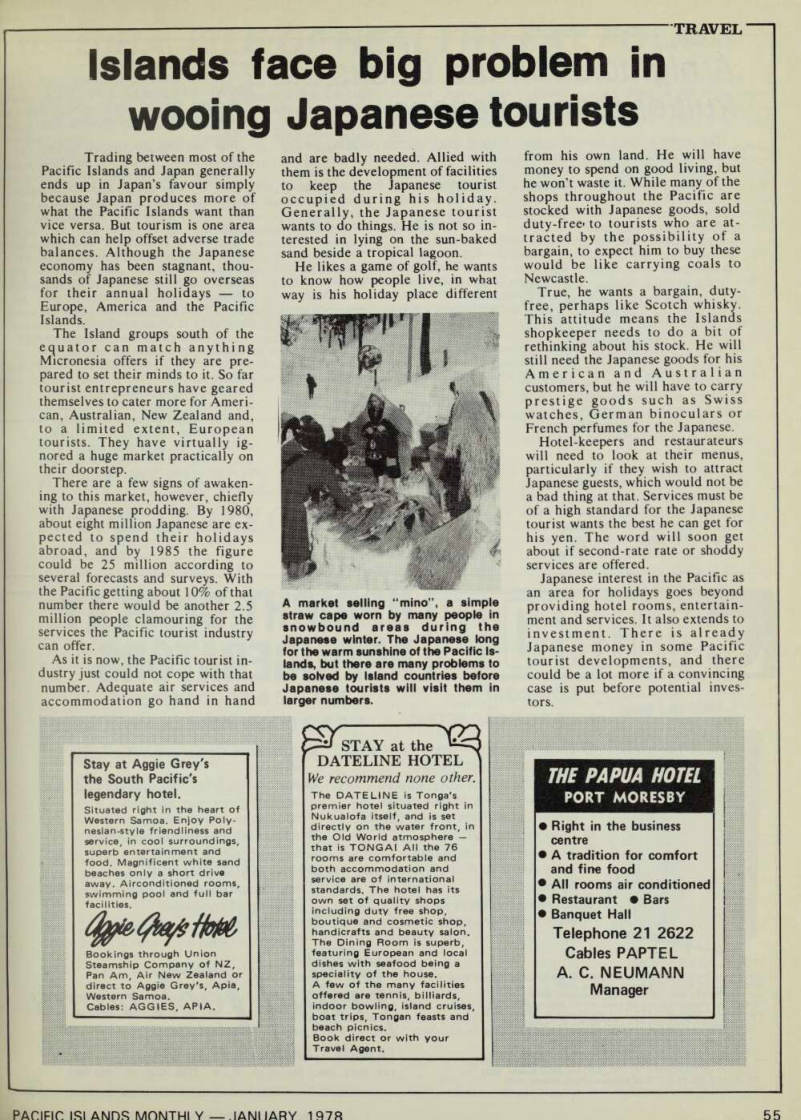
A market selling “mino”, a simple straw cape worn by many people in snowbound areas during the Japanese winter. The Japanese long for the warm sunshine of the Pacific Is lands, but there are many problems to be solved by Island countries before Japanese tourists will visit them in larger numbers.