Guam fights for its place
p. 53 · Read in the full issue
in the tourists’ sun
Over the past 10 years about one and a half million tourists, mainly Japanese, have spent almost SUS6OO million on visits to Guam. But facing competition from other destinations such as Hawaii, the Philippines and Bali, Guam as a tourist resort is facing an “identity crisis ’. DAN GIBSON reports from the spot on the problems, and on what the Guam Visitors Bureau plans \o do about them.
For 10 years now, Japanese tourists have been hopping on daily flights to Guam from Tokyo, pri marily lured by an abundance of sun, sand and sea.
But confronting a sagging tourism industry, and now competition from neighbouring Saipan, Guam leaders want to add to that “sun and sea” image.
Since that first Pan American World Airways flight brought 179 Japanese tourists 10 years ago, a total of 1 439 000 tourists pri marily Japanese have visited Guam, spending about $575 million according to official estimates.
But tourism officials say Guam s potential isn’t being tapped, and hotel managers, facing hordes of empty luxury rooms, agree.
“The identity of Guam in Japan until now has only been sun, sea and sand,” says Marty Pray, Guam Visi tors Bureau manager. But other destinations notably Hawaii, the Philippines and Bali offer the Japanese that same attraction plus more.
Guam, Pray says, must also develop a better image to compete.
The GVB is pumping most of its $3OO 000 advertising budget into Japanese magazine advertising designed to boost unique Guam ele ments: local legends, the Chamorro village fiestas and the Latte Stone, the prehistoric structures of the an cient Chamorros.
GVB is working with Dentsu Ad vertising Ltd, Japan’s largest adver tising firm with more than 5 000 employees. The two have isolated segments of the Japanese population they want to lure to Guam pri marily young married couples, with single women as a secondary target.
A survey here showed 70% of Japanese tourists to Guam to be honeymooners, indicating that Guam is fairly successful in luring that group from Japan. The Guam vacation is comparatively inexpen sive next to Hawaii, yet still offers the visitor a taste of the US.
Ironically, in GVB’s celebration of the 10th anniversary of tourism, one such couple was chosen to win prizes and special services. But the couple turned out to be unmarried.
They were “very good friends who
were thinking about getting married,” Pray said. “This is the third honeymoon couple in 15 months selected and two have not been married.”
No matter, he adds. “Two unmarried people bring just as much money to Guam as two married peopie.”
Another survey showed that tourists view Guam as more expensive, but friendlier, than they had envisioned. That “friendliness” is another part of Guam’s future image.
The new image may be paying off.
For the first seven months of 1977 there has been a 31% increase in Guam’s total visitors. This year apparently will be better than 1976, but still down from 1975, figures show.
But hotel managers say Guam is still a long way from healthy. They say some hotels may soon close because Guam with 2 000 first class hotel rooms is overbuilt.
With low occupancy rates the hotels must also fight high fuel and maintenance costs while keeping rates withm reach of the Japanese middle class traveller.
And through the years, Guam has been the only entry point for Japanese visitors travelling into Micronesia to Saipan, Truk, Palau and other islands. No more.
Continental Air Micronesia started daily direct services between Tokyo and Saipan on October 1, after years of delay in winning route approval from both US and Japanese aviation officials, While that development will un doubtedly serve as a boon for Saipan’s seven hotels two of which are not yet opened it is unclear what effect the direct flight will have on by-passed Guam, Air Micronesia will have three of its Tokyo-Saipan flights go on east ward to Hawaii, stopping in Truk, Ponape and Majuro en route. And three of its flights will go southward to Palau. The new route means a decrease in flights to Guam from Saipan from 28 to 25 each week, ac cording to Air Micronesia general manager Gene Hassing. A month before the new service was to be in itiated, Hassing said 60% of seats available in October had been pre sold.
The direct Tokyo .Saipan route .. wi „ mean initially a s igh t drop in he amount of money Guam is earn j •• GV B' s Pray concedes. But he th f nks the route eventually will im prove overall traffic K Guam hasn’t done badly in the last 10 years and will do better in the future, Pray believes or at least hopes.
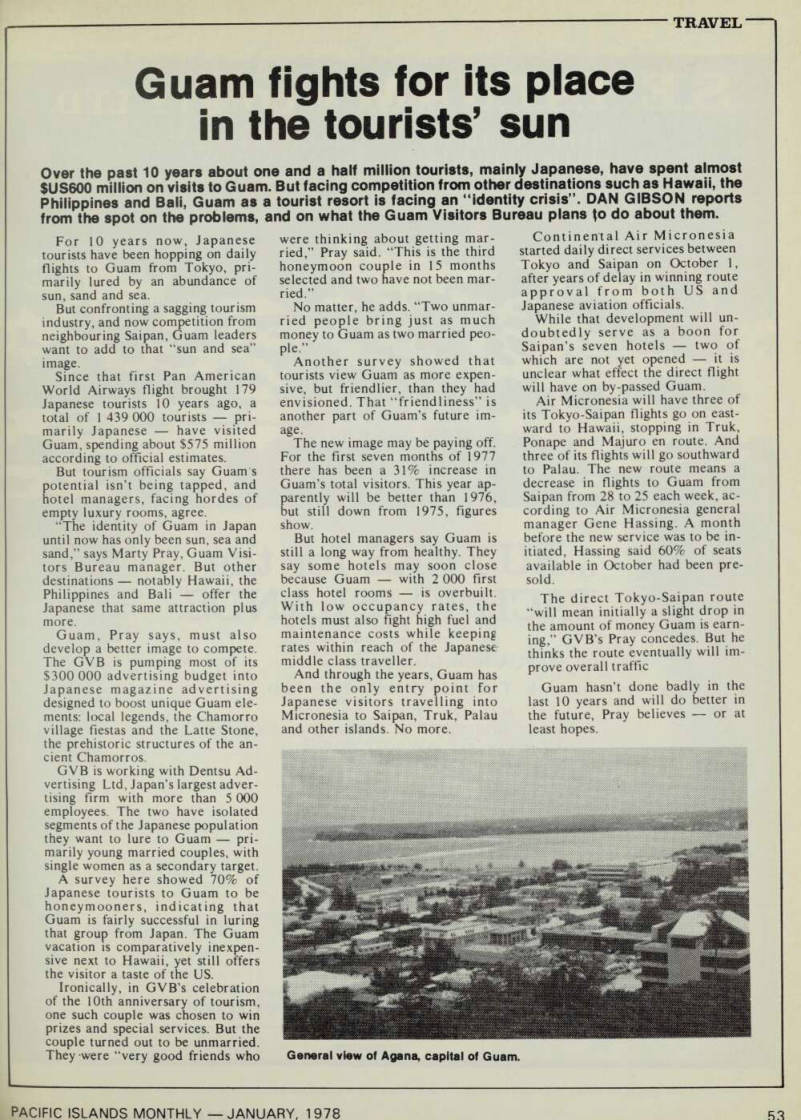
General view of Agana, capital of Guam.