People
pp. 34-35 · Read in the full issue
Fiji’s highly successful top cop, Police Commissioner John Yelland, resigned in November. He was due to return to his native England in February after his notice period expired. Mr Yelland was offered a further term of two and a half years, but had received an offer of a senior police post in the UK. As his future career lay there he could not afford to refuse it.
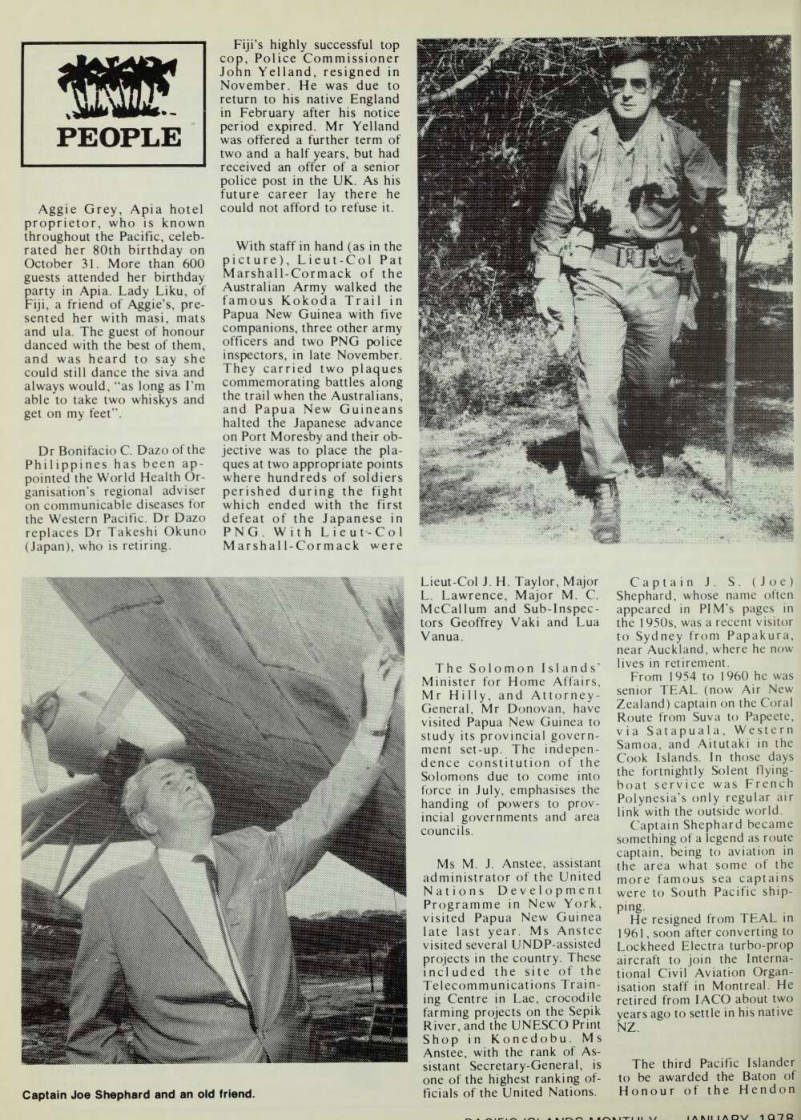
With staff in hand (as in the picture), Lieut-Col Pat Marshall-Cormack of the Australian Army walked the famous Kokoda Trail in Papua New Guinea with five companions, three other army officers and two PNG police inspectors, in late November.
They carried two plaques commemorating battles along the trail when the Australians, and Papua New Guineans halted the Japanese advance on Port Moresby and their ob jective was to place the pla ques at two appropriate points where hundreds of soldiers perished during the fight which ended with the first defeat of the Japanese in PNG. With Lieut-Col Marshall-Cormack were
Aggie Grey, Apia hotel proprietor, who is known throughout the Pacific, celebrated her 80th birthday on October 31. More than 600 guests attended her birthday party in Apia. Lady Liku, of Fiji, a friend of Aggie’s, presented her with masi, mats and ula. The guest of honour danced with the best of them, and was heard to say she could still dance the siva and always would, “as long as I’m able to take two whiskys and get on my feet”.
Dr Bonifacio C. Dazo of the Philippines has been appointed the World Health Organisation’s regional adviser on communicable diseases for the Western Pacific. Dr Dazo replaces Dr Takeshi Okuno (Japan), who is retiring.
Lieut-Col J. H. Taylor, Major L. Lawrence, Major M. C.
McCallum and Sub-Inspec tors Geoffrey Vaki and Lua Vanua.
The Solomon Islands’
Minister for Home Affairs, Mr Hilly, and Attorney- General, Mr Donovan, have visited Papua New Guinea to study its provincial govern ment set-up. The indepen dence constitution of the Solomons due to come into force in July, emphasises the handing of powers to prov incial governments and area councils.
Ms M. J. Anstee, assistant administrator of the United Nations Development Programme in New York, visited Papua New Guinea late last year. Ms Anstee visited several UNDP-assisted projects in the country. These included the site of the Telecommunications Train ing Centre in Lae, crocodile farming projects on the Sepik River, and the UNESCO Print Shop in Konedobu. Ms Anstee, with the rank of As sistant Secretary-General, is one of the highest ranking of ficials of the United Nations.
Captain J. S. (Joe) Shephard, whose name often appeared in PI M’s pages in the 19505, was a recent visitor to Sydney from Papakura, near Auckland, where he now lives in retirement.
From 1954 to 1960 he was senior TEAL (now Air New Zealand) captain on the Coral Route from Suva to Papeete, via Satapuala, Western Samoa, and Aitutaki in the Cook Islands. In those days the fortnightly Solent flying boat service was French Polynesia’s only regular air link with the outside world.
Captain Shephard became
something of a legend as route captain, being to aviation in the area what some of the more famous sea captains were to South Pacific ship ping.
He resigned from TEAL in 1961, soon after converting to Lockheed Electra turbo-prop aircraft to join the Interna tional Civil Aviation Organ isation staff in Montreal. He retired from lACO about two years ago to settle in his native NZ.
The third Pacific Islander to be awarded the Baton of Honour of the Hendon
Captain Joe Shephard and an old friend.
Metropolitan Police Training School, United Kingdom, is Cadet Officer Sinilau Kolokihakaufisi, 25, of Kolofoou, Tonga. The honour signifies distinction in the general course for overseas police officers. Tonga’s Minister of Police, Mr ’Akau’ola won the award in 1964, and the Assistant Com missioner of the Fiji Police Force, Mr Mosese Tuisawau, in 1967.
PNG Parliamentary Op position Leader Sir Tei Abal faces a huge claim for com pensation for the death of a police constable, Michael Taken Piakau, killed when his motor cycle was in collision with Sir Tei’s car in Novem ber, The constable’s tribal leaders in Enga Province, where Sir Tei also comes from, have demanded pay ment of 800 pigs and more than $90,000.
As Sir Tei and the constable are from separate clans, failure to settle the claim could result in a tribal payback fight for which the Highlands are notorious. The money is for material com pensation, the pigs as a transfer of a status symbol.
Mr Jack Healy (PIM, Nov., p 27) spent only two weeks as general manager of Polyne sian Airlines, resigning sud denly because of “unexpected circumstances”. It is under stood the reason was his wife’s serious illness. Mr Healy, an American, went to Polynesian Airlines from Tafuna, where he had been airport manager.
Mr Terence Betham, assistant general manager and execu tive vice-president, has been appointed acting general man ager of the airline.
It’s refreshing to find that, sometimes, some top poppies in the fields of officialdom have eyes for little things well below the affairs of state level.
Such as that very effective Australian High Com missioner to Papua New Guir a, Mr Tom Critchley.
He was around Bailebo in the Amazon Bay District one day and noticed some farmers tak ing latex from their rubber trees to the factory in buckets and, sometimes, walk ing several kilometres to get there. He also discovered that the farmers had built their own school but it wasn’t
strong on furniture. Mr Critchley has a small “dis cretionary aid fund”. Now, it’s short of more than a few kina, and the farmers, since Oc tober’s end, have been riding to the factory on new bicycles fitted with 45-litre tanks behind the saddle. More than that, the school is now fur nished with desks, tables and blackboards made at Port Moresby’s Koki Vocational Centre and assembled at Magarida Vocational Centre.
Mr Critchley got the idea for the bicycles from his years in Malaysia, and he thinks Papua New Guineans could make more use than they do of the bicycle. It’s expected that he will be moving on soon. Papua New Guinea would be sorry to see him go.
Sir Sydney Frost, the retir ing Chief Justice, “played an important and historic role in constitutional changes in Papua New Guinea,” accord ing to PNG’s Prime Minister, Mr Michael Somare, speaking in Port Moresby in Novem ber, at a farewell to Sir Sydney.
Sir Sydney, 61, formerly of Melbourne where he was a Victorian county court judge, has been a member of the PNG Bar for 13 years. He was Chief Justice when PNG en tered political independence and played an important role in constitutional inter pretations and in assimilation of the new constitution.
Mr Somare said that one of the delicate requirements of the judiciary in PNG was the application of the right balance between traditional and imported law. Each had its place in modern PNG so ciety, and Sir Sydney had shown a keen insight into ap plying this balance. Sensitive issues were involved, but Sir Sydney had approached them in a manner which had been invaluable.
Sir Sydney had also main tained the stimulus for social change which was so much the function of a good system of law and the courts. Mr Somare said: “Sir Sydney has well earned a place in the re cords of our nation in all aspects of the development of the judicial system.”
The new Chief Justice will be the present Deputy Chief Justice, Sir William Prentice.
Is the Bougainvilleans’ threat to secede from Papua New Guinea about to raise its
head again? A recent straw in the wind was the warning sounded by an ex-Bougainville MP and president of an activist group, Mr Raphael Niniku, at November’s end that new problems were being caused because of “trouble with Redskins” the darkskinned Bougainvilleans’ nickname for the lighter-skin ned people in other parts of
Png.
Mr Niniku, president of Napidakoe Navitu, complained that Bougainville was increasingly becoming a dumping ground for unwanted people from other parts of PNG. Bougainville islanders, he said, were in fear of being attacked by the migrants in urban and semiurban areas. They could not walk into town for fear of being abused or terrorised by drunken non-locals.
As much of the trouble is caused by migrant workers, the Miscellaneous Workers Union, representing Bougain villean and migrant workers, is expected to call for re strictions on migrant workers’ movements and on migration to the island, PNG’s Minister for Justice, Mr Delba Birio, has approved an arrangement whereby Dr Alexis Sarei, Premier of the North Solomons Province, will perform the marriage ceremony for anyone who has no church affiliations or religious beliefs. Dr Sarei wants seven days notice of a ceremony. Maybe there’ll be a rush for the honour of having the knot tied by the premier and who better than Dr Sarei, who was a Roman Catholic priest!
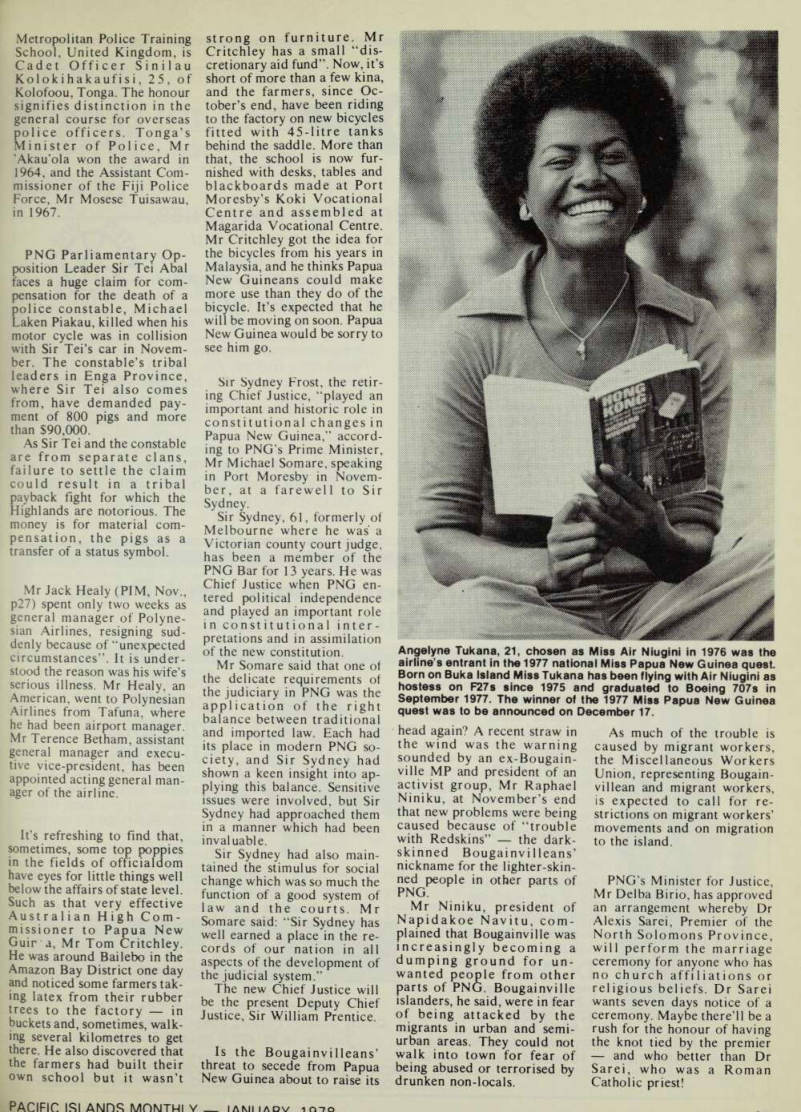
Angelyne Tukana, 21, chosen as Miss Air Niugini in 1976 was the airline's entrant in the 1977 national Miss Papua New Guinea quest.
Born on Buka Island Miss Tukana has been flying with Air Niugini as hostess on F27s since 1975 and graduated to Boeing 707s in September 1977. The winner of the 1977 Miss Papua New Guinea quest was to be announced on December 17.