a palace revolution
pp. 31-33 · Read in the full issue

Nauruans vote to “legalise” a palace revolution
One thousand five hundred and ninety-nine Nauruans went to the polls on November 12 to elect 18 members of the Nauru Parliament. Head Chief Hammer Deßoburt, ex-President of the Nauru Republic, who was voted out of office in December, 1976 by the new Nauru Party, an alliance mainly of younger Nauruans, because he refused to energise his Cabinet through an infusion of younger blood, had challenged the new government, aMeging that it was unconstitutional. The Nauru Party accepted the challenge and went to the people. PIM s editor John Carter, who arrived in Nauru when the smoke of battle was thickest, tells the story.
Tuesday, November 15, was a sad day for Nauru’s Head Chief Hammer Deßoburt. He had persuaded himself, and others, that he was the rightful president; that his eclipse 11 months before and the defeat of his government were un constitutional acts.
The people, he argued over the months, had voted for 18 members of the Nauru Parlia ment and, because there had never been any other sugges tion since May, 1968, that anyone should be President, they expected he would be re elected.
The Nauru Party, headed by ex-Ballarat (Victoria) Col lege boy and law student Ber nard Dowiyogo (31), was just a little self-conscious over the matter, though being in no doubt that theirs was a con stitutional government.
“Let the people decide in an election with a clear-cut issue,” demanded Hammer Deßoburt and his Opposition.
So the Nauru Party stuck its neck out and went to the peo ple. The people decided “Go back and govern”.
The House was as before when Nauru’s fifth Parliament met in the afternoon of November 15 nine Nauru Party members with one inde pendent member sitting with them, and eight others, Ham mer Deßoburt and seven sup porters. The public gallery, glass-partitioned off from the chamber and fitted with a public address system, was full. It holds about 80.
It was all over in under the hour. Independent David Peter Gadaraoa was re elected Speaker. He is a Nauru Party supporter at present and, in the event of a tie, can use a casting vote.
Nauru Party member Leo Keke, a barrister, became
Deputy Speaker. There were
no contests. The ex-Deputy Speaker, Derog Gioura, was a casualty of the electoral bat tle.
Then came nominations for President first nomination, Bernard Dowiyogo; second nomination, Hammer Deßoburt. Both accepted nomination.
It was all so matter-of-fact.
The ballot papers went around. Five minutes later Bernard Dowiyogo was again President of Nauru by nine votes to eight.
There was some desultory applause from the galley full of young Nauruans and three greyheads, Europeans.
The president congratu lated the Speaker on his elec tion and all the members for their success in the elections and added; “I hope we all work for the benefit of the'Re public of Nauru.”
And that was that. Head Chief Hammer Deßoburt said nothing. The people had had their say.
Isolated, only 26 miles below the Equator, Nauru says little to the outside world, at least about its politics. The news of the dis solution of Parliament in Oc tober was slow in leaking out.
What had caused it was far from clear.
Maybe it was an accident that PIM failed to receive several copies of the re public’s only news sheet, the government-run Bulletin, which is now published fortnightly.
One Australian newspaper suggested the government re signed because of financial difficulties. Actually, apart from some criticism over the government’s plan to borrow more than $22 million over seas, there were no financial difficulties preventing Presi dent Dowiyogo and his government from continuing to govern.
The sole reason why the President dissolved Parlia ment was to seek a mandate from the people in the face of the implacable opposition of the ex-president.
True, the Opposition twice walked out of the Committee of Supply meetings, leaving it without a quorum. Govern ment members walked out once. But the government had the answer to that problem a new Supply Act passed on June 9. It was intended to give parliament full power in financial matters and, in the event of more antics in Sup ply, to bypass the committee.
The Opposition challenged the legality of the new Act in the Nauru Supreme Court and lost.
Parliament could have
passed the Appropriations
Bill giving effect to the pro visions of the Budget, the Nauru Party having a majority of one. The Appropriations Bill reached its third, and last, reading.
Then the government re
signed.
There had been uproar in the House. Several times there was violence, tables over thrown, chairs dumped on ta bles, banging and thumping.
And above it all the cry from the Opposition that every thing the government did was illegal.
Even the public gallery, in side its sound-proofed bubble, kicked up a commotion.
“What could we do?” one Nauru Party member asked me. “Our legitimacy was in question and had been ever since we came to power.
Everything was questioned
because the people didn’t know that the president would be changed. To be constitu tional wasn’t enough. Had we legality to govern?
“That’s why we put our heads on the block, knowing the popularity and ability of the former president.
“On the results of Satur day’s elections we stand. Now we can go ahead and govern.
Nauru has found us ‘not guil ty’.”
What happens now?
The issue has divided the
Nauruans and there has been a lot of ill-feeling. But the Nauruans have been divided before a century and more ago when inter-tribal warfare
prevented a population ex
plosion.
There is a chance, however, that all, or almost all, will ac cept the result of the elections and that party politics in Nauru to stay, I think will lose their sting. A lot depends on Head Chief Hammer Deßoburt. He’s a busy man and hasn’t broadcast his feel ings about the result.
He can no longer accuse the government of being illegal.
He may bide his time until the next election, in three years’ time, if nothing untoward happens.
There will be arguments.
Hammer Deßoburt is still Head Chief. He is still power ful, exercising that power from the million dollar-plus Civic Centre where he presides over the Nauru Local Government Council. He suffered, as did many of his supporters, at the hands of the Japanese who shipped him and so many other to Truk in Micronesia as slaves of their war machine. Only half about 700, including Hammer came back.
He fought the governments of Britain, Australia and New Zealand and the gnomes of high finance who had robbed the Nauruans for so long of their only treasure, the phosphate. He fought for Nauru’s independence and won.
For that, and for his many sterling qualities, they made him President in May, 1968, and twice re-elected him. He rode high all the time, im perious, reluctant to delegate, ready to supplant parliament and overrule cabinet deci sions when they didn’t please him.
All that ended in Decem ber, 1976, but the Head Chief wouldn’t accept the fact. He
was 20 when he went to Truk.
He was 46 when they made him president and he’s still young enough and vigorous enough to continue fighting.
But what do the people think? They still think he’s a great man. Until last October, the majority thought he was the only leader Nauru had.
Now, they think that, in the matter of running the country, perhaps the younger ones have better ideas. They are all well educated, they have the support of their peers and, what’s more, even some of the older ones, the ones who suffered in Truk with Ham mer, think he should now hand over the reins.
A large section of the
church-going population,
Protestant and Roman Catholic, was outraged a few months ago over Chief Ham mer’s conduct at the funeral service in the Protestant church for Mr Austin Ber nicke, one of the old guard and one member of Hammer Deßoburt’s cabinet whom the Nauru Party wanted to re place.
Head Chief Hammer gave the funeral oration and chose the occasion to attack the government, alleging that their demand for Bernicke’s replacement had upset Mr Berndicke and caused his death.
“I think the election has been a good thing,” one old Truk veteran told me. “The Head Chief shouldn’t have done many things, like caus ing trouble in parliament.”
The result of the elections conveyed that feeling, and the elections brought one major change in the people’s think ing. The fight became less like a company directors’ struggle and more like elections as they are fought overseas. ‘‘Electioneering is low key,” PIM reported after the December incidents which shook the island to its phosphatic core and unseated its first president. They certainly weren’t low key this time.
There were 52 candidates for 1 8 seats and 1 599 Nauruans, out of an estimated population of 4 411, voted.
Only Nauruans can vote. All people 20 and over had the vote and it’s compulsory.
In the 1976 elections, in the Übenide constituency, Ber nard Dowiyogo polled second highest, after Buraro Detudamo, who was reckoned to be one of the most powerful of the leaders. This time, Ber
nard Dowiyogo was way ahead 172.6527 points value of votes, with Lagumot Harris, of the Nauru Party, second with 11 1.7637, Buraro Detudamo third with 107.6857, and Kenan Adeang, another Hammer supporter, fourth with 107.0424.
In his constituency of Boe, Hammer Deßoburt had 123.7500 points, with Kenas Aroi, a Nauru Party man, in the second seat with 86.2500 points.
There are eight constituen cies, Übenide returning four representatives and the others two.
As for electioneering, some candidates held campaign meetings, distributed leaflets and, in general, acted like any overseas politicians even to offering bribes.
One candidate, who didn’t win, had some leaflets printed and distributed promising free drinks, free cinema seats and free holidays in Fiji. 1 he government may take a tough line over some breaches of electoral regulations. It is believed irregularities can be proved against one successful Hammer supporter. In which
case, there may be a lawsuit and, perhaps, a Hammer man unseated, making way for another Nauru Party member and a larger Nauru Party ma jority in parliament.
Secure in the knowledge of its legitimacy, the Nauru Par ty government is expected to get tough if attempts, other than by parliamentary means, are made to thwart its desires.
A whisper reached me which, if true, could spark off another bitter struggle.
The Nauru Local Govern ment Council is second only to parliament. Headed by the Head Chief, it has gone on its way, running many of the re public’s financial affairs, in cluding the Nauru shipping and the co-operative stores.
No financial statement, no balance sheet is ever pub lished. Even parliament doesn’t get one.
One job the Nauru Party government is sure to set itself is to legislate for final control of the council’s affairs with publication of its financial affairs.
Head Chief Hammer will probably fight that tooth and nail. But the young legislators
want to control all that they have the power to control and do the job they promised to do to ensure that, with a more modern application to the Nauruans’ problems, the future, when the phosphate has run out, will be a bright one, for those several hundreds who, contrary to what the outside world believes, are less fortunate than some of their neighbours, and haven’t dollars running out of their ears. Some Nauruans have no land from which to draw profits from
phosphate.
Maybe, the government will plan for a viable substitute when the phosphate runs out other than a skyscraper in Melbourne, an airline which flies at a loss and ships which bring little wealth. So far, tourists are only tolerated on Nauru.
Head Chief Hammer built the Menen Hotel, as good as many overseas, to house the large crowd which came there in 1975 for the South Pacific Conference.
So far, most of its guests have been Japanese who tour the South Pacific in droves as Pilgrims for Peace one such party was there in November.
Using garbage, of which Nauru has a lot, all imported, the Nauru Phosphate Cor poration is filling in some of the worked-out areas. Alrea dy, vegetation covers large stretches on the plateau. One reclaimed area is a sportsfield.
There’ll be nothing to stop them from earmarking areas for use in a tourist industry, for a swimming pool or two, a couple of extra hotels and
some duty-free shops.
And, by the way, the co-op shops are in a scandalous state empty shelves, clothing in great disarray, despite an ap peal to customers to replace everything and not to handle some of the more fragile goods.
When the imported workforce of around 3 000 goes home, there’ll be no ‘‘Chinese Location”, or Gilbertese settlement.
There’ll be more room for tourists and the climate’s not at all bad. For one thing they don’t and can’t, have a hurricane.
Nauru could flourish as a tourist resort, and in years to come, that’s what it might be with a huge statue looking out to sea of Nauru’s builder and champion of freedom, Hammer Deßoburt.
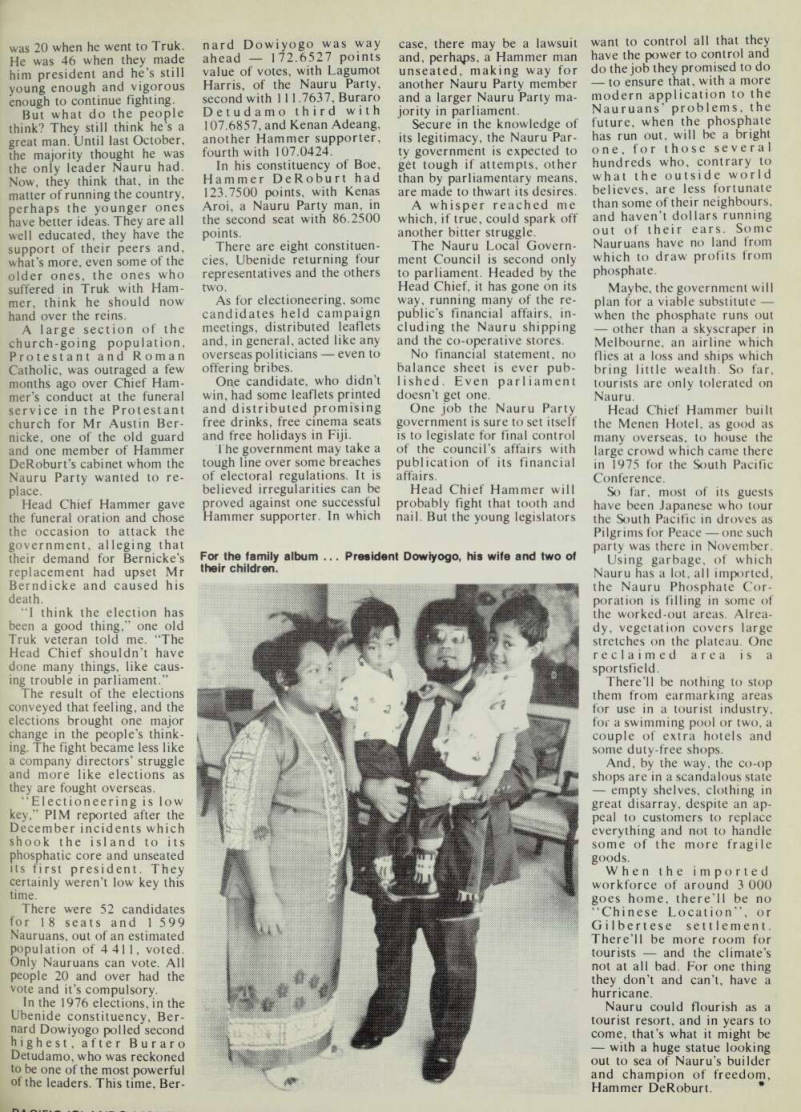
For the family album ... President Dowiyogo, his wife and two of their children.