“We eat fish!” - a Japanese
pp. 61-62 · Read in the full issue
message for Island nations
The message of fish in the Japanese diet rings through loud and clear for the South Pacific, Japan was built on a foundation of farms and fisheries. Rice and fish have been the staple foods of the Japanese since time immemorial, and still today Japan’s fisheries remain a vital sector of her economy.
Forget about the rice, but concentrate on that insatiable Japanese demand for fish. With proper advice and use of the proper techniques, several Pacific Island groups could join those which already have thriving fishing industries and which are selling their canned or frozen fish production to Japan.
Japan can supply the knowhow
and the money, and naturally will require an interest in any industry it supports. In getting into fishing enterprises in the Solomons and Fiji, Japan has not overlooked the fact that the local people also like to be part of the act, and has made provision to take them in as partners.
Because of its topography and limited arable land, Japan has had to look outside her own shores for food for its population of about 100 million. The incentive many years ago to create a fishing industry was great, and today the emphasis is on maintaining that industry. Today, Japanese fishermen range far out across the Pacific and down to the southern seas.
About 60% of the fish and shellfish eaten in Japan is in the form of processed goods. In recent years the supply has not been able to keep pace with the demand for fish.
This includes tuna, of which there is an abundance in the Pacific. Thus, prices have soared. The price of fish products has increased 2.7 times in the last 10 years, representing an an nual rate of increase of 10.3%.
A rapid increase in the volume of imported fish has been one of the natural consequences of this. Japan is now the world’s largest importer of fish and fish products after the US. The major import items are pro tein shrimp (about 39% of the total), tuna, octopus, fresh and
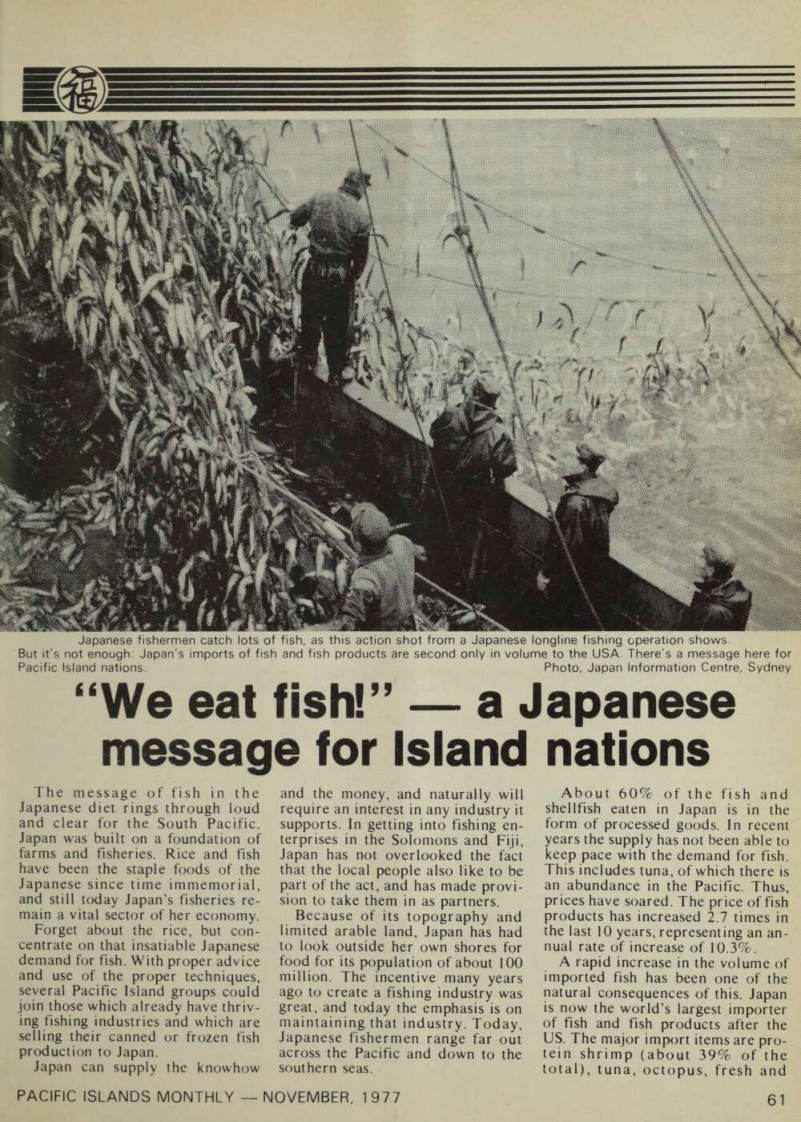
Japanese fishermen catch lots of fish, as this action shot from a Japanese longline fishing operation shows But it's not enough: Japan's imports of fish and fish products are second only in volume to the USA There's a message here for Pacific Island nations Photo, Japan Information Centre, Sydney
frozen cuttlefish, salted salmon roe and fishmeal. The major suppliers are Korea, Taiwan, the US, In donesia, China, India, Canada, Thailand, Mexico and Australia.
Could some Pacific Islands be add ed to that list?
The statistics show that the average Japanese eats about 90 g of fish daily, making Japan one of the world’s leading consumers of fish in terms of consumption per head of
population.
Japanese methods of preparing and eating fish range from the well known sashini raw fish preparation, through many methods of frying, boiling, grilling or baking. In recent years, the use of frozen fish has become increasingly popular, following the trend in most Western countries, because of the ease of keeping the fish and the simplicity of cooking.
However, a large amount of the fish eaten by Japanese is prepared and canned or bottled before sale.
For example, one popular method of preserving fish before sale is to marinate it in soy sauce. Dried and salted fish products are well known, and products less familiar in Western countries such as boiled fish paste and fish sausage are gain ing a place on the market.
In Japan, the preparation of raw fish dishes consists simply of cutting the raw fish flesh into fine slices, and, sometimes, soaking them in a marinade. Fish suitable for this in clude tuna, cultured yellowtail, squid, sole and sea bream.
For boiling or grilling, the Japanese housewife looks to mackerel, (bluefin tuna), saury, her ring and bottom fish. These are usually served seasoned with salt or soy sauce.
Finally, there is the third category of tuna, crab and a host of other sea creatures which are salted, smoke cured or otherwise processed before sale.
The production of the Japanese home-water fishing and sea fresh water fish culture industries now ex ceeds 10 million tonnes a year.
“Cultivation fishing” is the method of fish production in which fish fry, both artificially produced and caught in their natural environ ment, are protected and raised dur-
ing the early phase of life and then released at appropriate places to grow in a natural environment before being caught for consump tion. This method of production, which comprehensively applies sophisticated techniques, is being
actively promoted by the central and local governments in co-opera tion with fishermen in an effort to make fishing an industry that does not just harvest natural resources, but rather grows and replenishes them to prevent depletion.
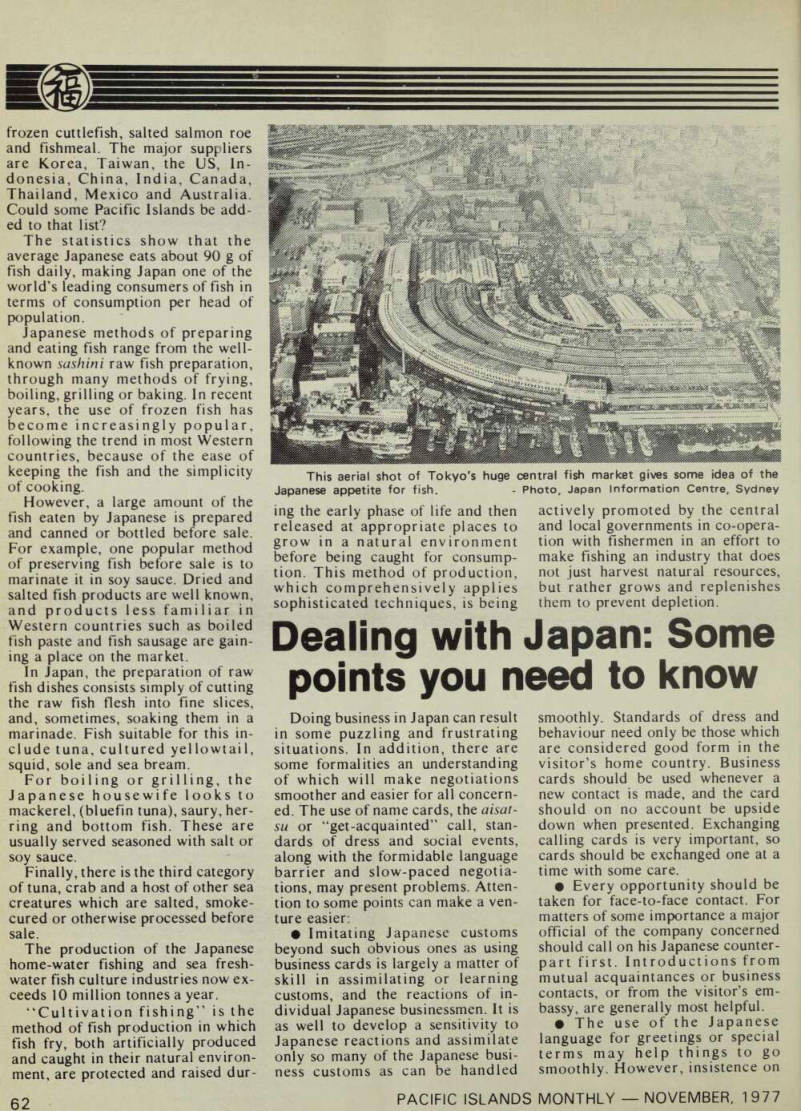
This aerial shot of Tokyo's huge central fish market gives some idea of the Japanese appetite for fish. - Photo, Japan Information Centre, Sydney