Two Sides To A Noted
pp. 50-52 · Read in the full issue
Tale Of The Sea
On September 2, 1905, the con verted Indian canoe, the Tilikum. berthed at Margate, on the south coast of England, having completed a voyage which began in Victoria, British Columbia in May, 1901.
The vessel was commanded by Captain John Claus Voss, who was to become one of the legendary figures of yachting history through the pages of his book The Ven turesome Voyages of Captain Voss, first published in 1913.
The book contains accounts of several small boat voyages but the saga of the Tilikum is the focus of attention, as it took place not very long after another equally renowned voyage, that of Joshua Slocum in the Spray.
Gray’s Publishing Ltd, of Sidney, British Columbia, have done Pacific Islands Yachting buffs a good turn by republishing Voss’s book. Once more the reader is taken across the Pacific, through the doldrums, and through stormy seas, to Penrhyn, Manihiki, Pukapuka, Samoa, Niua- Foou, Fiji and on to Australia.
The rest of the voyage is of little interest to those who are devoted to Pacific Ocean adventures, but the visits to the Islands give intriguing cameos of life then upon islands, whose stories in the period are not well known.
For instance we are told that on Penrhyn “Only on one occasion have 1 seen a South Sea Islander drunk, the chief of the island being very severe with those found guilty of this weakness; his best friends got hold of the man before the chief got to hear about it, and took him down to the beach, where, in spite of all his kicking and shouting, they put him under the water and held him there till I felt sure the poor fellow was drowned”.
Voss also gives an insight into the operations at Penrhyn and Manihiki of the traders Dexter and Winchester, who were powers in the area at the turn of the century.
Until he reached Fiji, Voss was accompanied by Norman Luxton, a young Canadian journalist, who put up the money for the voyage on the understanding that he would have
the literary rights that would arise from the voyage. Voss tells us little about the companion who shares some perilous times with him; in fact, Luxton merits only passing mention from the master of the Tilikum, apart from the suggestion of disagreement between the pair when the canoe was approaching
Penrhyn.
Voss was reluctant, he tells us, to land there but Luxton “blew up like a stick of dynamite”. According to Voss, Luxton said, “What do you mean by suggesting that we pass by an island like this, the most interest ing place we can go to. Never; we must go in at all costs. That is what I have come out for, to see small, out of-the-way islands and people, and if you look at your agreement you will find it is so. No, John, don’t talk to me like that”.
The Tilikum sailed on to Fiji, was cast up upon the reef, Luxton was severely injured and after the vessel was salvaged and reached Suva, the two parted company, with the un derstanding that Luxton would re join in Australia.
On the voyage to Sydney, Voss re ported that his new mate was lost overboard not long after leaving Fiji waters and that he had completed the voyage single-handed.
When Voss met up with Luxton again in Sydney he reports that his former mate said “Well, John, if I had known that such a thing would happen, I would never have left you.
I would far sooner have taken chances with my own life than see someone else die for me. But, John, after this accident we must put a stop to our adventure here, sell the boat and go back to Victoria.”
Voss also says that “Luxton was a good shipmate in every way, and was also a very careful man on board the boat, and I am quite cer tain that if he had remained on the vessel in Suva and made the trip with me to Sydney, the accident would not have happened”. Voss then became the sole owner of the Tilikum.
For all this, Voss has remained a rather shadowy figure, little is known of him apart from the adven tures he recounts in his book. His life before and after these events is not known in any real detail.
However, his story has remained unchallened for about 50 years.
Now it transpires that Norman
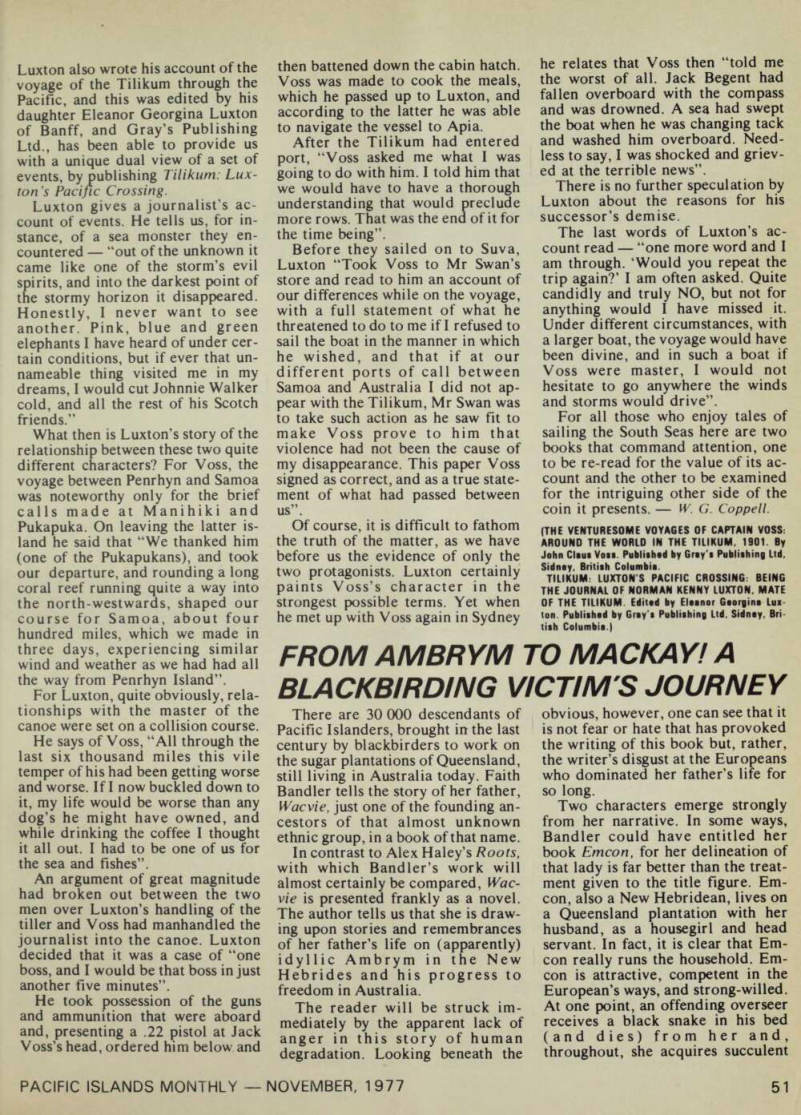
Tilikum at Apia - still looking "shipshape .
Luxton also wrote his account of the voyage of the Tilikum through the Pacific, and this was edited by his daughter Eleanor Georgina Luxton of Banff, and Gray’s Publishing Ltd., has been able to provide us with a unique dual view of a set of events, by publishing Tilikum: Lux ton’s Pacific Crossing.
Luxton gives a journalist’s ac count of events. He tells us, for in stance, of a sea monster they en countered “out of the unknown it came like one of the storm’s evil spirits, and into the darkest point of the stormy horizon it disappeared.
Honestly, I never want to see another. Pink, blue and green elephants I have heard of under cer tain conditions, but if ever that un nameable thing visited me in my dreams, I would cut Johnnie Walker cold, and all the rest of his Scotch friends.”
What then is Luxton’s story of the relationship between these two quite different characters? For Voss, the voyage between Penrhyn and Samoa was noteworthy only for the brief calls made at Manihiki and Pukapuka. On leaving the latter is land he said that “We thanked him (one of the Pukapukans), and took our departure, and rounding a long coral reef running quite a way into the north-westwards, shaped our course for Samoa, about four hundred miles, which we made in three days, experiencing similar wind and weather as we had had all the way from Penrhyn Island”.
For Luxton, quite obviously, rela tionships with the master of the canoe were set on a collision course.
He says of Voss, “All through the last six thousand miles this vile temper of his had been getting worse and worse. If I now buckled down to it, my life would be worse than any dog’s he might have owned, and while drinking the coffee I thought it all out. I had to be one of us for the sea and fishes”.
An argument of great magnitude had broken out between the two men over Luxton’s handling of the tiller and Voss had manhandled the journalist into the canoe. Luxton decided that it was a case of “one boss, and I would be that boss in just another five minutes”.
He took possession of the guns and ammunition that were aboard and, presenting a .22 pistol at Jack Voss’s head, ordered him below and
then battened down the cabin hatch.
Voss was made to cook the meals, which he passed up to Luxton, and according to the latter he was able to navigate the vessel to Apia.
After the Tilikum had entered port, “Voss asked me what I was going to do with him. I told him that we would have to have a thorough understanding that would preclude more rows. That was the end of it for the time being”.
Before they sailed on to Suva, Luxton “Took Voss to Mr Swan’s store and read to him an account of our differences while on the voyage, with a full statement of what he threatened to do to me if I refused to sail the boat in the manner in which he wished, and that if at our different ports of call between Samoa and Australia I did not ap pear with the Tilikum, Mr Swan was to take such action as he saw fit to make Voss prove to him that violence had not been the cause of my disappearance. This paper Voss signed as correct, and as a true state ment of what had passed between us”.
Of course, it is difficult to fathom the truth of the matter, as we have before us the evidence of only the two protagonists. Luxton certainly paints Voss’s character in the strongest possible terms. Yet when he met up with Voss again in Sydney
From Ambrym To Mackay! A
Blackbirding Victim's Journey
There are 30 000 descendants of Pacific Islanders, brought in the last century by blackbirders to work on the sugar plantations of Queensland, still living in Australia today. Faith Bandler tells the story of her father, Wacvie, just one of the founding ancestors of that almost unknown ethnic group, in a book of that name.
In contrast to Alex Haley’s Roots, with which Bandler’s work will almost certainly be compared, Wacvie is presented frankly as a novel, The author tells us that she is drawing upon stories and remembrances of her father’s life on (apparently) idyllic Ambrym in the New Hebrides and his progress to freedom in Australia.
The reader will be struck immediately by the apparent lack of anger in this story of human degradation. Looking beneath the
he relates that Voss then “told me the worst of all. Jack Begent had fallen overboard with the compass and was drowned. A sea had swept the boat when he was changing tack and washed him overboard. Need less to say, 1 was shocked and griev ed at the terrible news”.
There is no further speculation by Luxton about the reasons for his successor’s demise.
The last words of Luxton’s ac count read “one more word and I am through. ‘Would you repeat the trip again?’ I am often asked. Quite candidly and truly NO, but not for anything would I have missed it.
Under different circumstances, with a larger boat, the voyage would have been divine, and in such a boat if Voss were master, I would not hesitate to go anywhere the winds and storms would drive”.
For all those who enjoy tales of sailing the South Seas here are two books that command attention, one to be re-read for the value of its ac count and the other to be examined for the intriguing other side of the
coin it presents.
W. G. Coppell.
(The Venturesome Voyages Of Captain Voss:
AROUND THE WORLD IN THE TILIKUM, 1901. By John Claus Voss. Published by Gray's Publishing Ltd.
Sidnay, British Columbia.
Tilikum: Luxton's Pacific Crossing: Being
THE JOURNAL OF NORMAN KENNY LUXTON. MATE OF THE TILIKUM. Editad by Elaanor Georgina Lux ton. Published by Gray's Publishing Ltd. Sidnay. Bri tish Columbia.)
obvious, however, one can see that it is not fear or hate that has provoked the writing of this book but, rather, the writer’s disgust at the Europeans who dominated her father’s life for so long.
Two characters emerge strongly from her narrative. In some ways, Handler could have entitled her book Emcon, for her delineation of that lady is far better than the treat ment given to the title figure. Em con, also a New Hebridean, lives on a Queensland plantation with her husband, as a housegirl and head servant. In fact, it is clear that Em con really runs the household. Em con is attractive, competent in the European’s ways, and strong-willed.
At one point, an offending overseer receives a black snake in his bed (and dies) from her and, throughout, she acquires succulent
food items from the plantation man ager’s over-stuffed larder for her husband and fellow islanders living in the workers’ quarters.
The story itself is simple narra tive, uncomplicated by either fact or fantasy. It is a straightforward ac count, with little embellishment; even dates are missing in the main body, so our attention is firmly focused upon the lives of her characters, with all thought of historical context missing.
The political activist and humanist Bandler seems to have written her book to clear up some ideas in her own mind and perhaps that is why the female characters so dominate the pages. She tells us in the introduction that she is writing to illuminate a dark corner of Australia’s history, to give dignity to her people, and to make Australians in general aware of their history.
There is no hint at any time that she considers herself anything but Australian in terms of her allegiance. Her sense of belonging, she believes, is hindered by the refusal of other Australians to realise what and who she is. She is tired of being referred to as an Aborigine.
The only historical materials come in the first paragraph of the book, where she tells us that her father was kidnapped in 1883, escaped from bondage in 1897, and
If You're A Sucker For
Children's 800K5... But
Adults, as well as the children for whom it is intended, should enjoy the splendidly imaginative illustra tions in Glenice Kohnke’s The Green Parrot. Miss Kohnke, a well known Port Moresby artist, has given her birds of “the jungle, grass lands and sea” of Papua New Guinea the most delightful expres sions (my favourites are those on the faces of the Parrot and the Leguan “not very good friends” as they confront one another from op posite pages).
And if one were to disregard the text, this could be described as an excellent children’s book. But the text is there To start with, even a child (apart from the most dull) will pick up the fact that the first page of text doesn’t
died in 1924. The rest we must fill in. But perhaps she does not tell us too much of the context because she feels that such material is already available. It is the history of the growth of Australia from colony to almost independent country. The meticulous historian will no doubt complain that Bandler simplifies a complex situation; that Islanders brought to Australia benefitted in some cases from their time in Queensland. Let the reader be warned that Wacvie is not a report with historical fact, but an expres sion of contemporary feeling.
Wacvie and his fellow Islanders
fit the relevant pictures (“At this time the birds looked very plain.
They did not have the many-col oured feathers they have today,” writes Miss Kohnke. Yet, on the next few pages, she gives us pictures of birds with yellow, orange, blue, green, and red plumage Let me hasten to point out that children are far harsher critics than I. And, from my experience of teaching pre-school, I can imagine that quite a few are going to wail, “But it SAYS . . .”, and (if they haven’t been trained to respect books) hurl the The Green Parrot across the room!
Miss Kohnke’s story idea, is, like her pictures, imaginative, and it is a pity that, as well as taking more care over her choice of words, she didn’t
might have been slaves, though the term is not quite accurate. Of course, in terms of offficial regula tions, Wacvie was an indentured worker, “contracted” by a “labour recruiter”. But this thin guise was soon penetrated by even the most naive Australian contemporary to the events Bandler describes. The auction blocks at Mackay did not do commerce in work contracts, but in men’s lives.
The worst thing about books about atrocities of long ago is that even by using the most sensationalist of techniques (which Bandler does not) the true horror of the events cannot be appreciated fully.
Narratives such as Wacvie do not tell us much about the mechanics of slavery, however disguised by bureaucratic rhetoric, but they do show us how an indomitable spirit can deal with an impossible situa tion. Bandler portrays not what the prisoner feels about his (or her) bondage so much as she shows us how a descendant of such events can come to terms with hate and resent ment.
Wacvie Mussingkon, Emcon, and the European characters are all a part of Australia’s heritage in their different ways. Faith Bandler’s roots clearly are in the New Hebrides, but she has flowered here in Australia.
Grant McCall.
(WACVIE. By Faith Bandler. Published by Rigby Limited, 30 North Terrace, Kent Town, SA 5067. $7.95.)
expand on it.
The whole book seems to have been conceived in a hurry, and the text thrown together in even more of a hurry. Yet The Green Parrot is worth buying, if only for the il lustrations, though I feel that many parents will balk at paying K 3 for a
book printed (very WELL-printed,
mind you) in Hong Kong. Perhaps they would be happier to fork out that amount if the book included one of these funny little see-through records, of bird-calls or somesuch.
But I’m a sucker for children’s books, and personally would be happy to pay the K 3 for the pictures
alone Jane Belfield.
(THE GREEN PARROT, by Gleny* Kohnke. Published by Robert Brown and Associates. Port Moresby, PNG K 3.)
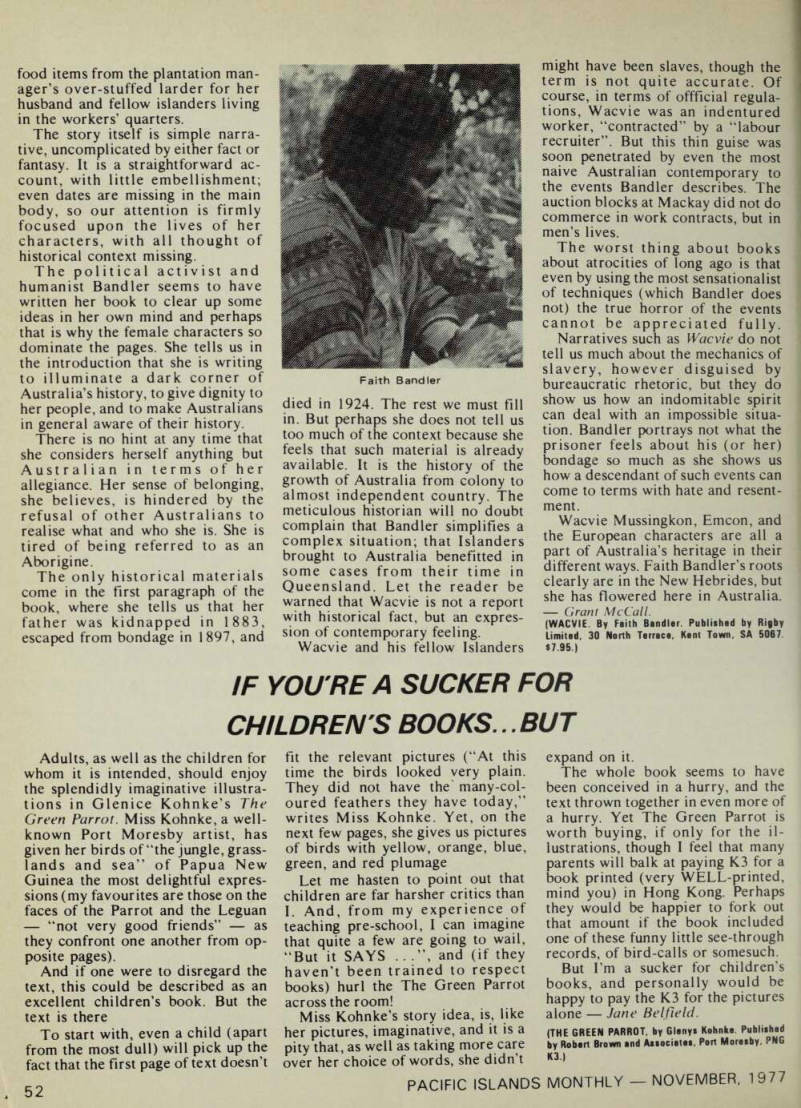
Faith Bandler