of the Ok Tedi copper project
pp. 47-107 · Read in the full issue
... and the problems and hopes, of the Ok Tedi copper project
From JAMES SINCLAIR in Port Moresby
I flew into Papua New Guinea’s Western Province, to the Ok Tedi Development Company’s basecamp at Tabubil, in a Douglas Airways Baron light twin. The journey from Port Moresby took almost three hours— longer than the flight to the Papua New Guinea capital from Sydney.
Tabubil (and Hong Kong camp on nearby Mount Fubilan, where the company is completing the dia mond-drilling test programme that will decide whether or not the Ok Tedi copper deposits are commer cially viable) is located in the dis tant, rain-drenched Star Mountains, a stone’s throw from PNG’s border with Irian Jaya, and many hundreds
of miles inland from the coast and Daru, headquarters station for the huge, lightly populated Western Province.
To visit the Ok Tedi workings is to take a step backwards in time, to the PNG of 20 years ago, when much of the interior remained unexplored and young Australians manned tiny bush outposts and cheerfully accepted isolation, rough living and a lack of female companionship, finding their satisfactions in the absorbing nature of their work.
Tabubil is as remote as any of the old Highlands patrol camps, although that most wonderful of man’s machines, the helicopter, has eased the task of mineral explora-
tion. Without the helicopter mineral exploration in the interior could hardly proceed and mineral ex ploration and exploitation is essen tial to the future of Papua New Guinea.
The Ok Tedi story began in 1968 with the discovery of copper sulphite ore near the base of Mt Fubilan by two geologists and a field assistant of the giant American mining company, Kennecott, during a geological reconnaissance by heli copter. ‘Copper’ was a magic word then Conzinc Riotinto had just an nounced that its extensive testing of the Panguna and Kupei areas on Bougainville had proved the ex-
istence of at least 770 million tonnes of ore carrying copper, gold and silver and the stage was set for the rapid development of the Bougain ville copper industry of today, so vital to the economy of PNG.
Bougainville was a part of the old Mandated Territory of New Guinea; if a copper mine could be developed in Papua, for so long the poor rela tion dependent on Australian finan cial hand-outs for survival, there would be important political as well as economic benefits. So within weeks, Kennecott field teams had commenced geological mapping.
Hopes were high and with enthusiasm the enormous problems of logistics imposed by the remote ness of the Ok Tedi region were tackled, and solved. A small base camp was established near an abandoned garden, which became a helipad, and it was from this little helicopter base a clearing in the dense green rainforest, a few tents and huts and an old taro garden that the geologists and surveyors
completed their mapping pro
gramme.
Results were highly encouraging, and Kennecott took the expensive gamble of proceeding to initial scout diamond drilling, which began in February 1969. By August, 17 holes had been drilled, the last on top of Mt Fubilan, over 1 830
metres high, the drilling rig being delivered by helicopter.
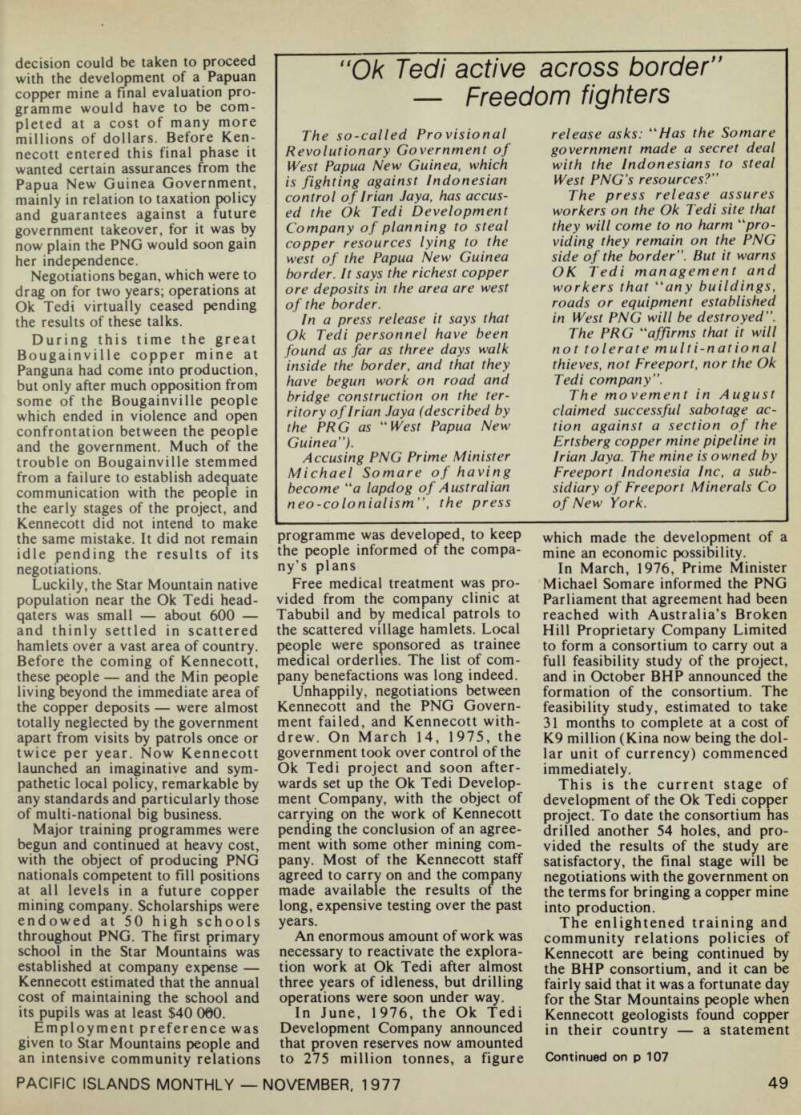
The results of the scout pro gramme were sufficiently promising to justify large-scale drilling. The initial camp was far too small to ac commodate the resulting influx of men and machines, and the present camp and airstrip at Tabubil were constructed.
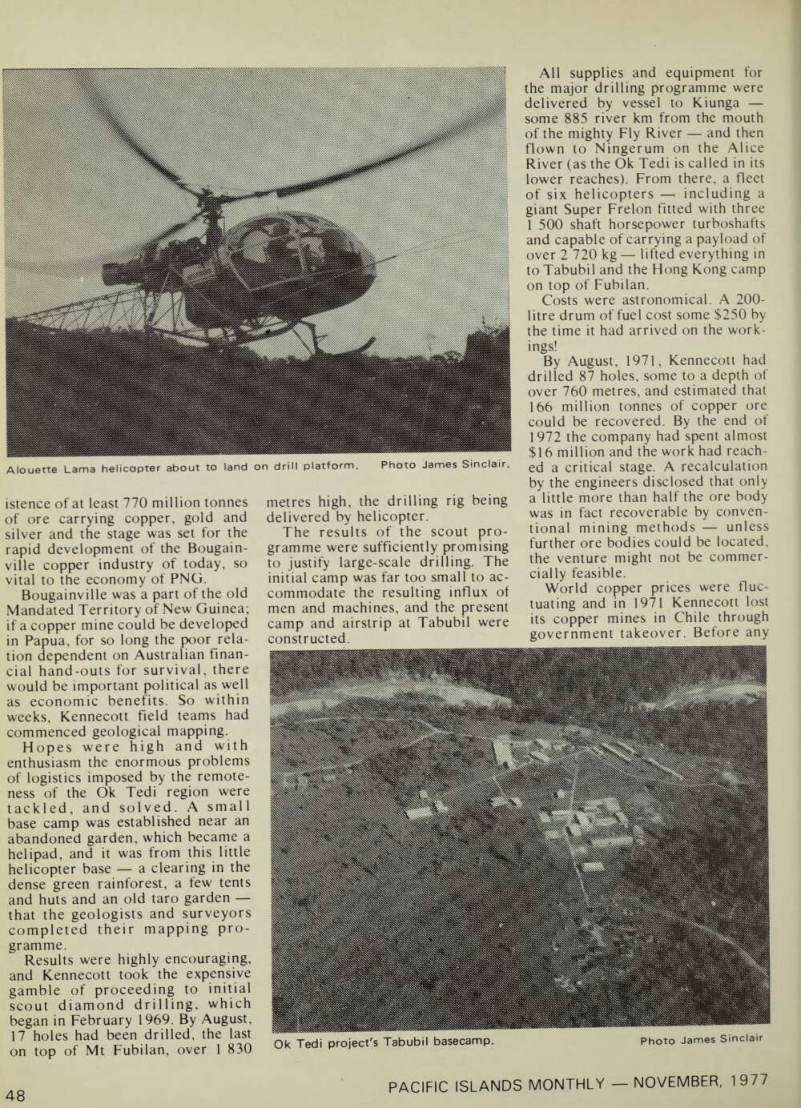
All supplies and equipment for the major drilling programme were delivered by vessel to Kiunga some 885 river km from the mouth of the mighty Fly River and then flown to Ningerum on the Alice River (as the Ok Tedi is called in its lower reaches). From there, a fleet of six helicopters including a giant Super Frelon fitted with three 1 500 shaft horsepower turboshafts and capable of carrying a payload of over 2 720 kg— lifted everything in to Tabubil and the Hong Kong camp on top of Fubilan.
Costs were astronomical. A 200litre drum of fuel cost some $250 by the time it had arrived on the work ings!
By August, 1971, Kennecott had drilled 87 holes, some to a depth of over 760 metres, and estimated that 166 million tonnes of copper ore could be recovered. By the end of 1972 the company had spent almost $l6 million and the work had reach ed a critical stage. A recalculation by the engineers disclosed that only a little more than half the ore body was in fact recoverable by conven tional mining methods unless further ore bodies could be located, the venture might not be commer cially feasible.
World copper prices were fluc tuating and in 1971 Kennecott lost its copper mines in Chile through government takeover. Before any
Alouette Lama helicopter about to land on drill platform. Photo James Sinclair.
Ok Tedi project's Tabubil basecamp.
Photo James Sinclair
decision could be taken to proceed with the development of a Papuan copper mine a final evaluation pro gramme would have to be com pleted at a cost of many more millions of dollars. Before Ken necott entered this final phase it wanted certain assurances from the Papua New Guinea Government, mainly in relation to taxation policy and guarantees against a future government takeover, for it was by now plain the PNG would soon gain her independence.
Negotiations began, which were to drag on for two years; operations at Ok Tedi virtually ceased pending the results of these talks.
During this time the great Bougainville copper mine at Panguna had come into production, but only after much opposition from some of the Bougainville people which ended in violence and open confrontation between the people and the government. Much of the trouble on Bougainville stemmed from a failure to establish adequate communication with the people in the early stages of the project, and Kennecott did not intend to make the same mistake. It did not remain idle pending the results of its negotiations.
Luckily, the Star Mountain native population near the Ok Tedi head qaters was small about 600 and thinly settled in scattered hamlets over a vast area of country.
Before the coming of Kennecott, these people and the Min people living beyond the immediate area of the copper deposits were almost totally neglected by the government apart from visits by patrols once or twice per year. Now Kennecott launched an imaginative and sym pathetic local policy, remarkable by any standards and particularly those of multi-national big business.
Major training programmes were begun and continued at heavy cost, with the object of producing PNG nationals competent to fill positions at all levels in a future copper mining company. Scholarships were endowed at 50 high schools throughout PNG. The first primary school in the Star Mountains was established at company expense Kennecott estimated that the annual cost of maintaining the school and its pupils was at least $4O 000.
Employment preference was given to Star Mountains people and an intensive community relations
programme was developed, to keep the people informed of the company’s plans Free medical treatment was provided from the company clinic at Tabubil and by medical patrols to the scattered village hamlets. Local people were sponsored as trainee medical orderlies. The list of company benefactions was long indeed.
Unhappily, negotiations between Kennecott and the PNG Government failed, and Kennecott withdrew. On March 14, 1975, the government took over control of the Ok Tedi project and soon afterwards set up the Ok Tedi Development Company, with the object of carrying on the work of Kennecott pending the conclusion of an agreement with some other mining company. Most of the Kennecott staff agreed to carry on and the company made available the results of the long, expensive testing over the past years.
An enormous amount of work was necessary to reactivate the exploration work at Ok Tedi after almost three years of idleness, but drilling operations were soon under way.
In June, 1976, the Ok Tedi Development Company announced that proven reserves now amounted to 275 million tonnes, a figure
which made the development of a mine an economic possibility.
In March, 1976, Prime Minister Michael Somare informed the PNG Parliament that agreement had been reached with Australia’s Broken Hill Proprietary Company Limited to form a consortium to carry out a full feasibility study of the project, and in October BHP announced the formation of the consortium. The feasibility study, estimated to take 31 months to complete at a cost of K 9 million (Kina now being the dol lar unit of currency) commenced immediately.
This is the current stage of development of the Ok Tedi copper project. To date the consortium has drilled another 54 holes, and pro vided the results of the study are satisfactory, the final stage will be negotiations with the government on the terms for bringing a copper mine into production.
The enlightened training and community relations policies of Kennecott are being continued by the BHP consortium, and it can be fairly said that it was a fortunate day for the Star Mountains people when Kennecott geologists found copper in their country a statement
Continued on p 107
)k Tedi - from p 49
diich can be made about few multi ational company operations today.
The odds are presently favourable )r the eventual mining of copper at )k Tedi, but much will depend pon the technical and engineering ;udy which is still under way.
It will cost perhaps K5OO million ) bring a mine into production, .oads must be built, and a pipeline ) carry the ore from the mine to iunga on the Fly River, about 100 m away, from where special (and astly) barges will transport the ore ) the mouth of the river for trans lipment to ocean-going carriers.
Progress of the work was at all ages hampered by the impossible eather conditions, for it rains con antly in the Ok Tedi country ver 10 000 mm a year and cloud uildups frequently grounded the Hicopters for days on end.
Ok Tedi will never be as big as ougainville.
Bougainville reserves total 940 illion tonnes of 0.48% copper ore, ith 0.5 grammes of gold and three ammes of silver per metric ton, hereas at Ok Tedi there are an esti ated 250 million tonnes of 0.85% >pper plus 26.5 m tonnes of rich 33% copper and a considerable iantity of very rich gold, sufficient all to sustain mining for 25 years, ut a mine at Ok Tedi will still be of lormous importance to PNG, both :onomically and politically.
There are today about 40 ex itriates working at Tabubil and ong Kong, plus an equal number nationals. At the peak of the test •illing programme there were 250 hites employed, straining accom odation, transport and technical isources to the utmost.
They work to an austere regime x straight weeks of duty seven days it week, and then two weeks holi in Australia. They are crudely aused but very well fed at com any expense and must make icir own entertainment.
Some such as site engineer and irveyor Fred Pratt have been at k Tedi since the old Kennecott ays, and to a man they are fiercely >yal to that company. They work osely as a team, but each man to is own specialty.
Men such as Zane White, Foy eckie, lan (Ned) Kelly, Charlie
Thurgood and Greg McGrath are veterans of years of service in this distant corner of the Western Pro vince. I met a singular character of Tabubil a heavily bearded young man, an expert mechanic and jack of-all-trades known simply as ‘Old Chap'. I imagine he had a formal name, but he was Old Chap to one and all and I soon found myself using this unusual label as a matter of course. And I found an old friend there, Les Gillies, whom I first met in the Markham Valley in 1949.
I flew with the two men who pilot the Alouette Lama and Hughes 500 C helicopters still in use at Ok Tedi, Laddie Hindley a veteran ’chopper pilot with 6 500 hours in his logbooks and Wes Mclver, with 3 500 hours.
I have done a lot of flying in Papua New Guinea over the past 30 years, but I have never flown with better pilots, or under worse weather conditions. It was an ex perience to be remembered to have taken off in a helicopter from Tabubil just after dawn and ascend swiftly through mist and cloud to Mt Fubilon and Hong Kong camp, skirting the vast sheer face of the
Hindenberg Wall with far vistas of the Star Mountains showing as the sun broke through the upper layer of cumulus.
The Ok Tedi project has been conducted throughout with integri ty, honesty and purpose. Papua New Guinea needs the Ok Tedi copper, and the men at work there are quietly confident that it will be forthcoming.