Magazine
pp. 44-47 · Read in the full issue
The PNG-Irian border —before it was a kingsize headache
The following two articles focus on one of the most sensitive areas in the Pacific region —the border between Papua New Guinea and the Indonesian province of Irian Jaya. In the first, David Marsh, who served there for many years as a patrol officer with the former Australian administration, looks back to a time when the area was less politically volatile but still offered plenty of drama of another kind. In the second, aviator-author James Sinclair reports on a recent visit to the Ok Tedi copper project, which holds out the promise of big social and economic changes for the area’s inhabitants.
By Da Vid Marsh
Recent mass border crossings by Papuans, now Indonesian nationals, from the Merauke area of Irian Jaya into the Trans Fly area of Papua New Guinea’s Western Province have thrown the spotlight on this lit tle-known area.
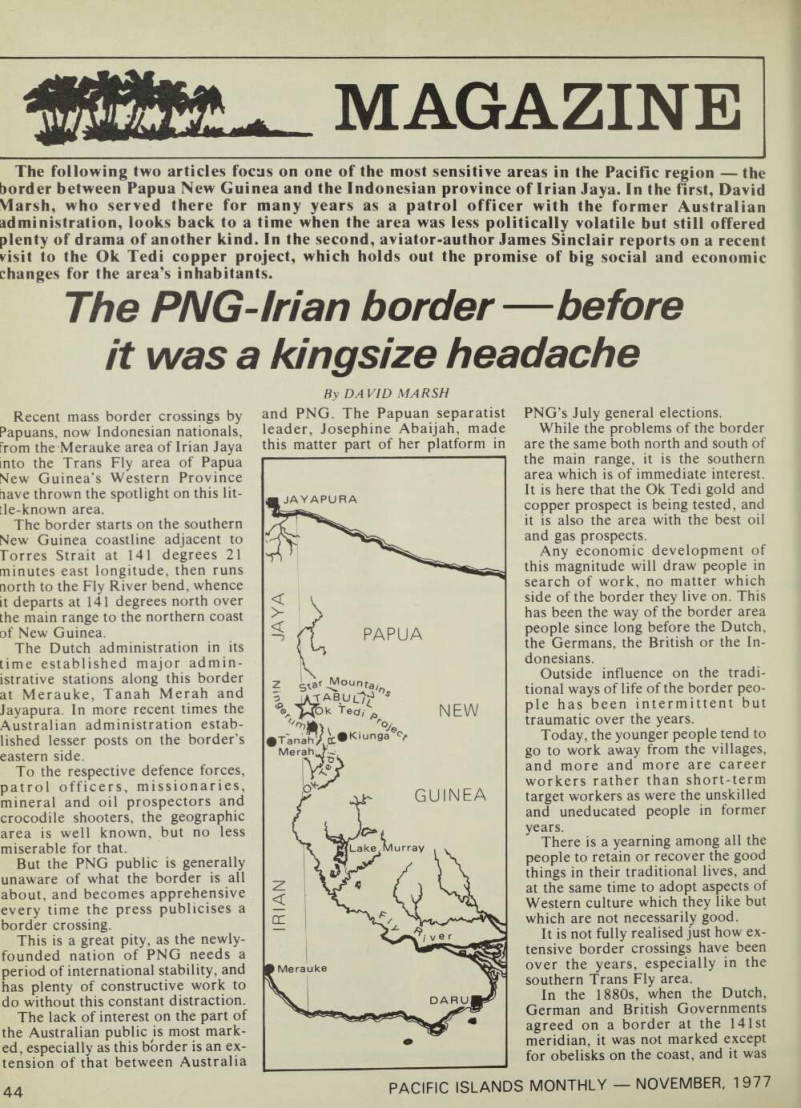
The border starts on the southern New Guinea coastline adjacent to Torres Strait at 141 degrees 21 minutes east longitude, then runs north to the Fly River bend, whence it departs at 141 degrees north over the main range to the northern coast of New Guinea.
The Dutch administration in its time established major admin istrative stations along this border at Merauke, Tanah Merah and Jayapura. In more recent times the Australian administration estab lished lesser posts on the border’s eastern side.
To the respective defence forces, patrol officers, missionaries, mineral and oil prospectors and crocodile shooters, the geographic area is well known, but no less miserable for that.
But the PNG public is generally unaware of what the border is all about, and becomes apprehensive every time the press publicises a border crossing.
This is a great pity, as the newly founded nation of PNG needs a period of international stability, and has plenty of constructive work to do without this constant distraction.
The lack of interest on the part of the Australian public is most mark ed, especially as this border is an ex tension of that between Australia
and PNG. The Papuan separatist leader, Josephine Abaijah, made this matter part of her platform in
PNG’s July general elections.
While the problems of the border are the same both north and south of the main range, it is the southern area which is of immediate interest.
It is here that the Ok Tedi gold and copper prospect is being tested, and it is also the area with the best oil and gas prospects.
Any economic development of this magnitude will draw people in search of work, no matter which side of the border they live on. This has been the way of the border area people since long before the Dutch, the Germans, the British or the In donesians.
Outside influence on the tradi tional ways of life of the border peo ple has been intermittent but traumatic over the years.
Today, the younger people tend to go to work away from the villages, and more and more are career workers rather than short-term target workers as were the unskilled and uneducated people in former years.
There is a yearning among all the people to retain or recover the good things in their traditional lives, and at the same time to adopt aspects of Western culture which they like but which are not necessarily good.
It is not fully realised just how ex tensive border crossings have been over the years, especially in the southern Trans Fly area.
In the 1880 s, when the Dutch, German and British Governments agreed on a border at the 141st meridian, it was not marked except for obelisks on the coast, and it was
only by administrative default or ac tivity that people along the border came under one government or another.
In fact, the inland populations were uncontrolled until recently, and did their own choosing when they wanted to contact a govern ment.
When the town of Merauke was established in what was Dutch New Guinea, it attracted many people from the Papuan Trans Fly area and they never returned. I am talking, of course, about people who were then under Australian, not Dutch, con trol. When I worked in that area in the mid-1940s the effects of this migration were still apparent, and the people spoke to us constantly of their relatives at Merauke with whom they exchanged visits fairly frequently. It is probable that many of the refugees of today feel that they are entitled to be welcomed in PNG because of this former rela tionship.
It was not until the 1960 s that the border was physically marked by the Australian and Indonesian governments, and the border dwellers were finally told to which nation they belonged. The marking also brought a more formal con sciousness of rights and duties to the people, which in many cases was quite foreign to their traditional way of life.
I recall a time in 1945 when I was patrolling the country in the southern section of the border and rounded up 121 armed Indonesians who had escaped from confinement at Tanah Merah across the border.
These people were living off the Pa puan villagers, using their arms as a threat. One could hardly blame them, for many of them had been massacred by villagers as they mov ed across country from Tanah Merah.
In those days this name of Tanah Merah inspired some awe amongst the people. At one time Soekarno was incarcerated there as a political prisoner. In those days, too, the Dutch New Guinea police tended to pursue fugitives and make retribu tive raids on villages well-inside Pa puan territory. The death toll was considerable, but those left maimed and without medical care were no better off, as a crippled person in a subsistence society is a very great burden and usually does not last long.
At this time, in the 19405, the in land people were cannibalistic.
Contrary to a lot of modern ballyhoo, they raided and massacred each other on a large scale. At Lake Murray in 1946 we buried the remains of 40 bodies which had been butchered with bamboo knives, the flesh carried away and eaten by a group living to the north of Lake Murray.
While we were seeking them out they in turn were massacred by raiders from Dutch New Guinea!
And so it went on.
Little wonder that today the country is sparsely populated and strongly polygamous! Men had up to nine wives, many of whom had been abducted from group to group as a result of raids. One woman who spoke Malay had originally come from an area nearly 320 km to the west, and had been abducted six times. On each occasion her current husband had been killed. She was quite philosophical about life and eventually married one of our police.
The work of patrols among people at this stage of first contact is subject to much misunderstanding. On one of our pursuits, the people we were after thought we were raiding to retrieve women and children they had, unknown to us, abducted. One night they brought this mass of ab ducted women and children down to the opposite side of Lake Murray
and left them there. As their original husbands and fathers were dead and their villages destroyed, we had the job of feeding and housing them. It did, however, put us in a position of great prestige, and mass abductions and cannibalism ceased in the area from about that time.
Other work of the patrol of course helped bring about the change. A large body of men captured by us over a period of some months were taken to Daru, stood trial in the Supreme Court, and were sentenced to one day’s gaol each. This happen ed to coincide with the com mencement of the follow-up patrol, and the men were returned to their women and children whom they had expected never to see again. If they were not repentant warriors, they certainly were enlightened ones!
The border country in this area of the Trans Fly is pretty terrible. The country is flat and swampy, with thorned sago and lawyer vines and nettles. Bush mites and leeches abound.
Game is plentiful, but movement is often so difficult that it tends to elude all but those with local ex perience. In the wet season the rain tends to go on and on, and the ill equipped refugees have a hard time moving about.
The sky in this period would be blackened by wild duck and geese.
Flying fox camps seemed endless on the rivers, while in the grasslands,
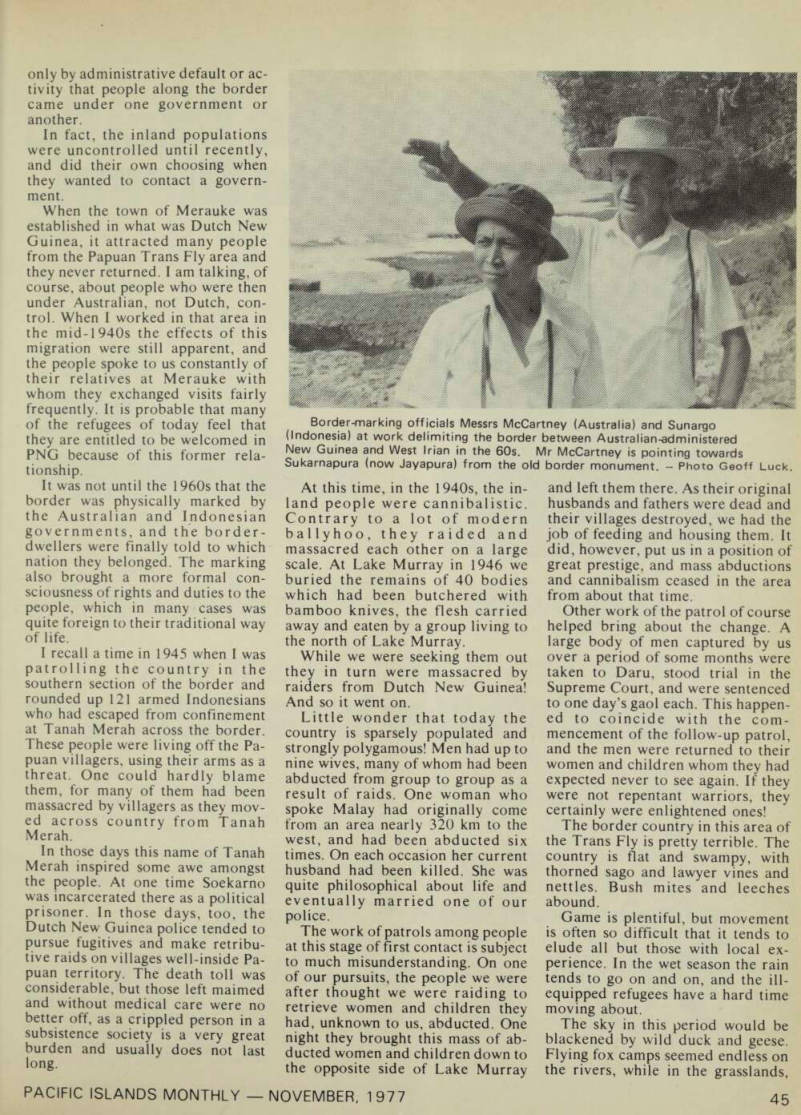
Border-marking officials Messrs McCartney (Australia) and Sunargo (Indonesia) at work delimiting the border between Australian-administered New Guinea and West Irian in the 60s. Mr McCartney is pointing towards Sukarnapura (now Jayapura) from the old border monument. - Photo Geoff Luck.
droves of wallaby, deer, pigs and cassowary were constant. Cro codiles of huge dimensions cruised the waterways or lay unmoving on the banks.
The main weapon was the bow and arrow. They were beautifully proportioned and carved weapons, and highly efficient.
On the middle Fly River the main habitation was either a long house for the entire village, or magnifi cently-built tree houses.
The staple diet was sago, although gardens were cultivated. These were frequently hidden in the bush, Clothing was minimal. The women wore a “G” string and the men a penis gourd and a skullcap.
The very young and old were naked.
At war the men wore a cuirass and a woven cane tube to protect the forearm from the bow string.
They had a war cry which really raised the hair on your spine. I have often wondered why modern armies fail to make proper use of this paralysing weapon.
The dead were placed on plat forms and cured with smoke and heat. The skin ends up like parch ment, taut over the skeleton. At this stage the corpse is sat up in the house with pride of place. It was rather disconcerting to enter a house and be confronted with a cor pse in the middle of a group having dinner.
Such was the state of the border people 20-odd years ago. It has changed slowly since, with the ad vent of oil-search companies, mis sionaries, traders and crocodile shooters. And, of course, admin istration posts, schools and hospitals.
Very soon the people acquired a veneer of sophistication. The out board motor, the steel axe and knife, modern medicines, law and order, Christianity and the new found freedom from fear of all kinds enabled them to catch up with the more sophisticated populations on the coast.
The shotgun has dramatically reduced the amount of game, and it is much more difficult for a man to be a subsistence farmer today. For the most part he has to have a sub sidiary cash economy to get by.
But despite all these changes the country itself is much the same.
Roads are still confined to special project areas. Aerodromes essen tially supply the people immediately adjacent, but do not open up the country at large. River transport is uneconomic because of the distances to be travelled, and the perishable nature and low value of the products available.
Yet here in this area lies tremen dous potential in copper, gold, tim ber and hydro power. But it has to be developed, and it will only be
developed at enormous financial cost. It is unlikely that the small population in that area will take much part in that development if and when it comes.
If it does come, we can expect people from across the Indonesian border to be part of it, because the refugee problem is both political and social.
The people of West Irian ex pected the Dutch to make them an independent nation. The Dutch led them to believe this. But Indonesia made West Irian part of Indonesia.
Then the people of PNG gained their independence in 1975.
The people of Irian Jaya just across the border in this area feel left out, for their standard of living, and their sense of freedom, are not consistent with those of their brothers in PNG. But since there have always been movements in this area, back and forth across a border that has little physical presence, it is normal enough that there should now be even more movement.
Indonesia could change this at titude by raising the people’s living standards. As it is most unlikely that this will happen from the develop ment of resources within Irian Jaya, and as Indonesia is already cutting down its aid programme, we can ex pect relationships to worsen amongst the politically conscious people of that area.