inter-island shipping
pp. 63-71 · Read in the full issue


Pacific Transport
Crisis looms for Fiji’s inter-island shipping
Fiji inter-island shipping is ap proaching a crisis which could well culminate in the government having to make a huge capital outlay to keep services going if existing operators are unable to continue.
That is the opinion of Mr Lloyd Williams, managing director of Williams Shipping Cos Ltd, of Suva.
Williams Shipping is a comparative newcomer to the Fiji maritime scene, although Mr Williams has had links with Pacific shipping for many years.
Burns Philp, W. R. Carpenter, Morris Hedstrom and Hurleys, which dominated inter-island ship ping for many years, have all pulled out. Many other smaller operators have also left the scene, till today there are only Williams Shipping, Rabi Holdings and a few others with one or two ships.
A glance at the daily shipping in formation in The Fiji Times shows there are several government-own ed tugs, plus the Komaiwai and the Taoniu, operated by Williams Ship ping, the Tovata and Ai Sokula ope rated by Rabi Holdings and the Kaunitoni, owned by the govern ment and chartered to Williams and Gosling to service the southern Lau islands.
Mr Williams told PIM shipping was among the world’s most costly forms of transport, and Islands ship ping was more costly still. In the Is lands the ships were worked “from stem to stern”; they operated in high risk areas, with greater wastage than usual, and capital life expectancy was short in comparison with the port-to-port operations associated with international shipping.
Pacific Islands shipping was directly affected in a compounded manner by the overseas price in creases in fuel oil, steel for repairs, machinery and safety and naviga tional equipment, all of which were direct imports from distant sources of supply. The pattern of operations to outer islands involved long routes with one-way freight. Islands economies today were such that
relative freight rates needed for eco nomic operation were impossible to apply.
It was not possible for inter island shipping services to operate at a profit under existing conditions without subsidy and assistance from other sources. The internal shipping services in Fiji suffered from lack of profitability, but in circumstances which the government was able to correct and control. In fact, much had already been done in that direc tion; much remained to be done.
Fiji, through government foresight and planning, had estab lished copra growers’ co-ops throughout the group, with central points to discharge cargo and take on copra. Thus, there had been cre ated two-way freight, which was necessary for profitable operation.
But that was offset by over organisation at the Suva end, the main point for loading and dis charging cargo. The system was too elaborate; where once there had been rapid turn-round of ships because the cargo was handled quickly, there was now slow dis
charge at the local ships’ wharf, Princes wharf.
Mr Williams said that a once-bus tling efficient area, used most days and nights, including Saturdays, now tended to hibernate over five working days with a consequent queue of ships, slow turn-round and added expense for all concerned, in cluding the government. The Ports Authority of Fiji and shipping operators were now paying attention to the problem.
The losses suffered by shipping operators at Princes wharf were only part of the overall problem, however. Local freight rates were controlled, but never seemed to take into account the special nature, hazards and provisions for replace ment of capital equipment.
The age and condition of many ships still operating was apparent.
There was no margin for replace ment of ships, a fact demonstrated over the last 18 months by the num ber of operators who had withdrawn from Fiji shipping or had severely curtailed their services. Ships were needed to carry timber, copra, meat, passengers, and so on. They provid-
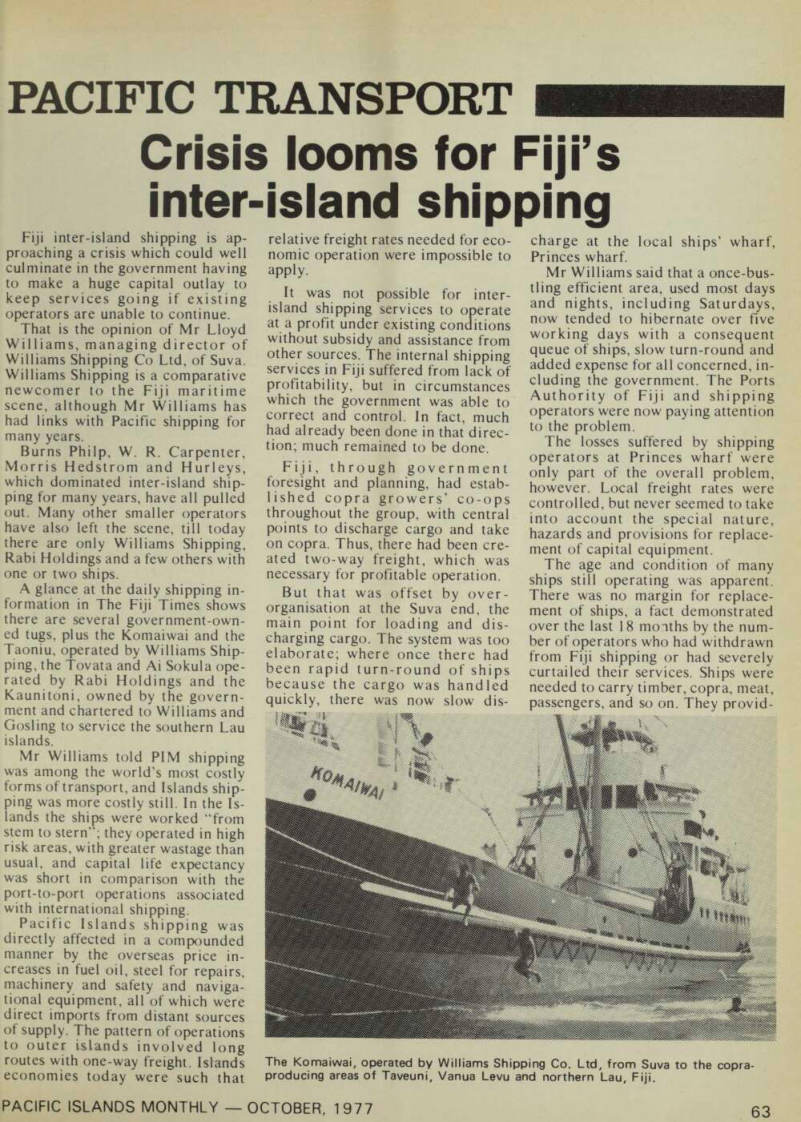
The Komaiwai, operated by Williams Shipping Co. Ltd, from Suva to the copra producing areas of Taveuni, Vanua Levu and northern Lau, Fiji.
ed services which had to be preserv ed, and stimulated, for a better Fiji.
If the present decline in shipping services was not curbed, the coming 12 to 18 months could see a crisis as further ships were withdrawn.
Mr Williams said that in the ab sence of private shipping he esti mated an initial capital outlay by the government of $5-$6 million could become necessary to find suitable replacements by 1980. But such a commitment would not be necessary if shipowners were given adequate encouragement now, and if they were helped to solve current problems.
If the situation was handled pro perly now, there could be improved services through better maintenance of ships and the introduction of new tonnage.
Mr Williams said his company would not now offer the Taoniu for sale. Plans to replace her with a ship with twice the capacity had been shelved. The Komaiwai and Taoniu were the chief freight and passenger carriers to the outer islands, includ ing Vanua Levu, Taveuni, northern Lau and Rotuma.
Those ships lift about half of Fiji’s total copra production for transport to the crushing mill at Suva. There are no immediate plans to expand or alter existing services, except by in troducing a small ship to give better service to the Labasa and Savusavu areas.
Although Mr Williams had painted a rather gloomy picture, two new shipping companies were registered at Suva, in August, presumably to operate services.
They were Kubunaiwai Shipping Ltd, of which George Tuisawau, Veisari, near Suva, is a director, and Zephyr Shipping Ltd, formed by Edwin Sandys, of Levuka.
Fewer Uk Ships
To Call At Islands
Fewer ships from Britain are likely to visit the South Pacific as conventional ships are replaced by container vessels. These companies operate Conference Line services.
They are the cargo division of P and O, Shaw Savill-Albion and Blue Star-Port Lines.
The cuts are likely to attect Australia and New Zealand, but are unlikely to affect the Island groups.
They could lose one service a year.
At present there is a service every 28 days to the Islands.
Pan Am fights for
S. Pacific monopoly
Pan American World Airways is making a determined fight to keep Continental Airlines out of the South Pacific route. President Carter recently named Continental as the second US carrier on the route. PAA has urged the US Civil Aeronautics Board to reconsider and reverse its decision about awarding the route to Continental.
As an alternative, PAA suggested that Continental should be required to serve American Samoa on all flights to Australia or New Zealand.
PAA questioned whether the route could stand another operator, trotting out as an argument the huge losses of SUS 32 million which American Airlines incurred in three years. When American and PAA flew the route together they did not have 50% of the market, a figure which PAA had only just achieved as the sole US airline on the route.
Gloomily, PAA forecast that history would repeat itself. After a time either PAA or Continental would be forced to the sidelines, or both would be poor competitors against strong foreign airlines.
Other airlines which fly varying routes between Australia and New Zealand and America are UTA, Canadian Pacific Airlines, Qantas and Air New Zealand.
PAA is almost touching in its con cern for American Samoa. It re minded the CAB that when the board started to investigate the route it emphasised its concern about services to American Samoa.
PAA claimed the decision would certainly not assure improved ser vice to American Samoa. It had made clear its intention to reduce its American Samoa service to one
flight a week when Continental en tered the service with five.
If the CAB reaffirmed the award of the service to Continental it should require that airline to serve American Samoa on all flights to Australia and New Zealand. If such a condition was not imposed, Conti nental would have every incentive to start over-flying American Samoa in an effort to compete for longer haul traffic.
PAA also submitted that while it was now free to schedule flights as the market demanded, the last time two US carriers operated over the routes the US Government accepted an Australian capacity limitation on the US services. Recent statements by Australian officials left little doubt that Australia would insist, as a condition to Continental’s entry to the route, that the two US carriers share an allocation of frequencies which would assure Qantas 50% of the market. • Britain will pay for a seaplane service in Tuvalu. Flights are ex pected to start in 1978 for a trial period of 18 months. • The runway at Lupepau’u Air port, Vavau, in Tonga has been lengthened to 1 067 metres and widened to 23 metres. This ex tension work allows aircraft a greater margin of safety. The only aircraft using the airport are twin engine Otters, operated by South Pacific Island Airways, of Pago Pago. The work was paid for by $54 000 in aid from Australia. • A single screw steel coastal tug, costing $l4O 000 was launched re cently in the Fiji government’s shipyard at Suva. The tug, named Ciwa (Fijian for nine), after sea trials, made its maiden voyage, tow ing a barge.
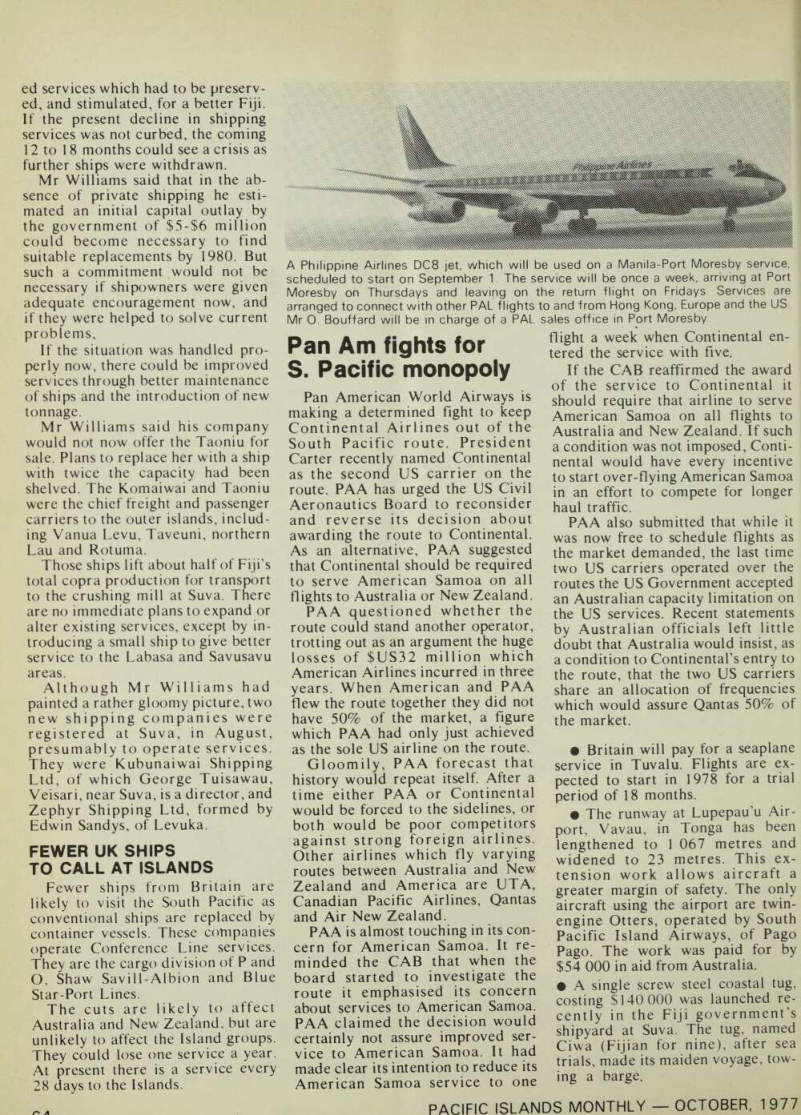
A Philippine Airlines DC8 jet, which will be used on a Manila-Port Moresby service, scheduled to start on September 1 The service will be once a week, arriving at Port Moresby on Thursdays and leaving on the return flight on Fridays. Services are arranged to connect with other PAL flights to and from Hong Kong, Europe and the US.
Mr O. Bouffard will be in charge of a PAL sales office in Port Moresby
Fiji Ship’S Master
Suspended For
Grounding
Captain Charles Junior Andrews, 27, has been suspended for 12 months by a Fiji court of marine in quiry. Andrews was master of the Fiji government landing barge, Duiyabaki, 260 tonnes, which ran aground in Lau in March. The ship grounded twice on the same voyage, while carrying government officers to supervise polling in Lau during the general election.
Mr Kenneth Moore, the presiding magistrate, said the two strandings were entirely due to the in competence of Andrews, who had failed to set a proper course for the Duiyabaki, and had failed to obtain the necessary information to help him navigate with safety. Andrews had shown great concern for the comfort of his passengers, but failed to make proper allowance for, and give consideration to, the effects of the current, tide, wind and position of sun.
Andrews was a young captain with his first command, sailing on a tight schedule in unfamiliar waters. But he was the master and was re sponsible for the passengers and the crew. Before a master was allowed to sail into unknown waters and put his ship at risk, the appropriate authorities should ensure he was properly advised.
Captain John Kerbeyson, the Marine Department’s principal ship surveyor and examiner of Fiji master’s certificates, told the court the government would have to spend about $BO 000 to restore the Duiyabaki to full-operational con dition. The government, at this stage, had no money for repairs. But if there was a general overhaul the Duiyabaki could run at least seven years without any trouble.
Andrews, in evidence, admitted his judgement was greatly handicap ped by the sun.
The Duiyabaki, on March 20, hit a reef patch near Daliconi village, Vanuabalavu. After pulling herself off, she ran aground on March 25, off Tuvuca.
When the Duiyabaki was launch ed at the end of 1967, the govern ment had plans to operate her as a landing craft should there be a need for mounting military operations on any of the islands. One of her first runs was with buses loaded with
their passengers at Suva for passengers read ‘troops’ and landed on Vanua Levu.
Near-Disaster For
Samoan Ferry
Western Samoa’s island ferry Hamutana almost overturned in August when buffeted by strong seas close to Apolima Island, between Savaii and Upolu. As it was a nine year-old child, three girls and three men were thrown overboard but were rescued.
The Hamutana rolled to about 45 degrees and stayed in that position for two to three minutes. Finally she righted and at reduced speed returned to pick up the people who had gone overboard. Sailors who jumped into the sea to help those in the water were picked up by another boat which went to the rescue.
Mr Falevi Kaiona Petana, man ager of the Inter-Island Shipping Co, which owns the Hamutana, said that, according to the clearance signed by a marine officer, there were 85 passengers on the trip.
Nauru’S Rosie D
Is In Service
The Nauru Pacific Line has taken delivery of a new bulk carrier, the Rosie D, which was built in Japan.
The ship is named in honour of the wife of the late Chief Detudamo, mother of Cr Buraro Detudamo.
The delivery ceremony was attend ed on behalf of the Nauru Local Government Council by Head Chief Hammer Deßoburt and Madame Deßoburt, and the secretary of the council, Cr Detudamo, and his wife.
The Rosie D has a gross carrying capacity of 17 691 tonnes. She can carry bulk fuel as well as bulk general cargo. Her maiden voyage was to Nagoya, Japan, to load general cargo for Singapore, she was then to sail to Nauru.
Korean Fish Catcher
Runs On Fiji Reef
The master of a wrecked Korear fishing ship, the Tongwha 303, offi cially abandoned the vessel twc days after it went aground or Cakaulekaleka Reef, about 22 mile* south of Korolevu in Fiji on July 17 The ship then passed into the hands of the Receiver of Wreck and the underwriter’s representative in Fiji.
The ship apparently caught fire before it ran aground on the reef
which is between Beqa and Vatulele Islands. The 19 members of the crew and the master, Captain Kim Chul Ho, were taken to Suva. They did not want to leave Fiji later for Pago Pago because, according to one man, they did not want to be brought before an inquest.
Two Cruise Liners
To Be Retired
The luxury US cruise liners, Mariposa and Monterey, which have been cruising in the Pacific for more than 20 years, will be with
drawn from service by next April, Pacific Far East Line announced re cently. They carried thousands of Americans on cruises from the US west coast to French Polynesia, the Cook Islands, New Zealand, Australia, New Caledonia, Fiji, Niuafoou (Tonga), American Samoa and Honolulu.
For much of their service they were operated by the Matson Line, but since 1971 they sailed under the PFEL flag. The Matson Line started a service from North America to Australia and New Zealand early this century.
The Vikings
Sail Again
The three cruise ships of the Royal Viking Line will be back in the South Pacific early in 1978. The ships have been calling regularly at various islands for the last four years. The Royal Viking cruises differ from the usual run of Islands cruises, which start and end in Sydney.
Extended line voyages are availa ble, with the opportunity of cruising between ports. It is possible, space permitting, to join one of the ships in an island port and disembark in New Zealand, Sydney, Cairns, or any port of call in any part of the world.
The Royal Viking Sky will sail
from Los Angeles on January 19 for Papeete, Moorea, Nukualofa, Auck land, Wellington, Picton and Sydney. She will then leave Sydney for California via Suva, Apia and Honolulu.
The Royal Viking Star will leave Los Angeles on January 24 for Bora Bora, Moorea, Papeete, Rarotonga, Auckland, Picton and Sydney. She leaves Sydney on February 18 for Florida via Suez. The Royal Viking Sea will leave San Francisco in February for Papeete, Moorea, Nukualofa, Auckland, Wellington, Picton and Sydney, sailing from Sydney for a cruise in south-east Asia, then across the north of the Pacific to California, before return ing to Europe.
The "Royal Viking Sky" passes the Sydney Opera House.