Wallets are growing thin
p. 61 · Read in the full issue
in New Caledonia
From PAUL STERLING in Noumea
In spite of the new reforestry programme, the people of New Caledonia are gradually waking up to the fact that money does not grow on trees.
As wallets and purses become slim and elegant, it becomes in creasingly obvious that a young and
expanding population needs other
interests than nickel mining.
Agriculture has been the scene of vigorous activity over the last few months and the territory will prob ably be self-sufficient in pork, beef and potatoes this year. Unfor tunately, these items are those where the administration has taken deter mined action, ignoring all re sistance, to create a marketing monopoly.
Mr Alain Bernut, in a recent television interview, declared that in New Caledonia people do not climb up trees to pick fruit, but wait for it to ripen and hit the ground, but he was not talking about agriculture.
He was simply forecasting that the territory would not make any offers to take over the deluxe clinic of Noumea until the bankrupt shareholders cried out in despair.
Strange words in the mouth of a socialist.
Bankruptcies, due to bad man agement or fraudulent operations, are numerous, but are philosophically described as “clean ing out the weeds”. The danger is that the same financial problems are now menacing the municipalities and the territory itself.
The Territorial Assembly has cheerfully knocked back France’s offer to subsidise private education, ignored most of the High Com missioner’s suggestions to create new revenues and reduced the part of the budget generally granted to local government. Having conceiv ed a monster, the present assembly will now wait for the new House, to be elected in September, to take re sponsibility for the miscarriage. Un fortunately, a menace of premature birth could bring a nasty surprise.
One of the problems is the FIP, the percentage of total budget that was passed on to the municipal bo
dies. Originally established at 22% of the budget, it has been the regular first victim of measures to balance the budget.
This year, the HP has been reduc ed to 18.5% against 19% for 1976, and the Noumea council has an nounced a budgetary deficit of 80 million Pacific francs. Noumea will probably have to borrow funds to continue current operations, but if the municipal budget is difficult to adjust, it is because there are alrea dy substantial loans to be repaid.
The new traffic plan, the magnifi cent Town Hall and the various sporting facilities, to which should be added the aquarium recently ac quired from Dr Catala, have been acquired on credit. Repayment of loans, in addition to the main tenance of sophisticated public in stallations, are a heavy burden.
To add to the difficulties, while the Association of Mayors agrees, according to its new chairman, Mr Roger Galliot, that the FIP must be raised, they also consider that Noumea’s share should be reduced.
To use Mr Galliot’s words: “Noumea now has everything it needed, it should be the turn of the other municipalities who are all fac ing financial difficulties.”
The territory can also take a careful look at its present ex penditure. As an example, the an nual three-year trip to France for metropolitan, and some local, pub lic servants, is a luxury that can be ill-afforded, particularly when the budget also throws in free tickets for spouse, children, and the accom panying maid for large families!
Public servants posted from France also receive a “premium for remote posting”, which some have been col lecting for several years. Three years on a tropical island with one of the highest standards of living in the world can hardly be called a hardship.
The Legislative Council which will be elected by the new assembly in September, in application of the new statute, could well face the problem of appointed receivers rather than elected directors.
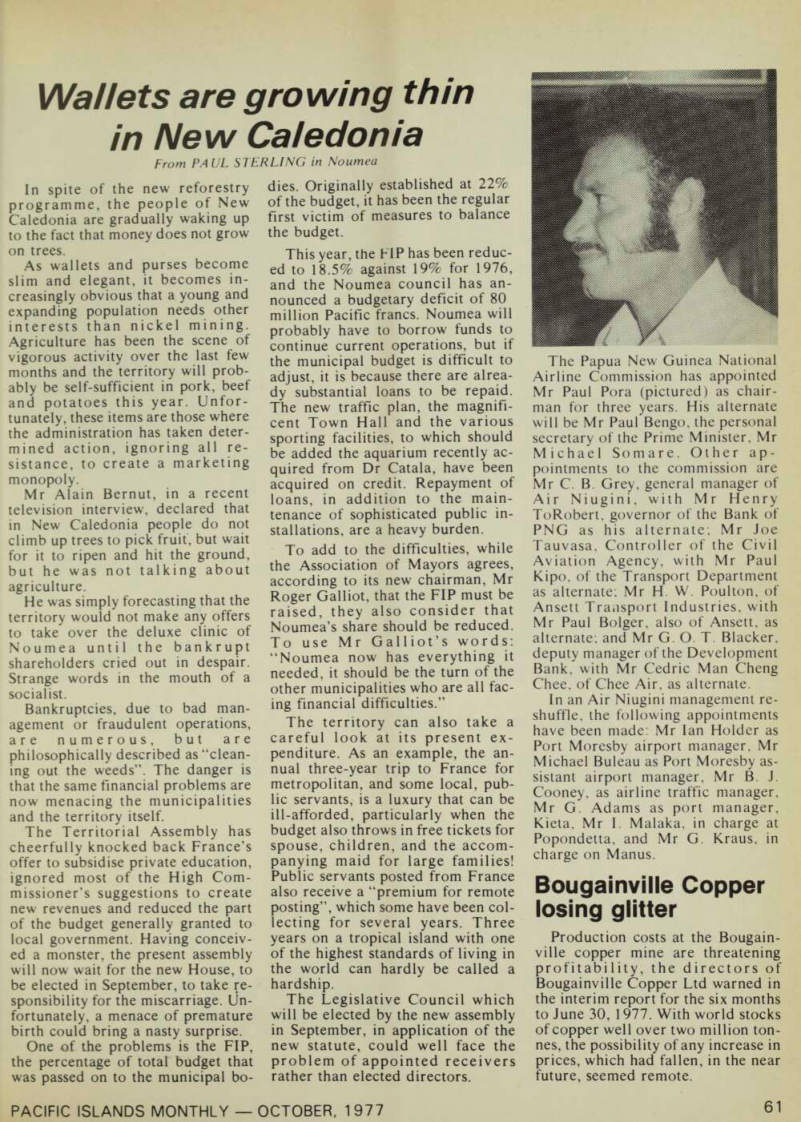
The Papua New Guinea National Airline Commission has appointed Mr Paul Pora (pictured) as chair man for three years. His alternate will be Mr Paul Bengo. the personal secretary of the Prime Minister, Mr Michael Somare. Other ap pointments to the commission are Mr C. B. Grey, general manager of Air Niugini, with Mr Henry Toßobert, governor of the Bank of PNG as his alternate: Mr Joe Tauvasa, Controller of the Civil Aviation Agency, with Mr Paul Kipo, of the Transport Department as alternate: Mr H. W. Poulton, of Ansett Transport Industries, with Mr Paul Bolger, also of Ansett, as alternate: and Mr G. O. T. Blacker, deputy manager of the Development Bank, with Mr Cedric Man Cheng Chee, of Chee Air, as alternate.
In an Air Niugini management re shuffle, the following appointments have been made: Mr lan Holder as Port Moresby airport manager, Mr Michael Buleau as Port Moresby as sistant airport manager. Mr B J.
Cooney, as airline traffic manager, Mr G. Adams as port manager, Kieta, Mr I. Malaka, in charge at Popondetta, and Mr G. Kraus, in charge on Manus.
Bougainville Copper
losing glitter
Production costs at the Bougain ville copper mine are threatening profitability, the directors of Bougainville Copper Ltd warned in the interim report for the six months to June 30, 1977. With world stocks of copper well over two million ton nes, the possibility of any increase in prices, which had fallen, in the near future, seemed remote.