... and Papuans, as Williams saw them
pp. 51-53 · Read in the full issue
Williams saw them
F. E. Williams, a South Australian and Rhodes Scholar, was appointed assistant government anthropologist in the Papuan Public Service in 1922, and in 1928 he suc ceeded Dr Walter Strong as govern ment anthropologist, a position he held until his death in 1943 in a wartime aeroplane crash in the Owen Stanley mountains.
Most anthropological writings are difficult, indeed repellent, for the general reader, for ethnographers as a class employ a strange vocabulary of words and terms which mean lit tle to the non-professional. A few, however, have written books and essays that have a wide appeal the personality of the author comes through, the language is clear and sometimes brilliant, and one is en tertained while being educated.
The books of Bronislaw Malinowski are prime examples how superbly he titled them! Coral Gardens and their Magic; Argonauts of the Western Pacific, The Sexual Life of Savages (you will be disappointed if you are looking for titillation) who would not want to read them? And F. E.
Williams, too, wrote the kind of
ethnographical books that must ap peal to anyone with a deep interest in the people of Papua New Guinea and their culture.
He published four books (recently re-issued) Orokaiva Magic, Orokaiva Society, Papuans of the Trans-Fly and Drama of Orokolo.
They are just as rewarding as those by the more celebrated Malinowski.
He also wrote over 40 reports, papers and essays. The books are available at most public libraries, but the shorter works are not easy to locate. They were mostly issued as slim bound monographs, or ap peared in professional journals.
This present book, therefore, is to be welcomed, for it presents a number of the most important of Williams’ essays, together with an introduc tion and notes by Erik Schwimmer. himself an anthropologist who has worked in the field in Papua New Guinea.
The title essay. The Vailala Mad ness, is of fundamental importance, for the “Madness” was the first re corded outbreak of what is known today as cargo cult, and Williams was the first ethnographer to study and describe the phenomenon. The
titles of the other essays in this col lection bear apt testimony to the range of his professional interest, and his use of words; Trading Voyages from the Gulf of Papua, Bull-Roarers in the Papuan Gulf Sex Affdiation and its Implication, Natives of Lake Kutubu, Papua (what a pity it is that the editor did not also include the superb Report on the Grasslanders printed as an appendix to the Papua Annual Re port 1938-39, and a must for anyone interested in the people of the Southern Highlands and that most enchanting of Papuan lakes, Kutubu) and the delightful Creed of a Government Anthropologist.
I believe that this book should be on the shelves of every library of PNG interest. It is a pity that the editor is not able to give us much in formation about Williams the man.
He is a curiously elusive figure. He lived for his work and thought nothing of spending six months at a time in the gloomy swamps of the Papuan Delta and similar un salubrious parts, studying the life of the people.
Young Papua New Guineans who are curious about the vanished customs of many of their tribes should cherish the work of F. E.
Williams. His school of anthropolo gy is not fashionable today, and few ethnographers probably read him, but to my mind his accounts are far more valuable than the streamlined efforts of many of the modernists.
His writing is warm and sym pathetic, but tinged with wry wit.
I recommend this book most high ly. It is well printed and bound, with a list of all Williams’ publications and a good bibliography. As prices go these days it is not overly ex
pensive at $lB.OO.
James Sinclair
(THE VAILALA MADNESS AND OTHER ESSAYS. By Francis Edgar Williams, with an introduction by Erik Schwimmer. Published by University of Queensland Press. >18.)
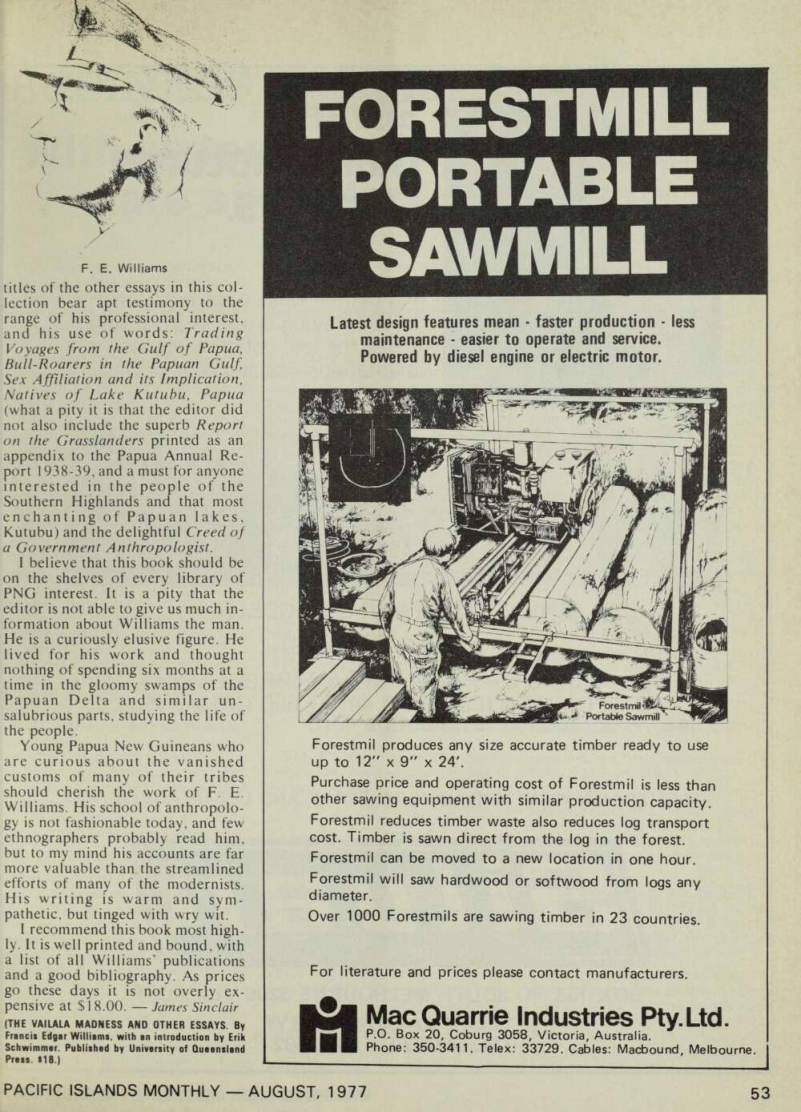
F. E. Williams