The Germans, the colonial
pp. 49-51 · Read in the full issue
masters of New Guinea ...
Australians often forget that Ger many was a great colonial power in the 19th and early 20th centuries.
We like to think that the modern history of the New Guinea part of Papua New Guinea began with the Australian mandate, but of course the Germans ruled there for 30 years before the Australians, and even today the effect of their admin istration has not entirely vanished.
When it is considered at all, Ger man colonial practice is usually written off as having been brutal, in humane and intolerant. This is, of course, too simplistic a view. There were good and bad administrators among the Germans, just as there were among the British and Australians. Part of the reason for the bad reputation of the Germans as colonialists has been the difficul ty until recent years of obtaining ac cess to official information.
The full range of German Foreign and Colonial Office records are now available to historians, however, and papers and essays are beginning to appear in such respected organs as The Journal of Pacific History.
The reputation of Germany can only gain from this close inspection, as the present book amply de monstrates.
Germany in the Pacific and Far East 1870-1914 is a collection of papers edited by two Pacific and Asian specialists, written by a num ber of historians and academics East and West German, Japanese, American, English and Australian on many aspects of German im perialism.
It is not light reading, but it is highly rewarding, and any precon ceived notions about the German approach to colonisation will surely be modified by a study of these papers.
The book is in three parts. The first contains three papers, on Ger man commercial penetration and development in the Pacific, China, the Netherlands, East Indies and
Malaya, two written by East Ger mans from a Marxist point of view and doubly interesting because of this.
The second part is wide-ranging; there are six papers on Anglo-Ger man rivalry in the Pacific, the Ger man role in the Samoan Tri dominium from 1889 to 1898, the work of the Imperial German Navy
in Asia and the Pacific as it affected colonial policy, the acquisition of the Caroline Islands, and a most revealing study German cultural and political influence on Japan.
Most Australians will find the third part of the book the most in formative. There are six papers again here, on aspects of German colonial rule and native response in German New Guinea, Samoa and Ponape, and Kiautschou. This last should convince doubters that Ger many was capable of enlightened colonial rule.
From 1898 to 1914, Germany owned the colony of Kiautschou, in Chiao-Chou Bay in the Chinese province of Shantung. For the brief period of its existence the colony was under the jurisdiction of the German Navy, which turned
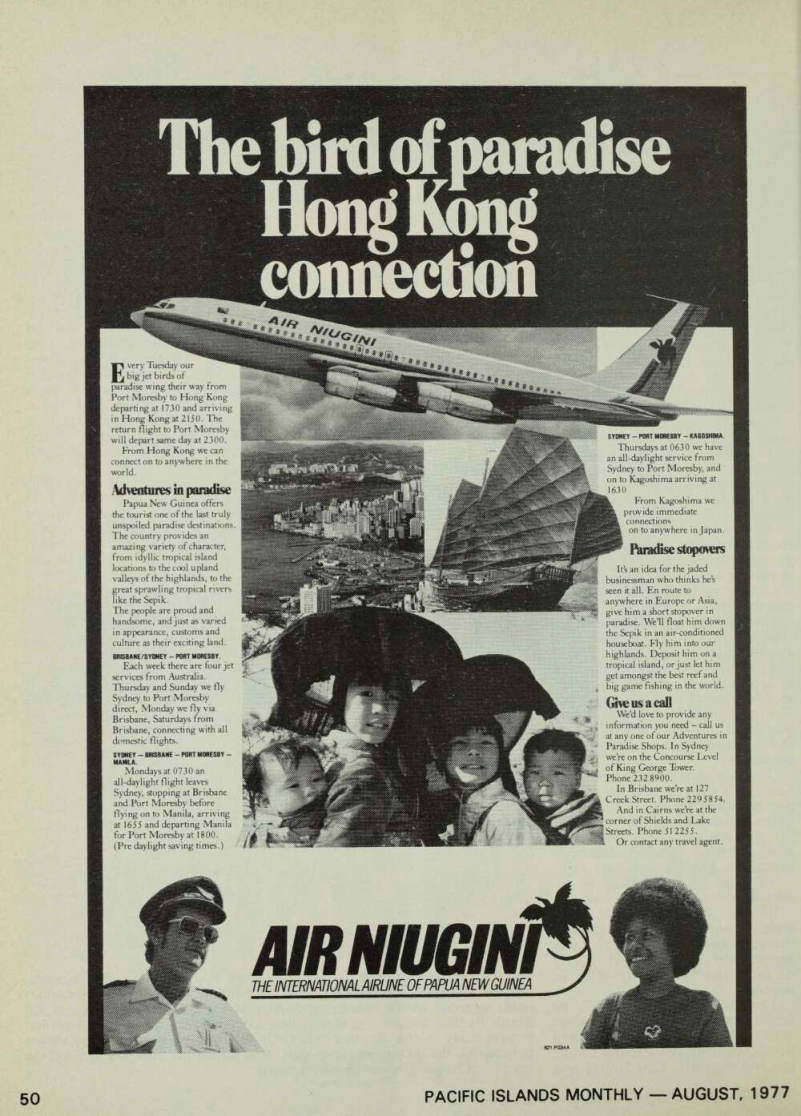
The German elite of New Guinea just before World War I, administrators, planters and traders. The short man in the centre of the front row is Dr Albert Hahl, regarded as the most outstanding of the German governors in the South Pacific before the war which robbed them of their power and possessions in the South Pacific. On the left of Hahl is the famous Bulominski, the district administrator, who forced the villagers to build the road from Kavieng which bears his name.
Kiautschou into a great commercial centre to rival the British colony of Hong Kong, for Anglo-German rivalry in China at this time was in tense. The navy made Kiautschou into a model colony, the most suc cessful that Germany ever had.
Three of the papers concentrate on German New Guinea. One, by Peter Sack, a German scholar who has made a particular study of Ger man New Guinea land laws, and en titled Law, Politics and Native “ Crimes ” in German New Guinea , is an excellent account of the methods the Germans employed to punish and control native unrest the punitive expedition, naval strength, the formation of a native police force, the use of the whip and the death sentence.
The second, by Ingrid Moses, is entitled The Extension of Colonial Rule in Kaiser Wilhelmsland , an examination of the ways by which the Germans, using few people, es tablished and maintained power and authority over a wild land and its wild inhabitants, .while the final paper Colonial Missions and Im perialism: The Background to the Fiasco of the Rhenish Mission in New Guinea , by Klaus-J. Bade, is a fascinating study of the work of the missions in general and the Rhenish Mission in particular.
At the beginning of World War I, after 27 years of devotion and zeal, the Rhenish Mission was able to claim just 96 parish members among the New Guinea people!
Probably the most valuable feature of this admirable book is the great wealth of source reference material it contains. Out of a total of 417 pages, 36 are devoted to chapter notes and 63 to a detailed guide to archival sources and a select bibliography. This section will appeal mainly to the specialist.
In all. an important book that de serves a wider readership than it will probably get. It is expensive but well produced. University of Queensland Press is today the lead ing University Press in Australia and is issuing some of the best books to be published in this country.
Even at $25 you should purchase the present volume if you are seriously interested in Pacific
history.
James Sinclair
(GERMANY IN THE PACIFIC AND FAR EAST 1870-1914. Edited by J. M. Moses add P. M.
Kennedy. Published by University of Queensland Press. $25.)